BIS Certification
 CDSCO
 PESO
 CPCB
 LMPC
 WPC Approval
 Global Approvals
 TEC
 ARAI
 BEE
 ISO Certification
 DGCA Certification
 NOC For Steel
 APEDA Registration























 Business Registration
 FSSAI Mark Certification












 (32).jpg)
 Legal Services
 Trademark Registration
 Copyright Registration
 Patent Registration
 By
- A CPCB plastic registration consultant helps you register on the CPCB EPR portal, sort out your data and handle CPCB queries.
- Registration is only the start. Every year you still have targets, returns and QR labelling to manage, and the 2026 amendment added recycled content and reuse rules.
- Choose a consultant who explains things in simple words and gives the scope in writing. Stay away from anyone who promises approval.
Introduction
Not sure if you need a CPCB plastic registration consultant? Here is a situation we hear about often. A snack brand in Pune sells on its own website and on two marketplaces. A contract manufacturer prints and fills the packets, but the brand’s name is on the pack.
One day a marketplace writes to them: please share your CPCB EPR registration number. The founder thinks the manufacturer will handle it. The manufacturer says it is the brand’s job. Three weeks pass, and nothing moves.
This is an example, not one particular client. Still, we see the same mix-up again and again. A good consultant clears it up fast. They tell you what your role is, what the portal needs, and what you must do after registration.
Below, you will see how the work really goes, what changed in 2026, and seven things to check before you hire anyone.
What does a CPCB plastic registration consultant do?
A CPCB plastic registration consultant helps producers, importers and brand owners register on the CPCB EPR portal for plastic packaging. They check your role and packaging type, collect your documents and data, file the application, answer CPCB queries, and guide you on yearly returns, targets and EPR certificates. They help with the work. But the data you give, and the legal responsibility, stay with you.
Think of a CA during tax season. You own the books. The CA knows the forms and the deadlines. A consultant does the same job for plastic packaging compliance.
How much help can you ask for?
- Registration only: role check, documents, application and replies to CPCB queries.
- Registration plus yearly filing: everything above, along with annual returns and target tracking.
- Full management: all of the above, plus help in arranging EPR certificates from registered processors.
Decide this at the very start. Many arguments later come from one side thinking a service was included when it was not.
Who needs plastic EPR registration with CPCB?
The Plastic Waste Management Rules put the duty on producers, importers and brand owners. Together they are called PIBOs. Recyclers and other plastic waste processors also have to register on the portal.
You are most likely covered if you:
- make goods and pack them in plastic,
- import goods that come in plastic packaging,
- sell under your own brand, even if someone else makes or prints the packaging,
- run an online brand and ship products in plastic packs that carry your name.
Some marketplaces and big buyers may ask for your registration number before they keep your listing or order live. That alone is a good reason to sort this out early.
Your packaging category matters as much as your role. The rules split plastic packaging into rigid, flexible, multilayered and compostable. Your category decides your targets. So if you pick the wrong one at the start, the mistake follows you into every return.
Plastic EPR rules in 2026: what changed
On 31 March 2026, the Ministry of Environment, Forest and Climate Change notified the Plastic Waste Management (Amendment) Rules, 2026, under G.S.R. 237(E). Going by reports on the amendment, these are the main changes:
- Recycled content: PIBOs must use more and more recycled plastic in packaging. Rigid packaging has the steepest steps.
- Reuse: some rigid packaging, such as large water containers, now has reuse targets.
- EPR certificates: buying and selling of certificates between processors and PIBOs is now formally written into the rules.
- Carry-forward: a limited window has been reported for the 2025-26 shortfall, to be cleared in stages.
- Audits: registered environment auditors can now verify compliance.
- Imports: recycled content in imported plastic packaging does not count towards your recycled content target.
Also remember that since 1 July 2025, plastic packaging must show the PIBO’s name and CPCB registration number through a QR code, barcode or unique identifier.
One caution. The summaries available online do not agree on the year-wise recycled content percentages. So read the Gazette notification yourself, or ask your consultant to show you the exact number for your category and year. A vague answer tells you a lot about the consultant.
Documents and data to keep ready
The portal asks for different inputs depending on your role and category, and CPCB’s guidance manual on the portal has the final word. As a starting point, most applicants should keep these handy:
- proof that your business exists, such as a certificate of incorporation or equivalent,
- GST registration and PAN,
- CIN, if your entity has one,
- Importer Exporter Code, if you import,
- details of the plastic packaging you put on the market, by category and quantity,
- details of your brand, your units and the person who will be the contact.
Delays usually come from data, not certificates. The most common problem is packaging quantities that do not match purchase records or invoices. So collect your records first. Then start the application.
How CPCB plastic EPR registration works, step by step
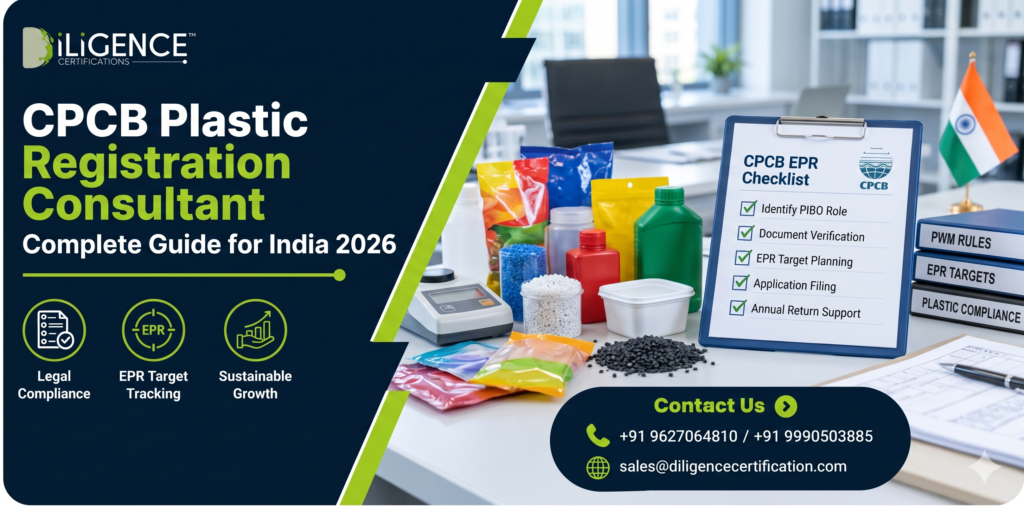
Step 1: Know your role and category
First decide whether you are a producer, importer, brand owner or processor. Then match each type of packaging you use to its category.
Step 2: Create your account on the portal
Registration is filed on the official CPCB centralised EPR portal for plastic packaging. Keep the login with someone in your own company who will still be there next year, not only with an outside agent.
Step 3: Upload documents and packaging data
Enter the details for each category and attach the supporting files. Check every number twice, because these figures feed your targets.
Step 4: Answer CPCB queries
CPCB may ask for clarification or extra papers. Quick and correct replies keep your application moving.
Step 5: Plan for life after the certificate
Once you are registered, you have to work towards your targets, file annual returns, arrange the EPR certificates you need and keep the identifier on your packs.
Do you need a consultant, or can you file on your own?
Both ways are fine. The portal is open to every business, and the guidance manual is free.
Self-filing can work well if you have just one type of packaging, clean records, and someone on your team who can spend time learning the portal.
A consultant makes more sense if:
- you use more than one packaging category,
- you import goods or sell through many channels,
- you have no compliance person in-house,
- a buyer or marketplace has given you a deadline,
- you want help with returns and certificates after registration.
The question is not whether you can click the buttons on the portal. The question is whether you can read the rules correctly every year, because they keep changing.
7 checks before you hire a CPCB plastic registration consultant
1. Do they ask about your business first?
A serious consultant asks about your packaging, your brand and your supply chain before talking price. If a quote arrives before any questions, be careful.
2. Is the scope in writing?
The document should say whether returns, targets and certificates are included, and what is billed separately.
3. How do they handle your data?
They should ask for invoices and purchase records. They should never suggest rounded or guessed numbers just to make the application look neat.
4. Who keeps the portal login?
The account belongs to your business. You should always be able to log in and see what has been filed.
5. How do they track rule changes?
Pick one recent change, such as the 2026 amendment, and ask what it means for your category. A clear, specific answer is a good sign.
6. What happens after registration?
Ask who will remind you about annual returns, how targets are tracked, and what help is there for certificates.
7. Are they honest about time?
CPCB decides when an application is approved. A consultant can prepare your file well, but cannot fix a date.
Warning signs when choosing a CPCB plastic registration consultant
If you notice any of these, slow down and ask questions before you sign anything:
- a promise of guaranteed approval or a fixed approval date,
- a price far below everyone else, with no written scope,
- pressure to submit estimated or adjusted packaging data,
- no access for you to the portal account,
- no clear explanation of categories, targets or returns.
Why Choose Diligence Certifications for CPCB plastic registration consultant Certification?
Diligence Certifications works with Indian businesses on regulatory registrations. Plastic EPR is one area where clients usually want clear guidance, not jargon. Our CPCB EPR plastic waste registration service is built around the checks listed above.
When you work with our team as your CPCB plastic registration consultant, you can expect:
- a first call to confirm your role and packaging categories,
- a document and data checklist in plain language,
- a written scope, so you know what is and is not included,
- help in replying to CPCB queries,
- reminders about annual returns, targets and on-pack labelling after registration,
- simple updates when the rules change.
We do not promise approval or fixed dates, because those decisions rest with CPCB. What we do promise is a clear process and straight answers.
Conclusion
A good CPCB plastic registration consultant is not the one who quotes fastest. It is the one who explains your duties clearly and stays with you after the certificate. Check the scope, see how they handle your data, and ask for honest timelines. Keep the portal account in your own hands, and read the 2026 changes for your own packaging category.
If you would like a second opinion on your situation, book a free consultation with the Diligence Certifications team. Bring your packaging details, and we will tell you plainly where you stand.
Frequently Asked Questions.
1. What is the full form of CPCB?
CPCB stands for Central Pollution Control Board. It is the national body that runs the EPR portal for plastic packaging and issues registrations.
2. What is the full form of EPR?
EPR stands for Extended Producer Responsibility. It means the business that puts packaging on the market is also responsible for its waste after use.
3. What is the full form of PIBO?
PIBO stands for Producers, Importers and Brand Owners. These are the businesses that must register for plastic packaging EPR.
4. What is the full form of PWM in the PWM Rules?
PWM stands for Plastic Waste Management. The rules are called the Plastic Waste Management Rules, 2016, and they were amended in 2026.
5. What is the full form of MoEFCC?
MoEFCC stands for Ministry of Environment, Forest and Climate Change. It notifies the plastic waste rules.
6. What is the full form of SPCB?
SPCB stands for State Pollution Control Board. It is the pollution control body of each state.
7. What is the full form of PWP?
PWP stands for Plastic Waste Processor. These are recyclers and other units that process plastic waste, and they register on the portal too.
8. What is the full form of GST, PAN and CIN?
GST is Goods and Services Tax. PAN is Permanent Account Number. CIN is Corporate Identity Number, given to registered companies.
9. What is the full form of IEC?
IEC stands for Importer Exporter Code. Importers need it when they register.