BIS Certification
 CDSCO
 PESO
 CPCB
 LMPC
 WPC Approval
 Global Approvals
 TEC
 ARAI
 BEE
 ISO Certification
 DGCA Certification
 NOC For Steel
 APEDA Registration























 Business Registration
 FSSAI Mark Certification












 (32).jpg)
 Legal Services
 Trademark Registration
 Copyright Registration
 Patent Registration
 By
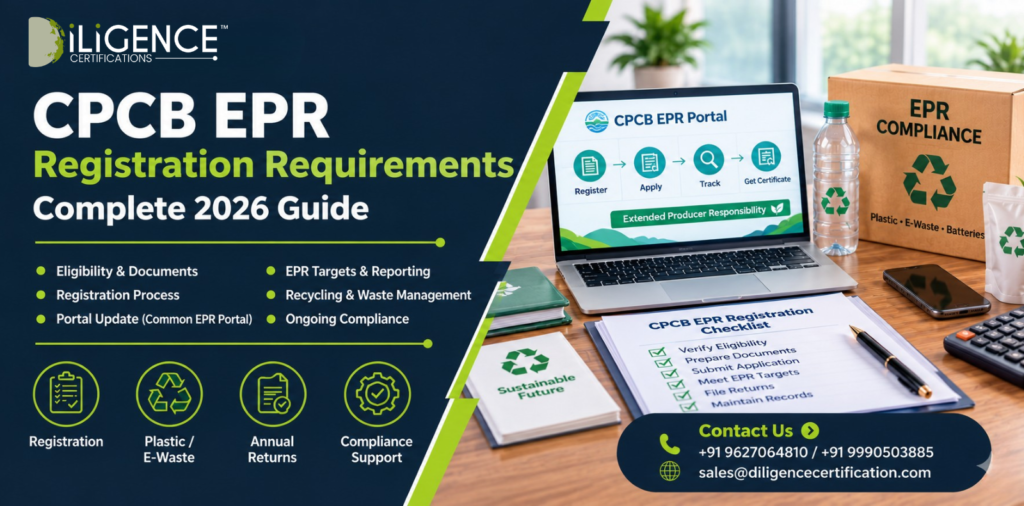
- The requirements for CPCB EPR registration depend on the type of waste the product and the business activity that fall under the environmental rules.
- If a business deals with packaging, batteries or electrical or electronic equipment it must check the relevant EPR framework separately.
- For packaging the Common EPR Portal is now the portal that hosts new updates after the migration from the older plastic EPR portal, in June 2026.
- Common documents that you will need include business registration details, PAN, GST information, authorised‑person details and product‑specific information depending on the category.
- After EPR registration I think you will face reporting, recycling targets, recordkeeping and other compliance responsibilities.
Introduction
A business can start small sell a products and slowly build a customer base across India. A cosmetics brand may start with three products. A packaged food company may sell through distributors before moving to online marketplaces. An importer may bring products into India and sell them under an Indian brand name.
As sales grow another responsibility can appear: compliance.
For example a company selling products in bottles or pouches may need to check whether it is part of the applicable Extended Producer Responsibility (EPR) framework. An importer of batteries or electrical equipment may have obligations under the relevant waste-management rules.
This is where CPCB EPR registration requirements become important. Businesses need to know if registration applies to them which category they are in what documents they need to prepare and what responsibilities they have after registration.
One common mistake is thinking that the packaging manufacturer is responsible for every obligation. That is not always true. A brand owner, importer or producer may have their responsibilities under the applicable rules even when another company makes the packaging.
The process also needs attention to changes in the portal. The old plastic packaging EPR portal was stopped for updates from 28 June 2026 and people were told to use the Common EPR Portal for new information and activities.
This guide explains the registration requirements, documents, application process and compliance issues, in simple English so businesses can find the right next step.
What Are CPCB EPR Registration Requirements?
CPCB EPR registration requirements are the rules that businesses covered by an Extended Producer Responsibility system must follow when they sign up and handle their duties. Extended Producer Responsibility makes businesses responsible for handling waste from the products or packaging they put into the market. Depending on the rules in place these responsibilities could involve recycling goals, plans for processing waste reporting keeping records and other tasks.
For example a company that sells food in packages needs to look at the rules for packaging if the packaging is in the category. A company that makes batteries has to check the Battery Waste Management Rules, 2022. A business that sells products needs to review the E-Waste (Management) Rules, 2022.
These are sets of rules. A registration under one type should not be considered as covering another.
The specific requirements depend on the business activity the definitions that apply the products involved and any exemptions or special rules that might be, in place.
Why is EPR registration important?
When it is required EPR registration is a part of following the law. It helps find out which business is responsible record details about the products and the company. Set the stage for meeting environmental duties.
However registration should not be seen as the step. Depending on the rules the business might also need to reach EPR goals fill out reports keep records and deal with requirements, from the regulators.
The first question should be: Which EPR rules apply to my business and what type of business do I have?
Once that is clear the company can get the right papers ready. Follow the correct process to apply.
Who Needs to Check CPCB EPR Registration Requirements?
Different businesses may have different responsibilities under India’s waste-management framework. The following examples help identify which requirements should be reviewed.
| Business activity | Main requirement to investigate |
| Selling products in plastic packaging under your own brand | Brand owner obligations under the applicable plastic EPR framework |
| Manufacturing plastic packaging | Producer registration and related responsibilities |
| Importing plastic packaging or packaged products | Importer obligations under the relevant rules |
| Manufacturing or importing plastic raw materials | Applicable registration and compliance requirements |
| Manufacturing covered electrical and electronic equipment | Producer obligations under the e-waste framework |
| Placing covered batteries on the Indian market | Battery EPR requirements |
| Recycling or processing regulated waste | Applicable waste-processor registration and operating requirements |
| Manufacturing specified compostable or biodegradable plastic products | Relevant registration and product-related requirements |
This table is a starting point rather than a final legal classification. A company may carry out more than one activity, and its responsibilities may depend on the specific rules and current notifications.
For plastic packaging, CPCB’s official resources identify producers, importers, brand owners and other specified entities as stakeholders covered by the registration framework. The latest instructions should be checked before applying.
Do small businesses need EPR registration?
A small business cannot simply assume it is exempt just because it has a turnover, a small workforce or only a few products.
The rules that apply and the changes made by law decide which entities have to register and whether any exemption fits a category. Business owners need to look at their role instead of trusting vague statements about small businesses.
For instance a small business that sells its brand of products might have to look at its situation in a different way than a retailer that sells items made and branded by someone else. An importer may have duties, for the products or the packaging it brings into India.
The safest way is to find the definition that applies and to double‑check the latest registration instructions.
Does selling through an e-commerce platform change the requirement?
I want to point out that selling through a marketplace does not automatically remove environmental compliance responsibilities.
I see that a business selling under its brand should examine the rules that apply to its products and packaging. I also see that an importer should review the obligations that are linked to its imports. I also see that other entities should assess their role, in the supply chain.
I want to remind you that a marketplace account, a supplier certificate or another companys EPR registration does not prove that your business has met every requirement.
Plastic Packaging EPR Registration Requirements
Plastic packaging is a worry for businesses that sell food, cosmetics, personal‑care items, household goods and other packaged stuff.
The Plastic Waste Management Rules, 2016 along with changes and the EPR guidelines set the rules for what businesses must do. The rules that apply depend on the type of business and on the plastic packaging that business puts on the market.
1. Identify your business category
Before you start the application find out whether your business is a producer, importer, brand owner or some other covered type of business.
A company that makes packaging for businesses may have different duties than a brand owner that buys ready‑made bottles, containers or pouches.
An importer who brings packaged goods into India must also look at what duties that importer has under the rules.
Write down the activities that your business actually does. This helps your business find the registration path and stop your business from picking a category just because another business used it.
2. Understand the packaging categories
The plastic packaging rules categories like rigid plastic packaging, flexible plastic packaging, multilayered packaging and special compostable or biodegradable plastic items.
These differences matter because the rules that apply can change from one category to another.
For instance a rigid plastic bottle and a multilayered pouch are not the same packaging. Your business should check the materials that business uses in its packaging and keep data about how much packaging business puts on the market.
When a product uses packaging parts write down those parts clearly instead of guessing.
3. Check applicable EPR obligations
Registration and the daily EPR work are linked,. They are not the same task.
Based on the rules your business may have to count its packaging amounts meet set recycling or other EPR goals keep records and send needed returns.
Your business should also look at the rules about content, reuse, labeling and other packaging rules. The exact duties depend on the rules that apply the category, the year and any valid exemptions.
Do not trust an old checklist unless you check that it shows the newest changes.
4. Use the plastic EPR portal
A big change in 2026 is about the plastic packaging portal.
The official portal notice says that the old plastic EPR portal stopped taking updates after 28 June 2026. Stakeholders were told to use the Common EPR Portal and businesses that are registered were asked to check their moved data and report any mistakes.
Your business should therefore use the official portal for new updates and follow its latest instructions.
This is very important, for companies that already have a registration. Those businesses should not think that moving to the portal means they can skip checking their business data certificate details or remaining duties.
Documents Required for CPCB EPR Registration
The exact document list depends on the waste stream, applicant category and current portal instructions.
For a plastic packaging application, businesses should prepare their legal entity details, authorised-person information and relevant product or packaging information. Additional information may be required depending on whether the applicant is a producer, importer, brand owner or waste processor.
Use the following checklist as a starting point.
| Document or information | Why it may be required |
| PAN details | Identifying the business or applicant |
| GST registration details | Verifying relevant business information |
| Company incorporation or constitution documents | Establishing the legal identity of the entity |
| Registered office and contact details | Recording the business address and communication information |
| Authorised person’s details | Identifying the person responsible for the application |
| Import Export Code, where applicable | Supporting importer-related information |
| Product and brand details | Identifying relevant products and business activities |
| Packaging material and quantity information | Supporting applicable plastic EPR reporting |
| Manufacturing or facility information, where applicable | Establishing relevant production or processing details |
| Required declarations and supporting documents | Meeting category-specific portal requirements |
Not every applicant will need every item listed above. The current official instructions should be followed for the specific category.
Why accurate documentation matters
Consider a business where the GST records show one name but the application uses a different name and does not explain how the legal entity and the brand are related.. Think about a business that reports packaging quantities that do not match its purchase records or its sales records. These kinds of differences can cause questions. Make it harder to report correctly in the future. The company needs to get all the details and make sure they are the same before sending the application. Keep all the supporting documents, for the information that is put into the portal. This will help when it comes to explaining how the numbers were worked out and answering any questions that may come up later.
How to Apply for CPCB EPR Registration
The process for applying varies depending on the type of waste involved but these steps can help you get started.
Step 1: Find the right rules
Check if your business has to follow the packaging rules, battery rules, e-waste rules or another related rule.
If your business works with than one type of product that is controlled look at each type separately.
Step 2: Know who you are
Decide if your business is a producer, an importer, a brand owner or another type of business that is covered.
Do not choose a category because of the company name or the type of registration a supplier has.
Step 3: Get your papers ready
Gather company details, tax information, authorized person details and product information. For packaging look at the materials and amounts of packaging that are part of the application.
Make sure all the information is the same on all the documents.
Step 4: Go to the website
For plastic packaging go to the current Common EPR Portal at https://epr.cpcb.gov.in/.
For batteries and e-waste go to the correct official registration system and follow the steps for that type of waste.
Step 5: Fill out the application
Put in the information that is asked for carefully. Read over the category the legal name, the address, the product details and any supporting papers before you send it.
If something is not clear look at the instructions on the website of putting in an estimate that is not allowed.
Step 6: Answer any questions
The authority might ask for details or changes. Send the information through the way and keep copies of all papers and letters.
Do not send papers that do not match just to finish the application faster.
Step 7: Check the results. Keep going
After the application is processed look at the certificate and any rules that come with it.
Write down the dates for reports the EPR goals and other tasks. Registration should be part of the company’s plan for staying in line, with the rules, not a one-time job.
CPCB EPR Registration for Batteries and E-Waste
Businesses should not think that one EPR registration covers all the products they sell. Each product type may fall under rules and each rule has its own registration process.
Battery EPR registration
The Battery Waste Management Rules, 2022 set up a system just for batteries. Businesses must check if they fit the definition of a producer or another group that is regulated under these rules.
If they do they might have to register meet EPR targets keep records and file the required returns.
To be sure check the way to apply and the documents needed using the official CPCB battery resources and the current instructions on the portal.
E-waste EPR registration
The E-Waste (Management) Rules, 2022 cover electrical and electronic equipment.
If your business makes or brings in equipment you need to check if you are classified as a producer under these rules. Also check if your products are actually covered.
Just because something has parts doesn’t mean it’s covered. You must read the product definitions and the latest rules carefully to decide if you need to register.
What if your business handles categories?
Imagine an Indian company that imports rechargeable electronic devices. These devices come with packaging.
The company may have to look at each part the device, the battery, inside it and the plastic packaging.
Each part might fall under a rule. Whether each rule applies depends on what role the company plays and the details of each product.
A practical approach is to maintain a compliance register with the following information:
- Product or packaging category.
- Applicable rules and amendments.
- Responsible legal entity.
- Registration category and portal.
- Registration status and certificate details.
- Applicable targets and reporting deadlines.
- Supporting documents and records.
This register helps prevent a registration under one framework from being mistaken for complete compliance across the business.
Common Mistakes During EPR Registration
Some registration problems arise because businesses start the application before checking the underlying requirements.
Assuming the packaging supplier is responsible for everything. The supplier’s role does not automatically remove the responsibilities of a brand owner, importer or another covered entity.
Choosing the wrong category. Producers, importers, brand owners and waste processors can have different requirements. Identify your role before applying.
Using unsupported quantity estimates. Packaging and product figures should be based on reliable business records and a documented calculation method.
Ignoring portal changes. Businesses using the previous plastic EPR portal should follow the instructions for the Common EPR Portal and verify migrated data where required.
Treating registration as the final step. Applicable targets, returns and recordkeeping duties may continue after registration.
Assuming all small businesses are exempt. Exemptions depend on the specific rules and stakeholder category. Confirm the current legal position.
Relying on outdated online articles. Older guidance may not reflect the latest amendments or portal instructions. Check the official sources before acting.
What Happens If a Business Does Not Meet Applicable EPR Requirements?
The results vary based on the laws that apply the kind of failure to follow rules and the specific details of the situation.
Depending on the rules that’re in effect failing to follow them can result in instructions to fix the problem payments for environmental damage if required by law stopping or removing the companys registration or other actions by the regulators.
Companies need to deal with missing details, places where reportsre not complete and other problems with following rules as soon as possible.
For instance if a company finds out that the amounts of packaging it reported were wrong it should look at the records and use the steps that are set out for fixing the information. Not dealing with the mistake can make it more difficult to fix later.
Do not trust an online message about punishments. Check the law and any recent changes before deciding what the possible results might be.
Official sources are the resources from the Central Pollution Control Board and the rules and regulations, from the Ministry of Environment, Forest and Climate Change.
How to Maintain EPR Compliance After Registration
A business should include EPR compliance in its activities instead of thinking about it only when a deadline is near.
Begin by keeping a list of all products that are covered the packaging materials used and the business categories involved. Make sure to keep records of purchases, sales and imports that show how much is used for reporting purposes.
Make a schedule for all the returns, goals, certificate requirements and other due dates. Give a person the job of working with accounts, procurement, operations and the compliance expert.
Store copies of all registration certificates the forms that were submitted any official letters and the records of recycling or processing. If needed keep proof that shows how the EPR goals were met.
Check messages often especially when the business brings out a new product changes the packaging or starts bringing in a new type of product.
For example a company that sells cosmetics and wants to offer a bottle size should check if the change has an effect, on the packaging information and the way it reports. An importer that starts bringing in an electronic product should look into whether the product changes the EPR duties the company must follow.
The goal is straightforward: the company should be ready to say what it sells, which rules apply and how it is meeting its duties.
Why Choose Diligence Certifications for CPCB EPR Registration Requirements Certification?
Understanding EPR requirements can be difficult when a business imports products, works with third-party manufacturers or sells different types of goods.
The challenge is not limited to completing an online form. Businesses must first identify the correct category, organise their documents and understand the continuing obligations that apply to them.
Diligence Certifications provides information about its compliance services through its official
Before appointing a consultant, ask clear questions:
- Which EPR category applies to my business?
- Which official portal should I use?
- What documents should I prepare?
- What obligations continue after registration?
- How should I maintain supporting records?
- How will changes in applicable rules be communicated?
A reliable consultant should explain the process in simple language, identify any uncertainties and avoid promising guaranteed approval without reviewing the facts.
The business should also retain access to its own registration details and records so that it can manage future compliance effectively.
Conclusion
Understanding CPCB EPR registration requirements is an important step for Indian businesses that manufacture, import or sell products covered by environmental rules.
The correct process begins with identifying the applicable waste stream, confirming the business category, checking eligibility and preparing accurate documents. Businesses should also use the appropriate official portal and keep track of any continuing compliance duties.
For plastic packaging, the move to the Common EPR Portal makes it especially important to follow current portal instructions and verify migrated information where applicable.
Registration alone may not complete your responsibilities. Depending on the framework, your business may also need to meet EPR targets, submit returns, maintain supporting records and respond to changes in the rules.
If you are unsure whether your business needs registration, start by reviewing your products, packaging, imports and business activities. You can then consult the applicable official guidance or contact Diligence Certifications to enquire about relevant compliance support.
Taking these steps before submitting an application can help your business approach EPR compliance in a more organised and informed manner.
Frequently Asked Questions
1. What are CPCB EPR registration requirements?
CPCB EPR registration requirements are the applicable registration and compliance conditions for businesses covered by Extended Producer Responsibility rules. The exact requirements depend on the waste stream, business category and relevant regulations.
2. Who needs CPCB EPR registration in India?
Producers, importers, brand owners and other specified stakeholders may need registration under the applicable framework. Businesses should verify their category and any relevant exemptions before applying.
3. Is EPR registration mandatory for plastic packaging?
Registration is mandatory for entities covered by the applicable plastic packaging EPR framework, subject to the current rules and relevant provisions. Businesses should confirm their category and use the current official portal.
4. What documents are required for CPCB EPR registration?
Depending on the applicant category, documents may include PAN, GST details, business registration information, authorised-person details, product information and relevant packaging, import or manufacturing records.
5. Do small businesses need EPR registration?
A small business should not assume it is exempt based on size alone. The applicable rules, stakeholder category and any specific exemption determine the requirement. Check the latest official guidance before making a decision.
6. Is CPCB EPR registration the same for plastic, batteries and e-waste?
No. Plastic packaging, batteries and e-waste are governed by separate frameworks. Businesses handling multiple categories should review the requirements for each relevant activity.
7. Which portal should I use for plastic EPR registration in 2026?
The previous plastic packaging EPR portal stopped accepting new updates from 28 June 2026. Stakeholders should use the Common EPR Portal at https://epr.cpcb.gov.in/ and follow its current instructions.