BIS Certification
 CDSCO
 PESO
 CPCB
 LMPC
 WPC Approval
 Global Approvals
 TEC
 ARAI
 BEE
 ISO Certification
 DGCA Certification
 NOC For Steel
 APEDA Registration























 Business Registration
 FSSAI Mark Certification












 (32).jpg)
 Legal Services
 Trademark Registration
 Copyright Registration
 Patent Registration
 By
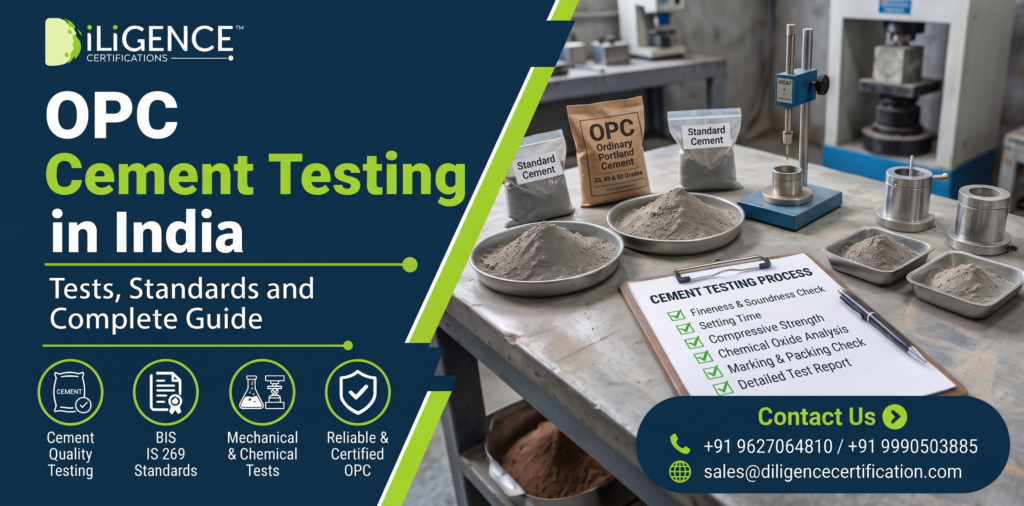
- OPC cement testing checks whether Ordinary Portland Cement meets the limits set in IS 269:2015.
- Cement is a product under compulsory BIS certification, so manufacturers need a valid licence to use the ISI mark.
- Tests cover chemical limits, physical properties like fineness, setting time, soundness and compressive strength.
- Testing is done in two places: the factory’s own lab (regular checks) and a BIS recognised lab (for the licence and surveillance).
- Most failures come from small things like wrong sampling, old marking or poor record keeping, not from big technical problems.
- Keep your test records ready. BIS can ask for them at any time after the licence is granted.
Introduction
Think of it like a school report card. A student may look smart and talk well, but the marks tell the real story. In the same way, a cement brand may look good on the bag. The test report tells the real story.
That is exactly what OPC cement testing does. It checks the cement against fixed limits and gives you proof in numbers.
In this blog, we will go step by step. What is OPC testing, which standard applies, which tests are done, how the BIS process works and what mistakes you should avoid. We have kept the language simple, so even a first-time applicant can follow it easily.
What Is OPC Cement Testing?
OPC means Ordinary Portland Cement. It is the most common type of cement used in building work like columns, beams, slabs, roads and precast items.
OPC cement testing means checking a cement sample in a lab to see if it meets the chemical and physical limits given in the Indian Standard. If the numbers are inside the limits, the sample passes. If even one important number is outside, the sample fails.
There are three things to understand here.
- Legal base: Cement comes under the Cement (Quality Control) Order, so BIS certification is compulsory for manufacturers selling it in India.
- Licence: A manufacturer needs a BIS licence to put the ISI mark on cement bags. Without it, selling that cement is a legal problem.
- Surveillance: After the licence is granted, BIS keeps checking. Samples are picked from the factory and the market and tested again.
So testing is not a one-time job. It is a regular part of running a cement plant.
Which Standards Apply to OPC Cement?
The main standard is IS 269:2015 (Ordinary Portland Cement - Specification). It is a single standard that covers 33 grade, 43 grade and 53 grade OPC. Earlier these grades were in different standards (IS 269, IS 8112 and IS 12269), but now everything is in one place.
BIS has also issued Amendment No. 1 to IS 269:2015, and licensees were given a last date to implement it. Always check the latest amendment status on the BIS website before you start, because standards can be revised.
| Standard | What it covers |
| IS 269:2015 | Requirements for OPC of 33, 43 and 53 grade |
| IS 4031 (all parts) | Methods of physical tests on hydraulic cement |
| IS 4032 | Method of chemical analysis of hydraulic cement |
| IS 650 | Standard sand for testing of cement |
| IS 3535 | Methods of sampling hydraulic cement |
Simple example: A plant makes 53 grade OPC. The lab will check chemical limits as per IS 269:2015, run physical tests as per IS 4031 parts, and use IS 650 standard sand for strength cubes. The sample is drawn as per the sampling method standard. If all results are inside the limits, the report is clean.
Why Is OPC Cement Testing Important?
Some people think testing is just a paperwork step. It is not. Here is why it matters.
- Strength of buildings: Weak cement means weak concrete. Testing protects the structure and the people inside it.
- Legal safety: Selling cement without a valid BIS licence can bring action under the law.
- Brand trust: Dealers, contractors and government projects ask for the ISI mark and test reports.
- Consistency: Regular tests help the plant find a problem in raw mix or grinding early, before the whole batch goes wrong.
- Tender eligibility: Many tenders and large buyers accept only BIS certified cement.
- Less wastage: Catching a bad batch in the lab is cheaper than taking back lakhs of bags from the market.
What Tests Are Conducted on OPC Cement?
Tests are mainly in two groups: chemical and physical. Let us understand each one in simple words.
1. Chemical Tests
These check what the cement is made of. The limits are given in IS 269:2015.
- Loss on ignition: Shows how much weight the cement loses when heated. Too much loss may mean the cement has absorbed moisture or has too much gypsum or limestone.
- Insoluble residue: Checks the part that does not dissolve in acid. A high value means impurities.
- Magnesia (MgO): Too much magnesia can cause expansion and cracks later.
- Sulphuric anhydride (SO3): Controls the gypsum content. Too little or too much affects setting and soundness.
- Alumina to iron oxide ratio and lime saturation factor: These show whether the raw mix is balanced.
- Chloride content: High chloride can rust the steel bars inside concrete.
2. Physical Tests
These check how the cement behaves when used.
- Fineness: How fine the cement powder is. Finer cement reacts faster and gains early strength.
- Standard consistency: The water needed to make a paste of standard thickness. This is the base for other tests.
- Setting time: Initial and final setting time. Cement should not set too fast or too slow.
- Soundness: Checks that the cement will not expand and crack after setting. Le Chatelier and autoclave methods are used.
- Compressive strength: Mortar cubes are made, cured in water and crushed at fixed ages. This is the test that decides the grade.
3. Marking and Packing Checks
This part is often ignored, but BIS officers do check it. The bag should carry the correct grade, the standard number, the ISI mark with licence number, batch details and the net weight.
OPC Grades in Simple Words
The grade number is the compressive strength in MPa that the cement should reach at 28 days. So 53 grade means it should reach at least 53 MPa at 28 days.
| Grade | What it means | Where it is commonly used |
| 33 grade | Lower strength | Plastering, non-structural and light work |
| 43 grade | Medium strength | General building work, slabs and columns |
| 53 grade | High strength | High-rise, bridges, precast and prestressed work |
Note: The exact strength limits at 3, 7 and 28 days for each grade are in IS 269:2015. Please read the latest copy before preparing your test plan.
Two Kinds of Testing: Factory Lab and Recognised Lab
This point confuses many first-time applicants, so let us make it clear.
| Point | Factory lab | BIS recognised lab |
| Who does it | Plant’s own quality team | Independent lab approved by BIS |
| When | Daily or every batch | At licence stage and during surveillance |
| Purpose | Control quality during production | Give independent proof of compliance |
| Records | Must be kept neatly | Test report is submitted to BIS |
A good plant does both properly. Factory lab keeps the quality steady. Recognised lab proves it to BIS.
Step-by-Step Process for BIS Certification of OPC Cement
Here is the usual flow. The exact steps may change as per BIS rules, so always confirm on the BIS portal.
- Check the scheme: Confirm that OPC under IS 269:2015 is covered and which grades you want in the licence.
- Set up the plant and lab: You need the required testing equipment, trained staff and a quality control system in the factory.
- Prepare the quality plan: Write down how you control raw material, grinding, storage and packing.
- Apply online: Fill the application on the BIS portal with company and factory details.
- Upload documents: Add the required papers (list is given below).
- Factory inspection: A BIS officer visits the plant to check the process, lab and records.
- Sample testing: Samples are drawn and sent to a recognised lab for full testing.
- Review of reports: BIS checks the inspection report and the test results.
- Grant of licence: If everything is fine, the licence is granted and you can use the ISI mark.
Which BIS Route Is Needed?
| Business type | Usual route |
| Indian cement manufacturer | BIS licence under the Product Certification Scheme |
| Foreign manufacturer selling in India | Licence under the Foreign Manufacturers Certification Scheme |
| Trader or dealer | Sells only certified cement, no licence of own, but must not sell wrongly marked bags |
| Brand owner with another plant making for them | Needs to follow BIS rules for such arrangements |
A licence needs attention when you change plant location, add a new grade, change the brand name or change the manufacturing process in a big way. Inform BIS in such cases.
Documents Required
The exact list is on the BIS portal. Generally, these are asked.
Company documents
- Company registration or partnership proof
- Factory address proof and ownership or rent papers
- Authorised person details
Product and process documents
- Manufacturing process flow
- Raw material details and sources
- Quality control plan
- List of testing equipment with calibration details
Testing records
- In-house test records for recent batches
- Calibration certificates of lab instruments
- Test report from a recognised lab, where required
How Long Does It Take?
There is no one fixed time. It depends on how ready your plant and lab are, how fast documents are submitted, the inspection schedule and the sample test time. Cement strength tests take 28 days by nature, so you must plan for that waiting period.
The best way to save time is to keep your documents clean and complete from day one.
What Affects the Cost?
We are not giving a fixed amount here because it changes case to case. These are the main factors.
- Number of grades you want in the licence
- BIS application and licence fees as per the current schedule
- Lab testing charges
- Lab equipment and its calibration
- Consultant or documentation support, if you take it
- Travel and inspection related expenses
If you want a clear breakup for your plant, send your details and ask for a quote.
Common Failures and Easy Fixes
| Problem | Why it happens | Easy fix |
| Setting time out of range | Wrong gypsum level or storage issue | Check SO3 and mixing, store cement dry |
| Low strength | Poor grinding or raw mix | Review fineness and kiln feed |
| High loss on ignition | Cement absorbed moisture | Improve storage and packing |
| Soundness failure | High free lime or magnesia | Control raw mix and burning |
| Marking mistakes | Old bag design | Update bag printing before applying |
Common Mistakes to Avoid
- Using an old standard number or old grade name on the bag.
- Taking samples in a wrong way, so results are not reliable.
- Not calibrating lab equipment on time.
- Keeping handwritten, messy or missing test records.
- Ignoring the amendment to IS 269:2015 and its implementation date.
- Storing cement samples in humid places before testing.
- Using the ISI mark before the licence is actually granted.
- Waiting till the last minute for the 28 day strength results.
Who Needs OPC Cement Testing?
- Manufacturers: Every cement plant making OPC for the Indian market.
- Importers and foreign makers: Those sending cement to India need to follow the foreign manufacturer route.
- Private label brands: If your brand is made at someone else’s plant, check how BIS rules apply to you.
- Quality teams and project buyers: To verify that the cement coming to site is genuine and tested.
Why Choose Diligence Certifications for OPC Cement Testing Certification?
BIS work looks easy from outside, but one small mistake in a document or a test plan can cost you weeks. Our team at Diligence Certifications works with manufacturers on exactly this kind of compliance work.
Here is how we help.
- We read the latest standard and amendment details and explain them in simple words.
- We help you prepare the documents and the quality control plan properly.
- We guide you on the lab, the samples and the testing schedule.
- We help you get ready for the BIS factory inspection.
- We support you after the licence for surveillance and renewals.
If you need help with your application, see our BIS certification service page and send us your details. The final decision on any licence always rests with BIS, and we never promise approval.
After the Licence: What Happens Next?
Getting the licence is not the end. BIS continues to monitor.
- Samples may be picked from the factory or the market.
- Your records and lab will be checked during visits.
- Marking on bags will be verified.
- Licence needs to be renewed on time.
Keep your quality system running every day, not only before an inspection.
Quick Checklist Before Sending Samples
- Correct grade and standard name confirmed
- Sample drawn as per the sampling method
- Cement stored dry and sealed
- Lab equipment calibrated
- Records filled for the batch
- Bag marking checked
- Lab recognised by BIS
Conclusion
OPC cement testing is the base of safe construction. It tells you, in numbers, whether the cement is fit for use. For a manufacturer, it is also the way to get and keep the BIS licence.
Start early, follow IS 269:2015 and its latest amendment, keep records neat and do not skip the small steps. If you feel stuck at any point, take expert help and avoid costly delays.
Frequently Asked Questions
1. What is OPC cement testing?
It is checking a cement sample in a lab for chemical and physical limits given in IS 269:2015.
2. Which standard is used for OPC cement?
IS 269:2015 is the main standard. Test methods are in IS 4031 and IS 4032.
3. Is BIS certification compulsory for OPC cement?
Yes, cement comes under compulsory BIS certification, so manufacturers need a licence for the ISI mark.
4. What are the grades of OPC?
33, 43 and 53 grade. They are all covered in IS 269:2015.
5. Which physical tests are done on OPC?
Fineness, standard consistency, setting time, soundness and compressive strength.
6. Which chemical tests are done?
Loss on ignition, insoluble residue, magnesia, sulphuric anhydride, chloride and ratio checks.
7. Why does strength testing take so long?
Cement gains strength slowly. The grade is based on the 28 day result, so the lab has to wait.