BIS Certification
 CDSCO
 PESO
 CPCB
 LMPC
 WPC Approval
 Global Approvals
 TEC
 ARAI
 BEE
 ISO Certification
 DGCA Certification
 NOC For Steel
 APEDA Registration























 Business Registration
 FSSAI Mark Certification












 (32).jpg)
 Legal Services
 Trademark Registration
 Copyright Registration
 Patent Registration
 By
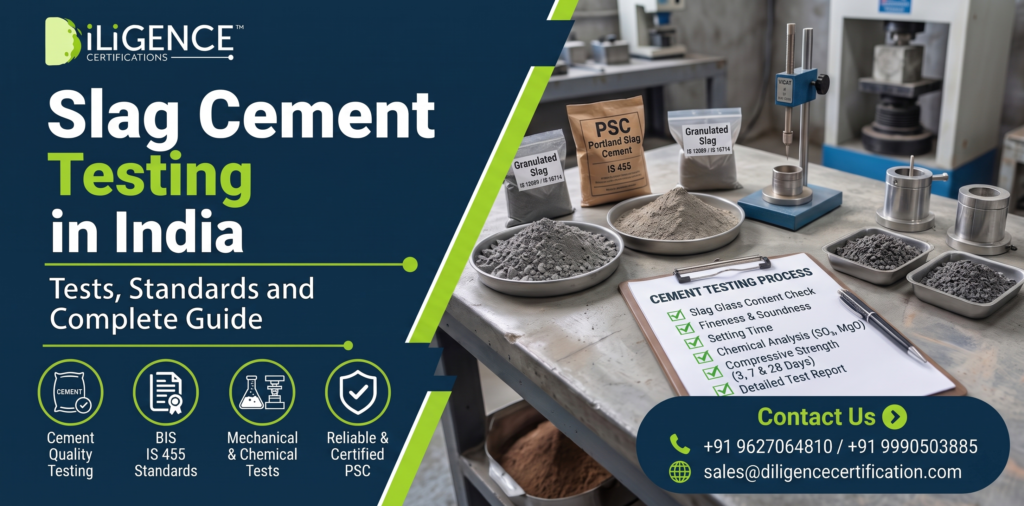
- Slag cement testing checks whether Portland Slag Cement (PSC) meets the limits set in IS 455:2015.
- Cement is under compulsory BIS certification, so a manufacturer needs a valid licence to use the ISI mark on PSC bags.
- Testing covers the finished cement (chemical and physical tests) and also the raw materials, mainly the slag.
- Slag quality matters a lot. Poorly granulated slag can spoil the whole batch, even if the clinker is good.
- Testing happens in two places: the factory lab for daily control and a BIS recognised lab for licence and surveillance.
- Keep records neat and check amendment status regularly. IS 455:2015 has been amended more than once.
Introduction
Think of it like making tea. OPC is plain chai. Slag cement is chai with a special masala added in the right amount. If the masala is too little, you get no benefit. If it is of bad quality, the whole cup is spoiled. Slag cement works the same way. The slag has to be right in quality and right in quantity.
That is why slag cement testing is important. It checks the final cement and also the material that goes inside it.
In this blog, we will understand what slag cement testing is, which standard applies, what tests are done, how the BIS process works and which mistakes you should avoid. We have kept the language simple so that a first-time applicant can follow it without any trouble.
What Is Slag Cement Testing?
Slag cement is also called Portland Slag Cement or PSC. It is made by grinding Portland cement clinker, gypsum and granulated blast furnace slag together, or by blending ordinary Portland cement with ground granulated blast furnace slag in the right amount.
Slag is a by-product of the steel industry. When it is cooled quickly, it becomes glassy and can react slowly with cement. That reaction gives the cement good durability and lower heat.
Slag cement testing means checking a sample of this cement in a lab to see if it meets the chemical and physical limits of the Indian Standard. If the numbers are inside the limits, the sample passes.
There are three points to understand here.
- Legal base: Cement comes under the Cement (Quality Control) Order, so BIS certification is compulsory for manufacturers.
- Licence: A manufacturer needs a BIS licence to put the ISI mark on PSC bags.
- Surveillance: After the licence, BIS keeps checking through factory visits and sample testing.
So testing is not a one-time job. It is part of the daily life of the plant.
Which Standards Apply to Slag Cement?
The main standard is IS 455:2015 (Portland Slag Cement - Specification). It covers the manufacture and the chemical and physical requirements of PSC.
This standard has been amended. Amendment No. 1 added an alkali content requirement. Amendment No. 2 added a new raw material, ground granulated blast furnace slag, and BIS gave licensees a last date of 17 February 2024 to implement it. Standards can change again, so always check the latest status on the BIS website before you start.
| Standard | What it covers |
| IS 455:2015 | Requirements for Portland Slag Cement |
| IS 12089 | Granulated slag for making cement |
| IS 16714 | Ground granulated blast furnace slag for blending with cement |
| IS 16353 | Portland cement clinker |
| IS 269:2015 | Ordinary Portland Cement, used when OPC is blended with slag |
| IS 4031 (all parts) | Methods of physical tests on hydraulic cement |
| IS 4032 | Method of chemical analysis of hydraulic cement |
Simple example: A plant makes PSC by grinding clinker, gypsum and granulated slag together. The lab first checks if the slag and clinker meet their own standards. Then the finished cement is tested for chemical limits and physical properties. Only when all results are inside the limits, the report is clean.
Slag Cement vs OPC vs PPC in Simple Words
| Point | OPC | PPC | Slag cement (PSC) |
| Main ingredient added | Only clinker and gypsum | Fly ash or calcined clay | Granulated slag |
| Standard | IS 269:2015 | IS 1489 | IS 455:2015 |
| Early strength | Faster | Moderate | Slower |
| Long-term durability | Good | Better | Very good, especially against chlorides and sulphates |
| Heat of hydration | Higher | Lower | Lower |
| Common use | General work | Residential and general | Marine, mass concrete, foundations and drainage work |
This table is only for basic understanding. Final choice depends on the project, so engineers should follow the project specification.
Why Is Slag Cement Testing Important?
Some people think testing is just paperwork. It is not.
- Strength and durability: Wrong slag content or poor slag quality can reduce strength over time.
- Legal safety: Selling PSC without a valid BIS licence can lead to legal action.
- Buyer trust: Contractors and government projects ask for ISI marked cement and test reports.
- Process control: Regular tests help the plant catch problems in grinding, blending or storage early.
- Tender eligibility: Many tenders accept only BIS certified cement.
- Right labelling: The slag content shown on the bag has to be correct, because engineers use it in design decisions.
What Tests Are Conducted on Slag Cement?
Tests are in three groups: raw material checks, chemical tests and physical tests.
1. Raw Material Checks
This is the part that makes slag cement different from OPC.
- Slag glass content: Glassy slag reacts well. Crystalline slag is almost inactive. The glass content is checked, usually under a microscope.
- Slag conformity: The slag should meet the requirements of its own standard.
- Clinker and OPC conformity: The clinker or OPC used should also meet its standard.
- Gypsum quality: Checked so that setting is under control.
2. Chemical Tests
These check what the cement is made of. Limits are in IS 455:2015.
- Magnesia (MgO): Too much magnesia can cause expansion later.
- Sulphuric anhydride (SO3): Controls the gypsum level and affects setting.
- Loss on ignition: Shows if the cement has taken moisture or contains too much unwanted material.
- Insoluble residue: Checks for impurities that do not dissolve in acid.
- Total chloride content: High chloride can rust the steel inside concrete.
- Alkali content: An additional requirement that came through the first amendment.
3. Physical Tests
These check how the cement behaves.
- Fineness: How fine the powder is. Finer cement reacts faster.
- Standard consistency: Water needed to make a paste of standard thickness.
- Setting time: Initial and final setting time. It should not set too fast or too slow.
- Soundness: Checks that the cement will not expand and crack after setting.
- Compressive strength: Mortar cubes are made, cured and crushed at fixed ages like 3, 7 and 28 days.
Some parts of the standard, like transverse strength, are optional and used only when buyer and manufacturer agree.
4. Marking and Packing Checks
The bag should carry the correct name, the standard number, the slag content, the ISI mark with licence number, batch details and net weight. If a repacking unit is involved, the name of the original manufacturer and its licence number are also required to be marked. BIS officers do check this.
Slag Content Explained Simply
The amount of slag in PSC is controlled by the standard. The BIS compendium of cement standards describes the slag part as not less than 25 percent and not more than 70 percent by mass of the cement. Please confirm the exact range in the latest copy of IS 455:2015 and its amendments before you plan your product.
| Slag level | Rough effect | Things to watch |
| Lower slag | Early strength is closer to OPC | Less durability benefit |
| Medium slag | Balanced strength and durability | Blending needs to be uniform |
| Higher slag | Better durability, lower heat | Early strength is slower, curing becomes very important |
Whatever the level, the number printed on the bag has to match what is actually in the cement.
Raw Materials You Must Control
| Raw material | Standard | What to check |
| Granulated slag | IS 12089 | Glass content, moisture, quality |
| Ground slag for blending | IS 16714 | Fineness and conformity |
| Clinker | IS 16353 | Chemical conformity |
| OPC (if used) | IS 269 | Must be a conforming grade |
| Gypsum | As per plant spec | Purity and SO3 contribution |
Two Kinds of Testing: Factory Lab and Recognised Lab
| Point | Factory lab | BIS recognised lab |
| Who does it | Plant’s own quality team | Independent lab approved by BIS |
| When | Daily or every batch | At licence stage and during surveillance |
| Purpose | Control quality in production | Give independent proof to BIS |
| Records | Must be kept neatly | Test report goes to BIS |
A good plant does both properly. The factory lab keeps quality steady. The recognised lab proves it.
Step-by-Step Process for BIS Certification of Slag Cement
The exact steps can change as per BIS rules, so confirm on the BIS portal.
- Confirm the scheme: Check that PSC under IS 455:2015 is what you want to make and note the latest amendments.
- Arrange raw materials: Make sure slag, clinker and gypsum meet their standards.
- Set up the lab: You need the required equipment, humidity control and trained staff.
- Prepare a quality plan: Write how you control blending, grinding, storage and packing.
- Apply online: Submit the application on the BIS portal.
- Upload documents: Add the required papers listed below.
- Factory inspection: A BIS officer visits the plant to check process, lab and records.
- Sample testing: Samples are drawn and tested in a recognised lab.
- Grant of licence: If BIS is satisfied with the inspection and reports, the licence is granted.
1. Detailed Slag Cement Testing Procedure in Laboratory
Slag cement testing is not limited to checking a single cement sample. A proper laboratory procedure includes sample collection, preparation, testing and result verification.
The process generally follows these steps:
Step 1: Sample Collection
A representative sample is collected from the cement production batch or packing stage. The sample should represent the complete batch rather than only one small portion.
Step 2: Sample Preparation
The collected cement is mixed properly to obtain a uniform sample. It is then divided into suitable quantities for chemical and physical testing.
Step 3: Chemical Analysis
The laboratory checks the chemical composition of PSC, including magnesia, sulphuric anhydride, chloride, loss on ignition and other specified parameters.
Step 4: Physical Testing
The sample is tested for fineness, consistency, setting time, soundness and compressive strength.
Step 5: Result Comparison
The laboratory compares the test results with the applicable requirements of IS 455:2015, including its amendments.
Step 6: Test Report Preparation
The final report records the sample details, test methods, observations and results. The manufacturer can use these results for quality control and applicable BIS certification requirements.
2. Important Laboratory Equipment for Slag Cement Testing
A cement testing laboratory needs suitable equipment to perform different physical and chemical tests. Equipment should be maintained, calibrated and operated by trained laboratory personnel.
| Testing equipment | Purpose |
|---|---|
| Blaine air permeability apparatus | Measures cement fineness |
| Vicat apparatus | Checks standard consistency and setting time |
| Le-Chatelier apparatus | Checks soundness |
| Autoclave | Performs autoclave soundness testing |
| Compression testing machine | Measures compressive strength |
| Cement cube moulds | Prepare mortar cubes |
| Laboratory balance | Measures sample weight |
| Muffle furnace | Supports chemical analysis |
| Humidity chamber | Maintains controlled curing conditions |
| Laboratory oven | Used for drying and moisture-related tests |
| Optical microscope | Helps examine slag glass content |
The BIS Product Manual PM/IS 455/3/Oct 2023 provides an indicative list of equipment required for testing Portland Slag Cement. It also describes equipment for testing granulated slag and ground granulated blast furnace slag. BIS
3. How Is Slag Glass Content Tested?
Glass content is one of the important quality parameters of slag used in Portland Slag Cement.
Granulated blast furnace slag contains glassy and crystalline phases. The glassy phase is important because it contributes to the cementitious reaction when used in cement.
The laboratory can examine slag using an optical microscope and suitable testing procedures.
The general process includes:
- Collecting a representative slag sample.
- Preparing the sample for examination.
- Examining the material under an optical microscope.
- Identifying the glassy and crystalline portions.
- Recording the observations and checking conformity with the applicable standard.
Why does this matter?
If the slag quality is inconsistent, the performance of the final cement can also become inconsistent. Manufacturers should therefore test slag before accepting a new supplier or changing the source of raw material.
4. Quality Control During Slag Cement Manufacturing
Testing the final cement is important, but controlling the manufacturing process is equally necessary.
A manufacturer should monitor the following activities:
Raw material inspection: Check the quality of slag, clinker, gypsum and other permitted materials before production.
Grinding control: Maintain suitable grinding conditions to achieve the required fineness.
Blending control: Ensure that slag and other ingredients are mixed uniformly.
Moisture control: Prevent raw materials and finished cement from absorbing excess moisture during storage.
Batch identification: Give every production batch a proper identification number to maintain traceability.
Packing inspection: Check bag condition, printed information, net quantity and applicable BIS marking.
A good quality control system helps identify problems before the finished cement reaches the market.
5. How to Read a Slag Cement Test Report
A slag cement test report provides information about whether a particular sample meets the specified requirements.
However, manufacturers should not look only at the final pass or fail statement. They should understand individual test results.
| Report parameter | What the result tells you |
|---|---|
| Fineness | Whether the cement grinding is suitable |
| Initial setting time | How quickly the cement starts setting |
| Final setting time | When the cement reaches the specified final setting condition |
| Soundness | Whether the cement shows excessive expansion |
| Compressive strength | Whether the mortar achieves the required strength |
| Loss on ignition | Indicates changes associated with moisture and volatile components |
| Chloride content | Helps assess compliance with the chloride requirement |
| Magnesia | Helps evaluate compliance with the chemical requirement |
| SO3 | Indicates sulphuric anhydride content |
Before accepting a test report, check these details:
- Sample identification and batch number.
- Name and address of the manufacturer.
- Applicable Indian Standard and amendments.
- Testing methods followed by the laboratory.
- Actual test values and applicable limits.
- Date of sample receipt and testing.
- Laboratory details and report authorisation.
A report for one batch should not automatically be treated as proof that every future batch will meet the requirements.
6. Storage and Handling Requirements for Slag Cement
Storage conditions can affect the quality of cement. Even a properly manufactured product can develop quality problems if it is exposed to moisture or handled incorrectly.
Manufacturers and packing units should follow these basic precautions:
- Store cement in dry and moisture-protected warehouses.
- Keep cement bags away from direct contact with the floor and walls.
- Avoid damaged or leaking bags.
- Maintain separate identification for different batches.
- Follow proper stock rotation practices.
- Prevent mixing of conforming and rejected material.
- Protect bulk cement during transportation.
- Maintain proper records of incoming and outgoing material.
For bulk packing terminals, batch identification and traceability are especially important. The BIS product manual also explains requirements relating to batch integrity, test certificates and storage controls. BIS
7. Applications of Portland Slag Cement
Portland Slag Cement is used in several construction applications because of its performance characteristics.
Some common applications include:
Marine construction: PSC may be selected for structures exposed to seawater and chloride environments, subject to engineering specifications.
Mass concrete: Its generally lower heat generation can be useful in large concrete placements.
Foundations: It can be used in suitable foundation and substructure applications.
Bridges and infrastructure: PSC is used in various infrastructure projects where durability is an important consideration.
Drainage and sewage structures: It may be suitable for certain structures exposed to aggressive environments, depending on the actual chemical exposure.
Industrial construction: It can be considered for industrial floors, foundations and other concrete works.
The final cement selection should always depend on structural design, exposure conditions, project specifications and the advice of the responsible engineer.
8. What Should You Check Before Selecting a Slag Cement Testing Laboratory?
Choosing the right laboratory is important for getting reliable test results.
Before sending your samples, consider these points:
- BIS recognition: If testing is required for BIS certification, verify that the laboratory is recognised by BIS for the relevant product and testing scope.
- Testing facilities: Check whether the laboratory has the equipment required for the applicable tests.
- Technical staff: Ensure that qualified personnel are available to perform and supervise testing.
- Calibration records: Equipment calibration should be maintained as required.
- Testing methods: Confirm that the laboratory follows the relevant IS 4031 and IS 4032 methods.
- Report quality: The report should clearly mention sample details, methods and test results.
- Testing schedule: Discuss sample submission, testing time and report availability before proceeding.
Remember that NABL accreditation and BIS recognition are not automatically interchangeable. For a particular BIS certification requirement, verify the laboratory’s applicable BIS recognition and testing scope.
9. Latest BIS Requirements for IS 455:2015
Manufacturers should pay attention to amendments because an old testing procedure or outdated raw material specification can create compliance problems.
As per the BIS standard details available in November 2026:
| Particular | Details |
|---|---|
| Standard | IS 455:2015 |
| Product | Portland Slag Cement |
| Revision | Fifth revision |
| First amendment | 2018 |
| Second amendment | 2023 |
| Latest BIS review information | Reviewed in 2025 |
| Reaffirmation | December 2025 |
| Certification | Mandatory |
The second amendment introduced ground granulated blast furnace slag as an additional raw material and updated certain packing-related references. BIS issued implementation guidelines with 17 February 2024 as the implementation deadline for licensees. BIS+1
Manufacturers should refer to the latest BIS standard and product manual before preparing their application.
Official references:
- BIS IS 455:2015 Standard Details
- BIS Product Manual for Portland Slag Cement
- BIS Scheme-I Certification Information
10. Difference Between Slag Cement Testing and GGBS Testing
Many manufacturers and buyers confuse Portland Slag Cement testing with Ground Granulated Blast Furnace Slag testing. Both are related, but they are not the same.
| Parameter | Slag cement testing | GGBS testing |
|---|---|---|
| Product | Finished Portland Slag Cement | Ground granulated blast furnace slag |
| Main standard | IS 455:2015 | IS 16714 |
| Main purpose | Checks finished cement conformity | Checks slag material conformity |
| Strength testing | Finished cement mortar strength | Material-specific requirements |
| Chemical testing | Finished cement composition | Slag chemical composition |
| Application | Used as cement in construction | Used as a cementitious material |
In simple words, GGBS is one of the materials used in cement production, while PSC is the finished cement product.
This distinction is important when preparing raw material reports and finished-product test reports.
Which BIS Route Is Needed?
| Business type | Usual route |
| Indian cement manufacturer | BIS licence under the Product Certification Scheme |
| Foreign manufacturer selling in India | Licence under the Foreign Manufacturers Certification Scheme |
| Repacking unit | Must follow BIS rules and show the original manufacturer’s name and licence number |
| Trader or dealer | Should sell only properly marked cement |
A licence needs attention when you change plant location, add a new product, change slag source in a big way or change the process. Inform BIS in such cases.
Documents Required
The exact list is on the BIS portal. Generally, these are asked.
Company documents
- Company registration or partnership proof
- Factory address proof and ownership or rent papers
- Authorised person details
Product and process documents
- Manufacturing process flow
- Raw material details and supplier names
- Quality control plan
- List of testing equipment with calibration details
Testing records
- In-house test records for recent batches
- Raw material test records, including slag
- Calibration certificates of lab instruments
- Recognised lab report where required
How Long Does It Take?
There is no fixed time. It depends on how ready your plant is, how quickly documents are submitted, inspection dates and sample testing. Cement strength testing needs 28 days by nature, so plan for that wait.
The best way to save time is to keep documents clean and complete from day one.
What Affects the Cost?
We are not giving a fixed amount here because it changes from case to case. These are the main factors.
- BIS application and licence fees as per the current schedule
- Lab testing charges
- Lab equipment and its calibration
- Raw material testing, especially slag
- Consultant or documentation support, if you take it
- Travel and inspection related expenses
If you need a clear breakup for your plant, send your details and ask for a quote.
Common Failures and Easy Fixes
| Problem | Why it happens | Easy fix |
| Low early strength | High slag level or coarse grinding | Review slag level and fineness |
| Setting time out of range | Wrong gypsum level | Check SO3 and mixing |
| Poor blending | Uneven mixing of slag and cement | Improve blending process and sampling points |
| High loss on ignition | Moisture absorbed during storage | Improve storage and packing |
| Slag not reacting well | Low glass content | Change slag source or check granulation |
| Marking errors | Old bag design | Update printing before applying |
Common Mistakes to Avoid
- Ignoring the amendments to IS 455:2015 and their implementation dates.
- Using slag without checking its glass content.
- Printing a slag content on the bag that does not match the real mix.
- Taking samples in a wrong way, so results are not reliable.
- Not calibrating lab instruments on time.
- Keeping handwritten, messy or missing records.
- Using the ISI mark before the licence is granted.
- Forgetting that strength tests take 28 days and applying at the last minute.
Who Needs Slag Cement Testing?
- Manufacturers: Every plant making PSC for the Indian market.
- Importers and foreign makers: Those sending PSC to India need the foreign manufacturer route.
- Repacking units and brand owners: Check how BIS rules apply to your arrangement.
- Project buyers and quality teams: To verify that the cement reaching site is genuine and tested.
Why Choose Diligence Certifications for Slag Cement Testing Certification?
BIS work looks easy from outside, but one small mistake in a document or a test plan can cost you weeks. Our team at Diligence Certifications works with manufacturers on this kind of compliance work every day.
Here is how we help.
- We read the latest standard and amendment details and explain them in simple words.
- We help you prepare documents and the quality control plan properly.
- We guide you on raw material checks, lab setup, samples and the testing schedule.
- We help you get ready for the BIS factory inspection.
- We support you after the licence for surveillance and renewals.
If you need help with your application, see our BIS certification service page and share your details. The final decision on any licence always rests with BIS, and we never promise approval.
After the Licence: What Happens Next?
Getting the licence is not the end.
- BIS may pick samples from the factory or the market.
- Records and lab setup can be checked during visits.
- Marking on bags will be verified.
- The licence has to be renewed on time.
Keep your quality system running every day, not only before an inspection.
Tips to Pass in the First Attempt
- Read the latest IS 455:2015 and all its amendments fully.
- Test your slag before you start production.
- Run trial batches and test them in your own lab first.
- Check blending uniformity at more than one point.
- Calibrate every instrument before the inspection.
- Keep batch records signed and dated.
- Update bag marking before you apply.
- Do a mock audit with your team a week before the BIS visit.
Quick Checklist Before Sending Samples
- Latest standard and amendments confirmed
- Slag and clinker tested and recorded
- Sample drawn as per the sampling method
- Cement stored dry and sealed
- Lab equipment calibrated
- Bag marking checked
- Lab recognised by BIS
Conclusion
Slag cement testing is the base of safe and durable construction with PSC. It tells you, in numbers, if the cement and its raw materials are fit for use. For a manufacturer, it is also the way to get and keep the BIS licence.
Start early, follow IS 455:2015 and its latest amendment, control your slag quality and keep records neat. If you get stuck at any point, take expert help and avoid costly delays.