BIS Certification
 CDSCO
 PESO
 CPCB
 LMPC
 WPC Approval
 Global Approvals
 TEC
 ARAI
 BEE
 ISO Certification
 DGCA Certification
 NOC For Steel
 APEDA Registration























 Business Registration
 FSSAI Mark Certification












 (32).jpg)
 Legal Services
 Trademark Registration
 Copyright Registration
 Patent Registration
 By
- Composite cement is a blended cement made with Portland cement clinker plus both granulated slag and fly ash. It is covered under IS 16415:2015.
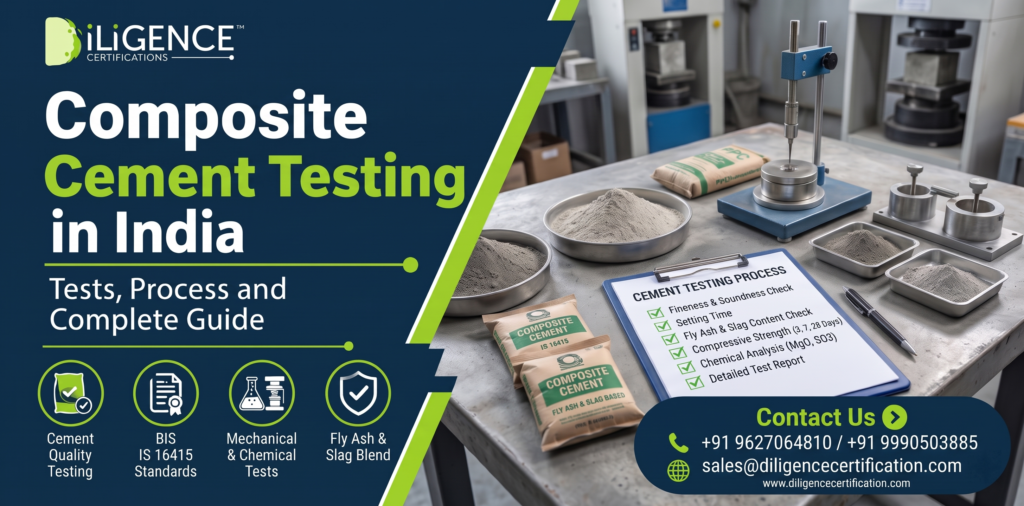
- Composite cement testing checks chemical and physical quality, like fineness, setting time, soundness and compressive strength.
- ISI mark is needed for composite cement under the Cement (Quality Control) Order. Always check the latest notification before you plan.
- Testing happens at two levels: your own factory lab, and a BIS recognised lab.
- Most failures come from wrong blend proportions, bad sampling and weak record keeping, not from the test itself.
- Plan your documents and sample preparation early. It saves weeks.
Introduction
Think about mixed fruit juice. If the makers add a little too much of one fruit, the taste changes. Sometimes it goes bad faster too. Composite cement works in a similar way. It is a mix of three main things: cement clinker, slag and fly ash. If the proportion is off, strength, setting time and durability can all change.
That’s exactly why composite cement testing matters. It tells you, with proper numbers, whether your cement is fit to be used in a house, a bridge or a road.
In this blog, we’ll go through everything in easy language. What composite cement is, which standard applies, which tests are done, how the BIS process works, and what mistakes to avoid. Read till the end, because the tips section can save you a lot of time.
What Is Composite Cement?
Composite cement is a type of blended cement. It is made by grinding or blending Portland cement clinker with granulated blast furnace slag and fly ash, along with gypsum. The word “composite” is used because more than one blending material goes into it.
Now, how is it different from other cements you may know?
| Cement type | What is blended with clinker | Relevant standard |
|---|---|---|
| OPC | Only gypsum, no major blending | IS 269 |
| PPC | Fly ash (or other pozzolana) | IS 1489 (Part 1) |
| PSC | Granulated slag | IS 455 |
| Composite cement | Both slag and fly ash | IS 16415 |
The idea behind composite cement is simple. Industrial by-products like slag and fly ash are used in a useful way. This helps in saving natural resources, and the final cement can give good long-term strength and durability when it is made correctly.
Which Standard Applies to Composite Cement Testing?
The main standard is IS 16415:2015, Composite Cement - Specification. It covers how the cement is made, what the chemical and physical requirements are, and how bags should be packed and marked. As per BIS records, this standard has one amendment (February 2023), and the compendium lists it as reaffirmed in 2020.
But IS 16415 is not the only document you will use. Test methods come from other standards too.
| Standard | What it covers |
|---|---|
| IS 16415:2015 | Requirements for composite cement |
| IS 4031 (various parts) | Physical test methods like fineness, soundness, setting time, strength |
| IS 4032 | Chemical analysis of hydraulic cement |
| IS 12089 | Granulated slag used in cement |
| IS 3812 | Fly ash used as a material in cement and concrete |
| IS 4905 | Methods of random sampling |
A simple example: Say your plant makes composite cement. For fineness you follow the method in IS 4031, and your result has to meet the limit given in IS 16415. So IS 4031 tells you how to test and IS 16415 tells you what the result should be.
For the exact clause numbers and limits, always refer to the latest copy of the standard, including the amendment.
Why Is Composite Cement Testing Important?
Some people think testing is just a paperwork thing. It’s not. Here is why it matters:
- Safety of structures. Weak or unsound cement can lead to cracks and early damage.
- Legal need. Composite cement falls under the Cement (Quality Control) Order, so the ISI mark is not optional for covered products.
- Consistency. Slag and fly ash quality can change from batch to batch. Regular testing catches that early.
- Customer trust. Builders and contractors look for the ISI mark on the bag.
- Less rejection. If you find a problem in your own lab, it is cheaper than finding it after the product has reached the market.
What Tests Are Conducted in Composite Cement Testing?
The tests are broadly of two types: physical and chemical. Let’s go through them one by one, in simple words.
Physical tests
- Fineness. This checks how finely the cement is ground. Finer cement usually reacts faster. The method comes from IS 4031 (Part 2).
- Normal consistency. This finds out how much water the cement paste needs to reach a standard stiffness. It is the base for other tests.
- Setting time. Initial and final setting time are measured. It tells you how long the cement stays workable and when it starts to harden.
- Soundness. This checks if the cement will expand after setting. Le Chatelier and autoclave methods are used.
- Compressive strength. Mortar cubes are made and crushed at set ages like 3, 7 and 28 days. This is the test everybody watches closely.
Chemical tests
- Loss on ignition. It shows how much weight is lost when cement is heated.
- Insoluble residue. It checks the part that does not dissolve in acid.
- Magnesia content. Too much magnesia can cause soundness problems.
- Sulphur trioxide (SO3). Controls the amount of gypsum effect and helps in proper setting.
- Chloride content. Important for protecting steel in concrete.
Marking and packing checks
Testing is not only about the cement itself. The bag also gets checked. Batch number, date of packing, net weight, the ISI mark and licence details must be properly printed as per the standard.
Raw Material Checks: The Part Many People Miss
In composite cement, the quality of your ingredients matters as much as the final cement. Slag and fly ash are by-products, so their quality can move around. Here is a quick view.
| Material | Why it matters | What to keep an eye on |
|---|---|---|
| Portland cement clinker | Gives the main strength and base chemistry | Chemical composition, consistency |
| Granulated slag | Adds long-term strength and durability | Glass content, chemical limits as per IS 12089 |
| Fly ash | Improves workability and later strength | Fineness, loss on ignition, as per IS 3812 |
| Gypsum | Controls setting | Purity, correct dosage |
The standard also fixes the range in which each material can be used. If your proportion goes outside the permitted range, the cement does not qualify as composite cement under IS 16415, however good the strength looks. So keep proper production records for every batch.
Two Kinds of Testing: Factory Lab vs Recognised Lab
This is a point where many first-time applicants get confused. There are two different places where testing happens.
1. Your factory lab. BIS expects a manufacturer to have an in-house lab with the needed equipment and trained people. Daily and batch-wise tests are done here. Records are kept and checked during factory visits.
2. A BIS recognised lab. For the licence application, product samples are tested in an independent lab recognised by BIS. You can check the lab scope on the BIS LIMS portal, and the lab must be recognised for IS 16415 testing.
Think of it like this: the factory lab is your daily practice, and the recognised lab is the final exam.
Step-by-Step Process for ISI Mark on Composite Cement
The exact route depends on your case, but a normal flow looks like this.
- Check the standard and the order. Confirm that your product falls under IS 16415 and the current Cement (Quality Control) Order.
- Set up your plant and lab. Production, quality control and testing facilities should be ready.
- Prepare your quality control system. Make a quality control plan with test frequency and records format.
- Collect documents. Company, plant, product and personnel details (see the list below).
- Apply on the BIS portal. Submit the application with the required fee and documents.
- Factory inspection. A BIS officer visits your plant and checks the process, lab and records.
- Sample drawing and testing. Samples are drawn and sent to a BIS recognised lab.
- Review of reports. BIS reviews the factory report and test reports together.
- Grant of licence. If everything is in order, the licence is granted and you can use the ISI mark.
For foreign manufacturers, the route goes through the Foreign Manufacturers Certification Scheme and normally takes longer.
Which BIS Route Is Needed?
| Your business type | Usual route |
|---|---|
| Indian cement manufacturer | Product certification licence from BIS (Scheme-I) |
| Foreign manufacturer exporting to India | Foreign manufacturer certification route |
| Brand owner using another plant | Needs the actual manufacturer to hold the licence for the product |
| Trader or dealer | No licence for selling, but should deal only in ISI marked cement |
A licence generally needs renewal, and it can need changes when you add a new plant, change the brand name or shift the production line. Always inform BIS and update it properly.
Documents Required
The list can change slightly case to case, but this is the usual set.
Company documents
- Proof of company registration
- Factory address proof and layout
- Details of authorised signatory
Product and process documents
- Manufacturing process flow chart
- Details of raw material sources, including slag and fly ash suppliers
- Plant and machinery list
- Quality control plan
Testing records
- Calibration records of lab equipment
- Details of testing equipment and trained staff
- Previous batch-wise test records
- Test reports of raw materials
How Long Does It Take?
There is no fixed number that works for everyone. It depends on how ready your plant and lab are, how fast samples get tested, and how quickly queries from BIS are answered. Strong 28-day strength testing also adds waiting time, because the cubes must age properly. A well-prepared applicant normally finishes faster than one who is fixing basics during inspection.
Cost: What Decides It?
We won’t throw random numbers at you, because costs change case to case. These are the factors:
- BIS application and licence fees
- Factory inspection and audit charges
- Testing charges of the recognised lab, as per its scope
- Equipment purchase and calibration for your own lab
- Consultant or documentation support, if you take it
For your exact plan, ask for a clear breakup before you start.
Common Failures and Easy Fixes
| Problem | Usually happens because | Easy fix |
|---|---|---|
| Low early strength | Too much fly ash or slag, or poor grinding | Review blend proportion and grinding |
| Soundness failure | High magnesia or free lime issue | Check raw material chemistry before use |
| Setting time out of limit | Wrong gypsum dosage | Adjust and retest the mix |
| Mismatch in records | Handwritten data without checks | Use a clean, signed format |
| Bag marking errors | Printing done without checking the standard | Verify the marking format before printing |
Common Mistakes to Avoid
- Using the old copy of the standard and skipping the amendment.
- Sending samples without proper sampling procedure.
- Not checking if the lab is recognised for IS 16415.
- Keeping lab equipment without proper calibration.
- Changing blend proportions without testing again.
- Weak record keeping of daily and batch tests.
- Printing bag markings in the wrong format.
- Starting the application late and then rushing everything.
Who Needs Composite Cement Testing?
- Manufacturers: Plants making composite cement in India.
- Importers: Anyone bringing composite cement from other countries.
- Foreign manufacturers: Plants outside India that supply to the Indian market.
- Private label owners: Brands that sell cement made by another plant.
- Large buyers and projects: They can request test reports for their own quality checks.
Why Choose Diligence Certifications for composite cement testing Certification?
BIS work needs patience and attention to small details. A missing record or a wrong format can slow everything down. At Diligence Certifications, our team helps you understand the standard in plain language and prepare your documents properly. We also guide you on lab testing and factory readiness, step by step.
If you want help with the full process, you can check our BIS certification service page or talk to our team. We guide you honestly, and we do not promise approvals, because the final decision always rests with BIS.
After You Get the Licence
Getting the licence is not the end. BIS can do surveillance visits and draw market samples from time to time. So keep your factory lab working properly, keep records updated and test every batch as per your plan. If something changes, like a new supplier of slag or fly ash, test again and inform BIS where needed.
Tips to Pass in the First Attempt
- Read IS 16415 fully, including the amendment.
- Run your own trial batches and test them before the official sampling.
- Check slag and fly ash for every new lot.
- Calibrate all lab equipment on time.
- Train your lab staff on IS 4031 and IS 4032 methods.
- Keep one person in charge of records.
- Confirm the recognised lab scope on the BIS LIMS portal.
- Do a mock audit one week before the real inspection.
Quick Checklist Before Sending Samples
- Latest IS 16415 and amendment available
- Blend proportion within permitted range
- Raw material test reports ready
- Sampling done as per IS 4905
- Lab confirmed as recognised for this standard
- Bag marking checked
- Records and calibration certificates in order
Conclusion
Composite cement testing is not just a formality. It protects your brand, your customers and the buildings made with your cement. When you understand the standard, keep your raw materials in check and maintain clean records, the whole process becomes much easier.
Start early, test regularly and always cross-check with the latest BIS notifications. If you need support at any step, Diligence Certifications is here to guide you.
Frequently Asked Questions
1. What is composite cement testing?
It is the set of chemical and physical tests done on composite cement to check if it meets IS 16415.
2. Which standard covers composite cement?
2. Which standard covers composite cement? IS 16415:2015 covers composite cement. Test methods come from IS 4031 and IS 4032.
3. What is composite cement made of?
It is made from Portland cement clinker, granulated slag, fly ash and gypsum.
4. Is the ISI mark compulsory for composite cement?
Yes, it falls under the Cement (Quality Control) Order. Please check the latest order for current details.
5. Which tests are done on composite cement?
Fineness, setting time, soundness, compressive strength, loss on ignition, insoluble residue, magnesia and sulphur trioxide, among others.
6. How is composite cement different from PPC?
PPC uses only fly ash or other pozzolana with clinker. Composite cement uses both slag and fly ash.