BIS Certification
 CDSCO
 PESO
 CPCB
 LMPC
 WPC Approval
 Global Approvals
 TEC
 ARAI
 BEE
 ISO Certification
 DGCA Certification
 NOC For Steel
 APEDA Registration























 Business Registration
 FSSAI Mark Certification












 (32).jpg)
 Legal Services
 Trademark Registration
 Copyright Registration
 Patent Registration
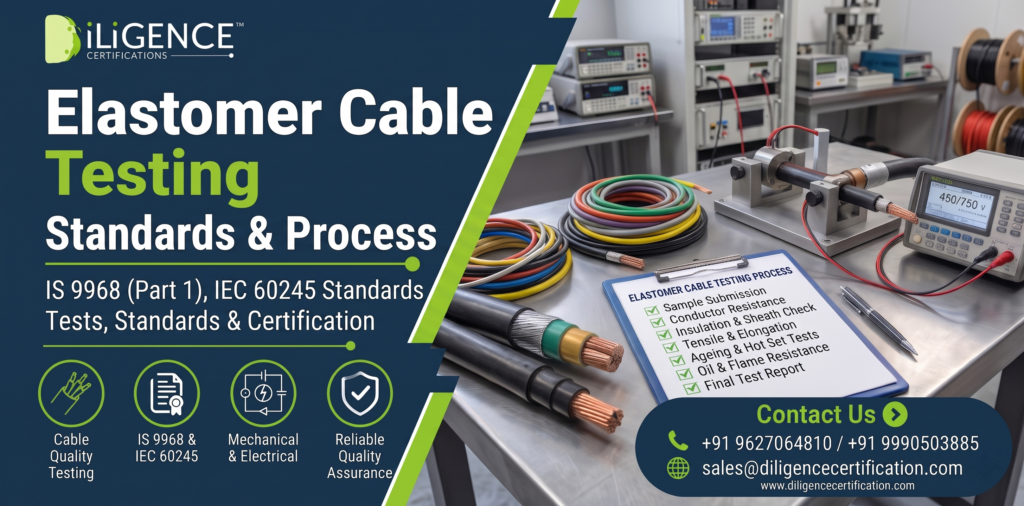
 By
- Elastomer cable testing checks if a rubber-type cable is safe, flexible and strong enough for real use.
- These cables use rubber-like insulation and sheath, so elastomer cable testing covers materials such as EPR, silicone, neoprene or EVA.
- Tests cover electrical safety, mechanical strength, ageing, heat, oil, flame and marking.
- For elastomer cable testing, samples should be tested at a recognised lab, and the report should match your cable construction.
- Most failures come from poor compound quality, wrong thickness and missing marking.
- Good planning before sampling saves time, money and repeat testing.
Introduction
Think about a mobile phone before launch. The company does not just switch it on and say it works. They drop it, heat it, bend it and charge it for days. Cables need the same treatment, especially the flexible rubber ones used on cranes, welding machines, mines, ships, pumps and portable tools.
These cables get pulled, twisted, stepped on, dragged through oil and left in the sun. If the rubber cracks or the insulation fails, the result can be a short circuit, a shock or even a fire.
That is exactly why elastomer cable testing matters. In this blog, we will explain it in very simple words, so even a first-time buyer or manufacturer can follow it easily.
What Is Elastomer Cable Testing?
An elastomer is a rubber-like material. It stretches when you pull it and comes back to its shape when you leave it. That is why it is perfect for cables that need to bend a lot.
Elastomer cable testing means checking such a cable in a laboratory against a set standard. The lab checks the conductor, the insulation, the outer sheath, the size, the marking and how the cable behaves under heat, stress and ageing.
In simple words, the lab answers one question: Will this cable stay safe and work well in real conditions for its expected life?
Elastomer cable testing is normally done on samples taken from a production batch. The lab then gives a test report that shows each test, the limit in the standard and the result found.
Common materials checked in elastomer cable testing
- EPR (Ethylene Propylene Rubber): good heat and weather resistance, used in many industrial cables.
- Silicone rubber: handles very high and very low temperatures, used near heaters and furnaces.
- Neoprene (CR): good against oil, flame and rough use, common in sheaths.
- EVA: halogen-free option, used where low smoke is needed.
- Natural or synthetic rubber blends: used in flexible and portable cables.
Simple Difference Between Elastomer Cables and PVC Cables
Many people mix these two up. Here is a quick comparison.
| Point | Elastomer (Rubber) Cable | PVC Cable |
|---|---|---|
| Feel | Soft and very flexible | Firmer and stiffer |
| Heat handling | Better, especially silicone and EPR | Moderate |
| Cold weather | Stays flexible | Can turn hard and crack |
| Rough use | Excellent for dragging and bending | Good for fixed wiring |
| Common use | Cranes, mines, welding, ships, portable tools | Homes, offices, general wiring |
| Testing focus | Ageing, flexing, oil, ozone, hot set | Insulation, flame, tensile |
So if your cable is rubber-insulated or rubber-sheathed, you need elastomer cable testing, not just the usual PVC tests.
Which Standards Apply?
The exact standard for elastomer cable testing depends on the cable type, voltage and where it will be used. Some commonly referred standards are:
| Standard | What It Covers |
|---|---|
| IS 9968 (Part 1) | Elastomer insulated cables for working voltages up to and including 1100 V |
| IEC 60245 series | Rubber insulated cables rated up to 450/750 V |
| IS 8130 | Conductors for insulated electric cables and flexible cords |
| IS 10810 series | Test methods for cables |
| Product or customer specification | Extra limits asked by the buyer, such as oil, flame or low temperature |
A simple example: Suppose a company makes a flexible rubber cable for a welding machine. The cable must follow the construction and test limits of the applicable standard. On top of that, the buyer may ask for oil resistance and a cold bend test. The lab will then test the cable on both sets of requirements.
Important note: Standards get revised from time to time, and the status of any mandatory rule for a particular cable type can change. Always check the latest version of the standard and the current notification before you start testing.
BIS Certification for Elastomer Cables (ISI Mark)
In India, many elastomer cables cannot be sold just because a lab test report is ready. They also need BIS certification. BIS means Bureau of Indian Standards, and its ISI mark tells the buyer that the cable follows the Indian Standard.
So elastomer cable testing and BIS certification go hand in hand. The test report proves the cable passes. The BIS licence gives you the legal right to put the ISI mark on it.
Which standards and rules are linked to BIS?
| Cable Type | Standard | BIS Link |
|---|---|---|
| Elastomer insulated cables up to 1100 V | IS 9968 (Part 1) | Covered under the Electrical Wires, Cables, Appliances and Protection Devices and Accessories (Quality Control) Order, as amended |
| Elastomer insulated cables from 3.3 kV to 33 kV | IS 9968 (Part 2) | Covered under the Cables (Quality Control) Order, 2020, as per the information available |
Quality Control Orders can change, and the dates and scope can be extended or revised. So always check the latest order on the BIS website before you apply.
How BIS certification differs from normal testing
| Point | Normal Lab Testing | BIS Certification |
|---|---|---|
| Purpose | Proves the cable passes the tests | Gives the licence to use the ISI mark |
| Who checks | The testing laboratory | BIS, along with a factory inspection |
| What is checked | The sample cable | Your factory, quality control system and in-house lab |
| After approval | Report is issued | Regular market and factory checks continue |
Simple steps to get the BIS licence
- Check the standard and scope. Confirm that your cable falls under IS 9968 and the right part.
- Set up your factory facilities. You need proper production equipment and an in-house lab for routine tests.
- Appoint quality control staff. BIS expects trained and competent people.
- Test samples at a recognised lab. Elastomer cable testing is done as per the standard.
- Submit the application. Share the application form, factory details and test reports.
- Factory inspection by BIS. The inspector checks your process, records and testing facilities.
- Licence is granted. Once everything is in order, you can use the ISI mark.
- Keep following the rules. BIS can take samples from the factory and the market later.
Important tips for BIS
- Use the ISI mark only after you receive the licence.
- Keep your in-house test records clean and up to date.
- Make sure the marking on the cable matches the licence.
- Foreign manufacturers have their own BIS route, so check the correct process.
- Cables with a different use, such as instrument or thermocouple cables, may fall outside the scope of IS 9968, so confirm before applying.
Why Is Elastomer Cable Testing Important?
Here is why smart manufacturers and buyers never skip it.
- Safety first: weak insulation can cause shock, short circuit and fire.
- Long life: ageing tests show how the cable will behave after years of use.
- Fewer complaints: a tested cable means fewer returns and fewer breakdowns at the customer site.
- Buyer trust: big buyers, EPC contractors and government tenders usually ask for test reports.
- Quality control: elastomer cable testing shows if your compound or process has a problem.
- Legal and tender needs: many projects need reports from a recognised laboratory.
- Brand name: one bad batch can hurt a brand for years.
What Tests Are Conducted in Elastomer Cable Testing?
There are many tests in elastomer cable testing, but they can be grouped into easy buckets. Not every cable needs every test. The standard and the cable type decide the list.
| Test Group | What the Lab Checks | In Simple Words |
|---|---|---|
| Conductor tests | Resistance, number and size of strands | Is the copper good and thick enough to carry current? |
| Insulation resistance | How well the insulation blocks current | Is current leaking out anywhere? |
| High voltage test | Cable under higher voltage for a fixed time | Does the insulation hold under stress? |
| Spark test | Voltage passed over the cable length | Are there any tiny holes or weak spots? |
| Dimension checks | Insulation and sheath thickness, overall diameter | Is the rubber layer as thick as it should be? |
| Tensile and elongation | Strength and stretch of the rubber | Does it stretch well without breaking? |
| Ageing test | Same tests after heating in an oven | Will the rubber stay good after years of use? |
| Hot set test | Elongation under load at high temperature | Is the rubber properly cured (cross-linked)? |
| Oil resistance | Rubber dipped in hot oil | Will it swell or soften near oil? |
| Ozone resistance | Exposure to ozone | Will it crack in open air over time? |
| Cold bend / cold impact | Cable bent or hit at low temperature | Will it crack in winter or cold stores? |
| Flame test | Cable exposed to a flame | Does fire stop spreading when the flame is removed? |
| Flexing and abrasion | Repeated bending and rubbing | Will it survive daily dragging and moving? |
| Marking check | Printing, colour and identification | Can you tell what the cable is and who made it? |
1. Electrical tests
These tests check how safe the cable is when electricity passes through it.
- Conductor resistance should not be higher than the limit.
- Insulation resistance should be high enough at the test temperature.
- High voltage test is done for a fixed time with no breakdown allowed.
2. Mechanical tests
Elastomer cables live a hard life, so these tests are very important.
- Tensile strength and elongation show how strong and stretchy the rubber is.
- Tear and abrasion tests show how it handles rough use.
- Flexing tests show how it handles repeated bending.
3. Ageing and thermal tests
Rubber changes with heat and time. So the lab keeps samples in an oven for a set time and then tests them again. The change in strength and stretch should stay within the limit.
4. Environmental tests
These check oil, ozone, water and cold weather. They matter a lot for cables used outdoors, in mines, on ships and in factories.
5. Fire performance tests
Some cables need a flame test. A few also need low smoke and halogen-free checks, depending on the use.
6. Marking and identification
The cable should carry correct marking, such as manufacturer name, voltage grade and size. Wrong marking is a very common reason for failure.
Types of Elastomer Cables That Need Testing
The testing approach changes a little with the application. Here are some common types.
- Flexible rubber cables for portable tools and machines.
- Welding cables that bend and drag all day.
- Crane and hoist cables that face pulling and twisting.
- Mining cables that face heavy mechanical stress.
- Ship and marine cables that face water, oil and salt.
- Silicone rubber cables used near furnaces, ovens and heaters.
- Lift and elevator trailing cables that move up and down all the time.
Raw Material Checks Before Elastomer Cable Testing
Elastomer cable testing does not start at the lab. It starts with good raw material. Many manufacturers check these before making the cable.
| Raw Material | What Is Checked | Why It Matters |
|---|---|---|
| Copper conductor | Purity, strand size, resistance | Wrong copper means high resistance and heating |
| Rubber compound | Batch quality, curing behaviour | Bad compound fails ageing and hot set tests |
| Sheath compound | Oil, flame and weather resistance | Weak sheath gets damaged in the field |
| Tape and fillers | Quality and thickness | Poor fillers affect shape and strength |
| Colour and ink | Print quality and durability | Faded printing leads to marking failure |
Two Kinds of Testing: Factory Lab and Recognised Lab
Many people get confused here. There are two places where testing happens.
| Point | Factory In-House Lab | Recognised / Third-Party Lab |
|---|---|---|
| Purpose | Daily quality control | Official proof and test report |
| Who does it | Manufacturer’s own team | Independent laboratory |
| Report acceptance | Mostly internal use | Accepted by buyers, tenders and authorities |
| Tests done | Routine tests | Full type tests and special tests |
A good manufacturer does both. Routine tests in the factory keep the quality steady. Type tests at a recognised lab give proof to the outside world.
Step-by-Step Process of Elastomer Cable Testing
Here is the usual process, in very simple steps.
- Decide the cable type and standard. Know the voltage, conductor size, material and the standard you want to follow.
- Check the latest standard. Make sure you are using the current version.
- Choose a recognised laboratory. Pick one that has the right equipment for rubber cable tests.
- Prepare the test plan. List all the tests needed, including any buyer-specific tests.
- Select the samples. Take samples from the same production batch, with proper length and quantity.
- Label and pack the samples. Write clear details so that nothing gets mixed up.
- Submit the samples with documents. Give the construction details and any drawings the lab asks for.
- Lab performs the tests. Some tests take only hours. Ageing and long-duration tests take days.
- Receive the test report. Check each result against the limit and keep the report safely.
Documents Required
For elastomer cable testing, the lab usually asks for the following. The list can change from lab to lab.
Company documents
- Company name, address and contact details
- Authorisation letter or request letter
- Factory or plant details, where needed
Product documents
- Cable construction details (conductor size, number of strands, insulation and sheath thickness)
- Material details of the compound used
- Drawings or datasheet, if available
- Voltage grade and the standard to be followed
Testing records
- Past test reports, if any
- In-house routine test records
- Calibration details of your instruments, where asked
How Long Does Elastomer Cable Testing Take?
The time depends on the number of tests and the lab’s workload. Simple routine checks can finish quickly. Full type testing with ageing, oil, ozone and flame tests takes longer, because some of these tests need days of conditioning.
If a sample fails, you need to fix the problem and test again. That adds more time. So always start early, and do not wait for the last week before a tender or delivery date.
Cost of Elastomer Cable Testing
There is no fixed price for elastomer cable testing that suits everyone. The cost depends on a few things.
- Number of tests needed
- Type of cable and number of cores
- Whether it is a routine test or a full type test
- Extra tests asked by the buyer
- Laboratory you choose
- Number of samples and repeat tests
The best way is to share your cable details with the lab and ask for a clear breakup of the test list.
Common Failures and Easy Fixes
Here are some problems that come again and again in elastomer cable testing, with simple fixes.
| Common Failure | Why It Happens | Easy Fix |
|---|---|---|
| Low tensile strength after ageing | Weak or wrong rubber compound | Review the compound and curing process |
| Hot set test failure | Rubber is not fully cured | Adjust curing temperature and time |
| Insulation thickness too low | Poor extrusion control | Calibrate the line and check thickness regularly |
| Conductor resistance too high | Thin or poor quality copper | Use correct strand size and good copper |
| Oil resistance failure | Wrong sheath compound | Use an oil-resistant compound |
| Cracks in cold bend test | Compound not suitable for cold use | Choose a low-temperature grade compound |
| Marking not clear | Faded ink or wrong print | Use durable ink and check every batch |
| Spark test failure | Tiny holes or air gaps in insulation | Check extrusion and remove contamination |
Common Mistakes to Avoid
A little care here can save you a lot of trouble.
- Testing against an old standard. Always use the latest version.
- Sending samples from different batches. The report then loses value.
- Skipping buyer-specific tests. Many tenders reject reports that miss these.
- Wrong or missing marking. This fails more cables than people expect.
- Not checking raw material. A bad compound batch can fail everything.
- Choosing a lab without proper facilities. Rubber tests need special equipment.
- Starting too late. Retesting takes time, and delays cost money.
- Not keeping records. Always store reports and batch details safely.
Who Needs Elastomer Cable Testing?
Elastomer cable testing is useful for many people, not only for manufacturers.
- Manufacturers: to prove quality and follow the standard.
- Importers: to check that imported cables meet the required rules and quality.
- Private label brands: to make sure the cable sold under their name is safe.
- Overseas manufacturers: to sell cables in India with proper test proof.
- EPC contractors and buyers: to verify quality before a big purchase.
- Export-only units: to meet the testing needs of the destination country.
Why Choose Diligence Certifications for Elastomer Cable Testing Certification?
Getting the testing and paperwork right can feel confusing, especially for a first-time applicant. That is where an experienced consultant helps.
At Diligence Certifications, the team explains the process in simple language and guides you step by step. Here is how we can support you:
- Understanding which standard and tests apply to your cable
- Preparing the document list in the right order
- Coordinating with laboratories for sampling and testing
- Reviewing the test report so that gaps are caught early
- Guiding you on what to fix if a test does not pass
You can know more about our support on our certification services page. We do not promise approvals or fixed results, because the final decision always depends on the test results and the rules at that time. What we promise is clear guidance and honest communication.
After Elastomer Cable Testing: What Next?
Getting a good test report is not the end of the story.
- Keep production quality the same as the tested sample.
- Run routine tests in your factory on every batch.
- Redo testing if you change the compound, the supplier or the design.
- Keep reports ready for buyers and audits.
- Track any change in the standard, and update your testing when needed.
Tips to Pass Elastomer Cable Testing in the First Attempt
- Read the standard fully before you make the sample.
- Test your raw material first.
- Make the test sample on a normal production run, not a special one.
- Check thickness and marking in your own lab.
- Do a small trial test in-house for ageing and hot set.
- Choose a lab that has done similar cables before.
- Keep the sample details and drawings ready.
- Keep some extra sample length for any retest.
Quick Checklist Before Sending Samples
- Latest standard confirmed
- Cable construction details ready
- Samples taken from the same batch
- Sample length and quantity as per the lab
- Marking checked and clear
- Buyer-specific tests listed
- Previous reports and records kept ready
- Lab contacted and booking confirmed
Conclusion
Elastomer cables work in some of the toughest places, so they cannot be left to chance. Good elastomer cable testing shows that your cable is safe, strong and made to last.
The path is simple when you take it step by step. Know your standard, check your raw material, test at a recognised lab, and keep your records clean. Avoid the common mistakes, and you will save time, money and a lot of headache.
If you are unsure where to begin, talk to an experienced consultant and get your elastomer cable testing plan right from day one.
Frequently Asked Questions
1. What is elastomer cable testing?
It is the process of checking a rubber-type cable in a laboratory against a standard. The lab tests the conductor, insulation, sheath, size, marking and how the cable behaves under heat, stress and ageing.
2. What is an elastomer cable?
It is a cable that uses a rubber-like material, such as EPR, silicone or neoprene, for insulation or sheath. These cables are soft, flexible and strong.
3. Which standard is commonly used for elastomer insulated cables?
IS 9968 (Part 1) is commonly referred to for elastomer insulated cables up to 1100 V. IEC 60245 is also used for rubber insulated cables up to 450/750 V. Always check the latest version.
4. What is a hot set test?
It checks if the rubber is properly cured. A sample is kept under load at high temperature. If it stretches too much or does not recover, the curing is not good.
5. Why is an ageing test done on rubber cables?
Rubber changes with heat and time. The ageing test shows if the cable will keep its strength and stretch after years of use.
6. Is oil resistance testing needed for all cables?
No. It is needed mainly for cables used near oil, such as in factories, mines and machines. The standard or the buyer decides it.