BIS Certification
 CDSCO
 PESO
 CPCB
 LMPC
 WPC Approval
 Global Approvals
 TEC
 ARAI
 BEE
 ISO Certification
 DGCA Certification
 NOC For Steel
 APEDA Registration























 Business Registration
 FSSAI Mark Certification












 (32).jpg)
 Legal Services
 Trademark Registration
 Copyright Registration
 Patent Registration
 By
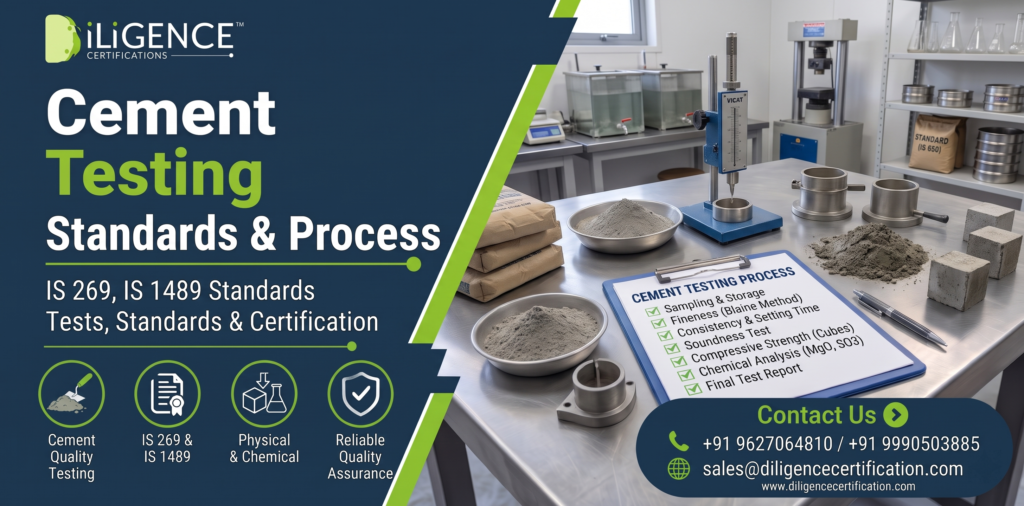
- Cement testing means checking cement in a lab to see if it is strong, stable and safe to use in construction.
- In India, cement is covered by mandatory BIS certification, so testing is not optional for manufacturers.
- The main tests are fineness, consistency, setting time, soundness, compressive strength and chemical analysis.
- Most tests follow IS 4031 and IS 4032, and the product standard decides the limits (for example IS 269 for OPC).
- Small mistakes in sampling, storage and paperwork cause most failures, not the cement itself.
- Always check the latest version of the standard before you start, because standards get revised.
Introduction
Think about a doctor. Before giving any medicine, the doctor asks for a blood test. Cement is the same. You cannot see its strength with your eyes. A grey powder in a bag looks the same whether it is good or bad. The only way to know is testing.
Cement holds a building together. Slabs, beams, columns, roads, bridges, everything depends on it. If the cement is weak, the whole structure suffers, sometimes years later. That is why cement testing matters so much.
In this blog, we will understand cement testing in very simple language. We will cover the tests, the standards, the BIS process, the documents, common failures and easy tips. No heavy theory. Just practical points.
What Is Cement Testing?
Cement testing is a set of lab checks done on a cement sample. These checks tell us about its physical strength, how fast it sets, whether it expands after hardening, and what chemicals it contains.
There are two broad parts:
- Physical tests: fineness, standard consistency, setting time, soundness and compressive strength.
- Chemical tests: things like magnesium oxide, sulphate, loss on ignition and insoluble residue.
Both parts are important. A cement can pass the strength test but fail on chemistry. Then it is still not acceptable.
Legal Base in India
In India, cement is under a Quality Control Order. Under the Cement (Quality Control) Order, nobody can manufacture, store for sale, sell or distribute cement that does not conform to the specified standard and does not carry the Standard Mark. In simple words, cement sold in the market needs BIS certification and the ISI mark.
So for a manufacturer, cement testing is part of getting and keeping the BIS licence. It is not a one-time thing. It continues even after you get the licence.
Which Standards Apply to Cement Testing?
There are two types of standards. One type tells you what the cement must achieve. The other type tells you how to test it.
| Standard | What It Covers |
|---|---|
| IS 269 | Ordinary Portland Cement (OPC) 33, 43 and 53 grade |
| IS 1489 (Part 1) | Portland Pozzolana Cement, fly ash based |
| IS 1489 (Part 2) | Portland Pozzolana Cement, calcined clay based |
| IS 455 | Portland Slag Cement |
| IS 3466 | Masonry cement |
| IS 8042 | White Portland cement |
| IS 6909 | Supersulphated cement |
| IS 4031 (various parts) | Physical test methods for cement |
| IS 4032 | Chemical analysis methods for hydraulic cement |
| IS 650 | Standard sand used for making mortar cubes |
A simple example: Suppose a plant makes OPC 43 grade. The product standard is IS 269. The tests are done as per IS 4031 and IS 4032. The result is compared with the limits written in IS 269. If every value is within the limit, the sample passes.
Please note: Standards are revised from time to time. For example, a revised version of IS 6909 for supersulphated cement has been published recently. Always check the latest version on the BIS website before testing or applying. Do not depend on old PDFs or old reports.
Why Is Cement Testing Important?
- Safety: Weak cement can lead to cracks, failures and even collapse.
- Legal compliance: Selling cement without the required certification is against the law and can attract action.
- Consistency: Testing makes sure every batch behaves in the same way.
- Customer trust: Builders and contractors trust the ISI mark.
- Durability: Good cement means a longer life for the structure.
- Cost control: Finding a problem in the lab is far cheaper than finding it on a construction site.
What Tests Are Done on Cement?
Here is a quick table. After this, we will explain each test one by one.
| Test | What the Lab Checks | In Simple Words |
|---|---|---|
| Fineness | Size of cement particles | How fine is the powder? |
| Standard consistency | Water needed for a standard paste | How much water makes a proper paste? |
| Setting time | Initial and final setting | How fast does it start and finish hardening? |
| Soundness | Expansion after setting | Will it swell or crack later? |
| Compressive strength | Strength of mortar cubes at 3, 7 and 28 days | How much load can it take? |
| Chemical analysis | MgO, SO3, LOI, insoluble residue | What is inside the cement? |
1. Fineness Test
Fineness tells us how small the cement particles are. Finer cement has more surface area, so it reacts with water faster and gains strength earlier.
There are two common methods. One is the sieve method, where cement is passed through a very small sieve and the leftover part is weighed. The other is the Blaine air permeability method, which measures surface area in square metres per kilogram. Most plants use the Blaine method.
Too coarse, and the strength comes slowly. Too fine, and the cement may crack more because of heat and shrinkage. So the standard keeps a limit.
2. Standard Consistency Test
This test finds out how much water is needed to make a cement paste of a standard thickness. The lab uses a Vicat apparatus with a plunger. The water amount is given in percentage of cement weight.
Why is this needed? Because the setting time and soundness tests use this same water percentage. If this step goes wrong, the next two tests also go wrong.
3. Setting Time Test
Cement does not harden suddenly. It first starts to set, then fully sets. The lab measures two points:
- Initial setting time: when the paste starts to lose its softness.
- Final setting time: when the paste has become fully hard.
The Vicat apparatus is used again, with different needles. Initial setting time gives workers enough time to mix, carry, place and finish concrete. Final setting time makes sure it hardens in a reasonable period. For OPC, the standard asks for a minimum initial setting time and a maximum final setting time. Check the latest IS 269 for the exact figures.
4. Soundness Test
Sometimes cement looks fine at first but expands slowly after setting. This can crack the concrete. Soundness checks this.
Two methods are used:
- Le Chatelier method: the paste is kept in a small mould and boiled. The gap between two pointers is measured. It mainly shows expansion because of free lime.
- Autoclave method: the sample is kept under high steam pressure. It also shows effects of excess magnesia.
A cement that fails soundness should never go to the market.
5. Compressive Strength Test
This is the most famous test. A mortar is made with cement, standard sand and water. It is poured into cube moulds, cured in water and then crushed in a compression machine at 3 days, 7 days and 28 days. The load at which the cube breaks is noted and converted into megapascals (MPa).
The grade of OPC (33, 43 or 53) comes from its 28 day strength. For example, OPC 43 grade is expected to reach at least 43 MPa at 28 days. The standard also gives minimum strength values for 3 and 7 days.
Important: the standard sand must be as per IS 650. Using ordinary local sand will give wrong results.
6. Chemical Analysis
The chemical test is done as per IS 4032. Some common checks are:
- Magnesium oxide (MgO): too much can cause long term expansion.
- Sulphuric anhydride (SO3): controls setting, but too much can harm the concrete.
- Loss on ignition (LOI): shows how much the cement has absorbed moisture or carbon dioxide, and tells us about storage and ageing.
- Insoluble residue: shows unwanted material or adulteration.
- Ratio of lime to silica, alumina and iron oxide: controls the balance of main compounds.
For blended cements like PPC and PSC, there are extra checks for fly ash, calcined clay or slag content, as per the product standard.
Two Kinds of Testing: Factory Lab and Recognised Lab
People often get confused here. Cement testing happens at two places.
| Type | Where | Purpose |
|---|---|---|
| Factory (in-house) lab testing | Inside the cement plant | Daily and batch wise checks to control production |
| Recognised or BIS lab testing | Outside lab approved for this work | Independent testing for licence and surveillance |
The factory lab is like your own home check. The outside lab is like an exam with an outside examiner. Both are needed. A strong in-house lab makes the outside test much easier.
Step-by-Step Process for BIS Registration of Cement
Here is the basic flow in simple steps. Details can change a little by plant, grade and scheme, so please confirm with BIS or an expert.
- Identify your product and standard. Decide whether you make OPC, PPC, PSC or another type, and note the matching IS number.
- Study the latest standard. Read the current version, including amendments and any revised dates.
- Check your plant and lab. You need proper machines, trained staff and calibrated instruments for in-house testing.
- Prepare a quality control plan. Write down which tests you will do, how often and who is responsible.
- Collect documents. Company papers, factory details, process flow, machine list and lab details.
- Apply on the BIS portal. Fill the form carefully and upload the documents.
- Factory inspection and sampling. A BIS officer visits, checks the plant and takes samples.
- Independent lab testing. The samples go to a recognised lab and are tested against the standard.
- Grant of licence. If the process and test results meet the requirements, the licence is granted and you can use the ISI mark.
After the licence, BIS continues surveillance with regular visits and sample checks. So testing never really stops.
Which BIS Licence Is Needed?
The route depends on who you are.
| Business Type | What Is Generally Needed |
|---|---|
| Indian cement manufacturer | BIS licence for each cement type and plant |
| Foreign manufacturer exporting to India | Registration under the scheme for foreign manufacturers |
| Importer or trader | Must sell only certified cement, a certified source is required |
| Brand owner (private label) | Must work with a licensed manufacturer, with the licence matching the product |
A licence is usually tied to a product, a standard and a manufacturing unit. If you add a new cement type or move to a new plant, you should check whether the licence needs to be extended or a new one taken.
Documents Required
Company documents:
- Business registration papers
- Address proof of the factory
- Authorised person details
Product and plant documents:
- Product type and grade
- Manufacturing process details
- Factory layout and machine list
- Raw material details
Testing records:
- Quality control plan
- In-house lab details and calibration records
- Past test reports of the product
Keep every paper updated. Old dates and missing signatures are very common reasons for delay.
How Long Does Cement Testing Take?
Some tests are quick and some need patience. Fineness, consistency, setting time and soundness can be done in a day or two. But compressive strength needs 3, 7 and 28 days of curing. So the full test cycle takes at least 28 days, only for the strength part.
The complete BIS process, which includes application, inspection and lab reports, takes longer. The time depends on your preparation, the lab schedule and how quickly you reply to queries. No one should promise an exact date.
What Decides the Cost?
We are not mentioning amounts here, because they change with many factors. The cost depends on:
- Type and grade of cement
- Number of tests required
- Chosen lab and its charges
- Number of samples
- Government fees under the scheme
- Your preparation level (repeat tests cost extra)
- Travel and inspection related expenses
If you want a clear breakup, share your product type and location with a consultant and ask for a written quote.
Common Failures and Easy Fixes
| Common Problem | Likely Reason | Easy Fix |
|---|---|---|
| Low strength at 28 days | Poor grinding, wrong clinker quality, wrong mix | Check raw mix, clinker and grinding settings |
| Setting time out of limit | Wrong gypsum amount | Adjust gypsum and re-test |
| Soundness failure | Excess free lime or magnesia | Control raw mix and burning |
| High loss on ignition | Cement stored in damp place | Fix storage, protect from moisture |
| Wrong sample results | Bad sampling or old sample | Take a fresh and proper sample |
| Report mismatch | Uncalibrated machines | Calibrate and keep records |
Common Mistakes to Avoid
- Using an old version of the standard.
- Taking samples from one corner of the bag or silo only.
- Keeping the sample open, so it absorbs moisture.
- Using non standard sand for strength cubes.
- Not calibrating the machines on time.
- Skipping the in-house tests and depending only on the outside lab.
- Filling the application with wrong or incomplete details.
- Ignoring surveillance samples after getting the licence.
Who Needs Cement Testing?
- Manufacturers: to get and keep the BIS licence.
- Importers and traders: to make sure the product they sell is certified.
- Private label brands: to confirm the partner plant is compliant.
- Overseas manufacturers: to sell in India through the correct scheme.
- Builders and contractors: to check quality on large projects, where needed.
Why Choose Diligence Certifications for Cement Testing Certification?
BIS paperwork and testing can feel heavy, especially for the first time. A small mistake can cost weeks. That is where proper guidance helps.
Diligence Certifications helps businesses understand the correct standard, prepare the documents and plan the testing in the right order. The team explains each step in simple language, so you know what is happening and why. You can know more about the company on the Diligence Certifications homepage, and you can read about the related support on the certification services page.
We do not promise approvals, because the final decision always rests with the authority. What we can do is help you prepare well, avoid common mistakes and save time.
After Registration: What Happens Next?
Getting the licence is not the end. BIS can visit the plant again and collect samples from the factory or even from the market. If a sample fails, there can be action, so you must keep your quality system running every day.
A few good habits help:
- Test every batch in your in-house lab.
- Keep all records neat and dated.
- Calibrate machines on schedule.
- Train new lab staff properly.
- Track any new amendment to the standard.
Tips to Pass in the First Attempt
- Read the latest standard fully, not just the summary.
- Run a trial test in your own lab before the official one.
- Take proper representative samples.
- Store samples in airtight containers.
- Use standard sand and calibrated equipment.
- Check that the temperature and humidity in the lab are as per the method.
- Keep your documents ready and cross-checked.
- Reply to every BIS query quickly and clearly.
Quick Checklist Before Sending Samples
- Latest standard checked
- Correct grade and type marked
- Sample taken properly and sealed
- In-house results available
- Machines calibrated
- Application details matched with documents
- Lab confirmed and slot booked
- Contact person and phone number added
Conclusion
Cement testing looks technical, but the idea is simple. We check whether cement is fine enough, sets at the right speed, does not expand, is strong and has the right chemistry. Every test has a reason, and every limit is there for safety.
For manufacturers, it is also the base of BIS certification. If you plan well, use the latest standards, keep your lab ready and maintain your records, the process becomes much easier. Start early, ask questions when in doubt, and never compromise on sampling and paperwork.
Frequently Asked Questions
1. What is cement testing?
It is a set of lab checks that tell us about the strength, setting behaviour, soundness and chemical quality of cement.
2. Is cement testing mandatory in India?
Cement is covered by a Quality Control Order, so BIS certification is required for the covered types, and testing is a big part of it.
3. Which standard is used for testing OPC?
OPC is covered by IS 269, and the test methods come from IS 4031 and IS 4032.
4. What are the main physical tests on cement?
Fineness, standard consistency, setting time, soundness and compressive strength.
5. Why is the compressive strength test done at 3, 7 and 28 days?
It shows how the strength grows with time. The 28 day value decides the grade.
6. What is the Le Chatelier test?
t is a soundness test where cement paste is boiled in a small mould to check expansion.