BIS Certification
 CDSCO
 PESO
 CPCB
 LMPC
 WPC Approval
 Global Approvals
 TEC
 ARAI
 BEE
 ISO Certification
 DGCA Certification
 NOC For Steel
 APEDA Registration























 Business Registration
 FSSAI Mark Certification












 (32).jpg)
 Legal Services
 Trademark Registration
 Copyright Registration
 Patent Registration
 By
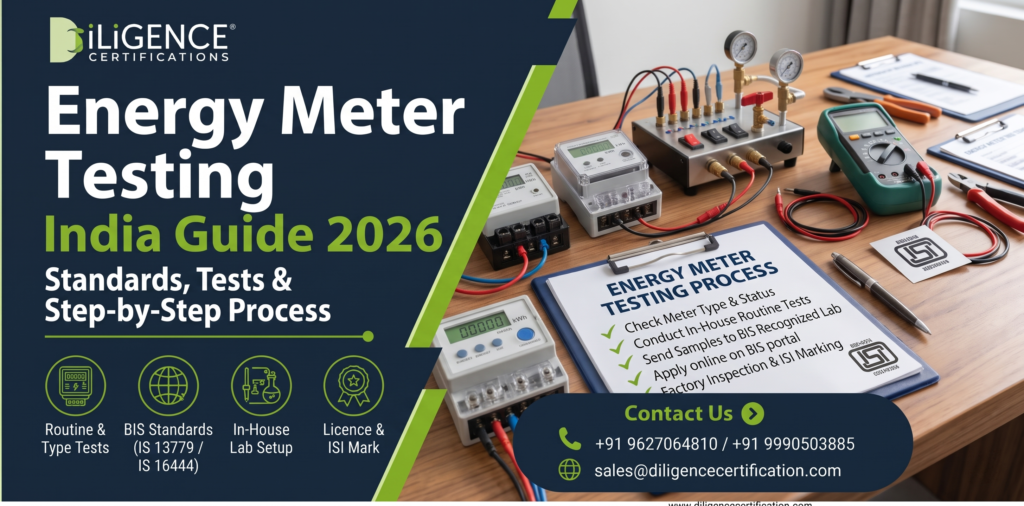
- Energy meter testing checks whether a meter measures electricity correctly, safely and for a long time.
- In India, static meters are tested mainly against standards like IS 13779, IS 16444 and IS 14697, depending on the meter type.
- Accuracy is the heart of the test, but safety, climate, EMC and tamper checks matter just as much.
- Testing is done in two places: your factory lab (routine) and a recognised outside lab (type tests).
- Most failures come from small things: wrong marking, weak sealing, poor firmware settings or incomplete documents.
- A little preparation before sending samples saves weeks of delay.
Introduction
The answer depends on one small box on your wall: the energy meter. If that box reads even a little higher or lower than the truth, someone loses money. Either the customer pays extra, or the power company loses revenue.
That is why energy meter testing exists. Think of it like a weighing scale at a vegetable market. If the scale is wrong, the whole trade becomes unfair. In the same way, a meter must be checked again and again before it is allowed to count your units.
In this blog, we will explain energy meter testing in very simple English. We will cover the standards, the tests, the process, the documents, the common mistakes and some practical tips. If you are a manufacturer, importer, or a utility buyer, this guide will give you a clear picture.
What Is Energy Meter Testing?
An energy meter (also called a watt-hour meter or electricity meter) measures how much electrical energy is used. The unit is kWh, which most people know as “one unit” on the bill.
Energy meter testing means checking a meter under controlled conditions in a laboratory. The lab applies known voltage, current and load, and then compares the meter reading with a very accurate reference instrument. The difference is the error. The error must stay inside the limits given in the standard.
But accuracy is only one part. A good test also checks:
- Whether the meter is electrically safe
- Whether it works in heat, cold and humidity
- Whether it survives dust, vibration and rough handling
- Whether it is not disturbed by electrical noise
- Whether it can catch tampering and cheating
- Whether the display, marking and communication work correctly
So, energy meter testing is not one single test. It is a full health check of the meter.
Types of Energy Meters in Simple Words
Before we go to the standards, let us understand the common meter types. The type decides which standard applies.
| Meter Type | Simple Meaning | Where It Is Used |
|---|---|---|
| Electromechanical meter | Old type with a rotating aluminium disc | Mostly being phased out |
| Static (electronic) meter | No moving parts, uses electronic circuits | Homes, shops, small industry |
| Smart meter | Static meter with two-way communication | Utilities, prepaid and remote reading |
| Direct connected meter | Current passes straight through the meter | Homes and small loads |
| Transformer operated meter (CT/PT) | Works with current and voltage transformers | Factories, big buildings, HT consumers |
Most new meters in India are static or smart meters. So most of this blog talks about these.
Which Standards Apply to Energy Meter Testing?
India follows Bureau of Indian Standards (BIS) documents for energy meters. The main ones are given below. Always check the latest version and amendment before you start, because standards get revised from time to time.
| Standard | What It Covers |
|---|---|
| IS 13779 | Static watt-hour meters (class 1 and 2) for AC single phase and three phase |
| IS 16444 | Static direct connected smart meters (class 1 and 2) |
| IS 14697 | Static transformer operated watt-hour and var-hour meters (accuracy classes like 0.2S, 0.5S and 1.0) |
| IS 15959 | Data exchange for meter reading, tariff and load control (communication side) |
| IS 13010 and related | Older AC electromechanical meters |
A simple example: A company makes a single-phase static meter for homes. It will mostly be tested as per IS 13779. If the same meter has a communication module and works as a smart meter, IS 16444 and IS 15959 also come into the picture.
Also remember that electricity utilities, through their purchase specifications, often add their own extra requirements. These are usually based on guidelines from the Central Electricity Authority (CEA). So a meter that passes the BIS test may still need to meet the utility tender conditions.
Why Is Energy Meter Testing Important?
Some people think testing is just a formality. It is not. Here is why it matters:
- Fair billing: A correct meter protects both the customer and the power company.
- Safety: A weak insulation or poor plastic can cause shock or fire.
- Long life: A meter is installed for years. It must not drift or fail in the first few summers.
- Tamper control: Electricity theft is a real problem. Good meters can detect magnets, missing neutral and reverse connection.
- Utility acceptance: Without valid test reports, most utilities will not even look at your product.
- Brand trust: One bad batch can damage a company name for a long time.
- Legal compliance: Meters must follow the rules that apply in the market where they are sold.
What Tests Are Conducted in Energy Meter Testing?
The tests are grouped so that it is easy to follow. Here is the full picture in simple words.
| Test Group | What the Lab Checks | In Simple Words |
|---|---|---|
| Accuracy tests | Error at different loads and power factors | Is the meter reading correct? |
| Starting current test | Meter should start counting at a very small current | Does it begin counting without delay? |
| No-load (creep) test | Meter should not count when there is no load | Does it run when nothing is switched on? |
| Meter constant test | Relation between display and output pulses | Do the pulses match the units? |
| Influence quantity tests | Effect of voltage change, frequency change, harmonics and temperature | Does the reading stay correct when the supply is not perfect? |
| Insulation tests | Impulse voltage and AC high voltage | Will it survive a lightning-type surge? |
| Climatic tests | Dry heat, cold and damp heat | Will it work in Delhi summer and Chennai humidity? |
| Mechanical tests | Vibration, shock and spring hammer | Will it survive transport and rough handling? |
| Ingress protection | Dust and water entry | Is the enclosure sealed well? |
| Fire and heat resistance | Glow wire and similar checks on plastic | Will the plastic catch fire? |
| EMC tests | Electrostatic discharge, fast transients, radio frequency fields | Does electrical noise disturb it? |
| Tamper tests | Magnetic field, neutral missing, earth loading, reverse flow | Can someone fool the meter? |
| Power consumption | Own power use of voltage and current circuits | How much power does the meter itself eat? |
| Display and marking | Readability, nameplate details, terminal markings | Is everything clear and correct? |
| Communication tests (smart meters) | Data exchange, remote read, events | Does the meter talk properly to the system? |
Let us look at some of the important ones in a little more detail.
1. Accuracy Tests
This is the most watched test. The lab applies a fixed voltage and different currents, from very low to maximum. It also changes the power factor, such as unity, lagging and leading. The meter reading is compared with a reference standard meter that is far more accurate.
The error limit depends on the accuracy class. A class 1 meter is allowed a smaller error than a class 2 meter. In many cases, the lab also checks the error after other tests, to see that the meter did not drift.
2. Influence Quantity Tests
In real life, supply is never perfect. Voltage goes up and down. Frequency moves slightly. Waveforms get distorted by fans, LED drivers and chargers. These tests check that the meter still reads within limits when such things happen.
3. Insulation Tests
The meter is hit with a high voltage impulse and a high AC voltage for a short time. It should not break down or flash over. This tells us the meter is safe for the user and the installer.
4. Climatic and Mechanical Tests
Meters sit on walls for ten years or more. They face heat, humidity, dust and vibration. In these tests, the meter is kept in a chamber with high temperature, low temperature and humid air, and then checked again. It is also shaken and hit with a small hammer to test the body.
5. EMC Tests
EMC means electromagnetic compatibility. A meter must not be disturbed by static charge, sudden spikes or radio waves from a mobile phone or walkie-talkie. If it is disturbed, the reading can jump or the display can reset.
6. Tamper Tests
This is a very important area. Some people try to slow down the meter using a strong magnet. Others remove the neutral wire or connect the load to earth. A good meter must either keep measuring correctly or record the event clearly. Smart meters also store such events and can send them to the utility.
Two Kinds of Testing: Factory Lab and Recognised Lab
Many people mix these two up, so let us make it clear.
| Point | Factory Lab Testing | Recognised Outside Lab Testing |
|---|---|---|
| Who does it | The manufacturer, in its own plant | An independent accredited or recognised laboratory |
| When | Every day, for batches and routine checks | For type approval and periodic checks |
| Purpose | Control quality on the production line | Prove the design meets the full standard |
| Tests | Mostly accuracy, insulation, marking, visual checks | The full list of type tests |
| Reports | Internal records | Official test reports used for applications |
Both are needed. Outside lab tests prove the design is good. Factory tests prove every unit that leaves the plant is also good.
Step-by-Step Process of Energy Meter Testing
The exact steps depend on the lab and the scheme. But the general flow looks like this:
- Identify the standard. Decide the meter type, class and standard (for example IS 13779 or IS 16444).
- Check the latest version. Confirm the current edition, amendments and any utility specification.
- Prepare the product file. Keep the circuit diagram, parts list, drawings and datasheet ready.
- Pre-test internally. Run a quick accuracy and insulation check in your own lab.
- Choose a suitable lab. Select a lab that has the right equipment and scope for your meter.
- Submit samples and documents. Send the required number of meters along with the application.
- Lab performs the tests. Accuracy, insulation, climatic, EMC, tamper and other tests are carried out.
- Review the test report. Read the report carefully. Check every remark and any failed point.
- Fix and retest if needed. If any test fails, correct the design or process and test again.
A small tip: do not treat step 4 as optional. Pre-testing is the cheapest way to find problems.
Documents Required for Energy Meter Testing
Document needs may change from lab to lab, but this list covers most cases.
Company documents
- Application form on company letterhead
- Company registration and address proof
- Authorisation letter for the person handling the work
Product documents
- Product datasheet and model list
- Circuit diagram and block diagram
- Bill of materials with critical components
- Photographs of the meter and nameplate
- User manual and installation guide
- Firmware version details (for smart and static meters)
Testing records
- Earlier test reports, if any
- Calibration certificates of your factory test equipment
- Factory test procedure and sample test records
Which Meter Needs Which Approval?
The approval route depends on the type of business and the product. Please confirm the latest rules before you start, because requirements for electrical products change over time.
| Business Type | What Usually Matters |
|---|---|
| Indian manufacturer | Type test reports, factory testing setup and the approvals required by the buyer or utility |
| Importer | Test reports for the imported model, proper marking and documents from the foreign maker |
| Private label brand | Reports linked to the actual factory and model, with brand details clearly mentioned |
| Overseas manufacturer | Authorised Indian representative and reports accepted in India |
| Utility supplier | Compliance with the utility tender, including extra technical conditions |
Whenever the design, main components, firmware or factory changes in a big way, the earlier test report may not remain valid. In that case, partial or full retesting may be needed.
How Long Does Energy Meter Testing Take?
There is no fixed answer. Time depends on the number of tests, lab queue, sample availability, and whether any test fails.
Some tests, like climatic and damp heat cycles, take many days on their own. A failed test and a retest can add weeks. So plan your time with some buffer. Do not make launch dates before test reports arrive.
Cost of Energy Meter Testing
We are not giving a fixed number here, because the cost changes with many things. These are the main factors:
- Type of meter (single phase, three phase, smart, transformer operated)
- Accuracy class
- Number of tests and the scope of the standard
- Number of samples required
- Whether retesting is needed
- Lab charges and sample transport
- Extra utility or communication tests
The best way to know your actual cost is to ask for a proper breakup from the lab or consultant for your exact model.
Common Failures and Easy Fixes
| Common Failure | Why It Happens | Easy Fix |
|---|---|---|
| Error outside limit at low current | Poor calibration or noisy circuit | Improve calibration steps and shielding |
| Meter creeps at no load | Software threshold or noise issue | Adjust the no-load logic in firmware |
| Fails EMC test | Weak filtering or poor PCB layout | Add filters and improve grounding |
| Fails damp heat test | Weak coating or poor sealing | Use better conformal coating and seals |
| Tamper not detected | Missing detection logic | Update the tamper algorithm and retest |
| Marking not accepted | Missing or wrong nameplate details | Check the standard marking list line by line |
| Plastic fails glow wire test | Wrong plastic grade | Use plastic with proper fire rating |
| Display fades or resets | Power supply weakness | Improve the power supply design |
Common Mistakes in Energy Meter Testing
These mistakes happen again and again. Try to avoid them.
- Using an old standard. The lab tests as per the current version, so check before you begin.
- Sending prototype samples. Samples must match the final production design.
- Changing components after testing. A new chip or plastic grade can make the old report useless.
- Ignoring firmware version. For static and smart meters, firmware is part of the product.
- Weak documents. Missing diagrams or wrong model names create delays.
- Skipping pre-testing. Failing at the lab is slower and costlier than failing in your own plant.
- Uncalibrated factory equipment. If your own reference meter is not calibrated, your daily results are not trusted.
- Forgetting the utility specification. Passing the BIS test does not always mean the utility will accept the meter.
Who Needs Energy Meter Testing?
- Manufacturers who make static, smart or transformer operated meters
- Importers who bring meters from other countries to sell in India
- Private label brands who get meters made by another factory
- Overseas manufacturers who want to supply to the Indian market
- Utility suppliers who bid in tenders for meter supply
- Buyers and EPC companies who want to verify the quality of meters before bulk purchase
Why Choose Diligence Certifications for Energy Meter Testing Certification?
Not everyone understands standards, labs and paperwork. That is where a good consultant helps. Diligence Certifications supports businesses with compliance and certification work, and our team explains each step in plain language.
Here is how we can help you with energy meter testing:
- Understanding which standard and class apply to your meter
- Checking your documents before submission
- Guiding you on lab selection and sample preparation
- Helping you read test reports and plan corrections
- Supporting you with the next compliance steps
You can read more about our work on our certification services page. We do not promise approvals, because the final decision always lies with the testing body or the authority. But we do promise honest guidance and clear communication.
After Testing: Keep the Quality Going
Getting a test report is not the end of the story. Utilities and authorities can check products in the market also. So keep these habits:
- Keep production the same as the tested design
- Record all factory test results batch by batch
- Calibrate your reference equipment on time
- Inform your consultant before changing any major component
- Keep samples of every batch for some time
Tips to Pass Energy Meter Testing in the First Attempt
- Read the standard fully, not just the summary.
- Run your own pre-test with the same load points as the lab.
- Lock the firmware before sending samples.
- Use components from reliable suppliers and keep their datasheets.
- Check marking and terminal details twice.
- Test climatic and EMC behaviour early in the design stage.
- Send extra samples if the lab allows, in case any unit is damaged.
- Talk to the lab before submission if you are unsure about any requirement.
Quick Checklist Before Sending Samples
- Correct standard and class confirmed
- Latest version and amendments checked
- Final production samples ready
- Firmware version frozen and noted
- Nameplate and terminal markings verified
- Datasheet, circuit diagram and parts list ready
- Factory equipment calibration certificates available
- Pre-test results saved
- Utility specification (if any) reviewed
- Application form signed and complete
Conclusion
An energy meter looks small, but its job is big. It decides how fairly crores of rupees of electricity are billed every month. That is why energy meter testing is serious work.
If you plan well, the process is not difficult. Choose the right standard, prepare your documents, pre-test in your own plant, and give the lab final production samples. Avoid the common mistakes and keep your quality steady even after the report arrives.
If you want help at any step, you are welcome to connect with the team at Diligence Certifications.
Frequently Asked Questions
1. What is energy meter testing?
It is the process of checking a meter in a lab to see whether it measures electricity correctly and is safe, strong and tamper resistant as per the standard.
2. Which standards are used for energy meter testing in India?
Common ones are IS 13779 for static meters, IS 16444 for smart meters, IS 14697 for transformer operated meters and IS 15959 for data exchange. Always check the latest version.
3. What is an accuracy class?
It shows how close the meter reading must be to the true value. A class 1 meter has tighter limits than a class 2 meter.
4. What is a static meter?
A static meter is an electronic meter with no moving parts. It uses circuits to measure energy.
5. What is the difference between a static meter and a smart meter?
A smart meter is a static meter that can also send and receive data, so remote reading and events are possible.
6. What is a no-load or creep test?
It checks that the meter does not keep counting units when no load is connected.
7. Why are EMC tests needed?
Electrical noise, static charge and radio waves can disturb a meter. EMC tests make sure the reading stays correct.