BIS Certification
 CDSCO
 PESO
 CPCB
 LMPC
 WPC Approval
 Global Approvals
 TEC
 ARAI
 BEE
 ISO Certification
 DGCA Certification
 NOC For Steel
 APEDA Registration























 Business Registration
 FSSAI Mark Certification












 (32).jpg)
 Legal Services
 Trademark Registration
 Copyright Registration
 Patent Registration
 By
- Dry battery testing means checking a battery in a lab against the Indian Standard for size, markings, leakage and life.
- For multipurpose zinc-carbon dry batteries, the main standard is IS 8144. The 2018 edition replaced the 1997 one, and a newer 2025 revision is also listed by BIS.
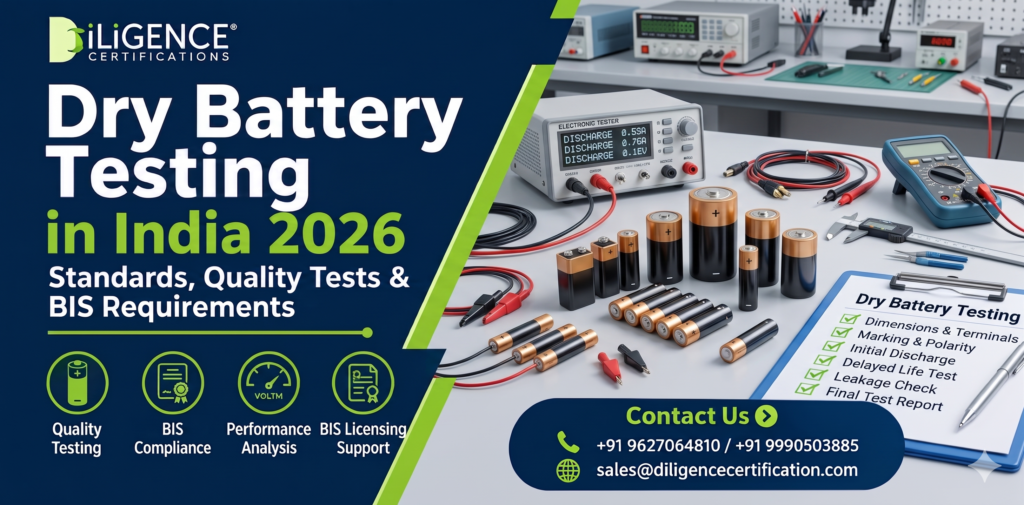
- Main lab checks are dimensions, terminals, markings, leakage, initial life and delayed life after storage.
- Not every battery type falls under the same rule. Zinc-carbon, alkaline and rechargeable cells are treated differently, so confirm your product category first.
- Testing is done per battery size and type. Planning your size list early saves time and money.
- Good records, correct markings and a working factory lab help you pass in the first attempt. No one can promise approval, because the result always depends on the actual test report.
Introduction
Think of a dry battery like the tiffin of a school child. It must stay sealed, must not spill and must last till lunch time. If the lid is loose or the food is bad, the whole day gets spoiled.
Dry batteries power torches, clocks, remotes, radios, toys and many daily gadgets. So they are tested before they reach your shop shelf. In India, this testing is linked to BIS certification and the ISI mark.
In this blog, we explain dry battery testing in very simple words. You will learn which standard applies, what tests are done, how the process works, which documents you need and which mistakes to avoid. Manufacturers, importers, private label brands and even shop owners can use this guide.
What Is Dry Battery Testing?
Dry battery testing is a set of lab and factory checks done on a battery to see if it meets the rules of the Indian Standard. The battery is measured, inspected, discharged, stored, checked for leakage and then discharged again. If the results stay within the limits, the test report says it conforms.
Simple points to remember:
- Legal base: Multipurpose dry batteries under IS 8144 are covered by BIS certification. Always check the latest order and notification for the exact scope.
- Licence: A manufacturer needs a BIS licence to use the ISI mark on these batteries. Testing is a big part of getting that licence.
- Surveillance: After the licence, BIS keeps checking through factory visits and market samples. So testing is not a one-time job.
Types of Batteries: Simple Difference
People often mix up battery types. This table makes it easy.
| Battery type | Where it is used | Main point | Standard that is usually checked |
|---|---|---|---|
| Zinc-carbon (multipurpose or heavy duty) dry battery | Remotes, wall clocks, torches, radios | Low cost, general use | IS 8144 |
| Alkaline primary battery | Toys, cameras, high-drain devices | Longer life than zinc-carbon | Check current scope. Some brands state it is outside the compulsory list |
| Rechargeable nickel-metal hydride cell | Rechargeable AA and AAA cells | Can be used again and again | IS 16046, under the registration scheme |
| Lithium-ion cell or battery | Power banks, phones, laptops | High energy | IS 16046 (Part 2) and related rules |
So, before you start, confirm exactly which type your product is. This one step avoids a lot of confusion later.
Which Standards Apply to Dry Batteries?
Here are the main documents to know.
| Standard | What it covers |
|---|---|
| IS 8144 | Multipurpose dry batteries (zinc-carbon): dimensions, markings, performance and leakage tests |
| IS 16046 | Safety of sealed secondary cells and batteries with alkaline or other non-acid electrolyte for portable use |
| IEC 60086 series | International standard for primary batteries, used as a reference |
A simple example: Suppose a company makes R6 (AA size) zinc-carbon batteries for the Indian market. It will be tested under IS 8144 for size, terminals, markings, leakage and discharge life. A company making rechargeable AA cells will follow the IS 16046 route instead.
Note on the revised version: IS 8144:2018 replaced the 1997 edition and also brought the older heavy duty battery standard under one roof. BIS has also published a third revision, IS 8144:2025. Always download the latest copy from the BIS website and check which edition applies on the date you apply, including any transition period.
Why Is Dry Battery Testing Important?
A weak battery is not only a waste of money. It can leak chemicals inside a device, damage the contacts and sometimes harm a child who plays with a toy. Testing helps because:
- It checks that the battery gives the life it claims.
- It checks that the battery does not leak under normal use and storage.
- It confirms that size and terminals fit the device properly.
- It protects consumers from cheap and unsafe products.
- It is a legal need for batteries that fall under the compulsory scope.
- It helps a brand build trust with retailers and buyers.
- It reduces returns, complaints and warranty issues.
What Tests Are Conducted in Dry Battery Testing?
The exact list and limits are in the standard. This table gives the idea in simple words.
| Test group | What the lab checks | In simple words |
|---|---|---|
| Dimensions | Height and diameter of the battery | Will it fit the device properly? |
| Terminals | Shape, position and condition of the positive and negative ends | Will it make good contact? |
| Markings | Name, size designation, voltage, date of manufacture, ISI mark, polarity signs | Is everything printed clearly and correctly? |
| Initial life test | Battery is discharged through a fixed load right after manufacture | How long does a fresh battery last? |
| Delayed life test | Battery is stored for a set time and then discharged | Does it still work well after sitting on a shelf? |
| Leakage test | Battery is checked for any leaking after use or storage | Does it stay sealed? |
| Visual check | Cracks, dents, damaged jacket or sleeve | Is the battery in good shape? |
Before sending samples, a good practice is to run your own basic checks in the factory lab. Even a quick check of markings and size can save a full round of testing.
Battery Sizes Explained in Simple Words
The standard uses short codes. Here is what they mean in daily language.
| IEC code | Common name | Where it is used |
|---|---|---|
| R03 | AAA | Remotes, small toys, wall clocks |
| R6 | AA | Torches, clocks, toys, remotes |
| R14 | C | Larger torches and radios |
| R20 | D | Big torches, lanterns and radios |
| 6F22 | 9-volt | Smoke alarms, small instruments |
If you make several sizes, tell your consultant early. Each size and type may need to be planned for testing.
Two Kinds of Testing: Factory Lab and Recognised Lab
This point confuses many first-time applicants.
Factory lab (in-house testing): Your own lab checks the batteries during production. It must have calibrated meters, discharge testers, trained staff and proper records. BIS officers look at this lab during inspection.
Recognised lab (third-party testing): An independent lab recognised for this product tests the sample. BIS also draws samples and sends them to such labs during the licence process and later during surveillance.
You need both. The factory lab shows that you control quality every day. The recognised lab proves that your batteries match the standard on paper. Think of it like cooking at home and then getting a food inspector’s report.
Step-by-Step Process for Dry Battery Testing and BIS Certification
- Confirm your product type. Check whether your battery falls under IS 8144 or another standard.
- Download the latest standard. Get the current edition of IS 8144 and the BIS product manual or guidelines for it.
- Plan your sizes. Decide which sizes (R03, R6, R14, R20 and others) you will register and how they are grouped for testing.
- Set up your factory lab. Keep testing equipment calibrated and keep a written test plan.
- Do pre-testing. Check size, markings, leakage and discharge life in your own lab first.
- Apply to BIS. Submit the application with documents and fee on the BIS portal.
- Factory inspection and sampling. A BIS officer visits, checks your process and lab, and draws samples.
- Test in a recognised lab. Samples go for testing against the standard. Wait for the report.
- Grant of licence and ISI marking. If reports and inspection are fine, the licence is granted and you can start using the ISI mark.
Note: For overseas factories, the process has extra steps and usually takes longer.
Which BIS Registration Is Needed?
| Business type | What is usually needed |
|---|---|
| Indian manufacturer | BIS licence under the product scheme, with factory inspection |
| Foreign manufacturer | BIS licence under the Foreign Manufacturers Certification Scheme, with an Authorised Indian Representative |
| Importer | Batteries must come from a BIS-licensed maker if they fall under the scope. Importer also follows customs and labelling rules |
| Private label brand | Batteries must be made by a licensed factory, and brand details must follow the licence and marking rules |
| Maker of rechargeable cells | Registration route under IS 16046, which is different from the ISI licence route |
If you change your factory, add a new size or change a key material, you may need to update the licence or test again. Check with BIS before making such changes.
Documents Required
Keep these ready before you apply.
Company documents
- Business registration proof (certificate or incorporation papers)
- Factory address proof and ownership or rent papers
- PAN and GST details
- Authorised signatory details and board resolution, if needed
Product documents
- List of battery sizes and types with the grouping plan
- Battery construction details and drawings
- Raw material list with suppliers (zinc can, manganese dioxide, carbon rod, electrolyte, separator, jacket)
- Manufacturing process flow chart
- Sample label with ISI marking layout
Testing and quality records
- Factory lab details with calibration certificates
- In-house test records for the last few batches
- Quality control plan and inspection checklists
- Previous test reports, if any
Clean and matching documents make the whole process smoother. Mismatch between papers is a very common reason for delay.
How Long Does It Take?
There is no fixed number of days that suits everyone. The timeline depends on your readiness, the lab schedule, the number of sizes and whether your factory is in India or abroad. Foreign factories usually take longer. Delays mostly come from missing documents, failed tests and slow replies to queries. So reply fast and keep your records ready.
What About Cost?
We are not giving fixed amounts here, because the cost changes from case to case. The main factors are:
- Number of battery sizes and groups to be tested
- Lab testing charges for each sample
- BIS application and licence fees
- Cost of sample batteries sent to the lab
- Factory lab setup or calibration cost
- Travel and inspection cost for overseas factories
- Consultant support, if you take it
Ask every provider for a written breakup, so that you can compare properly.
Common Failures and Easy Fixes
| Common problem | Why it happens | Easy fix |
|---|---|---|
| Short life in the discharge test | Weak active material or poor cell balance | Review the formulation and mixing process before sampling |
| Failure after storage | Moisture loss or self-discharge | Check sealing, separator and storage conditions in the factory |
| Leakage | Thin zinc can, poor seal or old stock | Improve the seal, check can quality and avoid long storage before sampling |
| Wrong size or loose fit | Tooling or jacket problems | Measure samples with calibrated tools before sending |
| Marking errors | Missing date code, voltage or ISI mark | Check the label layout against the standard |
| Documents mismatch | Different names or addresses on papers | Make one master data sheet and use it everywhere |
Common Mistakes to Avoid
- Using an old edition of the standard and not checking the latest one.
- Assuming that all battery types follow the same rule.
- Sending samples without a pre-test in the factory lab.
- Printing labels from memory and not from the standard.
- Not planning sizes properly and ending up with extra testing.
- Keeping calibration certificates out of date.
- Using very old stock as samples, which can fail the delayed life or leakage test.
- Waiting till the last week to start the process.
How to Check Dry Battery Quality as a Buyer or Shop Owner
You do not need a lab for basic checks. A few simple habits help.
- Look for the ISI mark: Check the pack for the BIS standard mark where it applies, along with the licence details.
- Check the date: Buy batteries with a clear manufacturing or expiry date. Avoid very old stock.
- Inspect the jacket: Dents, rust, white powder or sticky stains are warning signs.
- Match the size: Check that the size code on the pack fits your device.
- Store properly: Keep batteries in a cool and dry place. Do not keep them in a hot shop window.
- Do not mix: Never mix old and new batteries or different brands in one device.
- Remove dead cells: Take dead batteries out of devices soon, because they can leak.
A little care at the shop saves a lot of trouble at home.
Why Choose Diligence Certifications for dry battery testing Certification?
Getting through BIS for batteries means handling standards, documents, factory readiness, sampling and follow-ups. Many first-time applicants lose time on small things. This is where a good consultant helps.
At Diligence Certifications, we support manufacturers, importers and private label brands with a simple and clear approach:
- We read the latest standard and notifications first, so you start on the right base.
- We help you confirm which scheme your battery type falls under.
- We help you plan sizes, documents and pre-testing.
- We guide you on factory lab readiness and records.
- We coordinate the application and follow-up with the concerned offices.
- We keep you updated in plain language, without confusing jargon.
We do not promise approval, because the final decision depends on the factory inspection and the test reports. What we promise is a clean process and honest guidance. You can explore our BIS certification services to know more.
After Registration: What Happens Next
Getting the licence is not the end. BIS can visit your factory again and draw samples from the factory or from the market. Keep your lab running, keep your records updated and keep the markings correct on every batch. Pay the licence fees on time and inform BIS about any major change. Companies that treat the licence as a daily habit rarely face problems later.
Tips to Pass in the First Attempt
- Start with the latest edition of IS 8144 and read the scope carefully.
- Make a one-page checklist of all test groups and keep it with the production team.
- Run your own leakage and discharge checks before official sampling.
- Check the label on a trial batch against the standard.
- Use fresh, properly stored batteries as samples.
- Keep raw material records and batch numbers ready.
- Keep calibration certificates and staff training records in one file.
- Plan extra time. A rushed application is a risky application.
Quick Checklist Before Sending Samples
- Product type and scheme confirmed
- Latest IS 8144 edition downloaded
- Sizes and groups finalised
- Markings and labels checked
- Factory lab equipment calibrated
- Pre-test results reviewed
- Raw material and batch records ready
- Company and product documents matched
Conclusion
Dry batteries look small, but they run a big part of our daily life. Testing is the way to prove that a battery is safe, leak-free and gives the life it promises. For manufacturers, it means following the right standard, preparing the factory lab, planning samples and keeping every record clean. For buyers, it means choosing batteries with proper marks, fresh dates and good storage habits.
Start early, read the latest rules, keep your papers matching and take expert help where needed. That is the simplest path to a smooth dry battery testing and certification process.
Frequently Asked Questions
1. What is dry battery testing?
It is a set of lab checks on a dry battery to confirm that it meets the Indian Standard for size, markings, leakage and life.
2. Which standard applies to dry batteries in India?
IS 8144 covers multipurpose zinc-carbon dry batteries. Rechargeable cells follow a different standard, IS 16046.
3. Is BIS certification compulsory for dry batteries?
Multipurpose dry batteries covered by IS 8144 need BIS certification. Please check the latest notification for the exact scope.
4. Are alkaline batteries covered by IS 8144?
IS 8144 is written for zinc-carbon batteries. Some brands state that alkaline primary batteries are outside the compulsory list, but you should confirm the current position with BIS or a consultant.
5. What tests are done on a dry battery?
Common tests include dimensions, terminals, markings, initial life, delayed life and leakage.
6. What is the delayed life test?
The battery is stored for a set time and then discharged. It shows how well the battery holds its power on a shelf.