BIS Certification
 CDSCO
 PESO
 CPCB
 LMPC
 WPC Approval
 Global Approvals
 TEC
 ARAI
 BEE
 ISO Certification
 DGCA Certification
 NOC For Steel
 APEDA Registration























 Business Registration
 FSSAI Mark Certification












 (32).jpg)
 Legal Services
 Trademark Registration
 Copyright Registration
 Patent Registration
 By
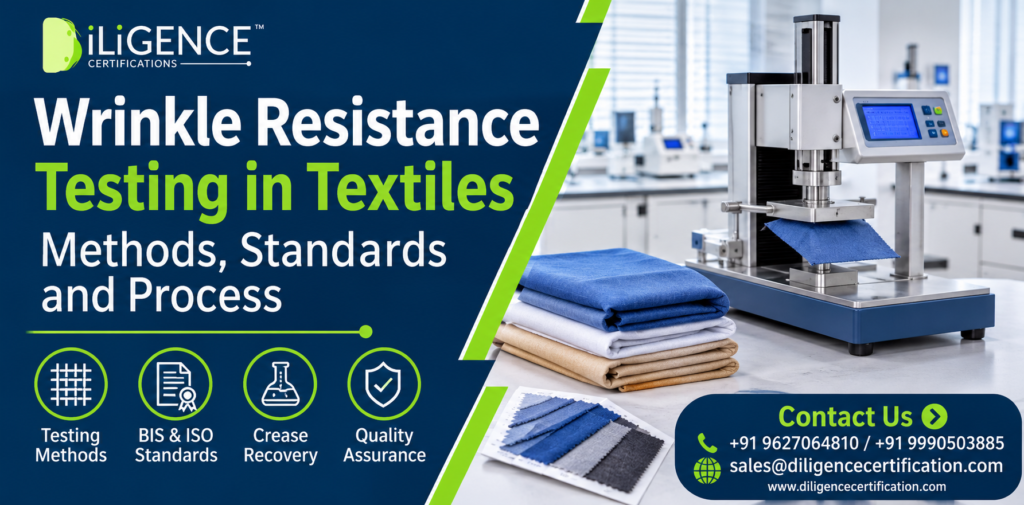
- Wrinkle resistance testing measures how well a fabric resists wrinkles and recovers after creasing.
- It helps textile manufacturers evaluate fabric appearance and quality.
- Common methods include crease recovery angle testing and wrinkle appearance assessment.
- ISO 2313 and ISO 9867 are important standards for evaluating crease recovery and wrinkle recovery.
- Cotton, polyester, wool, linen and blended fabrics can have different wrinkle resistance properties.
- Proper testing supports textile quality control and product development.
- Manufacturers should check applicable BIS standards and buyer specifications before testing.
Introduction
Wrinkles are one of the most common problems found in textile products. When fabric is folded, compressed, washed or worn, it may develop unwanted creases and wrinkles. Some fabrics recover their original appearance quickly, while others retain wrinkles for a long time.
For example, a polyester shirt may maintain a smooth appearance after folding, whereas a cotton shirt may require ironing to remove visible creases. This difference depends on fibre composition, yarn structure, fabric construction and finishing treatments.
Wrinkle resistance testing in textiles is a quality evaluation process used to measure how effectively a fabric resists wrinkles or recovers its original shape after deformation.
This testing is important for textile manufacturers, garment producers, fabric suppliers, exporters and apparel brands. It helps them understand fabric performance before using materials in shirts, trousers, uniforms, bedsheets, curtains and other textile products.
In this guide, we explain wrinkle resistance testing in simple language, including its importance, testing methods, BIS and ISO standards, equipment, procedures, applications and common mistakes.
What Is Wrinkle Resistance Testing in Textiles?
Wrinkle resistance testing is a textile testing process that determines how well a fabric can resist the formation of wrinkles or recover after being folded and creased.
When pressure is applied to a fabric, its fibres and yarns may change their original position. If the fabric does not recover properly, visible wrinkles remain on its surface.
A wrinkle-resistant fabric can maintain a smoother appearance even after normal handling, folding and wearing.
There are two important properties associated with this testing.
1. Wrinkle Resistance
Wrinkle resistance refers to the ability of a fabric to resist the formation of wrinkles when subjected to pressure, folding or deformation.
2. Crease Recovery
Crease recovery refers to the ability of a fabric to return towards its original condition after a crease has been created.
Both properties are related, but they are not exactly the same. A fabric may resist wrinkle formation well but may not recover equally well after a deep crease.
Testing helps manufacturers compare different materials and select suitable fabrics for specific applications.
Why Is Wrinkle Resistance Testing Important?
Wrinkle resistance is an important fabric quality characteristic because customers generally prefer textile products that maintain a neat and attractive appearance.
Testing helps manufacturers understand whether their fabrics meet the required performance and appearance expectations.
1. Improves Fabric Quality
Wrinkle resistance testing helps identify fabrics that develop excessive creases during normal use. Manufacturers can use the results to improve fabric construction, material selection and finishing treatments.
2. Supports Garment Manufacturing
Clothing manufacturers need fabrics that maintain their appearance during wearing, transportation and storage.
Testing helps manufacturers select suitable materials for:
- Shirts and trousers
- School uniforms
- Office clothing
- Jackets and dresses
- Workwear and industrial garments
3. Evaluates Easy-Care Performance
Many textile products are marketed as wrinkle-resistant, wrinkle-free or easy-care fabrics.
Testing helps manufacturers evaluate whether the fabric delivers the expected performance. However, test results alone do not automatically justify every marketing claim. Such claims should be supported by appropriate evidence.
4. Helps in Fabric Development
Manufacturers can compare different fibre blends, yarn structures and chemical finishing treatments to understand their effects on wrinkle recovery.
5. Reduces Customer Complaints
Fabrics that develop excessive wrinkles may lead to customer dissatisfaction. Proper testing helps identify performance problems before products reach the market.
6. Supports Export Quality Requirements
International buyers may specify wrinkle recovery or appearance requirements in their purchase specifications.
Testing helps textile exporters demonstrate that their fabrics have been evaluated against the agreed requirements.
Types of Fabrics Used in Wrinkle Resistance Testing
Different textile fibres have different wrinkle recovery characteristics. The results depend on fibre composition, yarn structure, fabric construction and finishing processes.
| Fabric type | General wrinkle behaviour |
|---|---|
| Cotton | Usually develops wrinkles easily |
| Polyester | Generally offers good wrinkle resistance |
| Linen | Naturally develops visible creases |
| Wool | Often has good natural crease recovery |
| Nylon | Generally has good wrinkle recovery |
| Cotton-polyester blend | Can offer improved wrinkle resistance compared with certain pure cotton fabrics |
Factors Affecting Wrinkle Resistance
Several factors influence the wrinkle resistance of textile materials.
Fibre Composition: Different fibres have different elasticity and recovery properties. Polyester generally has better wrinkle recovery than untreated cotton.
Yarn Structure: Yarn twist, thickness and construction can influence fabric recovery.
Fabric Construction: Woven and knitted fabrics may respond differently to folding and compression.
Fabric Thickness: Fabric weight and thickness can affect its behaviour during deformation.
Chemical Finishing: Resin treatments and other finishing processes can improve crease resistance.
Moisture Content: Humidity and moisture can influence fibre behaviour and recovery.
Understanding these factors helps manufacturers select suitable materials and improve fabric performance.
Common Methods of Wrinkle Resistance Testing in Textiles
Different methods are used to evaluate wrinkle resistance and crease recovery in textile fabrics. The appropriate method depends on the fabric type, product application and required testing standard.
1. Crease Recovery Angle Test
The crease recovery angle test is a commonly used method for measuring the ability of fabric to recover after folding.
In this method, a fabric specimen is folded and subjected to a specified load for a defined period. After removing the load, the specimen is allowed to recover under controlled conditions.
The angle formed by the recovered fabric is measured using a crease recovery tester.
Testing procedure:
- Prepare the fabric specimen according to the selected standard.
- Fold the fabric in the specified direction.
- Apply the required load for a defined period.
- Remove the load carefully.
- Allow the fabric to recover for the specified time.
- Measure the recovery angle.
- Record the test result.
A higher recovery angle generally indicates better crease recovery under the specified testing conditions.
Manufacturers may evaluate the fabric in both warp and weft directions because the results can differ.
2. Wrinkle Recovery Appearance Test
The wrinkle recovery appearance test evaluates the appearance of fabric after it has been deliberately wrinkled.
The tested fabric is compared with standard wrinkle reference replicas under controlled viewing conditions.
The evaluator assigns an appearance grade based on how closely the specimen matches the reference standard.
Testing procedure:
- Prepare the fabric specimen.
- Subject it to the specified wrinkling procedure.
- Allow the specimen to recover for the required time.
- Compare its appearance with standard reference replicas.
- Assign the appropriate appearance grade.
- Record the observations.
This method is useful for evaluating fabrics used in garments, home textiles and other applications where appearance is important.
3. Face-to-Face Crease Recovery Test
In this method, the fabric specimen is folded with its two faces together before applying the specified creasing load.
After removing the load, the fabric is allowed to recover. Its recovery angle is then measured.
This method helps evaluate the crease recovery behaviour of fabric under a particular folding arrangement.
4. Back-to-Back Crease Recovery Test
In the back-to-back method, the fabric is folded with its outer surfaces facing away from each other.
The specimen is subjected to the required pressure, and its recovery angle is measured after the load is removed.
This method can help manufacturers compare fabric behaviour under different folding arrangements.
The exact specimen dimensions, loading conditions, recovery period and measurement procedures must follow the selected testing standard.
Important Standards for Wrinkle Resistance Testing in Textiles
Textile testing standards provide uniform procedures for evaluating fabric performance. They help laboratories, manufacturers and buyers follow consistent testing practices.
The following standards are relevant to wrinkle recovery and crease resistance evaluation.
| Standard | Description |
|---|---|
| IS 4681 (Part 1):2024 | Determination of recovery from creasing using the horizontal specimen method |
| ISO 2313-1:2021 | Determination of crease recovery angle using a horizontally folded specimen |
| ISO 2313-2:2021 | Determination of crease recovery angle using a vertically folded specimen |
| ISO 9867:2022 | Evaluation of fabric wrinkle recovery using the appearance method |
| IS 6359:2023 | Conditioning of textile materials before physical testing |
| IS/ISO 7769:2009 | Assessment of the appearance of creases in fabrics after cleansing |
These standards cover different aspects of fabric conditioning, crease recovery and appearance evaluation.
Important: The applicable standard should be selected according to the fabric type, test objective and buyer’s requirements. Manufacturers and laboratories should verify the latest applicable editions before testing.
BIS Standards for Wrinkle Resistance Testing
The Bureau of Indian Standards (BIS) develops Indian Standards to support product quality, consistency and testing practices across different industries, including textiles.
For wrinkle and crease recovery testing, IS 4681 (Part 1):2024 is an important Indian Standard. It covers the determination of fabric recovery from creasing by measuring the recovery angle using the horizontally folded specimen method.
Other relevant Indian standards include:
- IS 4681 (Part 1):2024: Used for determining crease recovery angle.
- IS 6359:2023: Covers conditioning of textile materials before physical testing.
- IS/ISO 7769:2009: Covers assessment of crease appearance after cleansing.
For example, a manufacturer producing wrinkle-resistant shirts may need to evaluate crease recovery in both warp and weft directions, depending on the applicable product specification.
Is BIS Certification Compulsory for Wrinkle Resistance Testing?
No. Wrinkle resistance testing and BIS certification are different activities.
A fabric test report provides information about a particular performance characteristic. BIS certification is applicable when a product falls under a relevant certification requirement or scheme.
Manufacturers should check the applicable Indian Standard and Quality Control Order (QCO), if any, before making compliance decisions.
A test report does not automatically mean that the product has received BIS certification.
Equipment Used for Wrinkle Resistance Testing
A textile testing laboratory may use different instruments depending on the selected testing method.
Common equipment includes:
1. Crease Recovery Tester
This instrument measures the recovery angle of a folded fabric specimen after the specified load is removed.
2. Wrinkle Recovery Test Apparatus
This equipment is used to create controlled wrinkling conditions for evaluating fabric appearance.
3. Standard Wrinkle Replicas
These are reference samples used to compare the appearance of tested fabrics.
4. Fabric Cutting Tools
Cutting tools are used to prepare fabric specimens of the required dimensions.
5. Conditioning Chamber
A conditioning chamber maintains controlled temperature and humidity conditions when required by the testing procedure.
6. Measuring Scale and Timer
These tools help with specimen preparation and controlling the testing duration.
All equipment should be properly maintained and calibrated where applicable to ensure reliable results.
Step-by-Step Process of Wrinkle Resistance Testing
A systematic testing procedure helps laboratories obtain consistent and meaningful results.
Step 1: Sample Collection
The laboratory collects representative fabric samples from the production batch.
Samples should be selected carefully to avoid damaged or unusually defective areas.
Step 2: Sample Preparation
Fabric specimens are cut according to the dimensions and requirements of the selected standard.
The samples should be free from stains, visible damage and unwanted folds that could affect the results.
Step 3: Fabric Conditioning
The specimens are conditioned under the required atmospheric conditions before testing.
This step is important because temperature and humidity can influence textile properties.
Step 4: Application of Creasing Force
The fabric sample is folded in the specified direction and subjected to the required load for a defined period.
Step 5: Recovery Period
After removing the load, the fabric is allowed to recover for the specified duration.
Step 6: Measurement or Appearance Evaluation
Depending on the selected method, the laboratory either measures the recovery angle or compares the specimen with standard wrinkle reference replicas.
Step 7: Recording Results
The measurements and observations are recorded in the laboratory test report.
Step 8: Final Evaluation
The results are compared with the applicable product specification or buyer’s acceptance criteria.
If the results do not meet the required level, manufacturers may need to review fibre selection, fabric construction or finishing treatments.
How Are Wrinkle Resistance Test Results Evaluated?
The evaluation depends on the testing method used by the laboratory.
Crease Recovery Angle
In the crease recovery angle method, the result is expressed in degrees.
A larger recovery angle generally indicates that the fabric has recovered more effectively after creasing.
For example:
- A higher recovery angle indicates better recovery under the specified conditions.
- A lower recovery angle indicates that the fabric retains more of its folded shape.
The warp and weft directions may produce different results, so both directions should be considered when required.
Wrinkle Appearance Rating
In the appearance method, the fabric is compared with standard reference replicas.
A commonly used five-grade scale is:
| Grade | General appearance |
|---|---|
| Grade 5 | Excellent wrinkle recovery |
| Grade 4 | Good wrinkle recovery |
| Grade 3 | Moderate wrinkle recovery |
| Grade 2 | Poor wrinkle recovery |
| Grade 1 | Very poor wrinkle recovery |
A higher grade indicates a better appearance after wrinkling.
The acceptance grade depends on the applicable standard, product specification and buyer requirements. It should not be treated as a universal pass/fail limit for every fabric.
Common Applications of Wrinkle Resistance Testing
Wrinkle resistance testing is useful across several textile manufacturing and processing industries.
1. Apparel and Garment Industry
Shirts, trousers, dresses, jackets and uniforms are tested to evaluate their ability to maintain a neat appearance during regular use.
2. Home Textile Industry
Bedsheets, pillow covers, curtains and tablecloths may require wrinkle recovery evaluation to maintain their appearance after washing and handling.
3. Textile Export Industry
Exporters may need to provide fabric performance reports to international buyers. Testing helps demonstrate whether materials meet agreed quality specifications.
4. Polyester and Cotton Fabric Manufacturing
Manufacturers use testing to compare different fibre blends and understand how material selection affects wrinkle performance.
5. Industrial and Institutional Textiles
Workwear, hospitality uniforms and institutional clothing may require specific appearance and easy-care performance.
Factors That Can Improve Wrinkle Resistance
Manufacturers can improve wrinkle resistance by selecting suitable fibres, modifying fabric construction and applying appropriate finishing treatments.
1. Fibre Blending
Blending cotton with polyester can improve wrinkle resistance compared with certain 100% cotton fabrics.
2. Resin Finishing
Certain resin-based finishing treatments can improve crease recovery and help fabrics maintain their appearance.
3. Fabric Construction Improvement
Manufacturers can adjust yarn structure, fabric density and weaving parameters to influence fabric recovery.
4. Heat Setting
Synthetic fabrics may undergo heat-setting processes to improve dimensional stability and maintain their intended structure.
5. Proper Finishing Control
Correct control of finishing chemicals, temperature, processing time and curing conditions helps achieve consistent fabric performance.
Manufacturers should also evaluate the possible effects of finishing treatments on fabric strength, colour, softness and other important properties.
Common Mistakes During Wrinkle Resistance Testing
Incorrect testing practices can affect the reliability of results. Manufacturers and laboratories should avoid the following mistakes.
- Incorrect sample preparation: Specimens that do not meet the required dimensions can affect measurements.
- Poor conditioning: Testing without proper conditioning may produce inconsistent results.
- Incorrect folding: Folding in the wrong direction can influence crease recovery measurements.
- Uncontrolled loading: Applying an incorrect load or pressure may affect the test outcome.
- Incorrect recovery time: Measuring the sample before the specified recovery period can produce unreliable observations.
- Wrong testing standard: Using an unsuitable method can make the results irrelevant to buyer requirements.
- Improper equipment maintenance: Instruments that are not properly maintained may affect measurement accuracy.
- Incorrect interpretation: Results should be compared with the applicable specification rather than assumed industry-wide acceptance limits.
Avoiding these mistakes helps improve testing consistency and supports better textile quality control.
Documents Required for Wrinkle Resistance Testing
The documents required may vary depending on the laboratory, testing method and customer requirements.
Commonly requested information includes:
- Fabric sample details.
- Fibre composition and material specifications.
- Fabric construction details.
- Technical datasheet, if available.
- Required testing standard.
- Sample identification and batch details.
- Customer or buyer testing requirements.
- Previous test reports, if available.
- Applicable product specifications.
Providing accurate product information helps the laboratory select the appropriate testing procedure.
How to Choose the Right Textile Testing Laboratory?
Selecting a suitable testing laboratory is important for obtaining reliable and useful results.
Before submitting fabric samples, manufacturers should consider the following points.
1. Relevant Testing Experience
Choose a laboratory with experience in textile physical testing and crease recovery evaluation.
2. Standard Testing Facilities
Check whether the laboratory has suitable instruments for the required test method.
3. NABL Accreditation
If accreditation is required, verify that the laboratory holds valid NABL accreditation under ISO/IEC 17025 and that the specific testing method is included in its accredited scope.
4. Testing Method Selection
Confirm whether the laboratory can perform the required crease recovery angle or wrinkle appearance evaluation.
5. Detailed Test Reports
The report should clearly identify the sample, testing method, results and relevant testing conditions.
6. Buyer Requirements
Check the buyer’s technical specifications before submitting samples. Different buyers may have different acceptance requirements.
Role of Diligence Certifications in Textile Testing and Compliance
Diligence Certifications supports businesses in understanding product testing, certification procedures and applicable regulatory requirements.
For textile manufacturers, exporters, importers and suppliers, selecting the correct testing standard and understanding compliance requirements are important steps in maintaining product quality.
Diligence Certifications can assist businesses with:
- Understanding applicable BIS standards and product requirements.
- Identifying relevant testing procedures.
- Understanding documentation requirements.
- Providing guidance on applicable certification processes.
- Supporting businesses in understanding regulatory compliance requirements.
- Helping manufacturers prepare for product testing and certification.
It is important to understand that Diligence Certifications provides consultancy and compliance-related assistance. It is not a physical textile testing laboratory. Actual wrinkle resistance testing must be conducted by a suitable laboratory with the required testing facilities.
For businesses planning to manufacture or sell textile products in India, understanding applicable BIS requirements and testing procedures can help avoid unnecessary compliance problems.
Conclusion
Wrinkle resistance testing in textiles is an important quality evaluation process that helps manufacturers understand how fabrics behave after folding, compression and wrinkling.
Methods such as crease recovery angle testing and wrinkle appearance evaluation provide useful information about fabric performance. Standards such as IS 4681 (Part 1):2024, ISO 2313-1:2021, ISO 2313-2:2021 and ISO 9867:2022 help establish structured testing procedures.
By selecting suitable materials, maintaining proper manufacturing conditions and conducting appropriate laboratory testing, textile manufacturers can improve fabric quality and meet customer expectations.
Whether you manufacture cotton shirts, polyester garments, home textiles or blended fabrics, wrinkle resistance testing can support better product development and quality control.
Frequently Asked Questions (FAQs)
1. What is wrinkle resistance testing in textiles?
Wrinkle resistance testing evaluates how well a fabric resists wrinkles or recovers its original appearance after folding, creasing or compression.
2. Why is wrinkle resistance testing important?
It helps manufacturers evaluate fabric appearance, improve product quality, compare different materials and meet customer requirements.
3. Which standards are used for wrinkle resistance testing?
Important standards include IS 4681 (Part 1):2024, ISO 2313-1:2021, ISO 2313-2:2021 and ISO 9867:2022.
4. What is the crease recovery angle test?
It is a testing method that measures the angle formed by a fabric specimen after a specified folding and loading procedure. A higher recovery angle generally indicates better crease recovery.
5. Which fabrics are tested for wrinkle resistance?
Cotton, polyester, linen, wool, nylon and blended fabrics can be evaluated for wrinkle resistance and crease recovery.