BIS Certification
 CDSCO
 PESO
 CPCB
 LMPC
 WPC Approval
 Global Approvals
 TEC
 ARAI
 BEE
 ISO Certification
 DGCA Certification
 NOC For Steel
 APEDA Registration























 Business Registration
 FSSAI Mark Certification












 (32).jpg)
 Legal Services
 Trademark Registration
 Copyright Registration
 Patent Registration
 By
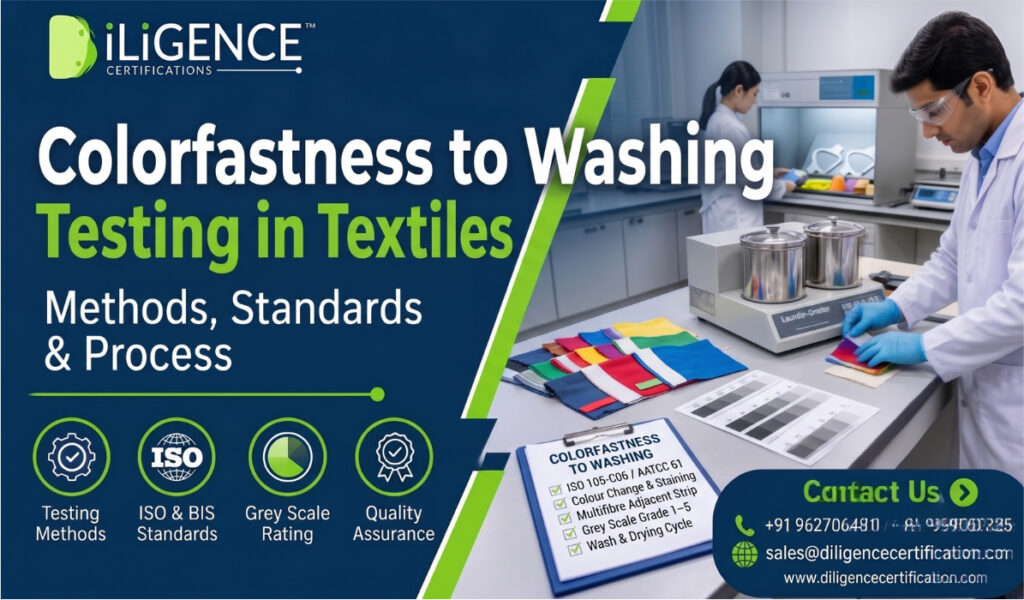
- Colorfastness to washing testing in textiles checks if a fabric keeps its colour after washing.
- It also checks if the dye leaves the fabric and stains other clothes washed with it.
- Results are given as grades from 1 to 5. Grade 5 is the best, grade 1 is the worst.
- ISO 105-C06 and AATCC 61 are two of the most used test methods. Your buyer usually decides which one to follow.
- Most failures come from weak dyeing, poor fixing or a wrong wash-off after dyeing.
- Test early, before bulk production. Fixing a problem after shipment is very costly.
Introduction
Think about a new red T-shirt. You throw it in the washing machine along with your white shirts. After the wash, everything is pink. The red shirt has become dull and the white ones are ruined. That is exactly the problem this test is made to catch, before the product reaches the customer.
For garment makers, exporters and fabric mills, colour quality is not a small thing. A single wash complaint can lead to returns, claims and a bad name with the buyer. That is why colorfastness to washing testing in textiles is one of the most common tests asked in every sourcing order.
In this guide, we will keep things simple. You will learn what the test is, how it is done, how results are read and what you can do to pass without stress.
What Is Colorfastness to Washing Testing in Textiles?
Colorfastness means the ability of a coloured textile to hold its colour when it faces something that can make it fade or bleed. In this case, that something is washing.
The lab takes a small sample of your fabric, washes it under controlled conditions and then checks two things:
- Colour change: Did the sample lose shade or look duller than before?
- Staining: Did the dye come out and colour the white fabric kept next to it?
The washing is done in a special machine with soap or detergent, a fixed temperature and a fixed time. The idea is to copy many home washes in a short time, so you get a fair answer in a few hours.
Why Is This Test Important?
- Customer happiness: Nobody wants a shirt that fades in two washes.
- Buyer approval: Most brands and retailers ask for a washing fastness report before placing an order.
- Export orders: Many overseas buyers will not accept a lot without a valid report.
- Fewer returns and claims: A good result early saves money later.
- Brand name: Good colour quality builds trust over time.
- Process control: The result tells your dyeing house if the dye, chemicals and process are working properly.
Which Standards Are Used?
There is no single test used everywhere. Different buyers and countries follow different methods. Here are the common ones.
| Standard | What it covers | Where it is mostly used |
|---|---|---|
| ISO 105-C06 | Colour fastness to domestic and commercial laundering | Widely used for exports to Europe and many other markets |
| AATCC 61 | Colour fastness to laundering, accelerated test | Common for buyers in the USA and for many global brands |
| ISO 105-A02 | Grey scale for judging colour change | Used with the wash test for grading |
| ISO 105-A03 | Grey scale for judging staining | Used with the wash test for grading |
A simple example: if your buyer in Europe asks for a wash fastness report, the lab will usually follow ISO 105-C06. If the buyer is a US brand, they may ask for AATCC 61. Always check the exact method, temperature condition and edition in your buyer’s order sheet. Standards get revised from time to time, so confirm the latest version with your lab before sending samples.
What Is Tested and How Is It Graded?
After washing, the lab compares the washed sample with the original one and the stained white fabric with a fresh white piece. For this, grey scales are used.
| Check | Scale used | What the lab looks at |
|---|---|---|
| Colour change | Grey scale for colour change | How much the sample has faded or changed shade |
| Staining | Grey scale for staining | How much colour has moved to the white fabric |
The grades are easy to understand:
- Grade 5: No change at all. Excellent.
- Grade 4: Very slight change. Good.
- Grade 3: Visible change. Average, often the lowest limit many buyers accept.
- Grade 2 and 1: Big change or heavy staining. Poor.
Half grades like 3-4 or 4-5 are also used. Most buyers ask for grade 4 or above for staining and grade 3-4 or above for colour change, but the exact limit is set by your buyer, so always check the order requirement.
The judging is done by trained people under proper light, usually in a standard light cabinet. This avoids mistakes caused by a dim room or yellow bulbs.
Understanding the Adjacent Fabric
During the test, a special white fabric is stitched along with your sample. It is called an adjacent fabric or multifibre fabric. It has strips of different fibres like cotton, nylon, polyester, acrylic, wool and acetate.
Why so many fibres? Because dyes behave differently on different fibres. A dye that does not stain cotton may stain nylon badly. The multifibre strip shows exactly where the bleeding is happening.
If your fabric is a blend, the lab may use the right type of adjacent fabric for that blend. Share the fibre content clearly so the lab picks the correct one.
Step-by-Step Test Process
The exact steps depend on the method. But in simple words, this is how it goes in most labs.
- Sample submission: You send the fabric or garment piece with details like fibre, colour and the test method required.
- Sample cutting: The lab cuts a small piece, usually around 10 cm by 4 cm.
- Stitching: The piece is stitched to the multifibre fabric on one side.
- Solution preparation: A detergent solution is made as per the standard.
- Loading: The stitched sample goes in a steel container with the solution. Steel balls are added in some methods to create the rubbing effect of a real wash.
- Washing: The container is rotated in a wash machine at the set temperature and time.
- Rinsing: The sample is rinsed in water, as the standard says.
- Drying: It is dried in air or at a limited temperature. The stitch is removed only as the method allows.
- Grading and report: The lab compares the sample using the grey scales and issues the report with grades.
Two Common Test Setups
You will often hear about mild and severe test conditions. A mild condition uses a lower temperature and fewer steel balls. It is meant for delicate fabrics like silk or wool. A severe condition uses a higher temperature and is used for items like cotton workwear or hospital linen that go through hot washes.
In simple terms, the temperature and time should match how the final product will really be washed. Testing a hot-washed bedsheet under a very mild condition will give you a false sense of safety.
How Long Does It Take?
The actual washing takes only a short time, often around 30 to 45 minutes per test. But drying, grading, report writing and sample queue add to it. In most cases, a report comes in a few working days. If you need it faster, ask the lab about urgent service early.
Cost of Testing
There is no fixed price for everyone. The cost depends on a few things:
- The test method chosen
- Number of colours and samples
- Whether you need one wash or multiple wash cycles
- Whether you want colour change and staining both
- Urgent or normal turnaround
- Whether the report is for a single buyer format
The best way is to send your requirement and ask the lab for a clear breakup before you confirm.
Common Reasons for Failure
Here are the problems we see again and again, and how to fix them.
| Problem | Why it happens | Easy fix |
|---|---|---|
| Heavy staining on cotton or nylon | Loose dye left on fabric | Do a proper wash-off and soaping after dyeing |
| Dull shade after wash | Poor dye fixing | Use the right fixing agent and follow the recipe |
| Dark shades failing | Too much dye on the fabric | Check dye amount and wash-off time |
| Reactive dye bleeding | Hydrolysed dye not removed | Increase hot wash and rinse steps |
| Blend fabric failing | Wrong dye class for one fibre | Use suitable dyes for each fibre in the blend |
| Random results between lots | Process not controlled | Fix temperature, time and chemicals in a written standard |
Common Mistakes to Avoid
- Testing only after the whole lot is ready.
- Sending an unclear sample without fibre or colour details.
- Not checking which method the buyer wants.
- Assuming one good result will be true for all shades.
- Skipping the final soaping after dyeing.
- Testing a light shade and using that result for dark shades of the same fabric.
- Ignoring the wash instructions printed on the care label.
- Keeping no record of dye recipes and process settings.
Tips to Pass in the First Attempt
- Do a small in-house check before sending to the lab.
- Keep dye lots and process records ready.
- Test the darkest and the brightest shades first, they are the risky ones.
- Make sure the fabric is fully washed off and dried before sampling.
- Choose dyes that suit the fibre and the end use.
- Share the buyer’s requirement sheet with the lab.
- Always test a sample from the real production lot, not just a lab dip.
- If a test fails, find the cause in the process before you test again.
Who Needs This Test?
- Garment manufacturers who make T-shirts, shirts, denim, kidswear and uniforms.
- Fabric mills and dyeing units who want to control quality before sending cloth.
- Exporters who must meet buyer and market requirements.
- Importers and traders who want to check a supplier’s quality.
- Private label brands who sell under their own name and carry the risk.
- Home textile makers of bedsheets, towels, curtains and cushion covers.
BIS Standards for Colorfastness to Washing in India
If you sell in India, BIS (Bureau of Indian Standards) is the name you will hear most. Here is the simple picture.
BIS has its own Indian Standards for colour fastness testing. Some of them are old and some are new, so always check the status before you quote one in a report. These are the ones people usually come across:
| Indian Standard | What it covers | Good to know |
|---|---|---|
| IS/ISO 105-C06 | Colour fastness to domestic and commercial laundering | Used as the wash test method in newer BIS product standards. The older 1994 edition is shown as withdrawn, so check the edition your product standard names. |
| IS/ISO 105-C10:2006 | Colour fastness to washing with soap or soap and soda | Replaced the older IS 687 test |
| IS 687:1979 | Washing fastness, Test 1 | Withdrawn by BIS |
| IS 3361:1979 | Washing fastness, Test 2 | Older method, still listed in BIS records |
| IS 12646:1991 | Colour fastness ratings, specification | Explains how grades are rated |
| IS 768:1982 and IS 769:1982 | Evaluating change in colour and staining | Used for grading with the grey scales |
| IS/ISO 105-A02 | Grey scale for assessing change in colour | Used to give the grade 1 to 5 |
A simple example: the BIS standard for polyester fibre filled pillows (IS 18930:2024) asks for washing fastness of grade 4 or better, for both colour change and staining, on dyed fabric. The test method it points to is IS/ISO 105-C06. So the wash test in this blog is exactly what a BIS lab would run for that product.
An important point. Colorfastness to washing is a test method, not a separate BIS certificate. It becomes a requirement only when the product standard for your item asks for it. Not every textile or garment needs BIS certification, so first check if your product falls under a BIS standard or a Quality Control Order. If it does, the lab will test your fabric as per that standard and its limits.
Things to keep in mind before you test for BIS:
- Find the exact product standard for your item and read its colour fastness table.
- Note the grade needed, the method named and the edition mentioned.
- Ask for a BIS-recognised lab if your registration or licence needs it.
- Test dyed fabric from the real production lot, not just a lab dip.
- Standards get revised, so confirm the latest edition on the BIS website before sending samples.
Why Choose Diligence Certifications for colorfastness to washing testing in textiles Certification?
Testing rules and buyer needs can be confusing, especially for a new business. At Diligence Certifications, we help you understand which test applies to your product and what you need to keep ready before you approach a lab.
Here is how we can support you:
- Understanding which method your buyer or market is likely to ask for
- Guidance on sample details, documents and records
- Coordination with testing labs so the process stays clear
- Help in reading the report and planning the next steps
- Support on related textile testing and compliance services
No one can promise a pass or approval, because the result always depends on your product. But with the right preparation, you save time and avoid repeat testing.
Conclusion
Colorfastness to washing testing in textiles is a small test with a big impact. It protects your customer, your brand and your order.
Start early. Know your buyer’s method. Keep your dyeing process clean and recorded. If you do these three things, most of the stress goes away.
If you are not sure which test suits your fabric, talk to an expert before you send samples. A short call today can save you a full lot tomorrow.
Frequently Asked Questions
1. What is colorfastness to washing?
It is how well a fabric holds its colour and avoids staining other fabrics when washed.
2. Which standard is used for this test?
ISO 105-C06 and AATCC 61 are among the most common. Your buyer decides which one to follow.
3. What is a good grade in this test?
Grade 4 or above is generally seen as good. Many buyers accept a minimum of grade 3 to 3-4 for colour change, but check your order.
4. What do grades 1 to 5 mean?
Grade 5 means no change and grade 1 means very heavy change or staining.
5. What is a multifibre fabric?
It is a white strip made of different fibres, used to show which fibre the dye stains.
6. Can I test a finished garment?
Yes. A small piece can be cut from the garment, though fabric testing before cutting is better.
7. Does the test need to be done for every colour?
Usually yes, or at least for the risky shades like dark, bright and reactive dyed colours.