



 BIS Certification
 CDSCO
CDSCO
 CPCB
CPCB
 LMPC
LMPC
 WPC Approval
 Global Approvals
 TEC
TEC
 ARAI
ARAI
 BEE
BEE
 ISO Certification
 DGCA Certification
 NOC For Steel
 APEDA Registration










 Business Registration
 FSSAI Mark Certification










 Legal Services
 Trademark Registration
 Copyright Registration
 Patent Registration
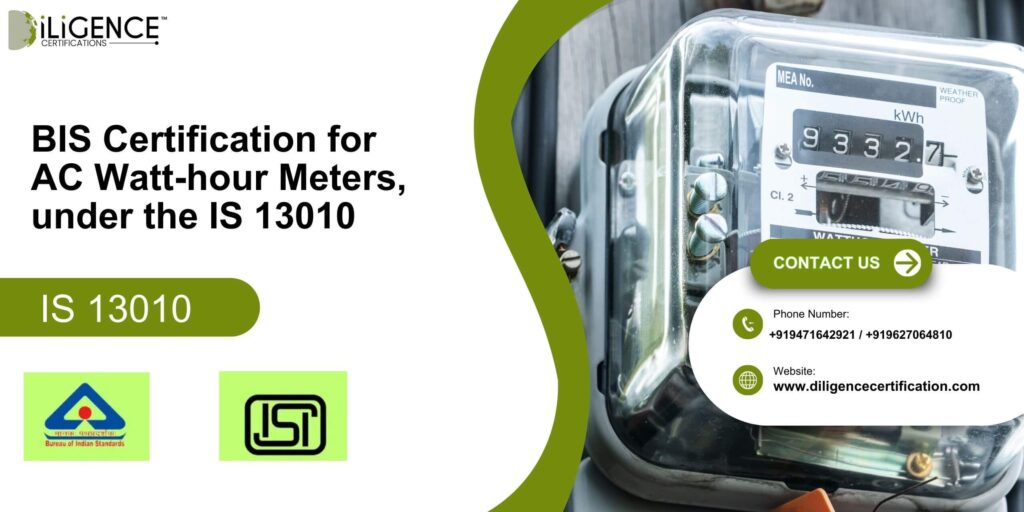
- Standard and Compliance – IS 13010 shows that types of AC watt hour meters (Class 0.5, 1 and 2) meet the related standards of accuracy and safety.
- Accuracy Classes – Class 0.5 indicates highly accurate (industrial applications), Class 1 means reasonably accurate (residential/commercial applications), Class 2 means reasonable accuracy when ultra-accuracy of performance isn’t the priority.
- Certification Process – which includes testing the product, inspection of factory, approval to a license, and periodic audits by BIS.
- Consumer Benefits – fair and reasonable billing, reliable performance, safety for a longer time.
- Manufacturer Benefits – legal compliance, market access, consumer confidence, and the ability to remain competitive in the marketplace.

What is BIS Certification for AC Watt-hour Meters, Class 0.5
BIS Certification for AC Watt-hour Meters, Class 0.5 means the energy meters are tested and certified by the Bureau of Indian Standards as conforming to Indian Standard IS 13010.
- Class 0.5 signifies an extremely accurate meter. These meters are utilized for industrial and commercial purposes and thus when there is even a small error in measuring the amount of electricity used, the error, in terms of costs, can be substantial.
- All the meters are lab tested, factory inspected, and quality assured, so that the meters are being used in a safe, reliable and accurate manner.
- Once certified, the manufacturer is permitted to place the ISI mark on the meter, which guarantees the consumer and the utility that the meter is tested to function accurately and reliably according to the standards.
Why BIS Certification is Mandatory for AC Watt-hour Meters, Class 0.5
- High Accuracy is Required – Class 0.5 meters are widely used in commercial and industrial applications, and even minor errors in billing can have serious financial implications for everyone, necessitating certification.
- Consumer protection and Utility protection – Certification protects tremendous losses for electricity boards and utilities consumers bill accurately and fairly with the least financial loss.
- Standardization and Quality Control – The BIS certification as per IS 13010 guarantees all meters have the same performance, safety, and longevity.
- Legal and Regulatory Compliance – For critical components, the government mandates BIS compliance so all meters are the same with regard to distribution and billing related to energy used.
- Trust and Marketable – Certified meters confer trust on the consumer, where certified meters are eligible for government tenders and have universal acceptance in the market.
Understanding IS 13010: The Standard for AC Watt-hour Meters
IS 13010 details specifications for construction, type tests, accuracy tests, and accuracy requirements for induction-type and static AC Watt-hour meters, Classifications of 0.5, 1, and 2.
To facilitate the communication of details, here is a summary.

The Scope of IS 13010:
- Relates to the use of induction-type and static AC Watt-hour meters for measuring electrical energy.
- These meters include single-phase and polyphase meters.
- Accuracy classes of 0.5, 1, and 2, with class 0.5 for the highest accuracy.
AC Watthour Meters – Accuracy Classes:
- Class 0.5: Very high accuracy, used for industrial and commercial applications where the electrical load requires accuracy down to thousandths of a kWh.
- Class 1: Accuracy adequate for general commercial and residential billing.
- Class 2: Sufficient accuracy employed when ultra-accuracy is not a necessary design requirement, having acceptable operational reliability.
AC Watt-hour Meters – Type Tests:
- The meter’s power consumption
- Starting and running characteristics
- Variation with frequency
- Effect of ambient temperature
- Effects of harmonics and magnetic fields
- Long-term reliability
These are all tests simulating real-world conditions to ensure the meters perform in an accurate manner under typical operating conditions.
Step-by-Step Process of BIS Certification for AC Watt-hour Meters

Receiving the BIS certification is in fact a very thorough process, but once you understand it as a process with steps, it will seem less daunting:
Application to BIS
Manufacturers need to begin with the application to the BIS, by filling out the application form, as well as information on their product, their manufacturing facilities and processes to ensure quality.
Product Testing
The meters need to be tested at BIS recognized laboratories and according to IS 13010. This is the phase where meters will be tested to show they can meet all relevant performance and safety requirements.
Factory Inspection
BIS officials will then conduct an inspection of the manufacturing factory to check that it has the capability to manufacture the product, the quality control systems in place, and ultimately that it meets the relevant standards.
License Issuance
Once manufacturers pass the two stages of inspection and testing, the BIS will issue them a license to use the ISI mark on their product.
License Renewal and Surveillance
Certifications are dynamic and not a one and done process. The BIS will conduct regular surveillance
Benefits of BIS Certification for AC Watt-hour Meters
- Accuracy and Trustworthiness – Guarantees that energy measured from the meter accurately balances with energy that the consumer is responsible for paying, meaning less disputes on billing.
- Protection for the public – Protects the public from being overcharged and undercharged and protects the public’s interest.
- Protection for your business – Protects your business from the legal implications of inaccurate meters – fines and penalties imposed by the governments are costly and put your business under substantial risk.
- Acceptance in the Market – Certificates from the BIS create trust and assurance that the meter is accepted by government bidding and tenders.
- Reputation and Credibility – Helps to improve a manufacturer’s established reputation and consumer confidence.
- Safety – The meters provided with BIS certifications are tested and evaluated to confirm satisfaction of established safety standards and conditions which reduces likelihood of meter failures and safety conditions.
- Durability – BIS certifies the meters for their durability, meaning they will provide safe and dependable service over time.
Key Highlights of BIS Certification for WHMC
- Adherence to IS 13010 – Separates acceptable performance from premium quality meters that meet Indian requirements for accuracy, safety, and performance.
- Accuracy Classes Assigned – Includes express Class 0.5 (high accuracy), Class 1 (standard), and Class 2 (acceptable tolerances).
- Testing and Evaluation – Rates of meters for laboratory load and performance capability on frequency/voltage variations, ambient conditions, harmonics, and long QA period tests.
- Factory Inspection and Audit – The Bureau of Indian Standards will perform physical inspections to verify manufacture and documentation for quality assurance standards.
- ISI Mark – Authorized meters may carry the ISI mark demonstrating trust, reliability, and government acceptance of standards.
- Periodic Audits – Procedures in place for periodic audits to perform continued compliance with Bureau of Indian Standards.
- Benefits to stakeholders – Outcomes of BIS methods include accurate billing for utilities, protecting revenue for utilities, and constructing confidence for manufacturers in the market.
Timelines, Costs, Validity & Renewal
- Timing: 4 – 8 weeks (depends on paperwork/testing/inspection);
- Costs: application + testing costs + annual fee;
- Validity: 1 year
- Renewal: yearly renewal needed with material submitted with fees each year, but assumes inspection/yearly.
Why choose Diligence Certifications
1. We Are Experts in BIS Compliance
- Diligence Certification specializes in BIS certification processes. We take care of all the tests, inspections, and documents correctly.
- Minimize chances of non-compliance or delays in the certification process.
2. Efficient Application Process
We provide a full-service experience that includes:
- Form submission
- Document preparation
- Sample testing
- Factory inspection
3. Save Time and Money
- We make sure you don’t incur delays from re-submitting documents or tests due to non-compliance.
- We work to minimize your time to a certification license from the day you submit your application.
4. Advisory Service in Quality and Compliance
- Although we can provide reassurance to our clients that AWHM is always operating all products for IS 13010 standards works in conjunction with advising our clients on QMS systems and the set up of a laboratory in compliance with IS standards.
5. Support After Certification
- We provide support for license renewal, refurbishment inspection, and ongoing compliance.
- We take the hassle out of keeping your ISI license valid.
Conclusion
The BIS Certification for AC Watt-hour meters listed under IS 13010 guarantees that the meters are reliable, accurate, and safe to use for both consumers and electricity suppliers. Additionally, it helps to ensure that the meter performance is similar amongst manufacturers, enhances consumer confidence in the meter, helps with capacity for regulatory claims, and enhances the progressive transparency and fairness of electricity billing processes. The process to attain a BIS Certification requires testing in a laboratory setting, understanding the extent of documentation required, and continuing factory inspections – it is an indication of bias of a manufacturer’s commitment to reliability and quality. That commitment is good for long term use of the meter while protecting continued consumer confidence.
Frequently Asked Questions
What is BIS Certification for AC Watt-hour Meters?
This refers to the certification process which states the AC Watt-hour Meters comply with the IS 13010 which is Indian Standard as to quality, performance, and most importantly accuracy. Any meters that have undergone this process can bear the ISI or Indian Standards Institute Mark, thus providing users assurance that the readings are accurate.
Why is BIS Certification important for Class 0.5 energy meters?
Class 0.5 energy meters are in commercial and industrial utilization so any margin of error incurs a financial impact to the utility. This is why a BIS Certification that is independent from the manufacturer is important to make sure that the measurement of the energy accounts are accurate, and protects the customer, as well as meeting standard for industry.
What does Class 0.5 mean in relation to classification and accuracy for energy meters?
Class 0.5 refers to the accuracy being exceptional and the classification stating the margin for error is ± 0.5%. Class 0.5 energy meters are effective for use in energy measurement for industrial and commercial applications and other meters needing accuracy.
What is the Indian Standard for AC Watt-hour Meters?
The Indian Standard the is IS13010, and this refers to the requirement for construction, criteria for type tests, performance standards and overall accuracy of the AC Watt
What are the primary accuracy classifications under IS 13010?
Class 0.5: High accuracy (Industrial/commercial).
Class 1: Standard accuracy (Residential/commercial).
Class 2: Acceptable accuracy (where ultra-precision is not critical).
What tests are performed when obtaining BIS Certification?
Meters are tested in laboratories for attributes such as power consumption, starting and running performance, effects of temperature, frequency, harmonics, magnetic field, and long-term capability tests.
What is the process to obtain BIS Certification?
The certification process includes submitting an application package, testing the product in a BIS recognized laboratory, a factory inspection, issuing a license, and a periodic inspection for compliance.
8. How long will it take to get BIS Certification for energy meters?
The entire duration for getting certified is approximately 4–8 weeks, depending on testing, inspection, and documentation readiness.
How long is BIS Certification valid for, and how is it renewed?
The certification is valid for 1 year and continues for the subsequent year if documentation has been received, fees are submitted, and inspection has been completed stressing the importance of periodic documentation.
What do manufacturers and consumers get from BIS Certification?
For consumers - Fair billing, accurate metering, and safety assurance
For manufacturers - Legal compliance, access to market, eligibility in bidding, confidence among consumers, and competitive advantage.