

 BIS Certification
 CDSCO
CDSCO
 CPCB
CPCB
 LMPC
LMPC
 WPC Approval
 Global Approvals
 TEC
TEC
 ARAI
ARAI
 BEE
BEE
 ISO Certification
 DGCA Certification
 NOC For Steel
 APEDA Registration













 Business Registration
 FSSAI Mark Certification











 Legal Services
 Trademark Registration
 Copyright Registration
 Patent Registration
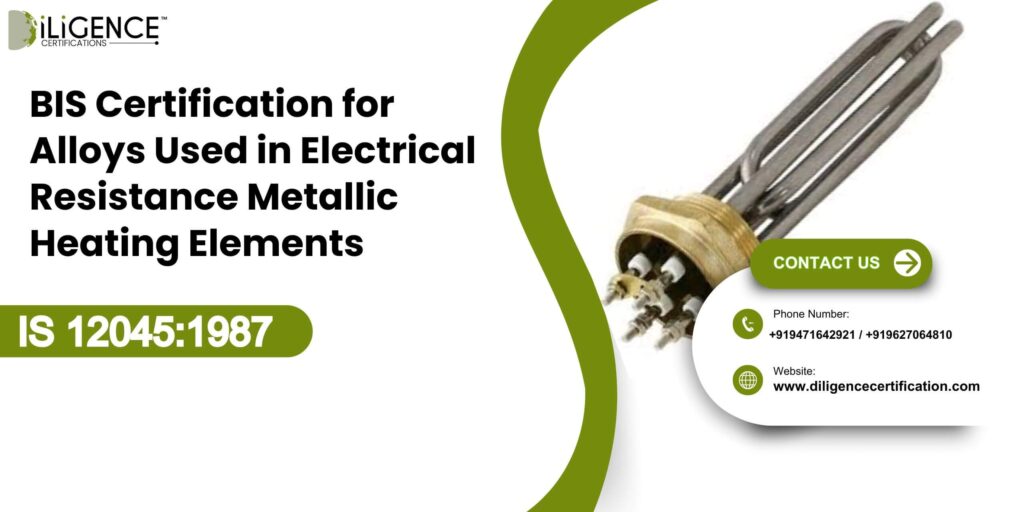
- Ensures the resistance of Alloys Used in Electrical standards.
- Mandatory for manufacturers, importers & OEMs using heating-element alloys in India.
- Requires factory inspection, independent lab testing & quality documentation.
- Helps companies get OEM contracts, government tenders & export credibility.
- Facilities with stable composition control and proper heat-treatment get faster approval.
Introduction
One of the oxygen electric nationalizing element factory manufacturer in Pune civilian a heating elements based on component idea loss of the resistance side of the wire consecutively series of IS 12045:1987 steps by the most important OEM spontaneously that took them the contract never the Quality of their production stayed the same but now the buyer accepted only materials that are BIS-approved to avoid variation in resistivity and long-term heat stability. Similar changes are happening everywhere in the range of appliance brands, industrial heater suppliers, and furnace manufacturers. As quality control orders tighten, uncertified Alloys Used in Electrical are increasingly being pointed out during vendor audits. Bureau of Indian Standards
What is IS 12045:1987?
IS 12045:1987 is an India Standard that outlines the technical requirements of the alloys that are used in electrical resistance metallic heating elements. It details the attributes of the alloy when exposed to high temperatures, repeated heating cycles and extended periods of service. The standard is aimed at ensuring that the material exhibits electrical resistivity that is predictable, mechanical properties that are stable, and oxidation behaviour that is reliable- these being the factors that are the most important for the safe and trouble-free function of the heating elements.
Key points:

- Covers resistance alloys such as Ni-Cr and Fe-Cr-Al in wire, strip, and ribbon form
- Defines limits for chemical composition, resistivity, and temperature coefficient of resistance
- Specifies mechanical properties such as tensile strength and elongation
- Includes provisions for oxidation resistance and thermal stability over long periods of time
- Forms the technical basis for BIS Certification for heating element alloys in India. ISI MARK
Why is BIS Certification Mandatory
BIS Certification is mandatory for that part of the metal base used for making electrical heating elements, i.e., resistance alloys covered by IS 12045:1987. These are the materials that have a direct impact on the safety, the life span, and the performance of the heating elements and thus, have to be of the highest quality. In case the main alloy is not uniform, a small change in the resistivity or the composition can result in a situation where the element will overheat, break down within a very short time, or an electrical hazard will occur.
Key reasons why it is mandatory:
- Ensures uniform resistivity and high-temperature performance across all batches
- Prevents substandard or unsafe alloys from entering industrial and consumer supply chains
- Aligns Indian manufacturers with quality benchmarks demanded by major appliance and industrial OEMs
- Supports traceability and accountability through periodic audits and surveillance
- Strengthens domestic industry standards while reducing dependency on uncertified imports
Importance and Benefits of BIS Certification
| Importance | Benefits |
| Ensures alloys meet defined safety and performance standards | Improves product reliability and reduces failure rates |
| Prevents uncertified or low-quality materials from entering the market | Enhances customer trust and acceptance by major OEMs |
| Supports regulatory compliance under mandatory Quality Control Orders | Enables participation in government tenders and regulated sectors |
| Maintains consistency in resistivity, composition, and thermal behaviour | Provides pricing leverage due to verified quality |
| Strengthens manufacturing discipline through audits and traceability | Boosts export credibility and eases global approvals |
Step-by-Step Process of BIS Certification

Step1:Documentation
- Collect required technical documents
- Prepare product specifications
- Gather company registration details
- Ensure documents follow BIS format
Step2:Product Testing
- Send samples to a BIS-approved lab
- Conduct safety and quality tests
- Receive test reports
- Confirm compliance with BIS standards
Step3:Application Submission
- Fill out the BIS application form
- Upload all required documents
- Attach valid test reports
- Pay the necessary BIS fees
Step4:Scrutiny and Inspection
- BIS reviews submitted documents
- Authority verifies test results
- Factory/product inspection may occur
- Clarifications requested if needed
Step5:Grant of License
- BIS approves the application
- License number is issued
- Product can carry BIS mark
- Renewal required before expiry
Documents Required for BIS Certification
| Category | Documents Required |
| Business Documents | Business license/registration, ISO certificate, organizational details |
| Manufacturer Details | Factory layout, process flow chart, machinery list, production details |
| Product Documents | Product specifications, component list, user manual, model details |
| Testing Documents | Test report from BIS-recognized lab, sample details, test request form |
| Legal & Compliance | Authorization letter, brand ownership proof, trademark certificate (if any) |
| Import/Foreign Manufacturer (If applicable) | AIR (Authorized Indian Representative) details, contract agreement, overseas manufacturer documents |
Timelines, Costs, Validity & Renewal
- Timelines: Usually from 20 to 30 days, with only 7-15 days for the testing.
- Costs: The cost of the government and the test varies depending on the product. There can be some additional charges though.
- Validity: The validity period is 2 years in most situations.
- Renewal: The renewal is done before the expiration; there should be updated documents/tests; the renewal
Why Choose Diligence Certifications
- Expert team with strong BIS and regulatory knowledge
- Fast, streamlined processing to reduce approval delays
- Accurate documentation and testing coordination
- Transparent guidance with clear communication
- High success rate and complete end-to-end support
Conclusion
Today, producers of resistance alloys are facing a market where supply of safe, consistent and traceable products is the main condition for seller’s eligibility. Obtaining BIS Certification for Alloys Used in Electrical Resistance Metallic Heating Elements IS 12045:1987 is a step towards confirming that every batch is in line with the technical requirements of OEMs, standardization bodies and export clients. It diminishes the chances of failures, makes vendor qualification easier and increases the company’s market credibility over time. Early compliance turned out to be a real leverage for businesses willing to grow or enter regulated sectors.
Frequently Ask Questions
What Is IS 12045:1987?
This standard is an Indian standard, which describes the technical conditions of the electrically resistant alloys that are used for metallic heating elements.
Why Must BIS Certification Be Done for Resistance Alloys?
As the safety, performance, and quality of the heating elements that are most important, and are directly related to these alloys, it is only logical that certification be mandatory in compliance with Government Quality Control Orders.
Which Materials Are Under IS 12045:1987?
Nickel-chromium, iron-chromium-aluminum, and other resistance alloys in rod, wire, strip, and ribbon forms.
Who Needs To Get BIS Certification Under This Standard?
Manufacturers, importers, and OEM suppliers of resistance heating element alloys, who are engaged in related activities, need BIS certification.
What Properties Are Tested During BIS evaluation?
The major concern is on the chemical composition, electrical resistivity, tensile strength, oxidation resistance, and thermal stability.
How Long Does The BIS Certification Process Takes?
The entire process is usually between 20 and 30 days. This time window also includes 7-15 days for laboratory testing.
Does BIS Conduct Factory Inspections?
BIS also has factory inspections. BIS, for example, confirms production, heat treatment control, and quality systems during these visits.
What are the Required Documents for Certification?
The most important documents to get the certification are business documents, manufacturing details, product specifications, test reports, and compliance records.
How Long Is The BIS License Valid?
The license is valid for 2 years in most cases.
What Are The Benefits Of BIS Certification For Resistance Alloys?
The quality certification makes the performer more reliable, is a very important factor for OEM approvals, allows participation in government tenders, and makes exports easier by increasing the trust of foreign buyers.