



 BIS Certification
 CDSCO
CDSCO
 CPCB
CPCB
 LMPC
LMPC
 WPC Approval
 Global Approvals
 TEC
TEC
 ARAI
ARAI
 BEE
BEE
 ISO Certification
 DGCA Certification
 NOC For Steel
 APEDA Registration












 Business Registration
 FSSAI Mark Certification









 Legal Services
 Trademark Registration
 Copyright Registration
 Patent Registration
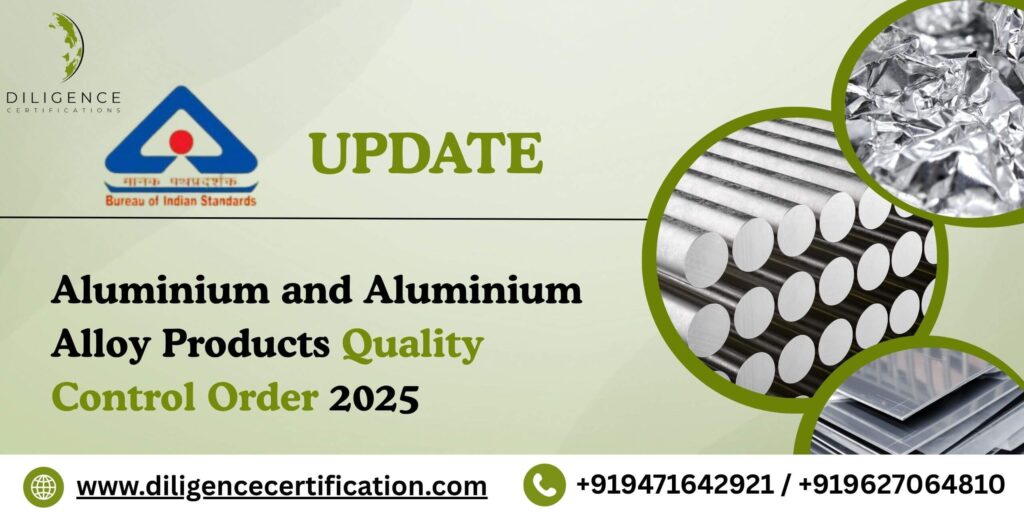
- The Aluminium Alloy Products QCO 2025 mandates BIS certification for key aluminium products in India.
- It aims to eliminate substandard imports, enhance domestic manufacturing, and ensure end-use safety.
- Compliance becomes mandatory from 1st October 2025, with serious implications for non-compliance.
Introduction
In a major regulatory step taken in India to enhance quality compliance in its substantial metal industry, the Ministry of Commerce and Industry, through the DPIIT, announced the Aluminium Alloy Products QCO 2025. This new QCO, dated 5th May 2025, shall come into force from 1st October 2025, directing BIS certification to be mandatory for many aluminium and aluminium alloy products.
The aluminium alloy product quality control order 2025 is basically for ensuring that aluminium and aluminium alloy products conform to Indian Standards, particularly structural reliability, performance, safety, and durability. These products are of great use in infrastructure, electrical systems, transport, consumer goods, packing, and many more. With India striving for Atmanirbhar Bharat and export standards, the step is presently in line with global-quality standards and consumer safety expectations.
The aluminium alloy product QCO 2025 mandates that both domestic manufacturers as well as importers comply with relevant IS codes and obtain BIS certification before offering such products in the Indian market. Violations could attract seizure of products, penalties, or outright prohibition on sales.
What is the Aluminium and Aluminium Alloy Product QCO 2025?

The Aluminium and Aluminium Alloy Products QCO 2025, is a regulation aimed at ensuring that aluminium products are of a certain quality standard. The step is a part of the overall initiative of the government to improve product safety, increase consumer confidence, and bring domestic manufacturing up to international quality standards.
Major Aims:
- Standardisation: Provide standardised quality in aluminium and aluminium alloy products.
- Consumer Safety: Ensure the safety of consumers from poor-quality products.
- Market Competitiveness: Improve the international competitiveness of Indian aluminium products.
- Environmental Compliance: Encourage eco-friendly production practices.
Scope and Applicability of Aluminium QCO 2025
The order applies to manufacturers, importers, and sellers of the mentioned aluminium and aluminium alloy products. Compliance is required for the following categories:
- Manufacturers: Organisations producing aluminium and aluminium alloy products in India.
- Importers: Organisations importing specified products into India.
- Sellers: Organisations dealing in the distribution and sale of these products.
Exemptions:
Products being exported.
- Products being used for research and development purposes.
- Goods produced by micro and small businesses, with time limits for compliance pushed to January 1, 2026, and April 1, 2026, respectively.
What Happened When BIS Rules Were Ignored
A Bengaluru-based auto parts company recently imported aluminium rods from China.
But when the shipment reached customs, it was blocked — the rods didn’t have BIS certifications under the new Aluminium Alloy Products.
The company lost over ₹3 lakhs in delays and penalties. Now, they only source from BIS-approved suppliers to stay compliant.
Products Covered Under the Order
The order specifies various aluminium and aluminium alloy products that must adhere to Indian Standards. Some of the key products include
For a comprehensive list of products and applicable standards, stakeholders are advised to consult the official notification.
To adhere to the Aluminium and Aluminium Alloy Products QCO 2025, the following must be done:
- Obtain BIS Certification: Guarantee that products meet the applicable Indian Standards and are certified by the Bureau of Indian Standards.
- Use of Standard Mark: Apply the Standard Mark on certified products, signifying compliance.
- Maintain Records: Maintain clear records of manufacturing, testing, and sales for inspection.
- Periodic Testing: Conduct periodic testing to ensure continued compliance with standards.
BIS Certification Compliance Timeline
The order stipulates the following compliance deadlines:
- General Manufacturers and Importers: October 1, 2025
- Small Enterprises: January 1, 2026
- Micro Enterprises: April 1, 2026
Entities must ensure compliance by the specified dates to avoid penalties and disruptions in operations.
What Happens If You Don’t Comply with BIS Certification?
Failure to comply with to the Aluminum and Aluminium Alloy Products QCO 2025 may result in:
- Sale Prohibition: In the Indian market, it is illegal to sell or distribute non-conforming goods.
- Legal Action: Under the BIS Act of 2016, organizations may face legal action.
- Penalties: As required by law, fines and other penalties may be imposed.
- Reputational damage includes loss of market reputation and consumer disrepute.
Role of Diligence Certifications in Ensuring Compliance
Diligence Certification offers end-to-end support to entities seeking compliance with the Aluminium and Aluminium Alloy Products QCO 2025 . Our services include:
Consultation: Professional advice on understanding the requirements of the order.
Assistance with Documentation: Assist in creating and submitting documents required for certification.
Coordination of Testing: Enabling product testing through authorized labs.
Audit Preparation: Assist in getting ready for BIS inspections and audits.
Continuous Compliance Support: Consistent information and help keeping up with regulations.
Our team of professionals minimizes operational interruptions by ensuring an effortless and effective certification process.
BIS Certification Process for Aluminium Products

- Initial Consultation: Understand the specific requirements applicable to your products.
- Documentation Preparation: Compile necessary documents, including product specifications, manufacturing details, and quality control measures.
- Application Submission: Apply for BIS certification along with the required documents.
- Product Testing: Coordinate with accredited laboratories for product testing as per relevant Indian Standards.
- Factory Inspection: Prepare for and facilitate BIS inspections of manufacturing facilities.
- Certification Issuance: Obtain BIS certification upon successful completion of testing and inspection.
- Standard Mark Usage: Begin affixing the Standard Mark on certified products.
- Ongoing Compliance: Regularly monitor and maintain compliance with standards, including periodic testing and record-keeping.
Without this certification, selling or importing aluminium products in India after 1st October 2025 will be illegal.
Conclusion
The implementation of aluminium alloy products QCO 2025 marks a major shift toward enforcement of quality, safety, and regulatory compliance within the metal and manufacturing-businesses of India. Clarity of message arises with the enforcement of the QCO from October 1, 2025: no aluminium or aluminium alloy product shall enter the Indian markets without BIS certification.
Whether you are manufacturing aluminium ingots, rods, foils, sheets, or a highly alloyed component, you will now have to seek BIS certification under the aluminium alloy products QCO 2025. This would mean, testing of your products, compliance with IS standards, submission of all correct documents, and factory audit successfully.
If you have a doubt as to what steps to be followed, what documentations are required, or whom to coordinate with in BIS, then you must rely on Diligence Certification. Our experts will help guide you in every last step from application through to approval to ensure a smooth error-free process. With that kind of guarantee, we are proud to say that we have helped hundreds of businesses achieve compliance with many BIS QCOs,
Frequently Asked Questions
Who needs to comply with Aluminium Alloy Products QCO 2025?
Any manufacturer or importer of aluminium products (rods, sheets etc.) must obtain BIS certification to be allowed to sell in India after October 2025.
Can foreign manufacturers apply for BIS certification?
Yes, foreign manufacturers can apply. However, they will first need to appoint an Authorized Indian Representative (AIR) and apply via the FMCS (Foreign Manufacturers Certification Scheme).
Is BIS certification a one-time process?
No, once "certified", manufacturers will need to renew their BIS licences after some time, and samples of their products will still be tested randomly after they are certified.
What happens if I miss the deadline in October 2025?
If you miss the deadline, your products will be either blocked at customs, or may be seized in local inspections, and you could face legal proceedings and heavy penalties.
Is Aluminium kitchen utensils part of this QCO?
No. This QCO is targeted at industrial products, not cooking or cooking utensils.
Why is the Aluminium Alloy Products QCO 2025 necessary?
The Aluminium Alloy Products QCO 2025 is in place to make sure companies are only using safe and high-quality aluminium products in industries like automotive and construction.
Is BIS certification necessary for imported aluminium products?
Yes, all aluminium products being imported into India must be BIS certified before importing into India or selling in India.
Who can apply for BIS certification?
Only the actual manufacturer—either Indian or foreign—can apply for the BIS certifcate. Traders and distributors cannot apply to commit products to a BIS certification
What are the implications for non-compliance?
Goods may be seized and up to ₹5 lakhs could be charged for selling un-certified products.
What is the last date of compliance?
Depending on your business, the deadline is the 1st of October 2025.