


 BIS Certification
 CDSCO
CDSCO
 CPCB
CPCB
 LMPC
LMPC
 WPC Approval
 Global Approvals
 TEC
TEC
 ARAI
ARAI
 BEE
BEE
 ISO Certification
 DGCA Certification
 NOC For Steel
 APEDA Registration












 Business Registration
 FSSAI Mark Certification










 Legal Services
 Trademark Registration
 Copyright Registration
 Patent Registration
- Mandatory Quality Compliance:BIS certification ensures the aluminium alloy redraw rods of the required quality, safety, and performance as per the specifications of the standard IS 9997:2023.
- Covers Electrical Grade Materials:The standard includes aluminium alloy redraw rods, which are used primarily in electrical conductors and cables, thereby providing high conductivity.
- Ensures Mechanical & Chemical Properties:The products must meet the required chemical composition, tensile strength, elongation, and resistivity.
- Third-Party Verification by BIS:Manufacturers must undergo testing, inspection, and surveillance by the Bureau of Indian Standards (BIS).
- Use of ISI Mark for Market Trust:BIS certification allows the aluminium alloy redraw rods to bear the ISI mark, thereby increasing the credibility of the product.
Introduction
Aluminium alloy redraw rods are widely employed as a primary raw material for manufacturing electrical conductors, cables, and wiring. The performance of aluminium alloy redraw rods directly influences the conductivity, durability, and efficiency of electrical devices. In order to maintain the quality and reliability of such devices, it is imperative to follow the standardized specifications. In this regard, the Bureau of Indian Standards (BIS) has formulated a standard titled ‘IS 9997:2023’ to define the specifications for aluminium alloy redraw rods. The standard specifies the chemical composition, mechanical properties, and performance of aluminium alloy redraw rods. The BIS certification for such raw materials ensures that the manufacturer is producing rods of the highest quality.
What is IS9997:2023?
IS 9997:2023 is an Indian Standard, and it is published by the Bureau of Indian Standards, commonly known as BIS. The standard provides detailed information about the requirements for aluminium alloy redraw rods, which are used in electrical works. The standard provides detailed guidelines so that the aluminium alloy redraw rods meet the necessary quality, safety, and performance requirements. The standard covers some of the following aspects: The chemical composition of aluminium alloy, the mechanical properties of aluminium alloy, and the electrical properties of aluminium alloy. The aluminium alloy redraw rods must meet the requirements of this standard. The aluminium alloy redraw rods must be used for manufacturing conductors and cables.
Key Points:
- Defines Product Specifications:The standard provides specific requirements for aluminium alloy redraw rods with respect to their size, dimensions, and tolerances, as per IS 9997:2023.
- Covers Chemical Composition:The standard covers the chemical composition limits of the product, including alloying elements, to ensure product consistency, strength, and conductivity.
- Specifies Mechanical Properties:The standard provides product specifications with respect to its mechanical properties, including tensile strength, elongation, etc.
- Ensures Electrical Performance:The standard provides product specifications with respect to its electrical properties, ensuring product suitability for use.
- Includes Testing & Quality Control Methods:The standard provides product testing and quality control methods.
Products Covered Under IS 9997 : 2023
IS 9997:2023 deals with aluminium alloy redraw rods, which are generally used as input material for producing electrical conductors and cables. Aluminium alloy redraw rods are made from aluminium alloys and are used for providing high electrical conductivity along with mechanical strength.Redraw rods are also available in coil form, which are then drawn into wires of smaller diameters. These wires are used for applications such as overhead transmission lines, cables, distribution, and winding wires.Redraw rods are also made from certain types of aluminium alloys used for electrical purposes and ensure that they meet certain requirements in terms of chemical composition, resistivity, tensile strength, and elongation.
Key Reasons:
- Aluminium Alloy Redraw Rods:The specification covers aluminium alloy redraw rods used for electrical purposes.
- Coiled Rod Forms:The specification covers rods available in coiled forms, which can be used for drawing wire of lower diameters.
- Raw Material for Conductors & Cables
- The rods can be used as raw material for the manufacture of conductors, cables, and wiring products.
- Applicable Alloy Grades:The specification covers aluminium alloy grades with suitable properties.
- Use in Power & Electrical Sector:The products can be used for transmission, distribution, and wiring in the power and electrical sector.
Importance and Benefits of BIS Certification
| Importance | Benefits |
| Mandatory Compliance with IS 9997:2023:Manufacturers have to adhere to all the specifications mentioned regarding the chemical, mechanical, and electrical properties. | Enhanced Product Quality:Guarantees superior performance, durability, and reliability of redraw rods. |
| BIS Certification Requirement:Manufacture and sale of the redraw rods are required to be certified, as applicable, in India. | Increased Market Trust:ISI marking instills trust among the consumers. |
| Factory Inspection & Testing:BIS carries out inspections of the factories, as well as testing of the products, to ensure the quality standards are being met. | Regulatory Compliance:Facilitates the smooth compliance of regulations. |
| Marking with ISI Label:Products have to bear the ISI marking, which ensures the products have complied with the Indian standards. | Better Market Opportunities:ISI marked products have better chances of getting contracts from the government or large businesses. |
| Continuous Surveillance:Regular audits and testing are conducted by BIS to maintain ongoing compliance. | Reduced Risk of Failures:ISI marking ensures the standard quality of the products, thus reducing the chances of failure. |
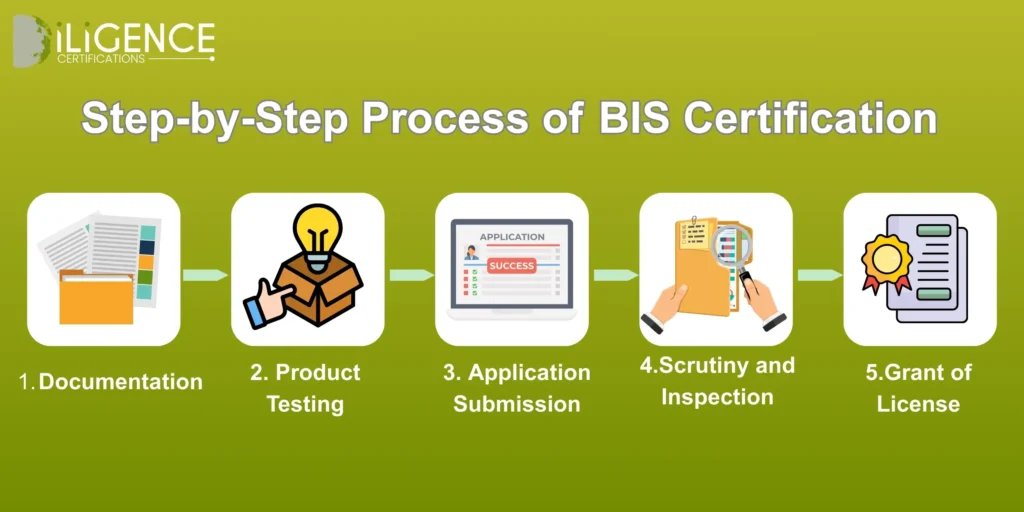
Step-by-Step Process of BIS Certification
Step1:Documentation
- Collect required technical documents
- Prepare product specifications
- Gather company registration details
- Ensure documents follow BIS format
Step2:Product Testing
- Send samples to a BIS-approved lab
- Conduct safety and quality tests
- Receive test reports
- Confirm compliance with BIS standards
Step3:Application Submission
- Fill out the BIS application form
- Upload all required documents
- Attach valid test reports
- Pay the necessary BIS fees
Step4:Scrutiny and Inspection
- BIS reviews submitted documents
- Authority verifies test results
- Factory/product inspection may occur
- Clarifications requested if needed
Step5:Grant of License
- BIS approves the application
- License number is issued
- Product can carry BIS mark
- Renewal required before expiry
Documents Required for BIS Certification
| Category | Documents Required |
| Business Documents | Business license/registration, ISO certificate, organizational details |
| Manufacturer Details | Factory layout, process flow chart, machinery list, production details |
| Product Documents | Product specifications, component list, user manual, model details |
| Testing Documents | Test report from BIS-recognized lab, sample details, test request form |
| Legal & Compliance | Authorization letter, brand ownership proof, trademark certificate (if any) |
| Import/Foreign Manufacturer (If applicable) | AIR (Authorized Indian Representative) details, contract agreement, overseas manufacturer documents |
Timelines, Costs, Validity & Renewal
- Timelines: Usually from 20 to 30 days, with only 7-15 days for the testing.
- Costs: The cost of the government and the test varies depending on the product. There can be some additional charges though.
- Validity: The validity period is 2 years in most situations.
- Renewal: The renewal is done before the expiration; there should be updated documents/tests; the renewal
Why Choose Diligence Certifications
Diligence Certifications is a renowned consultancy firm that specializes in providing BIS certification and compliance services to different industries. The organization is well-versed in providing services related to different Indian standards, such as IS 9997:2023. The organization ensures that manufacturers get hassle-free BIS certification services through their team of experts. The experts help clients through every step of the BIS certification process. The steps may involve preparing documents and filing applications, as well as conducting product testing and dealing with BIS authorities. The experts ensure that the BIS certification is obtained through a hassle-free and time-efficient way. Diligence Certifications is committed to providing high-quality services that are cost-effective and transparent to its clients.
Conclusion
A crucial part of ensuring the quality and safety of a product in the electrical industry is the BIS certification of aluminium alloy redraw rods according to IS 9997:2023. By adhering to this standard, the manufacturer can ensure that their product meets specific criteria in terms of chemical composition, mechanical strength, and electrical characteristics. By attaining BIS certification, the manufacturer is able to not only fulfill their responsibility as per regulations but is also able to increase their chances of gaining more business, especially in government contracts and large-scale business ventures.
Frequently Asked Questions (FAQs)
What is IS 9997:2023?
It is the Indian standard for aluminium alloy redraw rods used in the field of electricity.
Who needs BIS certification under this standard?
The manufacturer of aluminium alloy redraw rods.
What is the main use of redraw rods?
Redraw rods are used to manufacture electric wires, cables, and conductors.
Is BIS certification mandatory?
It may be mandatory under government notification.
What is the ISI mark?
It is a quality mark.
What tests are conducted under IS 9997:2023?
Chemical tests, mechanical tests, and electrical property tests.
How long does it take for BIS certification?
It takes weeks or even months for BIS certification, depending on the documentation and tests required.
Can foreign manufacturers apply for BIS certification?
Yes, foreign manufacturers can apply for BIS certification through the Foreign Manufacturer Certification Scheme (FMCS).
What are the activities undertaken after getting certification?
Surveillance and audits are carried out by BIS after certification.
Why is BIS certification significant?
It is significant because it helps in assessing the quality and safety of products.