



 BIS Certification
 CDSCO
CDSCO
 CPCB
CPCB
 LMPC
LMPC
 WPC Approval
 Global Approvals
 TEC
TEC
 ARAI
ARAI
 BEE
BEE
 ISO Certification
 DGCA Certification
 NOC For Steel
 APEDA Registration














 Business Registration
 FSSAI Mark Certification











 Legal Services
 Trademark Registration
 Copyright Registration
 Patent Registration
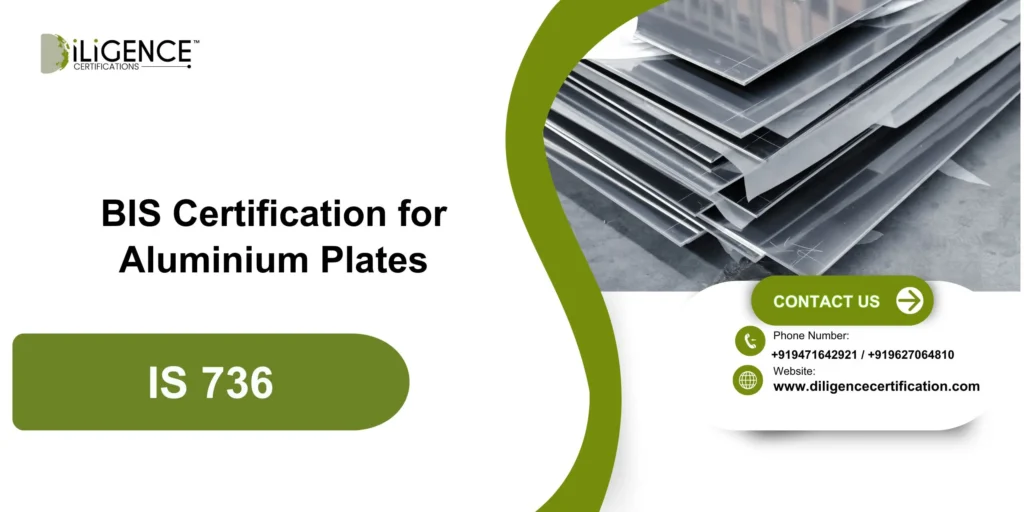
Ensures Compliance with IS 736: Aluminium plates with BIS certification are guaranteed to conform to the standards set for the chemical composition, mechanical properties, dimensional accuracy, and surface quality.
Compulsory ISI Mark for Manufacturers: It is only the producers holding a valid BIS licence that are allowed to sell aluminium plates in India with the ISI mark.
Enables the Metal to Last Longer and Work Better: Aluminium plates with a certification are the source of good metal through such features as corrosion resistance, mechanical stability, and long-term reliability in industrial and construction applications.
Organized Accreditation Scheme: The BIS scheme covers the following stages: documentation, product testing at accredited laboratories, factory inspection, scrutiny, and issuing of the licence.
Increases Consumer Confidence and Safety: Aluminium plates certified by BIS standards become brands that are trusted by the public, failure risk is lowered, regulatory compliance is ensured, and customer loyalty is enhanced.
Introduction
Aluminium and aluminium alloy plates have become popular materials in various type of industries that require a combination of lightweight, high strength and corrosion resistant. These are some of the most common types of usage for such: aviation components, building facades, vehicle parts, industrial equipment, and ship-building materials.
By different production methods which not only ensure the right alloy composition but also the dimensional accuracy, aluminium plates achieve high performance while still maintaining their toughness and strength. As these materials are usually subjected to extreme environments, compliance with IS 736 is needed to ensure safety, quality, and long service life.
Before aluminium plates are put on the Indian market, the Bureau of Indian Standards (BIS) through its inspection and certification process acts as a reference for industrial trust worthiness.
What Are Aluminium Plates – IS 736?
Aluminium Plates IS 736 is an Indian standard that outlines the technical requirements for aluminium and aluminium alloy plates. The standard specifies:
Chemical Composition – Makes sure of the correct aluminium alloying for strength, corrosion resistance, and general performance.
Mechanical Properties – Defines tensile strength, yield strength, and elongation for safe industrial use.
Dimensional Accuracy – Is a measure to check thickness, width, and tolerances for giving the exact application.
Surface Quality – The surfaces of the plates should not have any cracks, pits, or other defects.
Testing & Inspection Methods – Are the various stages in production that ensure the uniformity of quality across production batches.
Aluminium plates that meet IS 736 standards are a source of good performance, long life, and safety of operation in indispensable applications.
ISI Mark Certification for Aluminium Plates
Aluminium plates sold in India must have ISI Mark Certification under IS 736. Certification confirms that the product:
- Meets chemical and mechanical standards as per IS 736.
- Maintains dimensional accuracy for precise industrial applications.
- Exhibits consistent quality across production batches.
- Is thoroughly tested and inspected during manufacturing.
Only manufacturers with a valid BIS licence can affix the ISI mark on their aluminium plates.
Why Is BIS Certification Mandatory for Aluminium Plates?
Non-compliant aluminium plates are capable of causing:
- Corrosion becoming first visible or surface damage.
- Structural failure of industrial, marine, or construction applications.
- Increased costs of maintenance and replacement.
- Safety hazards for workers and end-users.
- Legal penalties or project rejection under regulated standards.
BIS certification is a surety of:
- Complete conformity with IS 736 standards.
- Great durability and rust resistance.
- Stable mechanical performance and dimensional accuracy.
- Acceptance of the product in the market and compliance with regulations.
- Better relationship and trust with customers, engineers and industrial buyers.
BIS certification is more than just a legal compliance; it is a quality and reliability indicator.
Importance and Benefits of BIS Certification
| Importance | Benefits |
| Compliance with IS 736 | Ensures corrosion resistance and strength |
| Standardized production | Maintains uniform quality across batches |
| Mechanical reliability | Reduces risk of structural or industrial failure |
| Regulatory compliance | Avoids legal issues and project rejection |
| Brand credibility | Builds trust with OEMs and industrial clients |
Step-by-Step BIS Certification Process
Step 1: Documentation
Create company profile, factory details, product descriptions, and quality control measures as per IS 736.
Step 2: Product Testing
Aluminium plates samples are analyzed for their chemical composition, mechanical properties, and dimensional accuracy in labs that are BIS recognized.
Step 3: Application Submission
File your application with the test reports and other documents on the BIS online portal.
Step 4: Scrutiny & Factory Inspection
The officials from BIS thoroughly examine the factory and production processes, and also the quality control systems.
Step 5: Grant of Licence
After a successful inspection and scrutiny, BIS grants a licence to the manufacturer to put the ISI mark on the aluminium plates that meet the standards.
Documents Required for BIS Certification
- Company registration certificate
- Location of manufacturing unit
- Product specifications and technical data
- Test reports from laboratories
- Quality control and inspection records
- Brand authorization (if applicable)
Timeline, Validity & Renewal
Certification Timeline: 20–30 working days
Licence Validity: 1–2 years
Renewal: Updated documents submission and confirmation of compliance before expiry.
Conclusion
BIS Certification for Aluminium Plates IS 736 is a certification that the product is in line with the national standards in terms of quality, durability, and performance. Aluminium plates that have been certified offer good resistance to corrosion, stable mechanical properties, and in general, they are reliable over a long period of time for applications in industry and the construction sector.
For the producers, obtaining a BIS certification is not only compulsory but also a quality, safety, and market trust indicator. Following the IS 736 standard helps the brand to gain more trust from the customers, it also ensures that the company is in line with the regulations and most importantly, it guarantees that the company will be efficient in its operations in the long run.
Frequently Asked for Questions
What is BIS Certification for Aluminium Plates IS 736?
BIS certification is a mark of aluminium plates that are consistent with IS 736 standards regarding their quality, durability, and performance.
Is BIS Certification mandatory for aluminium plates in India?
Factory owners must have a BIS license if they intend to sell aluminium plates with an ISI mark of the highest quality.
What does IS 736 standard cover?
The standard specifies the aspects of the product's chemical composition, mechanical properties, dimensional and surface quality.
How long does BIS certification take?
The whole certification process is usually done within 20-30 working days.
What is the validity of a BIS licence?
The Bureau of Indian Standards licenses issued to companies are valid 1-2 years with a date indicating when the license is due for renewal.
What are the main benefits of BIS-certified aluminium plates?
Firstly, the materials are used more reliably as the metal parts are better protected from rusting and also the mechanical strength is stable. Secondly, the company earns more significant trust from the market and consumers.
Can small manufacturers apply for BIS certification?
As for small manufacturers, they can do the same as big ones and submit an application
What documents are required for BIS certification?
The documents that are required include the company's registration, factory details, and good production through test reports and quality control records.
Can aluminium plates be sold without the ISI mark?
The ISI mark is not allowed to be carried by non-certified by BIS products that sell illegally.
Does BIS certification increase customer confidence?
Yes, BIS certification makes customers comfortable as it is a guarantee of quality, safety, and reliability.