BIS Certification
 CDSCO
CDSCO
 PESO
PESO
 CPCB
CPCB
 LMPC
LMPC
 WPC Approval
 Global Approvals
 TEC
TEC
 ARAI
ARAI
 BEE
BEE
 ISO Certification
 DGCA Certification
 NOC For Steel
 APEDA Registration























 Business Registration
 FSSAI Mark Certification












 (32).jpg)
 Legal Services
 Trademark Registration
 Copyright Registration
 Patent Registration
 By
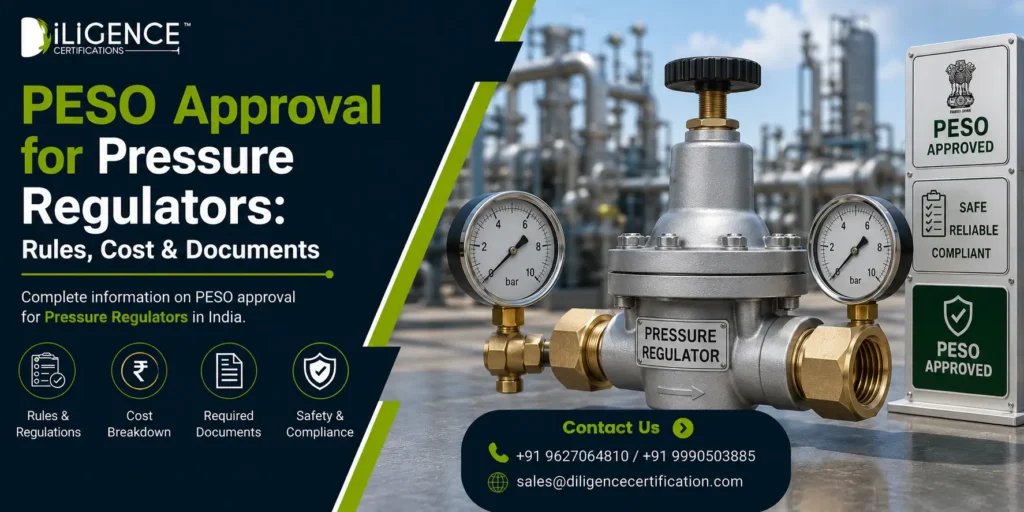
By - We need PESO Approval for Pressure Regulators when we make LPG regulators as per the Gas Cylinders Rules, 2016.
- The process of getting this approval involves a lot of things like drawings and design calculations and manufacturing details and testing and inspection and other documents that show we are complying with the rules.
- If we classify our product correctly and do the paperwork from the start we can avoid problems with PESO and we will not have to redo things, which means we can get the PESO Approval for Pressure Regulators quickly.
Introduction
A year ago a regulator manufacturer could easily focus on the engineering side of the regulator: the inlet pressure, the outlet pressure, the body material, the diaphragm performance and the leak testing of the regulator. The regulatory side of the regulator often gets attention when the company is ready to sell the regulator.
That is where the problems with the regulator start.
For products that are connected to LPG cylinders and pressurised gas systems a regulator is not another mechanical component. The failure of the regulator can mean gas flow, leakage or pressure instability of the regulator. This is one reason why Indian regulators, like the regulator are subject to specific safety and conformity requirements.
Under the Gas Cylinders Rules, 2016 PESOs approval framework specifically covers the manufacture of LPG regulators that are attached to self-closing valves. PESOs current Standard Operating Procedure states that approval for manufacturing cylinders, valves and regulators of Indian as well as foreign origin is handled by the Chief Controller of Explosives, Nagpur.
For a regulator manufacturer therefore PESO Approval for Pressure Regulators should be treated as a product-compliance project for the regulator, not an exercise of filling out an application form, for the regulator.
What Is PESO Approval for Pressure Regulators?
PESO Approval for Pressure Regulators is approval linked to the production of LPG regulators that are applicable under the Gas Cylinders Rules, 2016. The approval is given by the Chief Controller of Explosives after reviewing the technical details, design, ability to manufacture, testing setups and inspection findings.
PESO itself is responsible for approving LPG regulator manufacturing units and regulator designs, under the Gas Cylinders Rules system. It also keeps a list of approved LPG pressure regulator manufacturers.
This difference is important because companies sometimes use the words “PESO certificate” “PESO licence” and “PESO approval” in this way. They do not always mean the thing.
For a regulator manufacturer the key question is:
What exactly is the product, how does it connect to the gas cylinder, which rule is involved, what standard or code controls its design and what approval process is needed for that setup?
This evaluation needs to take place before making the production tools and sending products to market.
Is PESO Approval Required for Pressure Regulators?
For LPG regulators that are connected to self-closing valves the Gas Cylinders Rules say that approval from the Chief Controller is needed before the product can be made.
PESOs standard operating procedure clearly says that any person who wants to make LPG regulators connected to self-closing valves well as cylinders, valves, multi-function valves and other parts must get approval and send the required information, a fee for checking, design blueprints and calculations that are signed off by the inspection officer.
The rule is not about the word “regulator.” The way the product is built and how it is meant to be used are important.
That is why a manufacturer should not think that a regulator made for one type of gas service will automatically be handled the same way as another regulator.
What companies should do first
Before they start an application they should check:
- The type of gas service. How it will be used
- The type of regulator and how it is put together
- The pressure range at the inlet and outlet
- How it is connected
- Whether it is meant to be connected to a cylinder or a self-closing valve
- Which Indian Standard, code or specification applies
- Where the product will be made
- What testing facilities are available
- Whether an independent inspection officer or TPIA is involved
- Whether the application is for a new design, new place of production or a change to an already approved design
This first step of sorting things out is often where expert help, with following the rules can save time.
Which Standard Applies to LPG Pressure Regulators?
For low-pressure LPG regulators, IS 9798 is particularly important.
The BIS product manual for IS 9798 describes low-pressure single- or two-stage regulators and automatic changeover devices for LPG cylinders. The standard covers material, construction, performance and testing requirements. BIS also identifies IS 9798 as a product under compulsory certification and lists the Chief Controller of Explosives/PESO as the regulatory authority for this product.
BIS’s product-certification documentation also indicates that the licence scope can include regulator type, inlet size, end connection and the relevant PESO-approved drawing and approval number.
This means BIS requirements and PESO requirements should be reviewed together where applicable rather than treating them as completely separate checklists.
Why the drawing matters so much
Imagine the regulator drawing as the product’s identity card.
If the application describes one regulator but the drawing, test report, material specification or actual prototype shows another configuration, the technical file becomes difficult to defend.
For this reason, the design drawing should be controlled carefully before submission.
PESO Approval for Pressure Regulators: Step-by-Step Process
The exact route can vary depending on product configuration and application circumstances. The core approval sequence can be understood in the following stages.
1. Determine the Applicable Regulatory Route
Start by identifying whether the regulator falls within the Gas Cylinders Rules provisions.
Do not begin by downloading an application form.First establish the category, product configuration, applicable standard/code and manufacturing arrangement.
This prevents a problem: preparing a technically impressive application under the wrong regulatory route.
2. Prepare the Technical Design
The regulator design should clearly establish the engineering parameters to safe operation.
Typical technical information may include:
- Product designation
- Gas service
- Inlet pressure
- Outlet pressure
- Flow capacity
- Pressure range
- Body and component materials
- Connection details
- Dimensions
- Safety/relief arrangements where applicable
- Spring and diaphragm specifications
- Sealing arrangement
- Operating temperature range
- Design calculations
- Applicable /code
PESOs SOP requires design drawings and calculations to be duly endorsed by the inspecting authority. It also states that drawings should identify manufacturing code, design parameters, raw materials, manufacturer information, gas service and other relevant details.
3. Prepare the Manufacturing Documentation
PESO approval is not based on a drawing.The authority also needs confidence that the applicant has the capability to manufacture the approved product consistently.
The current SOP asks for information relating to the manufacturing process quality-control checks, testing equipment, machinery, inspection personnel, technical staff and relevant records.
A practical technical file may therefore contain:
- Company profile
- Manufacturing process flow
- Organisation structure
- Technical manpower details
- Raw-material specifications
- Incoming inspection procedure
- In-process inspection procedure
- inspection procedure
- Testing equipment list
- Calibration records
- Quality-control procedures
- Relevant ISO certification
- Previous manufacturing experience, where applicable
- Independent inspection arrangements
The objective is simple: prove that the factory can repeatedly manufacture what the approved drawing describes.
4. Submit the Application and Pay the Applicable Fee
Once the technical file is ready, the application is submitted through the applicable PESO process.The fee should not be confused with the total project cost.
A manufacturer may have expenses related to:
- Product testing
- Inspection
- Prototype preparation
- TPIA involvement
- Design documentation
- Factory modifications
- Calibration
- Consultancy
- Travel and inspection coordination
- Renewal/revalidation
Therefore, there is no sensible single “PESO regulator approval price” that applies to every manufacturer.
Documents Required for PESO Approval for Pressure Regulators
The exact document list can depend on the application, but PESO’s SOP provides a useful framework for manufacturers.
Key documents can include:
| Document | Purpose |
| Application/covering letter | Defines the purpose and scope of application |
| Company details | Establishes applicant identity |
| Product description | Identifies regulator type and intended use |
| Manufacturing code/standard | Establishes technical basis |
| Design drawings | Defines approved configuration |
| Design calculations | Demonstrates engineering adequacy |
| Manufacturing process | Shows how the product is made |
| QC procedures | Demonstrates production controls |
| Testing equipment details | Establishes testing capability |
| Calibration records | Supports reliability of measurements |
| Inspection arrangements | Identifies inspecting authority |
| Test and inspection records | Demonstrates conformity |
| Site/layout documents | Establishes manufacturing facility details |
| Land/possession documents | Establishes legal possession |
| Incorporation documents | Establishes legal identity |
| ISO/equivalent certification | Supports quality-system evidence |
PESO’s SOP specifically lists site and layout plans, land documents, incorporation documents, technical personnel information, manufacturing machinery, testing equipment, inspection arrangements and test records among the information required for regulator/cylinder/valve manufacturing approvals.
PESO Regulator Inspection and Prototype Testing
This is the part where all the paperwork meets the factory floor.
The PESO standard operating procedure says that they check the quality of things by inspecting, testing and examining the facilities that control the quality. They also watch when the prototype is tested to make sure it is done correctly by the people in charge.
In terms the people in charge need to make sure that the approved design and the prototype and the manufacturing facility and the testing and the inspection records all match up and tell the same story.For example if the drawing says to use one type of material but the prototype actually uses one that is a problem.
If the equipment they said they would use for testing is not even available at the factory that is a problem too.If the way they make things has changed but they do not have the documents to prove it that can cause issues as well.
So a good file that shows everything is in order is like a chain. Every part of the chain should match the part of the chain like the PESO Regulator Inspection and Prototype Testing process. Every link in the chain should be connected to the link and they should all be connected to the PESO Regulator Inspection and Prototype Testing.
What Happens After Prototype Evaluation?
After the prototype is built and the proper inspection and testing process is completed the inspection report and recommendation are sent for further action.
PESOs Standard Operating Procedure states that after an inspection and recommendation approval to make a cylinder, valve or regulator is given for the first time for one year and then it can be extended based on good performance.
This is a point for manufacturers who are planning to start production.
Getting the approval is not the end of the compliance process. Manufacturing records, product consistency, quality systems and any future design changes need to be controlled.
How Much Does PESO Approval for Pressure Regulators Cost?
There is no fixed cost for PESO Approval for Pressure Regulators.
The official fee is set by the regulatory schedule while the total commercial cost depends on how complicated the product is and how ready the manufacturer is.
Major cost factors include:
- PESO review and application fees
- Testing and laboratory costs
- Inspection and TPIA charges
- Prototype production
- Design and engineering paperwork
- Factory testing equipment
- Calibration
- Fixing any issues
- Evaluation of manufacturers if needed
- Renewal or revalidation
For manufacturers outside the country PESOs current Standard Operating Procedure has additional evaluation rules and costs. The procedure says there is a fee of ₹6,50,000 for checking a foreign factory under this process plus other paperwork, for foreign manufacturers.
Since fees and rules can change, companies should check the PESO schedule before planning their budget.
How long does it take to get PESO approval for pressure regulators?
The truth is that there is no time frame for this.The time it takes can depend on a lot of things like getting the product classification right, making sure the technical file is complete and having quality drawings.
It also depends on things like the testing schedule, whether the people who do the inspections are available and if the prototype and factory are ready.Sometimes the people in charge will ask questions. The company has to respond quickly.If the company makes changes to the product while it is being reviewed that can slow things down too.
For example if a company takes two weeks to fix a drawing after they have already submitted it that adds two weeks to the process.That is why it is usually better to prepare everything at the beginning rather than having to make corrections later on.
There are some reasons why PESO might have issues with an application.
1. The drawing and prototype do not match.
This is something that can be easily avoided.The drawing, the list of materials and the prototype should all describe the pressure regulator.
2. The design calculations are not complete.
The calculations should support what is stated on the drawing and in the application for the pressure regulator.
3. The testing documentation is not good enough.
The equipment used for testing how it is. The test procedures should all be clearly documented for the pressure regulator.
4. The standard reference is not correct.
A pressure regulator should not be submitted with a reference that was just picked randomly.The technical basis needs to match the pressure regulator.
5. There are changes to the design that are not controlled.
If a company changes a part, a connection, the material or a dimensional feature of the pressure regulator after it has been approved that can cause problems with compliance.PESO has a procedure that includes fees for scrutinizing changes to design drawings if a company wants to make changes after the initial approval for the pressure regulator.
6. There are gaps in the manufacturing facility.
The application for the pressure regulator might look perfect on paper. When someone goes to inspect the facility they might find that there are problems with the machinery, the testing facilities, quality control or the technical staff.
PESO Approval for Imported Pressure Regulators
Importers have to be very careful when they are bringing in pressure regulators from countries.The rules about gas cylinders are specific about regulators for LPG that are meant to be attached to gas cylinders.
PESO has a set of rules that says no one can import a valve or an LPG regulator that will be attached to a gas cylinder without getting the approval or licence first.The importer has to show the licence to the customs people and get their permission before the regulators can be brought into the country.
This is the reason why it can be a mistake to import the product first and then ask about PESO approval later. It can cost a lot of money.
For companies that make these products in countries they need to give more documents to get approval these include:
- Indian importer details
- Information about the company that makes the product
- The history of the company. What it has made
- Insurance to cover any problems with the product
- Pictures of the factory where the product is made
- The layout of the factory
- What the company has sold in the past both in its country and to other countries
- What tests the product has to go through
The rules from PESO have special conditions for companies in other countries that want to get approval for their products.
A manufacturer can reduce avoidable delays by completing a pre-submission review.
What Manufacturers Should Do Before Applying
Technical readiness checklist
- Confirm exact regulator model
- Freeze the product configuration
- Identify applicable standard/code
- Finalise engineering drawings
- Complete design calculations
- Prepare bill of materials
- Verify material specifications
- Establish manufacturing process
- Prepare inspection and test plans
- Check testing equipment
- Verify calibration
- Prepare quality-control records
- Confirm inspecting authority/TPIA requirements
- Review factory layout
- Organise statutory company documents
- Conduct a mock inspection
The purpose is not to create more paperwork.
It is to make sure that when the regulator is placed on the inspection table, the product, paperwork and factory all agree with each other.
Why Choose Diligence Certifications
A company that makes regulators probably knows more about regulators than a consultant does.That is not what we are worried about.The hard part is taking what engineers know and putting it into a file that the people in charge will accept.They need to see documents and be able to inspect things.A compliance specialist can help with this.They can help connect the engineering part to the standards and drawings and testing and the factory and the application and the inspection and the approval.
Engineering is connected to Standards and then to Drawings and then to Testing and then to the Factory and then to the Application and then to Inspection and then to Approval.Diligence Certifications helps companies with PESO compliance.They do things like look at the regulations and help with documents and get applications coordinate with people.
They work with businesses that deal with petroleum and gas and hazardous materials.Diligence Certifications also helps with Gas Cylinders Rules.You can look at the Diligence Certifications PESO License service if you need help, with PESO licenses and compliance.Diligence Certifications has a PESO License service.
If you want to know about the documents you need before you start the PESO License Requirements guide is helpful.Diligence Certifications has a PESO License Requirements Guide.
Frequently Asked Questions
1. What is PESO Approval for Pressure Regulators?
PESO Approval for Pressure Regulators is the applicable regulatory approval for manufacturing covered LPG regulators under the Gas Cylinders Rules, 2016. PESO’s SOP specifically addresses approval for manufacturing LPG regulators attached to self-closing valves.
2. Is PESO approval mandatory for LPG pressure regulators?
For LPG regulators falling within the applicable Gas Cylinders Rules provisions, approval is required before manufacturing. The exact applicability should be confirmed against the regulator’s construction, intended use and regulatory category.
3. Which authority grants approval for LPG regulator manufacturing?
The current PESO SOP identifies the Chief Controller of Explosives, Nagpur as the approving authority for manufacturing cylinders, valves and regulators of Indian and foreign origin under the stated route.
4. What documents are required for PESO regulator approval?
Documents can include application and company details, product information, design drawings, calculations, manufacturing-process details, quality-control procedures, testing equipment details, inspection arrangements, factory/site information and test records. The exact requirements depend on the application.
5. Is BIS certification also required for LPG regulators?
For products covered by the applicable BIS compulsory-certification framework, BIS certification may apply in addition to PESO requirements. IS 9798 is identified by BIS for low-pressure LPG regulators.
6. Can foreign manufacturers obtain PESO approval?
Yes. PESO’s SOP contains a specific route for foreign manufacturers seeking approval for cylinder, valve and regulator manufacturing, with additional documentation and physical-evaluation provisions.
7. How much does PESO regulator approval cost?
There is no single total project cost. The applicable statutory fee, testing, inspection, prototype, technical documentation and factory-readiness costs can all affect the final budget.
8. How long does PESO regulator approval take?
The timeline varies according to technical-file completeness, testing, inspection scheduling, factory readiness, authority queries and applicant response time. A fixed universal timeline should not be assumed.
Tags
- PESO Approval
- Pressure Regulators
- LPG Pressure Regulator
- PESO Certification
- Gas Cylinders Rules 2016
- LPG Regulator Manufacturer
- PESO License
- BIS IS 9798
- Gas Equipment Compliance
- Regulatory Approval India
Long-Tail Keywords
- PESO Approval for Pressure Regulators in India
- PESO approval for LPG pressure regulators
- PESO approval process for pressure regulators
- PESO regulator approval documents
- PESO approval cost for LPG regulators
- LPG pressure regulator PESO certification
- PESO approval for LPG regulator manufacturers
- Gas Cylinders Rules 2016 regulator approval
- LPG regulator manufacturing approval in India
- PESO approval for imported LPG regulators
- BIS IS 9798 LPG regulator certification
- pressure regulator compliance in India
Conclusion
For a pressure regulator manufacturer, compliance should begin well before the first commercial batch leaves the factory.The important part of PESO Approval for Pressure Regulators is not simply submitting an application. The product design, calculations, drawings, prototype, testing equipment, manufacturing process, inspection records and final product all need to form one consistent technical story.
That is also why early review is valuable. A drawing correction before prototype production is relatively simple. The same correction after inspection, testing and submission can cost considerably more in time and resources.
Diligence Certifications can help manufacturers and importers assess the applicable PESO route, organise technical documentation, coordinate compliance requirements and prepare for the approval process.
If you are planning to manufacture or import an LPG pressure regulator, share the regulator datasheet, drawing and intended gas application with a compliance specialist before filing. A short technical review at the beginning can prevent a long approval problem later.