



 BIS Certification
 CDSCO
CDSCO
 CPCB
CPCB
 LMPC
LMPC
 WPC Approval
 Global Approvals
 TEC
TEC
 ARAI
ARAI
 BEE
BEE
 ISO Certification
 DGCA Certification
 NOC For Steel
 APEDA Registration













 Business Registration
 FSSAI Mark Certification










 Legal Services
 Trademark Registration
 Copyright Registration
 Patent Registration
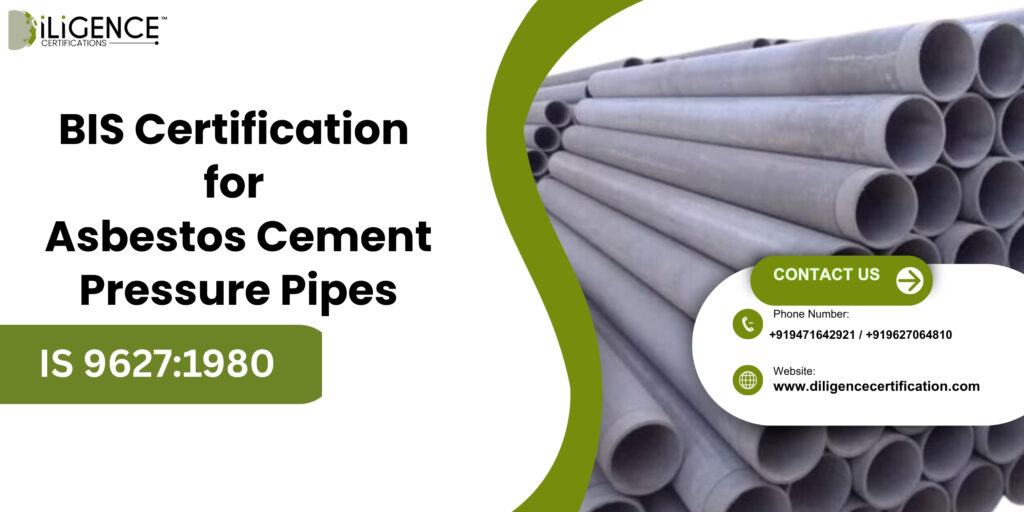
- BIS Certification for Asbestos Cement Pressure Pipes (Light Duty) ensures compliance with IS 9627:1980, guaranteeing product safety and durability.
- The ISI Mark builds customer confidence and enables participation in government tenders.
- Manufacturers benefit from improved credibility, quality control, and smoother market access.
Introduction
In India’s growing infrastructure sector, asbestos cement pressure pipes are used widely for water supply, drainage, and irrigation networks. However, product failures or leakage due to poor-quality materials can disrupt entire systems and cause financial loss.
Recently, a mid-sized pipe manufacturer in Gujarat faced shipment rejection for a state water project because their pipes lacked BIS certification under IS 9627:1980. This situation highlights the crucial role of certification in ensuring compliance, safety, and eligibility for government contracts.
The Bureau of Indian Standards (BIS) certification is not just a regulatory formality—it’s a mark of reliability, helping both manufacturers and project owners ensure consistent product performance.
What is IS 9627:1980?
IS 9627:1980 specifies the requirements, testing methods, and dimensional properties for Asbestos Cement Pressure Pipes (Light Duty).
These pipes are primarily used for:
- Water distribution systems
- Gravity flow pipelines
- Low-pressure applications in agriculture and drainage
The standard defines properties like internal pressure strength, straightness, water tightness, and hydrostatic test performance.
Pipes that conform to this standard are tested for dimensional accuracy, hydrostatic strength, and resistance to leakage before earning the ISI mark.
Why BIS Certification for Asbestos Cement Pressure Pipes (Light Duty) is Important
Obtaining BIS Certification ensures that the product meets the national quality and safety benchmarks. It also protects consumers, project developers, and manufacturers from risks associated with substandard materials.
Here’s why it matters:
- Legal Compliance – BIS certification is mandatory for asbestos cement pressure pipes under IS 9627:1980.
- Tender Eligibility – Public sector and state water boards only accept BIS-certified products.
- Market Credibility – ISI-marked products signal quality assurance to contractors and buyers.
- Product Safety & Durability – Certification ensures the pipe can withstand operational pressures.
- Reduced Risk of Rejection – Certified products face fewer quality inspection rejections.
Understanding the ISI Mark for Asbestos Cement Pressure Pipes
The ISI Mark on Asbestos Cement Pressure Pipes (Light Duty) is a sign of quality, safety, and compliance with IS 9627:1980, the Indian Standard defined by the Bureau of Indian Standards (BIS).
It assures that every pipe has undergone strict laboratory testing for strength, pressure resistance, dimensional accuracy, and durability.
Manufacturers holding the ISI Mark can confidently supply their products for drinking water, irrigation, and drainage systems, where reliability is critical.
This certification also enhances the product’s credibility, making it eligible for government tenders and export opportunities.
Benefits of BIS Certification for Asbestos Cement Pressure Pipes (Light Duty)
- Quality Assurance: Ensures that every pipe meets the stringent requirements of IS 9627:1980, guaranteeing strength, pressure resistance, and long-term performance.
- Market Credibility: The ISI Mark builds customer trust and improves brand reputation among builders, contractors, and government authorities.
- Legal Compliance: BIS Certification is a mandatory requirement for manufacturers selling asbestos cement pressure pipes in India, ensuring compliance with national quality laws.
- Tender & Export Eligibility: Certified manufacturers can participate in government projects and international tenders, expanding their business reach.
- Reduced Risk of Product Failure: Regular factory inspections and product testing by BIS help prevent leakage, breakage, and contamination issues.
- Customer Confidence: The ISI Mark gives end-users assurance that the product is safe, durable, and reliable for water and sewerage applications.
Step-by-Step Process for BIS Certification (IS 9627:1980)
1. Application Submission
Manufacturers must apply through the BIS portal (www.bis.gov.in) under the ISI certification scheme, selecting IS 9627:1980 as the applicable standard.
2. Document Preparation
Documents such as factory layout, production flow chart, equipment list, and quality manuals are required.
3. Product Testing
Samples of asbestos cement pipes are tested at a BIS-recognized laboratory for physical and mechanical compliance.
4. Factory Inspection
BIS officials inspect the production unit to verify testing equipment, manufacturing process, and quality systems.
5. Grant of License
After successful inspection and lab test approval, BIS grants the manufacturer a license to use the ISI mark for the product.
Documents Required for BIS Certification for Asbestos Cement Pressure Pipes (Light Duty)
To obtain BIS Certification under IS 9627:1980, manufacturers must submit the following documents to the Bureau of Indian Standards (BIS):
- Application Form: Duly filled application form (Form VI and Form VII) for BIS Certification.
- Manufacturing Unit Documents:
- Company registration certificate or factory license
- Manufacturing layout plan and production process details
- List of machinery and equipment used in production
- Product Details:
- Product specifications and technical drawings
- Test report from a BIS-recognized laboratory confirming compliance with IS 9627:1980
- Quality Control Documents:
- Internal quality control (IQC) plan
- Details of raw materials and suppliers
- Calibration records of testing instruments
- Authorized Personnel Documents:
- ID and authorization letter of signatory person
- Undertaking for conformity to BIS standards
- Factory Inspection Support Documents:
- Proof of factory location (electricity bill, rent/ownership papers)
- Employee list and production records
- Sample product for on-site testing during BIS inspection
- Additional (if applicable):
- Import-export code (IEC) for exporters
- Trademark registration certificate (if ISI Mark will include a brand name)
Validity and Renewal of BIS License
The BIS License for Asbestos Cement Pressure Pipes (Light Duty) is typically valid for two years.
Manufacturers can apply for renewal before expiry, provided product quality and factory standards remain consistent.
BIS conducts periodic surveillance audits to ensure ongoing compliance.
Common Challenges Manufacturers Face
Many manufacturers struggle during BIS certification due to:
- Incomplete testing or incorrect sampling
- Documentation errors during application
- Non-calibrated testing equipment
- Lack of trained quality personnel
Working with an experienced BIS certification consultant can streamline the process and prevent rejections or delays.
Cost of BIS Certification
The cost of BIS certification for asbestos cement pressure pipes depends on:
- Factory location and scale of production
- Testing frequency and lab charges
- Application and inspection fees
While costs vary, the investment results in long-term compliance, market trust, and business growth.
Why Choose Diligence Certification
Diligence Certification simplifies the BIS Certification process for Asbestos Cement Pressure Pipes (Light Duty) by managing everything — from testing and documentation to BIS coordination. With deep knowledge of IS 1592:2003 requirements, the team ensures smooth approval, compliance assurance, and faster certification without delays or errors.
Conclusion
Obtaining the BIS Certification for Asbestos Cement Pressure Pipes (Light Duty) under IS 9627:1980 is not just a compliance requirement — it’s a mark of trust, durability, and market credibility. The ISI Mark assures customers, government bodies, and contractors that the product meets stringent quality and safety benchmarks set by the Bureau of Indian Standards.
For manufacturers, this certification opens access to government tenders, boosts brand reputation, and ensures consistent quality assurance. With professional guidance from Diligence Certification, the process becomes smooth — from document preparation and product testing to final BIS approval.
In today’s competitive construction and infrastructure industry, BIS certification isn’t optional — it’s essential for long-term growth and credibility.
Frequently Asked Questions
What is BIS Certification for Asbestos Cement Pressure Pipes?
BIS certification is a mandatory approval of the product complying with IS 9627:1980 with respect to safety, strength and durability.
What is the applicable standard for Asbestos Cement Pressure Pipes (Light Duty)?
The applicable Indian Standard for Asbestos Cement Pressure Pipes (Light Duty) is IS 9627:1980.
Why is BIS Certification mandatory for these pipes?
To ensure safety of the product and also enable the manufacturers to sell and supply the pipes in India, as per the law.
Where are asbestos cement pressure pipes usually used?
They are usually used in water supply, drainage, irrigation and other low-pressure pipeline applications.
What does the ISI Mark on the pipes indicate?
The ISI Mark indicates that the pipes meet the BIS quality, performance and safety standards.
Who grants BIS Certification?
The Bureau of Indian Standards (BIS) is the authority that grants BIS Certification (Government of India).
What tests are required as part of the certification?
The testing can involve hydrostatic strength and leakage resistance (dimensional accuracy and pressure testing too).
How long is the BIS License valid?
Usually the license is valid for 2 years. The license is renewable.
Can I use non-certified products on Government projects?
No. Government and Public sector tenders only use BIS-certified products.
How long does it take to get certified?
Frequently take 30-60 days (once testing and documentation are complete).