



 BIS Certification
 CDSCO
CDSCO
 CPCB
CPCB
 LMPC
LMPC
 WPC Approval
 Global Approvals
 TEC
TEC
 ARAI
ARAI
 BEE
BEE
 ISO Certification
 DGCA Certification
 NOC For Steel
 APEDA Registration















 Business Registration
 FSSAI Mark Certification












 Legal Services
 Trademark Registration
 Copyright Registration
 Patent Registration
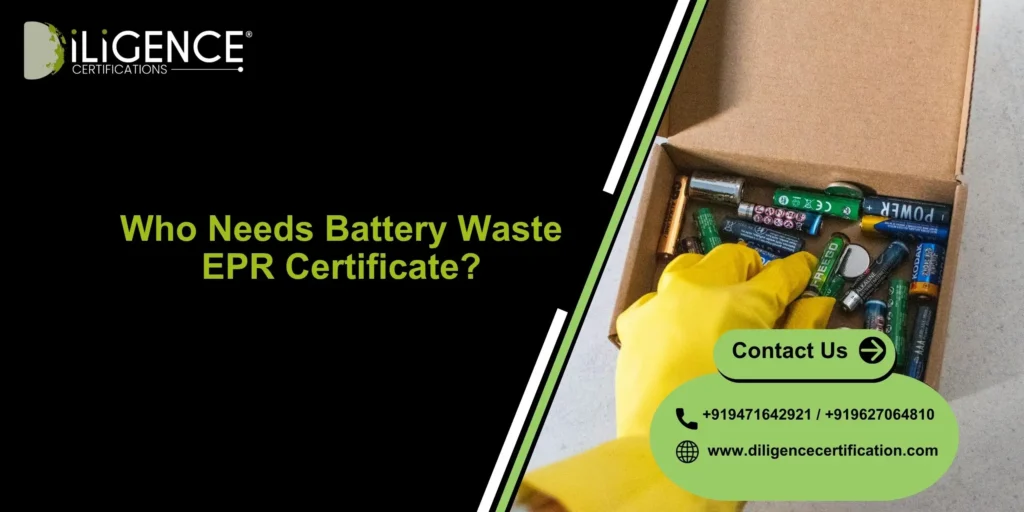
- Battery Waste EPR Certificate is mandatory for producers, importers, and brand owners dealing with batteries in India.
- Registration is regulated by the Central Pollution Control Board (CPCB) under Battery Waste Management Rules, 2022.
- Non-compliance can lead to heavy penalties, business restrictions, and legal action.
- EPR ensures proper collection, recycling, and environmentally safe disposal of battery waste.
- Online registration, annual returns, and target fulfillment are key compliance requirements.
Introduction | Battery Waste EPR Certificate
With the rapid growth of electronics, electric vehicles, and portable devices, battery usage in India has increased significantly. However, improper disposal of battery waste poses serious environmental and health risks due to hazardous materials like lead, lithium, and cadmium.
To address this issue, the government introduced Battery Waste Management Rules, 2022, making it mandatory for businesses to take responsibility for the lifecycle of batteries they introduce into the market. This responsibility is fulfilled through the Battery Waste EPR Certificate.
This guide will help producers, importers, and brand owners understand who needs this certification, why it is important, and how to obtain it easily.
What is a Battery Waste EPR Certificate?
Battery Waste EPR Certificate is the certification issued by CPCB for businesses to manage their battery waste through Extended Producer Responsibility (EPR).
Extended Producer Responsibility entails the responsibility of producers towards:
- Battery Collection
- Battery Recycling/Reprocessing
- Hazardous Waste Disposal
- Annual Recycling Target
This certificate is the assurance that businesses are actively involved in minimizing the environmental pollution generated by battery waste.
Who Needs Battery Waste EPR Certificate?
The following entities are required to obtain Battery Waste EPR registration in India:
1. Producers:- The producers of batteries or battery-operated goods such as:
- Lithium ion batteries
- Lead acid batteries
- EV batteries
- Portable batteries
2. Importers:- The companies which import batteries or battery-operated devices in India.
3. Brand Owner:- Firms dealing with batteries which are not produced by themselves.
4. Manufacturer of Battery Equipments: Companies manufacturing equipment in which batteries form an essential part.
5. Recycler (where applicable):- Firms involved in refurbishment and recycling of batteries.
Why Battery Waste EPR Certificate is Required
Key Reasons
- Legal Compliance: Mandatory under Indian environmental laws
- Environmental Protection: Prevents hazardous waste pollution
- Circular Economy: Promotes recycling and reuse of battery materials
- Business Continuity: Avoids penalties and operational shutdown
- Brand Reputation: Shows commitment to sustainability
Additional Benefits
- Helps track battery lifecycle
- Encourages eco-friendly practices
- Reduces landfill waste
- Supports government sustainability goals
Importance and Benefits
| Importance of EPR Certificate | Benefits for Businesses |
| Ensures legal compliance | Avoids penalties and legal risks |
| Promotes safe disposal of battery waste | Enhances brand credibility |
| Reduces environmental pollution | Builds customer trust |
| Encourages recycling and reuse | Cost savings through resource recovery |
| Supports government sustainability initiatives | Competitive advantage in the market |
| Tracks waste management process | Improves operational efficiency |
Process to Obtain Battery Waste EPR Certificate
Getting Battery Waste EPR registration involves several steps:
Step 1: Identify Applicability
Determine whether your business falls under producer, importer, or brand owner category.
Step 2: Prepare Required Documents
Common documents include:
- Company registration certificate
- PAN and GST details
- IEC (for importers)
- Product details
- Authorized signatory details
Step 3: Create Account on CPCB Portal
Register on the official CPCB EPR portal for battery waste management.
Step 4: Submit Application
Fill out the online application form with accurate details and upload required documents.
Step 5: EPR Plan Submission
Provide a plan for:
- Collection mechanism
- Recycling partnerships
- Target fulfillment strategy
Step 6: CPCB Review
Authorities verify the application and may request clarification or additional documents.
Step 7: Approval and Certification
Once approved, the EPR certificate is issued.
Step 8: Post-Compliance Requirements
- Meet annual recycling targets
- File annual returns
- Maintain proper records
Challenges of Getting this Certification Without a Consultant
While the process is online, businesses often face several difficulties:
1. Complicated Regulatory Framework It is difficult to grasp all the legal aspects involved in Battery Waste Management Rules.
2. Misleading Documents Documents with inaccurate information can lead to delays.
3. Planning for EPR Formulating an effective system needs technical know-how.
4. Technical Problems Technical problems in entering data on the CPCB portal are common.
5. Tedious Procedures Multiple inquiries can make the process take time.
6. Yearly Targets Complying with yearly targets needs constant effort.
Why Choose Diligence Certification for this Certification
Diligence Certification provides end-to-end support for Battery Waste EPR registration, making the process smooth and hassle-free.
Key Advantages
- Expert Guidance: Professional assistance with complete regulatory knowledge
- Documentation Support: Accurate preparation and submission of documents
- Fast Processing: Reduced approval time through error-free applications
- Customized EPR Plans: Tailored strategies for compliance and target fulfillment
- End-to-End Service: From registration to annual compliance management
- Affordable Pricing: Cost-effective solutions for startups and enterprises
Choosing a professional consultant ensures compliance without stress and allows businesses to focus on their core operations.
Conclusion
Battery Waste EPR Certificate is not just a legal requirement but a crucial step toward sustainable business practices in India. With increasing environmental concerns and strict regulations, producers, importers, and brand owners must ensure proper compliance.
Obtaining EPR certification helps businesses avoid penalties, improve brand image, and contribute to environmental protection. Although the process may seem complex, proper guidance and professional support can make it seamless.
By taking timely action, businesses can stay compliant and play an active role in building a cleaner and greener future.
Frequently Asked Questions (FAQs)
Who needs a Battery Waste EPR Certificate in India?
Producers, importers, and brand owners dealing with batteries must obtain it.
Is Battery EPR registration mandatory?
Yes, it is mandatory under Battery Waste Management Rules, 2022.
What happens if I don’t get EPR registration?
You may face penalties, legal action, and business restrictions.
Which authority issues the EPR certificate?
The Central Pollution Control Board (CPCB) issues the certificate.
How long does it take to get EPR registration?
It typically takes a few weeks, depending on documentation and approval.
Do importers need Battery EPR certification?
Yes, importers must register before selling batteries in India.
What documents are required for EPR registration?
Basic documents include PAN, GST, company registration, and product details.
Is EPR required for electric vehicle batteries?
Yes, EV battery producers must comply with EPR regulations.
Do I need to file returns after registration?
Yes, annual returns and compliance reports are mandatory.
Can a consultant help in EPR registration?
Yes, consultants simplify the process and ensure error-free compliance.