



 BIS Certification
 CDSCO
CDSCO
 CPCB
CPCB
 LMPC
LMPC
 WPC Approval
 Global Approvals
 TEC
TEC
 ARAI
ARAI
 BEE
BEE
 ISO Certification
 DGCA Certification
 NOC For Steel
 APEDA Registration

















 Business Registration
 FSSAI Mark Certification












 Legal Services
 Trademark Registration
 Copyright Registration
 Patent Registration
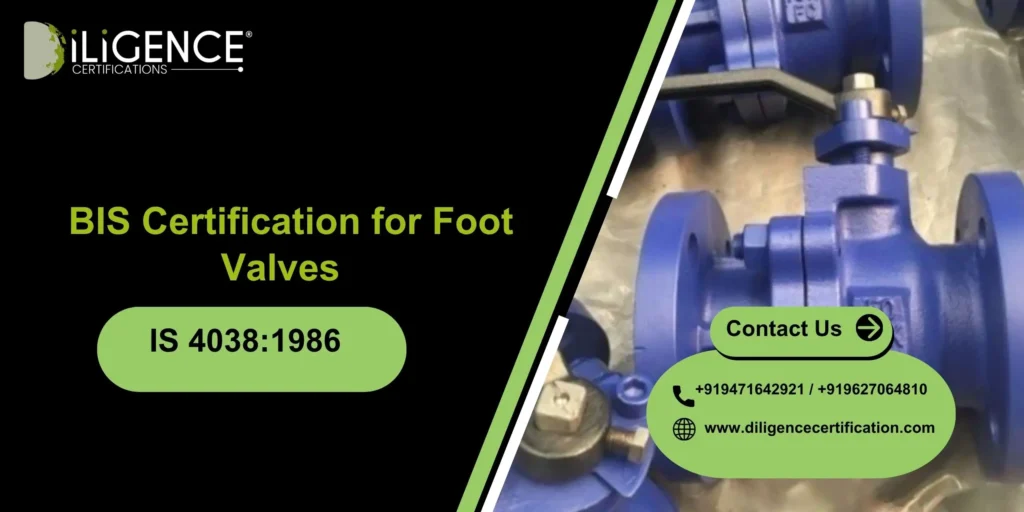
- Ensures Product Quality & Safety: BIS Certification for Foot Valves Product certification by BIS ensures that the foot valves are safe to use, meeting the set criteria under IS 4038:1986, which ensures their durability, safety, and effectiveness in water systems.
- Mandatory Compliance for Manufacturers: Manufacturers need to adhere to the set BIS norms in order to legally manufacture and supply foot valves in the country, especially in government or high-scale projects.
- Covers Material & Design Specifications: It outlines the material, design, and specification of the foot valves used in suction lines.
- Testing & Inspection Requirements: Foot valves need to undergo rigorous testing, such as pressure testing, leakage testing, etc., to attain BIS product certification.
- Use of ISI Mark & Trust Factor:Product certification by BIS enables manufacturers to use the ISI mark, which helps in gaining greater trust and acceptance in the market.

Introduction | BIS Certification for Foot Valves
BIS Certification for Foot Valves for IS 4038:1986 is a significant quality assurance activity that ensures foot valves for water pumping systems meet the requirements specified by the Bureau of Indian Standards (BIS). Foot valves are critical in the prevention of backflow and maintenance of suction pipeline priming, and hence their reliability is of utmost importance.
What is IS 4038:1986?
IS 4038:1986 is an Indian Standard that is published by the Bureau of Indian Standards (BIS). It outlines the requirements that must be met by a foot valve used in suction lines of pumps. This standard ensures that the manufacturing of foot valves is carried out in terms of quality, strength, and performance characteristics.It deals with the material used in the manufacturing of the foot valve, design, size, workmanship, and testing of the foot valve. It also deals with the testing of the foot valve, which can be carried out through hydrostatic pressure testing, leakage testing, etc.
Key Points:
- Indian Standard for Foot Valves:IS 4038:1986 is a standard set by the Bureau of Indian Standards, which regulates the quality and performance of foot valves.
- Defines Material and Construction Requirements:IS 4038:1986 specifies the requirements of the materials, design, and construction details to ensure strength, durability, and resistance to corrosion.
- Covers Dimensions and Technical Specifications:IS 4038:1986 provides guidelines on the size, dimension, and technical specifications to ensure uniformity in the manufacturing process.
- Includes Testing and Performance Criteria:IS 4038:1986 includes tests such as pressure tests, leakage tests, and performance tests to ensure the reliability and performance of the foot valves.
- Ensures Efficient Pump Operation:IS 4038:1986 enables the foot valves to efficiently perform the function of preventing the backflow and maintaining the priming of the pumps.
Products Covered Under IS 4038 : 1986
The standard IS 4038:1986 specifies foot valves used in suction pipelines for pumps. The foot valves are designed for efficient control of water flow and for preventing backflow. The foot valves are important components for efficient operation of the pumps.
Key Reasons:
- Metallic Foot Valves:Foot valves made from materials like cast iron, brass, and gunmetal, which have a long service life and can resist corrosion in water systems.
- Flanged Foot Valves:Foot valves with a flanged design, which is used to connect the valve to the pipes in a leak-proof manner, especially in larger pipes.
- Threaded (Screwed) Foot Valves:Compact foot valves with a threaded design, which is used in smaller pipes, especially in domestic and agricultural pump systems.
- Foot Valves with Strainers:Foot valves have an inbuilt strainer, which helps to keep the pump free from dirt, dust, and solid particles, thus extending the life of the pump.
- Industrial & Agricultural Use Foot Valves:Foot valves specifically designed for use in irrigation systems, water supply networks, and industrial pumping operations.
Importance and Benefits of BIS Certification
| Importance | Benefits |
| Ensures Standardized Quality:IS 4038:1986 certification ensures that foot valves are of standardized quality, which is established by the Bureau of Indian Standards, thereby eliminating any defects in products. | Improved Market Access:Products with certification are easily accepted in government contracts and other big projects. |
| Enhances Safety & Reliability:Valves that are certified and tested are less likely to cause any leakage, failure, or backflow, ensuring safe and efficient operation of pumps. | Customer Trust & Satisfaction:ISI marking ensures the quality of products, and this enhances customer trust and satisfaction. |
| Regulatory Compliance:It helps in complying with various regulations and norms set by the Indian government, which is very helpful in providing products to various projects in both government and private sectors. | Reduced Product Failures:Products with certification are durable and have a longer lifespan, thus minimizing failures. |
| Quality Assurance: Through TestingThe testing of products is mandatory, ensuring that they are efficient in operation and working conditions. | Competitive Advantage:Products with BIS certification have a competitive edge over other products in the market. |
| Builds Brand Credibility:BIS certification with the ISI mark ensures that there is a high level of trust with various industries, contractors, and consumers. | Supports Export Opportunities:ISI certification enhances the reputation of products, and this is crucial in exporting products to other markets. |

Step-by-Step Process of BIS Certification
Step1:Documentation
- Collect required technical documents
- Prepare product specifications
- Gather company registration details
- Ensure documents follow BIS format
Step2:Product Testing
- Send samples to a BIS-approved lab
- Conduct safety and quality tests
- Receive test reports
- Confirm compliance with BIS standards
Step3:Application Submission
- Fill out the BIS application form
- Upload all required documents
- Attach valid test reports
- Pay the necessary BIS fees
Step4:Scrutiny and Inspection
- BIS reviews submitted documents
- Authority verifies test results
- Factory/product inspection may occur
- Clarifications requested if needed
Step5:Grant of License
- BIS approves the application
- License number is issued
- Product can carry BIS mark
- Renewal required before expiry
Documents Required for BIS Certification
| Category | Documents Required |
| Business Documents | Business license/registration, ISO certificate, organizational details |
| Manufacturer Details | Factory layout, process flow chart, machinery list, production details |
| Product Documents | Product specifications, component list, user manual, model details |
| Testing Documents | Test report from BIS-recognized lab, sample details, test request form |
| Legal & Compliance | Authorization letter, brand ownership proof, trademark certificate (if any) |
| Import/Foreign Manufacturer (If applicable) | AIR (Authorized Indian Representative) details, contract agreement, overseas manufacturer documents |
Timelines, Costs, Validity & Renewal
- Timelines: Usually from 20 to 30 days, with only 7-15 days for the testing.
- Costs: The cost of the government and the test varies depending on the product. There can be some additional charges though.
- Validity: The validity period is 2 years in most situations.
- Renewal: The renewal is done before the expiration; there should be updated documents/tests; the renewal
Why Choose Diligence Certifications
Diligence Certifications is a company that is trusted and provides end-to-end services for obtaining BIS certification for foot valves according to IS 4038:1986. The company’s focus on precision and efficiency makes the entire process of BIS certification for foot valves a relatively easy and straightforward process for manufacturers. With the help of Diligence Certifications, manufacturers can obtain expert guidance for the entire process of BIS certification for foot valves and complete the process with ease and precision by following all the BIS norms without any delays.
Conclusion
The role of BIS Certification of Foot Valves as per IS 4038:1986 cannot be overlooked when considering product quality, safety, and performance in water pumping equipment. By adhering to the norms set by the Bureau of Indian Standards, manufacturers can provide quality products that are long-lasting and efficient in performance, as desired by the industry. By achieving BIS certification, not only can a company fulfill its legal obligations but also reap the benefits of increased market scope. A company can take advantage of government contracts and industrial applications.
Frequently Asked Questions (FAQs)
What is IS 4038:1986?
It is an Indian standard that provides specifications for foot valves used in pump suction lines.
Who issues BIS certification?
The certification is issued by the Bureau of Indian Standards (BIS).
Is BIS certification compulsory for foot valves?
It varies depending on government notifications, but it is highly recommended.
What is the ISI mark?
It is a certification mark given to a product if it conforms to BIS standards.
What materials are covered under this standard?
It covers materials such as cast iron, brass, and gunmetal.
What tests are to be performed for certification?
Tests include pressure testing, leakage testing, and performance testing.
How long does it take to get BIS certification?
It takes a few weeks to a few months to get BIS certification.
Can small manufacturers apply for BIS certification?
Yes, small and large manufacturers can apply.
What is the validity period of BIS certification?
The validity period is usually 1 to 2 years.
Why is BIS certification important?
It ensures product quality, safety, and improves market acceptance.