


 BIS Certification
 CDSCO
CDSCO
 CPCB
CPCB
 LMPC
LMPC
 WPC Approval
 Global Approvals
 TEC
TEC
 ARAI
ARAI
 BEE
BEE
 ISO Certification
 DGCA Certification
 NOC For Steel













 Business Registration













 Legal Services
 Trademark Registration
 Copyright Registration
 Patent Registration
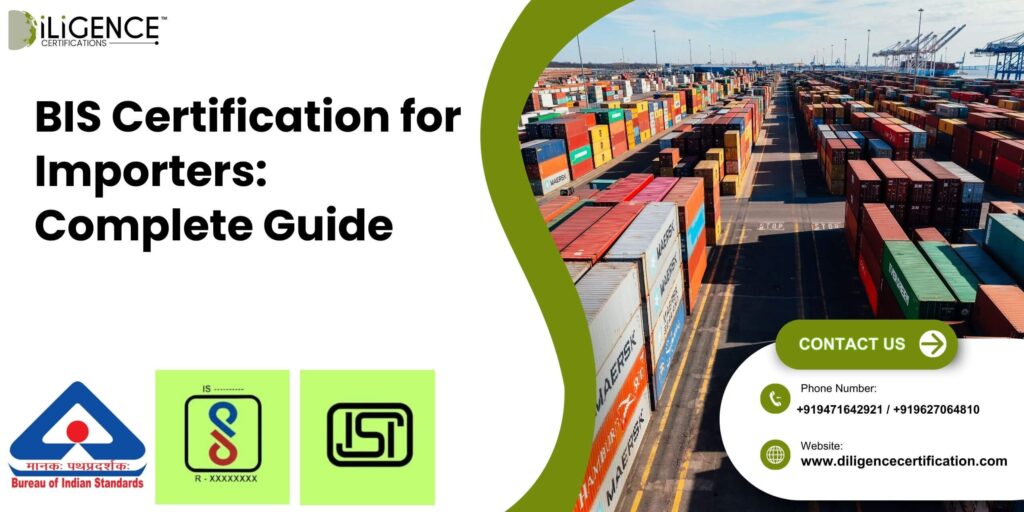
- BIS Certification for Importers is necessary if one wants to import regulated products into India in a legal manner.
- BIS Certification for Importers is a guarantee that the products brought from outside will meet the Indian safety and quality standards.
- BIS Certification for Importers is a great tool to help eliminate the risks of delays in customs, seizure of goods and problems of compliance.
- BIS Certification for Importers is an instrument that allows the consumers to have more trust in the products as it verifies the product reliability.
- BIS Certification for Importers is a great tool to facilitate the smooth market entry and enhance business credibility in India.
Introduction
BIS certification is a must-have for importers who wish to bring regulated products to India. It guarantees that the products brought in from outside meet the safety, quality, and performance standards as per the Bureau of Indian Standards. For importers, having this certification is like a ticket to the Indian market as they comply with the domestic laws, and besides, they do not face hurdles at customs, rejection of goods, or limitation of sales areas. Knowing what BIS demands is like having the green light for the import process, and at the same time, businesses gain the trust and confidence of the Indian market. Bureau of Indian Standards
What Is BIS Certification?
BIS Certification is an approval issued by the Bureau of Indian Standards that confirms a product meets the required safety, quality, and performance standards before it can be sold in India.
1. Explanation of BIS
Bureau of Indian Standards (BIS) is a national standards body in India which is responsible for quality standards, product testing, and consumer safety in various industries. BIS is the regulator of both domestically produced and imported goods to maintain the same standards in the market.
2. Purpose of BIS Certification
The primary objective of BIS Certification is to ensure that the products that are going to be sold in the Indian market are safe, trustworthy, and made according to Indian standards. This, in turn, limits the chances of defects, accidents, and substandard goods that are going to be sold to the consumers.
3. Why it matters specifically for importers
Importers must possess BIS Certification as it is a vital requirement by customs for them to allow many regulated products into India. It is the solution to avoiding the situations of delay, confiscation of goods, legal issues, and market restrictions. By having BIS Certification, importers can ensure that their goods are cleared without a hitch, can be trusted by the customers, and they can legally sell their products throughout India.
Why BIS Certification Is Mandatory for Importers
BIS Certification is necessary for importers in order to guarantee that products that are coming to India are in compliance with the national safety and quality standards. It protects consumers, supports regulatory compliance, and prevents the entry of unsafe or substandard goods. Importers must follow BIS requirements to avoid customs delays, product seizures, and legal issues.
Key Points
- It is a legal requirement for a large number of regulated imported products.
- It ensures that products are in line with Indian safety and quality standards.
- It is a measure against the rejection of goods at customs or their confiscation.
- It shields consumers from unsafe or defective products.
- Importers can stay compliant and have a smooth market entry by this means.
Types of BIS Certifications Relevant for Importers
1. Compulsory Registration Scheme (CRS)
- It is a limitation for electronic and IT-based products for e.g. mobiles, laptops, adapters, LED lights, and the like.
- Before the products can be imported, they have to be tested in laboratories approved by BIS and must be duly registered.
2. ISI Mark Certification

- It is a necessity for regulated products such as electrical appliances, cement, steel products, and household goods.
- The main purpose of this certification is to make sure that products conform to Indian Standards (ISI mark) and are safe for the end-users.
3. Foreign Manufacturer Certification Scheme (FMCS)
- It is the case when products are made outside India but are under the mandatory BIS regulations.
- The foreign factory has to inspect, test products, and the foreign manufacturer will be issued a certificate.
4. Hallmarking Certification
- It is necessary if gold and silver jewelry or articles are imported into India.
- It is a confirmation of purity and authenticity as per BIS standards.
Products That Require BIS Certification for Import
Most of the products imported into India need to be certified by BIS in order to conform to the safety and quality standards of the country. The Bureau of Indian Standards is the institution that oversees these categories and requires them to go through the standards before obtaining the customs clearance.
1. Electronics and IT Products
This is a product category that refers to the inclusion of types of products such as mobile phones, laptops, tablets, LED TVs, chargers, power banks, and other digital devices which come under the CRS scheme.
2. Electrical Appliances
Switches, electric motors, cables, household appliances, transformers, and extension cords are some of the products.
3. Construction Materials
It includes building materials such as cement, steel bars, pipes, PVC, and other construction-related products that directly influence the safety of the structure.
4. Household and Kitchen Items
Pressure cookers, gas stoves, water heaters, and other essential home-use products.
5. Medical Devices and Equipment
Only those healthcare and diagnostic devices which are gated and must comply with BIS standards.
6. Toys and Child Safety Products
Plastic toys or toys made of any other material need to get a green light from the BIS if they want to be safe for children.
7. Precious Metals and Jewelry
Gold and silver products have to be hallmarked so as to facilitate the process of purity and authenticity confirmation.
BIS Certification Process for Importers

BIS Certification is a program that is implemented to confirm the safety and quality of the Indian standards of the imported products that are allowed to be circulated in the market. Typically, these are the steps that are involved:
1. Identify the Applicable BIS Standard
An importer must be clear as to whether his goods are subject to mandatory BIS certification and must also find the corresponding Indian Standard (IS) number.
2. Submit the Application
The foreign manufacturer or the importer through the BIS online portal submits the application along with product details and attaches other necessary documents.
3. Prepare and Submit Required Documents
Documents include business registration, product specifications, technical details, manufacturing information, and authorization letters.
4. Product Testing in BIS-Approved Laboratory
Product samples have to be tested in a laboratory which is BIS approved so as to ensure that the products meet the required standards.
5. Factory Inspection (If Required)
For schemes like ISI or FMCS, BIS inspectors may visit the foreign manufacturing site to assess production quality and processes.
Documents Required for Importers
| Document | Purpose |
| Business registration (Importer/Company details) | Verifies the legal identity of the importer |
| Product specifications and technical details | Helps BIS assess product standards and requirements |
| Test reports (if available) | Supports initial product evaluation |
| Manufacturing details from foreign supplier | Confirms production process and product origin |
| Authorization letter from manufacturer | Allows the importer to apply on the manufacturer’s behalf |
| Import/export license (if applicable) | Confirms permission to trade internationally |
Benefits of BIS Certification for Importers
- Facilitates easy clearing of the customs and keeps the products from being seized.
- Supports the conformity to the obligatory safety and quality standards set by India.
- Increases the confidence of the consumers and elevates the reputation of the brand.
- Decreases the chance of offering products that are unsafe or defective.
- Provides for legal market access and therefore, leads to an increase in business possibilities in India.
- Reduces the risk of being held liable and thus, ensures protection from regulatory fines.
- Enables a competitive edge in comparison to non-certified products.
Renewal and Compliance Requirements
- A BIS certification must be renewed within the period of its validity.
- Renewal may also refer to documents and production records that date from the recent period.
- To determine compliance, certain product areas will have to be re-tested.
- Manufacturers have the responsibility to maintain the quality and standards of their products at the same level.
- Should there be any change in the design, materials, or production process, it is required to notify BIS.
How a Compliance Partner Can Help ( Diligence Certifications)
- Support importers step-by-step through the whole BIS Certification process starting from the application up to the approval stage.
- Implements all paperwork to be precise and complete so that there will be no postponements or refusals.
- Communicates with BIS regarding product testing and, if necessary, factory inspections.
- Helps with renewal of the certificate and continuous compliance obligations.
- Delivers knowledgeable and efficient guidance in dealing with the BIS rules, which results in saving time and lowering risks.
Conclusion
Importers require a BIS Certification to be able to bring safe and quality products to the Indian market. The certification acts as a guard against delays at customs, legal troubles, and the risk of a bad reputation because of the sale of substandard products. Also, it is a way of gaining the trust of consumers and enhancing the brand image. It is very helpful to have an agreement with a skilled compliance company, such as Diligence Certifications, which can make the process more efficient, convenient, and trustworthy, guiding the application, testing, renewal, and compliance.
Frequently Ask Questions
What is BIS Certification for importers?
BIS Certification is a penalty that is dropped by the Bureau of Indian Standards, which in its inner sense is a green signal that the goods imported meet safety, quality, and performance requirements of India.
Who needs BIS Certification for importers?
Importers of products that are electronically, appliances, construction materials, medical devices, precious metals, and the like regulated sectors.
Is BIS Certification mandatory for all imported products?
Not at all. Only a few specifically regulated products that are selected from the rest of the world that need to be certified by BIS mandatorily. Other products may receive voluntary certification.
What types of BIS Certification are relevant for importers?
These include among other things the Compulsory Registration Scheme (CRS), ISI Mark Certification, Foreign Manufacturer Certification Scheme (FMCS), and Hallmarking for gold/silver.
Which imported products require BIS Certification?
These include Electronics, electrical appliances, construction materials, medical devices, toys, household items, and precious metals/jewelry.
What is the BIS Certification process for importers?
Basically, it is about identifying a product standard, applying with the necessary documents, testing the product, factory inspection (if needed), and the certificate issuance.
What documents are required for BIS Certification for importers?
The particular documents are business registration certificate, product specifications, technical details, test reports, manufacturing information, authorization letter, and import/export license.
What are the benefits of BIS Certification for importers?
What are those benefits? They are Legal compliance, easy customs clearance, customer loyalty, risk lowering, and brand trust.
How often does BIS Certification need renewal?
It is necessary for the certification to be renewed at the time of its validity and may require re-testing, renewing documentation, and submitting product/manufacturing change reports.
How can a compliance partner like Diligence Certifications help?
The role of a compliance partner such as Diligence Certifications is to be the importer's guide step-by-step during the entire process, ensuring that all papers are in order, facilitating testing and inspection, assisting with the renewal process, and providing continuous compliance assurance.