 BIS Certification
 CDSCO
CDSCO
 PESO
PESO
 CPCB
CPCB
 LMPC
LMPC
 WPC Approval
 Global Approvals
 TEC
TEC
 ARAI
ARAI
 BEE
BEE
 ISO Certification
 DGCA Certification
 NOC For Steel
 APEDA Registration











 Business Registration
 FSSAI Mark Certification











 (32).jpg)
 Legal Services
 Trademark Registration
 Copyright Registration
 Patent Registration
 By
By - Razor blade steel needs to have BIS Certification IS 9294:1979 as a must.
- It guarantees that the hardness, the thickness, and the corrosion resistance are kept to the standard.
- Factory audit, lab testing, and ISI marking are among the requirements.
- Delays often come from poor documentation or uneven hardness.
- Compliance improves blade quality and brand credibility.
Introduction
Once a razor blade brand in Pune figured out that the complaint environment is not at all easy to accept, their shipment of cold-rolled stainless steel strips was impounded at the port because the material did not conform to BIS requirements under IS 9294:1979. The production stopped instantly, the distributors became anxious, and the weeks of work and planning were scattered because of a single missing certification. Such cases are happening more frequently than manufacturers acknowledge. In India, razor-grade stainless steel is considered a material of utmost precision, and BIS certification is the one that decides whether it can legally be allowed to enter the market or even the factory floor. Bureau of Indian Standards
What is IS 9294:1979?
IS 9294:1979 is the Indian Standard that governs the quality of cold-rolled stainless steel strips used for razor blade manufacturing. It imposes very high standards and close tolerances for chemical composition, hardness, thickness, and corrosion resistance so that producers of razor blades get a consistent and accurate-grade raw material. The standard is the basis for BIS Certification, which is compulsory both for Indian manufacturers and importers selling razor-grade steel to the domestic market.
Key Points

- Defines quality benchmarks for razor-blade-grade stainless steel strips.
- Covers chemical composition, mechanical properties, and surface finish.
- Ensures uniform hardness and dimensional precision for blade performance. ISI MARK
- Required for BIS Certification under mandatory compliance for razor materials.
- Helps prevent blade breakage, rusting, and inconsistent sharpness during production.
Why is BIS Certification Mandatory
BIS Certification has to be there for cold-rolled stainless steel strips for razor blade usage because the environment is the primary factor for consumer safety, product reliability, and manufacturing consistency. Blades are high-stress, ultra-thin parts, and a single slight variation of hardness or surface quality may result in the blade breaking, hurting the skin, or quick corrosion.
Key reasons include:
- Ensures the steel meets IS 9294:1979 requirements for hardness, composition, and surface finish.
- Prevents unsafe or substandard steel from entering the Indian market.
- Protects consumers from blade defects caused by poor-quality raw material.
- Supports uniform manufacturing quality and reduces production rejects.
- Gives importers and manufacturers a legally valid mark of conformity that regulators can verify.
Importance and Benefits of BIS Certification
| Importance | Benefits |
| Ensures steel meets IS 9294:1979 quality norms | Higher blade sharpness and durability |
| Prevents substandard razor-grade steel in the market | Lower rejection rate during stamping and grinding |
| Protects consumer safety and shaving performance | Better corrosion resistance and longer shelf life |
| Mandatory compliance for imports and local production | Smoother regulatory clearance at ports |
| Creates uniformity across manufacturers | Stronger brand credibility and customer trust |
Step-by-Step Process of BIS Certification
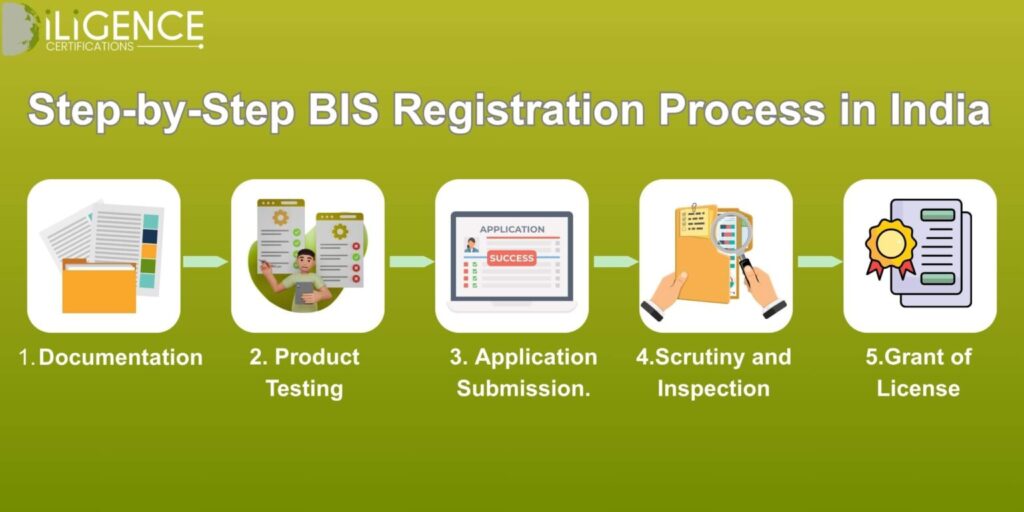
Step1:Documentation
- Collect required technical documents
- Prepare product specifications
- Gather company registration details
- Ensure documents follow BIS format
Step2:Product Testing
- Send samples to a BIS-approved lab
- Conduct safety and quality tests
- Receive test reports
- Confirm compliance with BIS standards
Step3:Application Submission
- Fill out the BIS application form
- Upload all required documents
- Attach valid test reports
- Pay the necessary BIS fees
Step4:Scrutiny and Inspection
- BIS reviews submitted documents
- Authority verifies test results
- Factory/product inspection may occur
- Clarifications requested if needed
Step5:Grant of License
- BIS approves the application
- License number is issued
- Product can carry BIS mark
- Renewal required before expiry
Documents Required for BIS Certification
| Category | Documents Required |
| Business Documents | Business license/registration, ISO certificate, organizational details |
| Manufacturer Details | Factory layout, process flow chart, machinery list, production details |
| Product Documents | Product specifications, component list, user manual, model details |
| Testing Documents | Test report from BIS-recognized lab, sample details, test request form |
| Legal & Compliance | Authorization letter, brand ownership proof, trademark certificate (if any) |
| Import/Foreign Manufacturer (If applicable) | AIR (Authorized Indian Representative) details, contract agreement, overseas manufacturer documents |
Timelines, Costs, Validity & Renewal
- Timelines: Usually from 20 to 30 days, with only 7-15 days for the testing.
- Costs: The cost of the government and the test varies depending on the product. There can be some additional charges though.
- Validity: The validity period is 2 years in most situations.
- Renewal: The renewal is done before the expiration; there should be updated documents/tests; the renewal
Why Choose Diligence Certifications
- Expert team with strong BIS and regulatory knowledge
- Fast, streamlined processing to reduce approval delays
- Accurate documentation and testing coordination
- Transparent guidance with clear communication
- High success rate and complete end-to-end support
Conclusion
BIS certification for cold-rolled stainless steel strips for razor blades, IS 9294:1979, is what eventually defines a razor brand’s ability to provide blades that are stable, safe, and of high performance. Basically, when the raw material is up to spec, everything downstream becomes more predictable-edge formation, coating quality, stamping precision, and even user experience. For manufacturers and importers, conformity is not only a legal requirement; it is also a very effective safeguard against production interruptions, port delays, and loss of good name. If you require clear instructions or an easier way to get your certification, our team is there to assist you from the initial assessment to the final licence granting.