BIS Certification
 CDSCO
 PESO
 CPCB
 LMPC
 WPC Approval
 Global Approvals
 TEC
 ARAI
 BEE
 ISO Certification
 DGCA Certification
 NOC For Steel
 APEDA Registration























 Business Registration
 FSSAI Mark Certification












 (32).jpg)
 Legal Services
 Trademark Registration
 Copyright Registration
 Patent Registration
 By
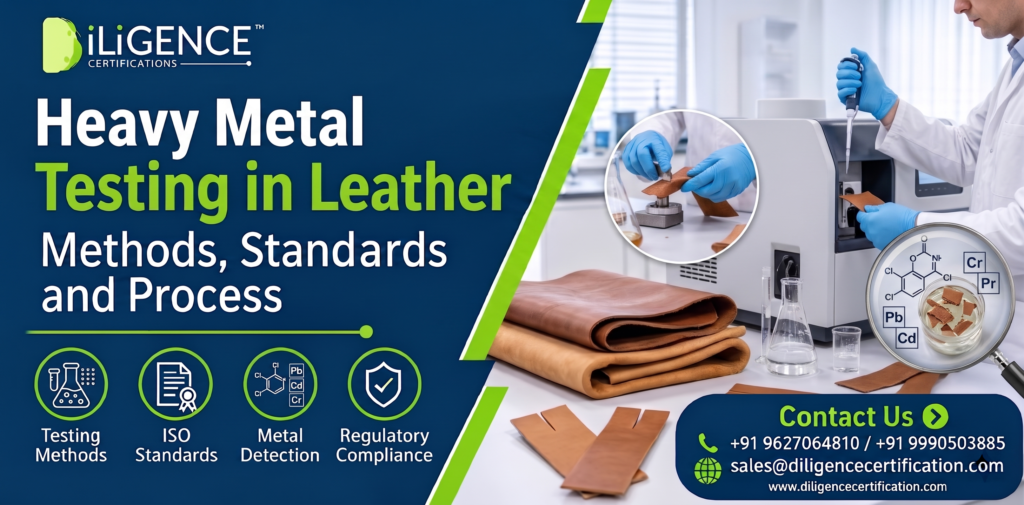
- Heavy metal testing in leather helps identify harmful metals present in leather products.is
- Commonly tested metals include lead, cadmium, chromium, mercury, arsenic and antimony.
- Chromium VI is an important chemical concern in leather manufacturing.
- ISO 17072-1 and ISO 17072-2 are important standards for determining extractable and total metal content in leather.
- ICP-MS, ICP-OES and AAS are commonly used analytical techniques.
- Leather manufacturers, exporters and suppliers use chemical testing to meet buyer and regulatory requirements.
- Testing should be performed by a competent laboratory using the applicable testing method.
Introduction
Leather is widely used in footwear, handbags, jackets, furniture, automotive interiors, belts, wallets and other consumer products. It is valued for its strength, flexibility, durability and attractive appearance. However, the chemicals used during leather processing can sometimes introduce unwanted substances, including heavy metals.
Heavy metal testing in leather is an important chemical testing process that helps manufacturers identify and measure potentially harmful metallic elements in leather materials. These metals may enter leather through tanning chemicals, dyes, pigments, finishing agents, water or other manufacturing processes.
Some metals, such as lead, cadmium and mercury, can create health and environmental concerns when their concentrations exceed applicable safety requirements. Chromium also needs special attention because chromium-based tanning is widely used in the leather industry. In particular, hexavalent chromium (Cr VI) is a restricted substance in several international markets.
For leather manufacturers and exporters, testing is useful for checking product quality, meeting customer specifications and supporting regulatory compliance. This guide explains the importance of heavy metal testing, common metals, testing methods, ISO standards, procedures and documentation requirements.
What Is Heavy Metal Testing in Leather?
Heavy metal testing in leather is a laboratory-based chemical analysis used to identify and measure the concentration of selected metallic elements present in leather materials.
The testing process helps determine whether the leather contains metals within the limits specified by applicable regulations, product standards or buyer requirements.
Leather goes through several manufacturing stages, including:
- Raw hide and skin preparation
- Liming and deliming
- Pickling
- Tanning
- Dyeing
- Retanning
- Fatliquoring
- Finishing and coating
During these stages, different chemicals and processing materials may be used. If raw materials or chemical inputs contain unwanted metals, traces may remain in the finished leather.
Testing can be performed on raw leather, semi-finished leather and finished leather products, depending on the purpose of the assessment.
It is important to understand that total metal content and extractable metal content are not the same. Total metal testing measures the overall quantity of selected metals in the sample, while extractable metal testing measures metals released under specified extraction conditions.
Why Is Heavy Metal Testing Important for Leather Products?
Heavy metal testing plays an important role in leather manufacturing because leather products may come into direct or indirect contact with human skin.
Here are the main reasons why manufacturers should consider this testing.
1. Helps Identify Harmful Metals
Some heavy metals can create health risks when exposure occurs above applicable safety levels. Testing helps identify unwanted metal contamination in leather materials.
2. Supports International Market Compliance
Different countries and markets have chemical safety requirements for consumer products. Leather exporters may need to demonstrate compliance with restrictions on certain metals and chemical substances.
3. Improves Product Quality
Chemical testing helps manufacturers monitor the quality of leather materials and identify possible contamination during production.
4. Builds Buyer Confidence
International buyers, footwear brands, retailers and importers may request chemical test reports before accepting leather products. Proper testing documentation helps demonstrate that the material has been assessed against specified requirements.
5. Reduces Rejection Risks
Products that fail chemical safety requirements may face shipment delays, rejection, rework or additional testing costs. Regular testing helps identify potential problems before products reach the market.
6. Supports Responsible Manufacturing
Monitoring chemical substances encourages manufacturers to select suitable raw materials and improve chemical management practices.
Common Heavy Metals Tested in Leather
Several metallic elements may be included in a leather chemical testing programme. The exact list depends on the product type, destination market and applicable buyer or regulatory requirements.
1. Chromium (Cr)
Chromium is commonly associated with leather tanning. Trivalent chromium (Cr III) is used in conventional chrome tanning, while hexavalent chromium (Cr VI) is a particularly important restricted substance.
Chromium VI can develop under certain conditions, including oxidation during leather processing or storage. Therefore, specific chromium VI testing is important for leather products.
2. Lead (Pb)
Lead may enter leather through contaminated pigments, dyes, coatings or other chemical materials. It is commonly included in chemical safety assessments for consumer products.
3. Cadmium (Cd)
Cadmium can be associated with certain pigments, colourants and contaminated raw materials. Testing helps identify its presence and concentration.
4. Mercury (Hg)
Mercury is a toxic metal that may enter materials through contaminated chemicals or environmental sources. It may be included in a broader heavy metal analysis.
5. Arsenic (As)
Arsenic is a potentially harmful element that may be present due to contaminated raw materials, water or processing chemicals.
6. Antimony (Sb)
Antimony may be present in certain pigments, additives and chemical formulations. Its testing requirements depend on the product and applicable specifications.
7. Other Metals
Depending on the testing requirement, laboratories may also analyse:
- Barium
- Copper
- Nickel
- Cobalt
- Selenium
- Zinc
- Tin
- Manganese
Not every metal has the same regulatory restriction or acceptable limit. The applicable requirement must be checked separately for each substance.
Important Standards for Heavy Metal Testing in Leather
International testing standards provide recognised methods for determining metal content in leather. Manufacturers and laboratories should select the correct standard according to the purpose of testing.
The following standards are particularly relevant.
| Standard | Testing Purpose |
|---|---|
| ISO 17072-1:2019 | Determination of extractable metals in leather |
| ISO 17072-2:2022 | Determination of total metal content in leather |
| ISO 17075-1:2017 | Determination of chromium VI using a colorimetric method |
| ISO 17075-2:2017 | Determination of chromium VI using a chromatographic method |
| ISO 10195:2018 | Thermal pre-ageing of leather and determination of chromium VI |
ISO 17072-1: Extractable Metals Testing
ISO 17072-1 specifies a method for determining extractable metals in leather.
The method uses an acid artificial-perspiration solution to extract metals from the leather sample. The extracted metals are then analysed using suitable instrumental techniques.
This method is especially useful for evaluating extractable chromium in chrome-tanned leather.
ISO 17072-2: Total Metal Content Testing
ISO 17072-2 specifies a method for determining the total metal content in leather.
The sample is digested before the metal concentration is measured using analytical equipment such as ICP-MS, ICP-OES or AAS.
It covers several elements, including lead, cadmium, mercury, arsenic, antimony and other selected metals. Chromium testing under this method has an important limitation for chromium-tanned leather, so the correct method must be selected.
ISO 17075-1: Chromium VI Testing
ISO 17075-1 specifies the colorimetric method for determining hexavalent chromium in leather.
It is applicable to different types of leather and is used to measure chromium VI in solutions extracted under specified conditions.
ISO 17075-2: Chromatographic Method
ISO 17075-2 specifies the chromatographic method for determining chromium VI in leather.
It provides an alternative analytical approach and is useful when colour interference in the sample extract needs to be avoided.
ISO 10195: Thermal Pre-Ageing
ISO 10195 describes a thermal pre-ageing procedure used to assess the tendency of chromium-tanned leather to form hexavalent chromium under specified conditions.
The procedure does not simulate actual leather production or real-life usage conditions.
Important: Standards may be revised or replaced. ISO 17072-1 is under revision in 2026. Laboratories and manufacturers should verify the latest published edition and applicable customer or regulatory requirements before testing.
Heavy Metal Testing Methods Used in Leather
Laboratories use different analytical techniques depending on the metal being tested, required detection limits and applicable testing standards.
1. ICP-MS Testing
Inductively Coupled Plasma Mass Spectrometry (ICP-MS) is an advanced analytical technique used to detect and quantify metals at very low concentrations.
The sample is prepared and introduced into a plasma source. The instrument identifies elements based on their mass-to-charge ratios.
Main advantages:
- High sensitivity
- Suitable for trace-level metal analysis
- Can analyse multiple elements
- Useful for checking very low metal concentrations
2. ICP-OES Testing
Inductively Coupled Plasma Optical Emission Spectrometry (ICP-OES) measures metals by analysing the light emitted by excited atoms and ions in plasma.
It is commonly used for multi-element analysis and can measure different metals in prepared leather samples.
Main advantages:
- Multi-element analysis
- Suitable for routine chemical testing
- Good analytical performance
- Useful for determining metal concentrations in prepared samples
3. Atomic Absorption Spectroscopy (AAS)
Atomic Absorption Spectroscopy measures the absorption of light by free atoms of a specific element.
It is used to determine the concentration of selected metals in prepared samples.
Main advantages:
- Suitable for individual metal analysis
- Established laboratory technique
- Useful for routine testing
- Available for several metal-specific applications
4. Colorimetric Testing
Colorimetric testing is used for determining chromium VI under ISO 17075-1.
The method involves chemical reactions that produce a measurable colour response. The intensity of the colour is related to the concentration of chromium VI in the prepared extract.
Step-by-Step Process of Heavy Metal Testing in Leather
The testing procedure depends on the selected standard and the type of metal being analysed. A typical laboratory testing process includes the following steps.
Step 1: Sample Collection
A representative leather sample is collected from the material or finished product.
The sample should represent the actual batch being evaluated. Different colours, coatings or material compositions may require separate samples.
Step 2: Sample Preparation
The laboratory prepares the leather sample according to the relevant testing method.
Preparation may include cutting, reducing the sample into smaller pieces and preparing a suitable test specimen.
Step 3: Chemical Extraction or Digestion
The sample undergoes extraction or digestion depending on whether extractable or total metal content is being measured.
For extractable metal testing, an artificial-perspiration extraction procedure may be used. For total metal analysis, the leather is digested using an appropriate laboratory procedure.
Step 4: Instrumental Analysis
The prepared sample is analysed using the required equipment, such as ICP-MS, ICP-OES or AAS.
For chromium VI, the laboratory follows the applicable ISO 17075 method.
Step 5: Result Calculation
The laboratory calculates the metal concentration and expresses the result in an appropriate unit, commonly milligrams per kilogram (mg/kg).
Step 6: Result Evaluation
The measured results are compared with the applicable regulatory limits, customer specifications or product requirements.
Step 7: Test Report Preparation
The laboratory prepares a test report containing the sample details, testing methods, results and relevant observations.
The manufacturer can use this report to support quality control and compliance activities.
Chromium VI Limit in Leather: What Manufacturers Should Know
Chromium VI is one of the most important chemical parameters for leather products, particularly those that come into contact with human skin.
Under the European Union’s REACH restriction, leather articles that come into contact with skin must not be placed on the market if they contain chromium VI at concentrations equal to or greater than 3 mg/kg, based on the total dry weight of the leather.
The same restriction applies to leather parts in articles that come into contact with skin.
This requirement is particularly relevant to products such as:
- Leather footwear
- Leather jackets
- Gloves
- Handbags
- Belts
- Leather watch straps
- Leather furniture components that contact skin
Manufacturers exporting to Europe should carefully review this restriction and ensure that their products meet the applicable requirements.
It is important to remember that the 3 mg/kg threshold is a chromium VI-specific EU requirement. It should not be treated as a universal permissible limit for all heavy metals or all leather products.
Factors That Can Affect Heavy Metal Content in Leather
Several manufacturing and environmental factors can influence the metal content of leather.
1. Raw Hide Quality
Raw hides and skins may contain contaminants due to environmental exposure, storage conditions or the quality of the original material.
2. Tanning Chemicals
Certain tanning chemicals may introduce metals into leather. The quality and composition of chemical inputs are therefore important.
3. Dyes and Pigments
Some colouring materials and pigments may contain metallic impurities. Manufacturers should select suitable chemical formulations.
4. Water Quality
Water used during leather processing may introduce unwanted substances if it contains contaminants.
5. Finishing Chemicals
Coatings, finishing agents and other surface treatments may contribute to the chemical composition of the finished material.
6. Storage Conditions
Storage and environmental conditions can influence certain chemical changes in leather. Chromium VI formation, for example, may be affected by factors such as heat and oxidation.
Documents Required for Leather Heavy Metal Testing
The exact documents depend on the laboratory, testing scope and customer requirements. Commonly requested information includes:
- Sample identification details
- Product or leather material description
- Manufacturer or supplier details
- Sample quantity
- Batch or lot number
- Colour and finish details
- Required list of metals to be tested
- Applicable testing standards
- Destination market or buyer specification
- Previous test reports, if available
Providing accurate information helps the laboratory select an appropriate testing method and prepare the correct report.
Common Mistakes to Avoid During Heavy Metal Testing
Manufacturers sometimes face testing failures or delays because of incorrect sample preparation or an unsuitable testing scope.
The following mistakes should be avoided:
- Selecting the wrong testing method: Total metal and extractable metal tests measure different properties.
- Ignoring chromium VI: Total chromium results cannot automatically confirm chromium VI compliance.
- Testing only one sample: Different colours, finishes and production batches may have different chemical compositions.
- Using outdated standards: Always verify the applicable edition before starting the testing process.
- Ignoring destination-market requirements: Requirements may differ between the EU, USA and other markets.
- Providing incomplete sample details: Missing product or batch information can create confusion during testing.
- Relying on old test reports: A previous report may not represent a new formulation or production batch.
How to Choose a Leather Testing Laboratory
Choosing the right laboratory is important for obtaining reliable chemical testing results.
Before selecting a testing laboratory, manufacturers should consider the following points:
- Check whether the laboratory has relevant testing capabilities.
- Verify its NABL accreditation under ISO/IEC 17025, where applicable.
- Confirm that the required test method is included in its accredited scope if accredited results are needed.
- Ask whether the laboratory can test all required metals.
- Confirm that the laboratory follows the correct ISO testing procedure.
- Check the reporting units and detection limits.
- Ensure that the test report clearly identifies the sample and applicable methods.
- Confirm whether the report meets the buyer’s or destination market’s requirements.
A laboratory’s accreditation should always be checked against its actual scope of accreditation. Not every laboratory accredited for chemical testing is necessarily accredited for every leather testing method.
Why Choose Diligence Certifications for Heavy Metal Testing in Leather?
Diligence Certifications helps manufacturers, suppliers, importers and exporters understand product testing and compliance requirements.
For businesses involved in leather manufacturing, chemical compliance is an important part of product quality and market readiness.
Diligence Certifications can assist businesses with:
- Understanding applicable leather testing requirements
- Identifying relevant ISO testing standards
- Guidance on selecting suitable testing laboratories
- Understanding chemical compliance requirements
- Support with testing documentation
- Guidance on product certification and regulatory procedures, where applicable
It is important to understand that Diligence Certifications provides consultancy and compliance-related assistance. It is not a physical testing laboratory and does not independently perform heavy metal testing.
Actual sample analysis and test reports must be obtained from a competent laboratory with the appropriate testing facilities.
Conclusion
Heavy metal testing in leather is an important process for checking the chemical safety and quality of leather materials. It helps manufacturers identify unwanted metals, monitor production quality and understand whether their products meet applicable regulatory and customer requirements.
Standards such as ISO 17072-1, ISO 17072-2, ISO 17075-1 and ISO 17075-2 provide recognised methods for testing extractable metals, total metal content and chromium VI in leather.
For manufacturers and exporters, selecting the correct testing method, maintaining proper documentation and working with a competent laboratory can make the compliance process more effective.
Regular chemical testing and responsible selection of raw materials and processing chemicals can also help leather businesses improve product quality and reduce the risk of non-compliance.
Frequently Asked Questions (FAQs)
1. What is heavy metal testing in leather?
Heavy metal testing in leather is a chemical analysis used to identify and measure metals such as lead, cadmium, chromium, mercury and arsenic in leather materials.
2. Why is heavy metal testing important for leather products?
It helps identify potentially harmful metal contamination, supports chemical safety assessments, improves quality control and helps manufacturers meet buyer and regulatory requirements.
3. Which metals are commonly tested in leather?
Commonly tested metals include chromium, lead, cadmium, mercury, arsenic and antimony. Other metals may also be tested depending on the product and applicable requirements.
4. Which ISO standard is used for heavy metal testing in leather?
ISO 17072-1:2019 is used for extractable metal testing, while ISO 17072-2:2022 is used for total metal content determination.
5. What is the chromium VI limit in leather?
Under the EU REACH restriction, leather articles that come into contact with skin must not contain chromium VI at concentrations equal to or greater than 3 mg/kg of the total dry weight of the leather.
6. Which equipment is used for heavy metal testing?
Common analytical equipment includes ICP-MS, ICP-OES and Atomic Absorption Spectroscopy (AAS). The equipment depends on the metal and testing method.