



 BIS Certification
 CDSCO
CDSCO
 CPCB
CPCB
 LMPC
LMPC
 WPC Approval
 Global Approvals
 TEC
TEC
 ARAI
ARAI
 BEE
BEE
 ISO Certification
 DGCA Certification
 NOC For Steel
 APEDA Registration











 Business Registration
 FSSAI Mark Certification










 Legal Services
 Trademark Registration
 Copyright Registration
 Patent Registration
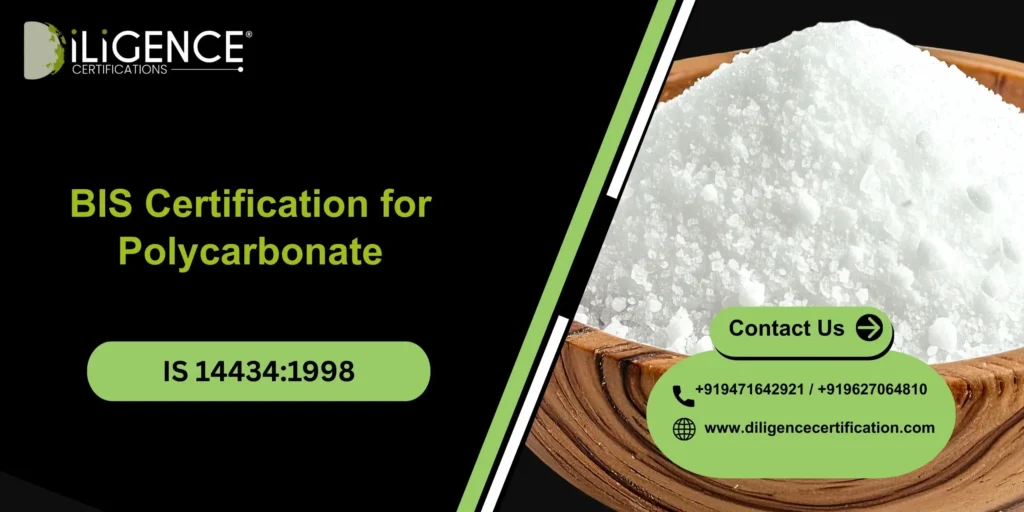
- RegulatoryAuthority:The Bureau of Indian Standards is the main agency to a great extent responsible for the issuing of the BIS certification which is a mark of product quality and safety in India.
- Applicable Standard:IS 14434:1998 BIS Certification for Polycarbonate is a standard that dictates the requirements, test methods, and properties of materials for polycarbonate plastics.
- Material Quality:Polycarbonate, being a BIS certified product, must possess the following features: strength, transparency, heat resistance, and impact performance as per the standards laid down.
- Quality Testing:Testing of the mechanical, thermal, and chemical properties of the product samples is done in laboratories after taking samples to check conformity with the standards.
- Market Compliance:In India, it is against the law for manufacturers to produce polycarbonate without BIS certification and they are prohibited from selling such products.
Introduction
BIS Certification for Polycarbonate as per IS 14434:1998 is a stamp of approval for polycarbonate that is used to make articles conforming to the standard quality, safety, and performance level prescribed by the Bureau of Indian Standards (BIS). The document presents the material’s properties, its durability, and the requirements for the tests that have been met by the manufacturer. Hence, the manufacturers can sell authentic and high grade polycarbonate products legally in India.
What is IS 14434:1998?
IS 14434:1998 BIS Certification for Polycarbonate is an Indian Standard published by the Bureau of Indian Standards that specifies quality requirements, material properties, and testing methods for polycarbonate plastics. In essence, the standard ensures that polycarbonate materials possess the necessary mechanical strength, heat resistance, clarity, and impact resistance for industrial and commercial applications, thereby also meeting safety and performance criteria.
Key Points:
- Issuing Authority: IS 14434:1998 is an Indian Standard, which was issued by the Bureau of Indian Standards.
- Standard Scope: This standard specifies the essential requirements of polycarbonate plastics for use in various industries and for commercial purposes.
- Material Properties: In addition to other matters, the standard specifies maximum limits for properties such as mechanical strength, impact resistance, transparency, and thermal stability.
- Testing Methods: IS 14434:1998 specifies the test methods to verify the physical, mechanical, and performance characteristics.
- Quality Assurance: Compliance with the polycarbonate materials supply in the market will be a guarantee for safety, product quality, and reliability.
Why is BIS Certification Mandatory
If you would like your products to comply with the safety, quality and performance standards of India, which have been established by the Bureau of Indian Standards, then getting BIS Certification is a must for you. It is a step that protects consumers against the supply of inferior products, promotes standardization in industries, makes sure that companies are abiding by the law, and at the same time, allows manufacturers to produce, import and sell legally in the Indian market, thus maintaining their trust and credibility.
Key Reasons:
- Consumer Safety:Ensures that the goods are safe and of good quality, in this way consumers will not be made to consume dangerous or low quality products.
- Legal compliance:According to the law, only the products that have been given an ISO license by the Industrial Licensing Board (BIS) shall be allowed to be manufactured, imported or sold in India.
- Quality Assurance: Assures products continuously meet the Indian Standards for quality and life.
- Market Credibility: Builds a good reputation and a stronger relationship with customers, dealers, and government regulators.
- Regulatory Control: Provides the Bureau of Indian Standards with the authority to inspect and control product quality in various sectors.
Importance and Benefits of BIS Certification
| Importance | Benefits |
| Quality Standardization: Makes sure that products are produced in accordance with the prescribed Indian Standards for consistent quality. | Market Access: It allows one to easily enter the Indian market without facing any legal obstacles. |
| Consumer Protection: Protects the consumer from receiving unsafe, low quality, or unapproved products. | Customer Trust: The products bearing the BIS mark are more trusted and consumers have greater confidence in them. |
| Legal Requirement: It is compulsory for the products that the government has notified to be legally manufactured, imported, or sold in India. | Brand Reputation: Manufacturers get their brand and professional image enhanced. |
| Regulatory Oversight: Grants the Bureau of Indian Standards the authority to inspect the factory conditions and check the quality of the products. | Reduced Rejections: The probability of product failure, recalls, or regulatory penalties is very low. |
| Market Discipline: Assists in the removal of inferior products from the market and also supports the idea of competition based on merits. | Competitive Advantage: Products with certificates are more likely to be chosen as compared to those without certificates. |
Step-by-Step Process of BIS Certification
Step1:Documentation
- Collect required technical documents
- Prepare product specifications
- Gather company registration details
- Ensure documents follow BIS format
Step2:Product Testing
- Send samples to a BIS-approved lab
- Conduct safety and quality tests
- Receive test reports
- Confirm compliance with BIS standards
Step3:Application Submission
- Fill out the BIS application form
- Upload all required documents
- Attach valid test reports
- Pay the necessary BIS fees
Step4:Scrutiny and Inspection
- BIS reviews submitted documents
- Authority verifies test results
- Factory/product inspection may occur
- Clarifications requested if needed
Step5:Grant of License
- BIS approves the application
- License number is issued
- Product can carry BIS mark
- Renewal required before expiry
Documents Required for BIS Certification
| Category | Documents Required |
| Business Documents | Business license/registration, ISO certificate, organizational details |
| Manufacturer Details | Factory layout, process flow chart, machinery list, production details |
| Product Documents | Product specifications, component list, user manual, model details |
| Testing Documents | Test report from BIS-recognized lab, sample details, test request form |
| Legal & Compliance | Authorization letter, brand ownership proof, trademark certificate (if any) |
| Import/Foreign Manufacturer (If applicable) | AIR (Authorized Indian Representative) details, contract agreement, overseas manufacturer documents |
Timelines, Costs, Validity & Renewal
- Timelines: Usually from 20 to 30 days, with only 7-15 days for the testing.
- Costs: The cost of the government and the test varies depending on the product. There can be some additional charges though.
- Validity: The validity period is 2 years in most situations.
- Renewal: The renewal is done before the expiration; there should be updated documents/tests; the renewal
Why Choose Diligence Certifications
Diligence Certifications is a compliance consulting firm that people can count on. The company provides complete assistance for BIS and other mandatory certifications. Through expert advice, straightforward procedures, and punctual delivery, Diligence Certifications enables manufacturers and importers to get approvals without a fuss, and at the same time, be fully compliant with regulations and get their products to the Indian market faster.
Conclusion
BIS Certification under IS 14434:1998 is really a necessary step for polycarbonate products in India to ensure their quality, safety, and performance. Following the norms of the Bureau of Indian Standards enables producers to be on the right side of the law, keep up the quality of their products consistently, and gain the confidence of the customers. It can be said that BIS certification is a great help for the brand image in the market, conformity with regulations, and continuous business development.
Frequently Asked Questions (FAQs)
What is BIS Certification for Polycarbonate?
BIS certification is a compulsory certification that makes sure polycarbonate products conform to the quality and safety standards of India.
Which authority issues BIS Certification?
BIS Certification is the issuance of the Bureau of Indian Standards.
What is IS 14434:1998?
IS 14434:1998 is the Indian Standard that defines the requirements and test methods of polycarbonate plastics.
Is BIS Certification mandatory for polycarbonate in India?
Absolutely, it is illegal to manufacture and sell polycarbonate products without BIS certification.
Who needs to apply for BIS Certification?
Any manufacturer or importer of polycarbonate products for the Indian market is to be responsible for BIS Certification application.
What properties does IS 14434:1998 test?
It tests the mechanical strength, heat resistance, transparency, and impact resistance.
How long does the BIS Certification process take?
Normally, depending on testing and verification of documents, it takes about 20-30 days.
What is the duration of the BIS Certification?
In most cases, the certificate remains valid for 2 years.
Is factory inspection mandatory for BIS Certification?
Yes, the factory or product inspection by BIS is very likely before issuing the license.
Is renewal of BIS Certification possible?
Yes, the renewal has to be done before the expiry with updated documents and compliance details.