



 BIS Certification
 CDSCO
CDSCO
 CPCB
CPCB
 LMPC
LMPC
 WPC Approval
 Global Approvals
 TEC
TEC
 ARAI
ARAI
 BEE
BEE
 ISO Certification
 DGCA Certification
 NOC For Steel
 APEDA Registration















 Business Registration
 FSSAI Mark Certification












 (32).jpg)
 Legal Services
 Trademark Registration
 Copyright Registration
 Patent Registration
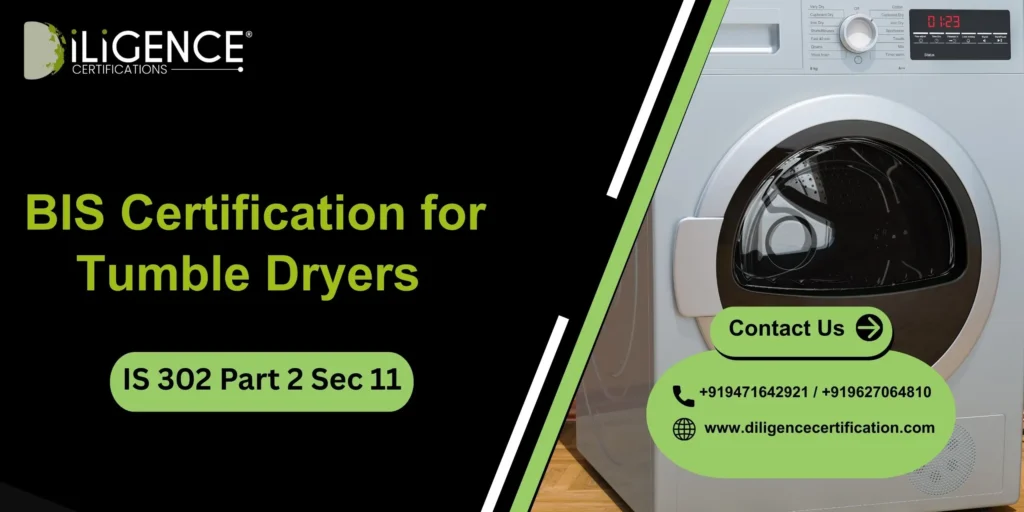
- Mandatory Compliance – BIS Certification for Tumble Dryers has been made compulsory in regard to electric tumble dryers through the IS 302 safety standard.
- Dual Standard Coverage – IS 302 Part 1 (General Safety) + IS 302 Part 2 Section 11 (Product Specific Safety).
- Covers Household & Commercial Use – It is applicable for domestic, semi-commercial, and commercial machines.
- Assures Electrical and Thermal Safety – Protects the user against electric shock, overheating, fires, and mechanical hazards.
- Essential for Indian Market Entry – Requirements for manufacturing, importation, or sales of tumble dryers within India.
Introduction
This makes tumble dryers a very important electrical appliance in India, since the modern households, laundromats, hotels, hospitals, and commercial laundry services grow very fast. These machines reduce drying time significantly and improve hygiene, but they also involve high heat, rotating parts, and electrical components that, unless manufactured correctly, may pose potential safety risks.
The Bureau of Indian Standards (BIS) has made certification mandatory for tumble dryers manufactured or sold in India to cover their performance reliability for ensuring the safety of users and electrical protection. This certification falls under the category of IS 302 Part 2 Section 11: 1994, read along with IS 302 Part 1, which lays down general safety requirements for household and similar electrical appliances.
What is BIS Certification for Tumble Dryers?
BIS Certification for Tumble Dryers is a type of conformity procedure which aims to test and verify that a product like Tumble Dryers is compliant with safety norms in India as regards electrical insulation, heating functions, mechanical strength, and other operations.
The certification is awarded on the basis of “ISI Mark Scheme,” which ensures that the product is compatible with:
- IS 302 Part 1 General safety requirements common to electrical appliances
- IS 302, Part 2, Sect. 11: 1994 – Specific safety requirements for tumble dryers
Only after the testing, inspection, and documentation verification are done, can the manufacturer or importer of the product legally mark the product ‘ISI’.
Applicable Indian Standards Explained
IS 302 Part 1 – General Requirements This standard deals with the safety of household and similar electrical appliances including:
- Protection against electric shock
- Insulation and leakage current limits
- Mechanical Strength
- Temperature increase limits
- Heat and fire resistance
IS 302 Part 2 Section 11: 1994 General Requirements for Tumble Dryers
- Heating element safety
- Rotation of drums, mechanical hazards
- Airflow and ventilation needs
- Fire prevention
Temperature control and cut-off mechanisms Both the standards are to be compiled together before the approval of BIS certification.
Key Features Covered Under BIS Certification
1. Electrical Safety It shall ensure sufficient insulation, earthing, and protection from electric shock during both normal and abnormal working.
2. Thermal Protection Checks that the internal temperatures are within safe ranges and prevent the risk of fires caused by overheating.
3. Mechanical Safety Examines safety of rotating drum, door lock system, and protection provided by guards against components in motion.
4. Fire Hazard Prevention Great importance is placed upon lint accumulation, airflow, and cooling.
5. Durability and Reliability It ensures that the appliance functions safely even after prolonged use.
Why BIS Certification is Required for Tumble Dryers
1. Legal Compliance According to the developed norms, it is illegal to sell or import tumble dryers in India without BIS certification; penalties are awarded regarding BIS Act provisions.
2. Consumer Safety Tumble dryers are high-temperature appliances, which make certification highly relevant to prevent cases of accidents and even death.
3. Quality Assurance Certification ensures that products meet standardized performance and safety benchmarks.
4. Penetrasi Market Retailers, distributors, and government buyers seem to like BIS-certified appliances.
5. Brand Trust & Credibility ISI mark enhances consumer confidence in a product and its brand reputation.
Importance vs Benefits of BIS Certification
| Importance | Benefits |
| Mandatory by law | Legal market access in India |
| Ensures user safety | Reduced liability & recalls |
| Prevents substandard products | Improved product reliability |
| Required for imports | Smooth customs clearance |
| Standardizes manufacturing | Competitive market advantage |
BIS Certification Process
Step1:Documentation
- Collect required technical documents
- Prepare product specifications
- Gather company registration details
- Ensure documents follow BIS format
Step2:Product Testing
- Send samples to a BIS-approved lab
- Conduct safety and quality tests
- Receive test reports
- Confirm compliance with BIS standards
Step3:Application Submission
- Fill out the BIS application form
- Upload all required documents
- Attach valid test reports
- Pay the necessary BIS fees
Step4:Scrutiny and Inspection
- BIS reviews submitted documents
- Authority verifies test results
- Factory/product inspection may occur
- Clarifications requested if needed
Step5:Grant of License
- BIS approves the application
- License number is issued
- Product can carry BIS mark
- Renewal required before expiry
Documents Required for BIS Certification
| Category | Documents Required |
| Business Documents | Business license/registration, ISO certificate, organizational details |
| Manufacturer Details | Factory layout, process flow chart, machinery list, production details |
| Product Documents | Product specifications, component list, user manual, model details |
| Testing Documents | Test report from BIS-recognized lab, sample details, test request form |
| Legal & Compliance | Authorization letter, brand ownership proof, trademark certificate (if any) |
| Import/Foreign Manufacturer (If applicable) | AIR (Authorized Indian Representative) details, contract agreement, overseas manufacturer documents |
Timelines, Costs, Validity & Renewal
- Timelines: Usually from 20 to 30 days, with only 7-15 days for the testing.
- Costs: The cost of the government and the test varies depending on the product. There can be some additional charges though.
- Validity: The validity period is 2 years in most situations.
- Renewal: The renewal is done before the expiration; there should be updated documents/tests the renewal
Challenges of Obtaining BIS Certification Without a Consultant
1. Complex Documentation It can be confusing to prepare as well as comprehend the meaning of various Business Income Survey (BIS) forms, technical documents,
2. Standard Interpretation Issues Misinterpretation in clauses of the standards of IS 302 has been a major cause of rejection in
3. Test Delays Failure to properly prepare the sample or failure of the tests can lead to increased time and cost.
4. Factory Inspection Readiness BIS factory audit work requires adherence to quality control and manufacturing standards.
5. Communication Barriers Working together with BIS officers and labs without experience may be frustrating and time-consuming.
Why Choose Diligence Certificate Consultancy?
1. Comprehensive Support for End-to-End Diligence Certificate conduct the whole process of BIS certification—from application to obtaining the license.
2. Expert Standard Analysis Our experts apply the standards of IS 302 diligently and help you get approved at the very first attempt
3. Laboratory Test Coordination We work with labs recognized by BIS to prevent testing mistakes and delays.
4. Factory Audit Assistance We are preparing your factory and your team to ensure that BIS inspections go smoothly.
5. Faster Turnaround & Cost Efficiency Our method eliminates risks associated with rejection, which saves time and money.
Conclusion
BIS Certification of Tumble Dryers for IS 302 Part 2 Section 11: 1994, together with IS 302 Part 1, is an imperative requirement in India. The BIS Certification of tumble dryers according to IS 302 Part 2 Section 11: 1994, together with IS 302 Part 1, is an imperative requirement in India.
Although obtaining certification can be complicated, partnering with an experienced consultant such as Diligence Certificate Consultancy can certainly aid in achieving it efficiently and with fewer errors.
Frequently Asked Questions (FAQs)
Is BIS certification mandatory for tumble dryers?
Yes, it is mandatory in India.
Which BIS standard applies to tumble dryers?
IS 302 Part 2 Sec 11 with IS 302 Part 1.
Does IS 302 Part 1 apply to all appliances?
Yes, it covers general safety requirements.
Is BIS certification required for imported tumble dryers?
Yes, imported models must be BIS certified.
What is the ISI mark for tumble dryers?
It indicates BIS compliance and product safety.
How long does BIS certification take?
Usually 4–6 weeks.
Are commercial tumble dryers covered?
Yes, both domestic and commercial dryers.
What tests are conducted under BIS?
Electrical, thermal, and safety tests.
Can BIS certification be done without a consultant?
Yes, but the process is complex.
Why choose a BIS consultant?
To reduce delays and rejection risks.