BIS Certification
 CDSCO
CDSCO
 PESO
PESO
 CPCB
CPCB
 LMPC
LMPC
 WPC Approval
 Global Approvals
 TEC
TEC
 ARAI
ARAI
 BEE
BEE
 ISO Certification
 DGCA Certification
 NOC For Steel
 APEDA Registration























 Business Registration
 FSSAI Mark Certification












 (32).jpg)
 Legal Services
 Trademark Registration
 Copyright Registration
 Patent Registration
 By
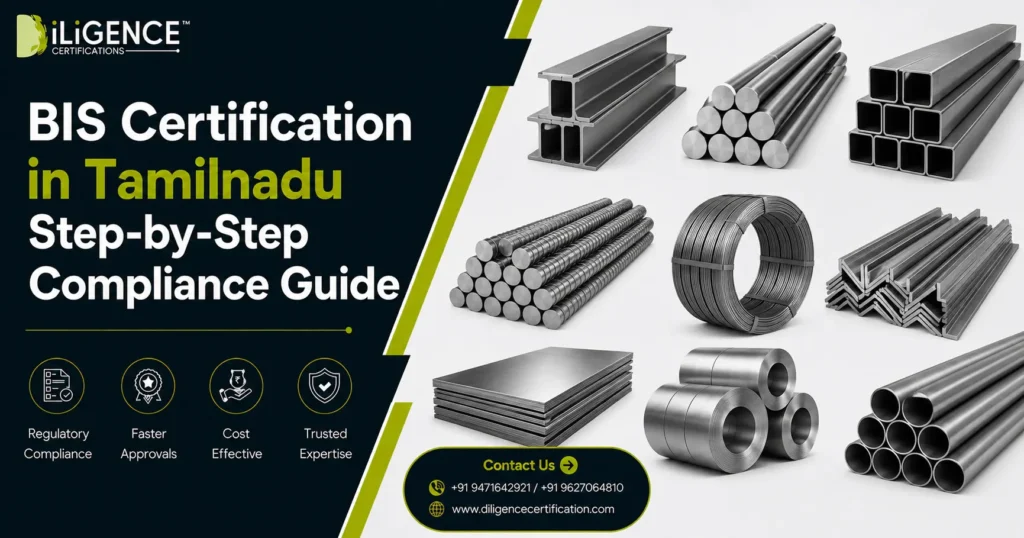
By - BIS certification in Tamilnadu is required for controlled goods to guarantee safety, quality, and market legality in India.
- The requirements are for electronic items, steel, cement, automobiles, and industrial products before their sale or import.
- The process entails testing, documentation, inspection, and approval from BIS.
Introduction
An industrial switch manufacturer in Hosur had produced units of industrial switches that were to be utilized in an infrastructure project in India.
Unfortunately, the shipment could not go through in its final stages of shipping.
The problem here did not concern any production glitch; rather, it was the problem of BIS Certification in Tamilnadu for the product range.
The process took several weeks during which additional warehousing costs arose and the company’s reputation suffered along with partial loss of the deal to a competing firm that had already obtained the necessary certification.
Such situations are quite common in the business environment of Tamilnadu. In Chennai, Coimbatore, Tiruppur, and Sriperumbudur, firms often suffer from compliance problems much more frequently than from production problems.
BIS Certification in Tamilnadu is not some kind of extra step; it is a legal control measure to determine if the product is to be admitted into the Indian market.
Knowledge of BIS Certification in Tamilnadu
The Bureau of Indian Standards (BIS) is the national body that determines the quality standards, safety measures, and performance of goods available in India.
A BIS-certified product implies:
- Adherence to Indian Standards (IS codes)
- Security measures for consumer and industry users
- Suitability for sale in the Indian market
- Approval to stamp ISI mark (for eligible products)
In Tamilnadu, where the manufacturing process is highly export-oriented and procured, BIS certification is considered a condition precedent rather than an option.
It is a “sales pre-requisite” for many industries.
Industrial Importance of BIS Certification in Tamilnadu
Tamilnadu is among the leading industrial states in India, producing heavily in the fields of automobile manufacturing, electronics, engineering, textile machinery, and heavy industries.
But, just because there is high production capacity doesn’t mean that access to markets will be assured.
Industries hit hard:
Automotive industry (Chennai-Sriperumbudur)
Manufacturers of components must follow BIS standards in case of parts related to safety.
Electrical & Electronics (Coimbatore, Chennai)
Chargers, switches, lighting equipment, and wiring devices have to strictly adhere to standards.
Engineering & Fabrication Industry (Hosur, Ranipet)
Industrial machinery falls into the category of BIS standards.
Textile Machinery Industry (Coimbatore, Tiruppur)
Mechanical and electrical components of machinery require certification.
Lack of BIS Certification in Tamilnadu will deny even the best quality products access to procurement channels.
What Products Require BIS Certification in Tamilnadu?
BIS certification is not universal for all products. It applies only to notified categories under Indian law.
Electrical & Electronic Products
- Mobile chargers
- LED lighting products
- Power adapters
- Electrical switches
- Laptops and IT equipment
Construction Materials
- Cement
- Steel bars and structural components
- Pipes and fittings
- Aggregates and building materials
Automotive Components
- Brake components
- Safety systems
- Electrical vehicle parts
Consumer Goods
- Pressure cookers
- Gas appliances
- Kitchen equipment
Industrial Chemicals & Inputs
- Manufacturing chemicals
- Processing materials
- Industrial additives
Applicability depends entirely on Indian Standard (IS code) classification.
Types of BIS Certification Schemes in India
Understanding the scheme is critical before applying for BIS Certification in Tamilnadu.
1. ISI Mark Scheme
For domestic manufacturers producing regulated goods. Includes factory inspection and periodic surveillance.
2. CRS Scheme (Compulsory Registration Scheme)
Applies mainly to electronics and IT products. Based heavily on laboratory testing.
3. FMCS Scheme
For foreign manufacturers exporting to India. Requires overseas factory inspection.
4. Hallmarking Scheme
Applicable to gold and silver jewellery certification under BIS standards.
Each scheme has different compliance intensity and documentation requirements.
Step-by-Step BIS Certification Process in Tamilnadu
The BIS process is structured but detail-sensitive.
Step 1: Identification of IS Code
Every product must be mapped to the correct Indian Standard.
Step 2: Application Submission
Application is filed on BIS portal with company details.
Step 3: Document Verification
Technical and legal documents are reviewed.
Step 4: Product Testing
Samples are tested in BIS-approved laboratories.
Step 5: Factory Inspection (if required)
BIS officials verify production setup and quality control systems.
Step 6: License Grant
Approval is issued and product can carry BIS mark.
Documents Required for BIS Certification in Tamilnadu
Documentation quality is one of the strongest success factors.
- Company incorporation certificate
- Factory license
- Product specification sheet
- Test reports from BIS-approved labs
- Manufacturing flow diagram
- Authorised signatory documents
- Quality control documentation (if applicable)
Even minor mismatch between declared specifications and test reports can delay approval significantly.
Cost of BIS Certification in Tamilnadu
There is no single fixed cost. It varies based on product type and scheme.
Cost components:
- Application fees
- Laboratory testing charges
- Factory inspection charges
- Annual licensing fees
- Consultancy or compliance service charges
Key cost influencing factors:
- Number of product variants
- Testing complexity
- Lab selection
- Re-testing requirements
For MSMEs, testing cycles often become the largest cost driver.
Timeline for BIS Certification in Tamilnadu
- CRS products: 15-30 days
- ISI Mark Scheme: 30-120 days
- FMCS Scheme: 60-180 days
Common delay reasons:
- Incorrect IS code mapping
- Incomplete documentation
- Lab testing backlog
- Inspection scheduling delays
- Product specification mismatches
Key Challenges Faced by Tamilnadu Businesses
Despite strong industrial infrastructure, compliance gaps are common.
Major issues:
- Lack of early-stage compliance planning
- Misclassification of products
- Delayed laboratory testing
- Lack of BIS regulatory expertise
- Frequent updates in standards
For instance, an electrical manufacturer in Coimbatore missed a deadline for product launch for over a month because of wrong category chosen, although all production was finished.
Benefits of BIS Certification in Tamilnadu
Business-level benefits:
- Legal approval for regulated products
- Stronger brand credibility
- Access to government procurement
- Easier entry into retail chains
- Reduced regulatory risk exposure
- Higher buyer confidence
In procurement-driven industries, BIS certification is often a mandatory vendor qualification filter.
Why Diligence Certification for BIS Certification in Tamilnadu
Diligence Certification provides structured compliance support for manufacturers, importers, and exporters dealing with BIS requirements.
Core service areas:
- End-to-end BIS application management
- Accurate IS code identification for products
- Laboratory coordination for product testing
- Factory inspection preparation support
- Documentation validation and correction
- Risk reduction in application rejection
Value in practical applications:
The majority of BIS delays occur due to mistakes in process, such as poor documentation, improper classification, or inadequate coordination of testing.
Diligence Certification aims to address such operational issues.
Practical result:
An engineering firm of medium size based in Chennai saw dramatic improvement in the approval process thanks to improvements in documentation and testing coordination.
For MSMEs, this is a matter of time to market and revenue.
Conclusion
BIS Certification in Tamilnadu is an extremely important compliance factor that affects manufacturing continuity and product acceptability in the market.
Compliance preparedness is just as crucial in the competitive industrial environment of Tamilnadu as manufacturing capacity itself.
The companies that manage to integrate compliance preparations from the early stages will have an advantage in terms of time saving and financial security.
For the manufacturers and importers in India, BIS Certification in Tamilnadu is not a bureaucratic obligation but a clear road map to access the Indian market legally.
Frequently Asked Questions
BIS Certification In Tamilnadu - What is it?
This is a certificate confirming that the product conforms to safety and quality standards set in India.
This certificate verifies that the product conforms to the appropriate Indian Standards (IS codes) released by BIS before putting the product into the market.
Is BIS Certification Mandatory in Tamilnadu?
For products falling under BIS mandatory notification.
Not all products but only those regulated by the Government fall under BIS notification requiring BIS certification.
What Products Need BIS Certification?
Electronics, cement, steel, automobile components, and selective consumer products.
It depends on the IS code classification and additional products are added every now and then under the BIS regulations.
Who Provides BIS Certification?
The Bureau of Indian Standards, Government of India.
It is an agency working under the Ministry of Consumer Affairs and takes responsibility for testing and monitoring quality of the product.
How Long Does it Take For BIS Certification?
Between 15-120 days depending on product category.
Are MSMEs eligible for BIS certification?
Yes, MSMEs are eligible for all BIS programs.
They are allowed to apply via BIS portal but most of them prefer professional assistance to save themselves from any mistake in documentation.
What if there is no BIS certification?
Products can face legal restriction or non-approval for entering the market.
Usually, the product can be blocked in customs, taken out of retail chains, or cannot participate in government tenders.
Is factory inspection compulsory?
Yes, for ISI Mark Scheme and some particular items.
BIS inspectors will check manufacturing process, quality control system, and capacity of production.
Can imported products be approved via BIS scheme?
Yes, via FMCS scheme for foreign producers.
Foreign production must follow the BIS rules and be inspected by appointed officials from BIS.
Why BIS is needed in Tamilnadu?
Because of high manufacturing volume and strict procurement procedures.
It is necessary for industries of Tamilnadu to follow the national compliance norms.