BIS Certification
 CDSCO
CDSCO
 PESO
PESO
 CPCB
CPCB
 LMPC
LMPC
 WPC Approval
 Global Approvals
 TEC
TEC
 ARAI
ARAI
 BEE
BEE
 ISO Certification
 DGCA Certification
 NOC For Steel
 APEDA Registration























 Business Registration
 FSSAI Mark Certification












 (32).jpg)
 Legal Services
 Trademark Registration
 Copyright Registration
 Patent Registration
 By
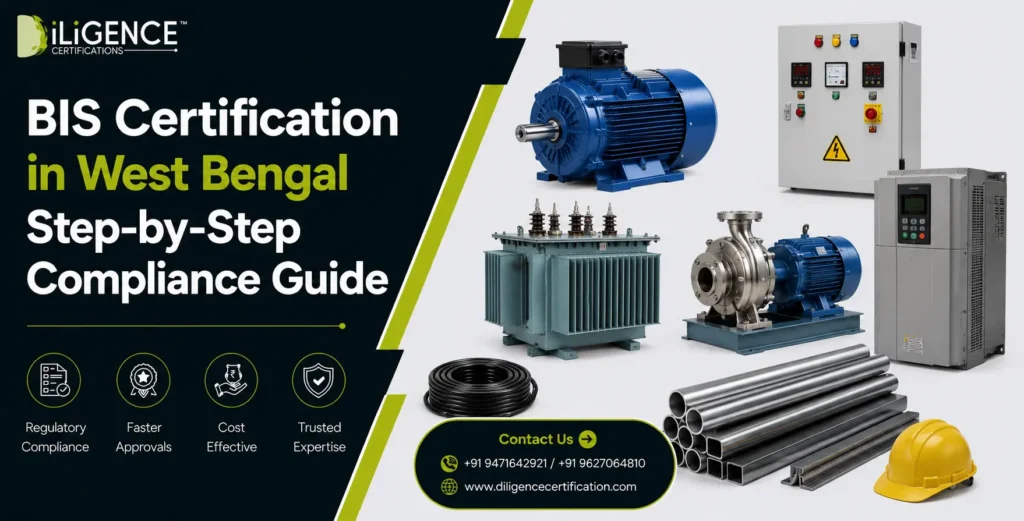
By - BIS Certification in West Bengal is compulsory for some regulated goods to ensure their safety, quality and compliance with Indian standards.
- This process includes testing, documentation and certification by Bureau of Indian Standards which provides legal entry to the market.
- This is advantageous for the companies operating in West Bengal because of improved market credibility and tender qualifications.
Introduction
There was once an electrical equipment manufacturing firm of medium size based out of Howrah which was facing problems with their shipments getting rejected time and again in Kolkata port due to lack of compliance clearance rather than any kind of quality issues.
This problem is quite common in the state of West Bengal, especially in major cities such as Kolkata, Durgapur, and Siliguri where more stringent laws on product standards are being implemented. BIS Certification in West Bengal is no longer just a regulatory process but also a commercial one.
What is BIS Certification in West Bengal?
“BIS Certification in West Bengal” denotes the compliance certification granted by the standards body in India regarding products made, imported, or marketed within the state.
This is regulated by the Bureau of Indian Standards, who ensure that products conform to set standards of safety, performance, and quality.
From a practical perspective, BIS certification implies that the product is legally marketable in India.
Why BIS Certification in West Bengal Matters
West Bengal is industrially robust in electricals, steel, textiles, and consumer goods. Thus, enforcement of compliance requirements is more stringent in comparison to smaller markets.
Major reasons businesses need BIS Certification in West Bengal:
- Mandatory for notified product categories under Indian law
- Prevents customs clearance issues at Kolkata port
- Builds trust with distributors and institutional buyers
- Essential for government and PSU tenders
- Reduces legal and financial risk during inspections
A procurement manager at a PSU based out of Kolkata once told us that almost 30% of their tenders are rejected on account of non-compliance, despite being price and technically competitive.
Types of BIS Certification Applicable in West Bengal
Different product categories require different certification schemes.
1. ISI Mark Certification
Applicable to:
- Cement
- Electrical goods
- Steel products
2. CRS (Compulsory Registration Scheme)
Common for:
- Electronics
- IT hardware
- Battery-operated devices
3. FMCS Certification
For foreign manufacturers exporting to India
Key insight:
The type of BIS Certification in West Bengal depends entirely on product classification under Indian standards.
Products Covered Under BIS Certification in West Bengal
Not all products require BIS approval, but several regulated categories do:
- Electrical appliances
- Construction materials
- Household electronics
- Industrial machinery
- Medical devices (in coordination with other regulators)
- Steel and cement products
If a product falls under mandatory BIS notification, selling it without certification is a compliance violation.
How to get BIS Certification in West Bengal?
Getting a BIS Certification in West Bengal involves a systematic procedure for products to meet quality, safety, and performance criteria defined by the Bureau of Indian Standards (BIS). The process may change based on the type of product and certification method, but carefully following all stages can reduce the chances of delays and accelerate approval:
1. Standard identification
The process begins with determining the relevant Indian Standard (IS). Each product, when applying for mandatoryBIS certification, is designated a particular Indian Standard, ensuring that its qualities, performance and safety meet the criteria. You should always choose the correct IS in accordance to your product because a mistake at this stage can be costly.
2. Filling an Application form
Following successfulIdentification Of the IS, a manufacturer fills a BIS Application Form through a dedicated online portal. The application includes detailed details about the company, manufacturing infrastructure,product characteristics, its development procedure and relevant technical paperwork. The completeness of all records guarantees smooth processing of your application without queries.
3. Testing Of Samples
A sample of your product is subsequently dispatched to a
BIS accredited lab
in India for product testing. This is to verify the standard, durability, durability and other essential aspects of your product and its compliance with the prescribed Indian Standard. A test report from this stage becomes a part of your application form.
4. Verification of documentation
BIS officers thoroughly scrutinise the information contained in your application to confirm completeness, consistency and correctness as against your product details and test results. These documents may include a factory license, certificate of incorporation of company, product design, production records, quality control methods, authorization letters etc. Any inconsistencies can create a gap and delay the entire process.
5. FactoryInspection(If Necessary)
In cases like ISI Certification, the company’s manufacturing premises will have to be visited by a BIS team for inspection of manufacturing procedures, systems for quality assurance and inspection mechanisms before a certificate may be issued.
6. BIS License Granted
On success of product test, document assessment and inspection of manufacturing infrastructure,BIS issues a Certification License. This license validates your product meets all necessary quality requirements and may therefore be tagged using BIS marks such as the ISI mark,CRS logo, etc. But remember; once certified, ongoing compliance remains essential.
Documents Required for BIS Certification in West Bengal
Businesses typically need:
- Company incorporation certificate
- Manufacturing license
- Product technical specification sheet
- Test reports from approved labs
- Identity and address proof of authorised signatory
- Factory layout (for manufacturing units)
Incomplete documentation is one of the most common reasons for delays in BIS Certification in West Bengal.
Cost of BIS Certification in West Bengal
The cost varies depending on product type and certification scheme.
Typical cost components:
- Application fees
- Testing charges
- Inspection fees
- Consultancy or facilitation charges
Higher-complexity products (like electronics or machinery) generally incur higher testing costs.
Timeline for BIS Certification in West Bengal
- CRS Certification: 15-30 days (if documents are complete)
- ISI Certification: 30-60 days
- FMCS Certification: 60-90 days or more
Delays usually occur due to:
- Test failures
- Documentation gaps
- Factory inspection scheduling
Benefits of BIS Certification in West Bengal
Obtaining BIS Certification in West Bengal brings various advantages for manufacturers, importers, as well as brand owners. Besides satisfying all regulatory demands, certification aids business entities to enhance the market standing, broaden brand reputation and reach out throughout India.
1. Market Legality
By receiving BIS certification, manufacturers and importers certify that all products fulfill BIS’ mandatory quality standards, which results in the compliance of BIS regulations as required for market selling of their respective products throughout the country without encountering any regulatory challenges. Further, the risk related to product rejection, clearance customs duties, customs duty fine and similar, is significantly reduced while inspecting.
2. Improved Brand Trust
A BIS certification mark helps consumers across various retail and corporate channels in identifying the standard of the product and also helps in building consumer confidence in the respective brand name. Such certified products are widely recognized for fulfilling all the basic quality parameters set by BIS; therefore, customers rely more on it, in comparison to products that lack the BIS Certification.
3. Tender Eligibility
Most government tender bodies, PSUs, as well as enormous corporate sector companies are in requirement for buying BIS certified products and also prefer including this condition in their procurement plans. Having BIS certification provides you an extra edge while submitting tenders as it offers the qualification to bid on greater valued contracts as well as projects.
4. Reduced Compliance Risk
Getting BIS certified assists manufacturers, importers as well as brand owners to stand up to the required legal requirements in relation to their respective product and Indian product standards. In doing so, a business can successfully mitigate compliance related expenses including customs fines, product recalls, product liability law issues as well as shipment delays.
5. Market Expansion
A BIS Certification Certification enables various entities to grow in new territories as well as enter various distribution networks across India. Distributors and wholesalers tend to be more welcoming to certified goods, enabling faster distribution as well as a broader customer reach. Hence, the businesses achieve a faster entry in new markets as well as build long-term credibility on the basis of BIS certification which eventually aids for expanded distribution, market expansion and the business development.
Challenges in BIS Certification in West Bengal
Even experienced manufacturers face challenges:
- Misclassification of product category
- Delays in lab testing availability
- Documentation mismatch
- Lack of awareness of updated standards
A common observation among compliance consultants is that nearly 40% of delays come from initial application errors.
Testing and Laboratory Coordination Challenges
Testing is another major dependency in BIS Certification in West Bengal.
BIS-approved laboratories operate under strict scheduling systems. Once a product sample is submitted, the testing cycle depends on:
- Lab workload
- Product complexity
- Required safety parameters
- Retesting needs (if initial results are inconclusive)
A delay at this stage has a cascading effect on the entire certification timeline.
For example, in consumer electronics, a single non-compliance in electrical safety parameters may require retesting, adding 10-20 additional days to the process.
This is why coordination with labs is not optional but a strategic necessity.
Why Systematic Compliance Handling Matters
Systematic compliance handling ensures that each stage of BIS Certification in West Bengal is executed in a structured sequence rather than an ad-hoc manner.
Without structured handling:
- Applications may enter incorrect review cycles
- Testing delays become untracked
- Regulatory queries remain unresolved longer than necessary
With structured handling:
- Classification is verified before submission
- Documentation is pre-audited
- Lab coordination is planned in advance
- Scrutiny queries are resolved systematically
This approach significantly reduces uncertainty in approval timelines.
How Diligence Certifications Supports BIS Certification in West Bengal
At this stage, most businesses require structured guidance rather than trial-and-error approaches.
Diligence Certifications provides:
- End-to-end documentation support
- Product classification assistance
- Coordination with BIS-approved labs
- Application tracking and compliance updates
Why Choose Diligence Certifications for BIS Certification in West Bengal
The process of obtaining BIS Certification in West Bengal goes beyond simply filing an application form. Product Classification, accurate documentation, and coordination with BIS approved testing labs are key aspects of the process which often lead to delays.
That is where the importance of systematic compliance handling comes into play.
Diligence Certifications provides structured compliance assistance to manufacturers, importers, and brands by ensuring the entire BIS certification process is streamlined in a compliant manner. The aim here is to minimize the delays that may occur due to inaccurate documentation and incorrect testing.
Benefits of getting help from Diligence Certifications:
- Handling the BIS Certification process for West Bengal applications comprehensively
- Product categorization based on Indian Standards set by BIS
- Coordination with BIS certified testing labs
- Efficient handling of all issues that come up during scrutiny
- Lower risks of rejection of your application and delays
In case of industries dealing with electrical goods, consumer electronics, and industrial machinery even minor documentation issues might lead to several weeks of delays.
Conclusion
BIS Certification in West Bengal is no more a mere formality but a requirement for compliance that influences business operations, market reach, and credibility.
For the manufacturers and importers working in the cutthroat industry in West Bengal, certification will reduce risks and promote sustainable business growth in the long run.
The well-managed BIS Certification in West Bengal process guarantees not only the approval but also compliance in the changing market scenario.
Professional compliance services offer a structured approach to streamline the whole process.
Frequently Asked Questions
Do you need BIS Certification in West Bengal?
Yes, this certification is mandated by the Indian Government under the relevant compulsory certification schemes for particular items. You absolutely can’t market or import such items legally in West Bengal or other parts of India if they don’t have the essential BIS approval. That applies to you whether you’re the maker, distributor, or even just the owner of a particular brand of such an item.
How long will BIS Certification take?
It largely hinges on what kind of item we’re talking about and the applicable BIS scheme. For CRS certification it takes about 15-30 days. For theISI mark it’s usually a bit longer, from about 30 to 60 days.
If it’s for a foreign company wanting certification for that market under the FMCS scheme, it can stretch from 60 to 90 days or more.
Don’t forget factors such as clear documents, proper laboratory testing, and smooth factory inspection scheduling!
What’s the outcome of not having it?
Let’s be blunt: the results can be tough. The authorities will most likely seize items. In some cases they might send import shipments back.
There could be financial penalties or even lawsuits.
And oh, that’s just the immediate hit to your reputation and workflow!
Can traders get certified?
Typically, the license is granted to the maker. BUT depending on the BIS scheme, importers, the authorized Indian representative (AIR) for foreign companies or even brand owners might play a key role in getting things done. If you just distribute without manufacturing or importing, you can't generally get certified on your own.
Is the approval valid countrywide?
Yep, it certainly is. Once BIS has issued a valid certificate for your product, you’re golden from the Himalayas to the southern coast. You can sell all over India without any issue. Obviously, keep maintaining the certification and all related rules to ensure it stays current!
Who in West Bengal needs this mark?
If you’re manufacturing, importing, a foreign company selling into India, or own a brand for products on the mandatory list of BIS-you’re in the scope. Before you put any product on the shelves in the Indian market, ensure it has the required certification.
Are small businesses also included?
Absolutely. The category of the product is the deciding factor, not how large or small your company is. It doesn't matter if you're a global powerhouse or a local startup; if the product requiresBIS certification, you gotta get it.
Do we have to undergo a factory inspection?
Sometimes yes, sometimes no, depending on which BIS scheme we're looking at! For the Compulsory Registration Scheme (CRS), inspection before registration usually isn’t necessary. On the flip side, if you’re going for the ISI Mark, you’ll typically have an inspection at your factory to ensure production, quality control, testing and capacity are all up to the required standards.
How long is it valid for?
Again, it depends. But generally, for many certification schemes, the license is good for about 1 to 2 years. After that, you just need to renew it to continue your business, assuming you stay in compliance and meet the renewal requirements, of course.
What happens when it runs out of time?
Well, you definitely can’t use the BIS mark on that product after it expires! You have to stop production, selling, and importing of that item until you have renewed the certificate. Failing to do so can result in official action, legal troubles, and the shutdown of your operations. It is always a great idea to begin the renewal procedure ahead of time.