

 BIS Certification
 CDSCO
CDSCO
 CPCB
CPCB
 LMPC
LMPC
 WPC Approval
 Global Approvals
 TEC
TEC
 ARAI
ARAI
 BEE
BEE
 ISO Certification
 DGCA Certification
 NOC For Steel
 APEDA Registration










 Business Registration
 FSSAI Mark Certification










 Legal Services
 Trademark Registration
 Copyright Registration
 Patent Registration
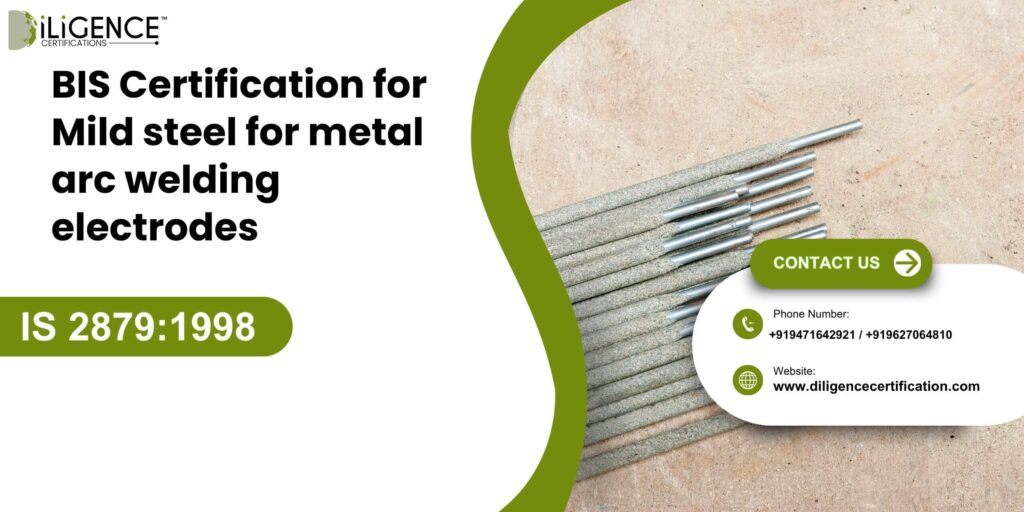
- A BIS certification as per IS 2879:1998 is compulsory for metal arc welding electrodes of mild steel.
- The standard specifies the chemical composition, tolerances, and testing requirements.
- The process involves application, audit, testing, and licence grant by BIS.
- Certification builds buyer trust, improves quality compliance, and expands market access.
- Licence holders are required to keep up their test reports, ensure correct marking and be subject to periodic BIS inspections.
Introduction
One of the companies that produces wire rods in Raipur was continuously facing delays at customs due to the absence of BIS certification for their products as per IS 2879:1998. Though their steel was of good quality as per the internal tests, steel could not be sold in the market legally without a BIS license. After going through the testing and paperwork, they got the certification and thus were able to regain the trust of the buyers. These instances are a clear indication of how BIS permission has become pivotal for manufacturers and importers of mild steel utilized in the production of welding electrodes. Bureau of Indian Standards
What is IS 2879:1998?
IS 2879:1998 is a BIS standard that specifies the quality and testing requirements for mild steel used in making metal arc welding electrodes. It ensures that the steel used as electrode core wire meets uniform chemical and mechanical standards for reliable welding performance.
Key Points:

- Defines the material for billets, blooms, and wire rods intended for the fabrication of electrodes.
- Defines limits for carbon, manganese, phosphorus, sulphur, and other elements.
- Specifies mechanical strength, surface finish, and dimensional tolerances.
- It also indicates the sampling, testing, and inspection frequency procedures.
- Certification by BIS that is compulsory indicates that the product is safe, of good quality, and conforms to the trade rules. ISI MARK
Why is BIS Certification Mandatory
BIS certification is necessary for guaranteeing that only quality-assured and standardized materials are those which are produced, sold, or imported in India. The specification of this requirement under IS 2879:1998 for mild steel used in metal arc welding electrodes serves to make the quality as well as the safety standard the same in all industries where the welding integrity is of the utmost importance.
Key Points:
- It is enforced by the Government of India through the Steel and Steel Products (Quality Control) Order.
- Prevents the use of substandard steel, which may cause welding failures or structural problems.
- Guarantees that manufacturing companies carry out the production and testing activities as per BIS standards and also follow the proper industries standards.
- Builds buyer and user confidence by verifying compliance with national quality benchmarks.
- Non-certified products can be seized, rejected, or banned from sale or import in India.
Importance & Benefits of BIS Certification
| Importance | Benefits |
| Ensures compliance with IS 2879:1998 and government Quality Control Orders | Legal approval to manufacture, sell, or import within India |
| Maintains uniform quality and chemical composition of mild steel | Enhances product reliability and welding performance |
| Protects end users and industries from poor-quality materials | Builds trust with buyers and government organizations |
| Supports traceability and accountability in production | Increases chances of winning tenders and industrial contracts |
| Prevents market entry of substandard or unsafe steel products | Reduces risk of rejections, penalties, and shipment delays |
| Aligns with India’s “Make in India” and quality-driven manufacturing goals | Improves brand reputation and market competitiveness |
| Helps exporters meet global quality benchmarks | Opens access to international markets and certification recognition |
Step-by-Step Process of BIS Certification

Step1:Documentation
- Collect all required documents such as factory layout, process flow chart, and quality manual.
- Ensure product specifications align with the relevant Indian Standard (e.g., IS 2879:1998).
- Produce evidence for manufacturing capability, testing facilities, and production records.
- It is better to check the documents for completion by yourself before handing them over to the office so that your submission will not be rejected or your resubmission delayed.
Step2:Product Testing
- Make the product ready for sampling and send them to a BIS-approved laboratory for testing according to the standard.
- In general, the tests involve chemical, physical, and visual examination.
- Furthermore, maintain a record of the batch numbers and test results for later use.
- Certification is granted only to those products that meet all the test parameters.
Step3:Application Submission
- Filing an application online through the BIS portal under the pertinent scheme (ISI or CRS) is the way to go.
- Also, along with the application, the test reports, factory details, and other documents should be submitted.
- The application and testing fees, as prescribed, should be paid as well.
- After that, a BIS officer is allocated to assess the application.
4. Scrutiny and Inspection
- BIS officials verify the documentation and test results to confirm that all papers are there and the regulations are followed.
- To verify production capacity and laboratory facilities, a plant visit is scheduled.
- Inspectors cross-check on-site testing, equipment calibration, and quality control systems.
- Non-conformities, if found, must be corrected before final approval.
5. Grant of Licence
- After a successful inspection and meeting of requirements, BIS will be granting the licence.
- The manufacturer is allowed to put the Standard Mark on the products that have got the certificate.
- The license number and validity period are displayed on all the appropriate packaging and documents along with the Standard Mark.
- Statements of continuous surveillance, including sample testing, serve as evidence of compliance with the provisions.
Documents Required for BIS Certification
| Category | Documents Required |
| Business Details | Company registration certificate, GST certificate, and factory licence |
| Manufacturing Setup | Factory layout plan, process flow chart, and list of machinery/equipment |
| Quality Control | Internal test reports, quality manual, and calibration records |
| Product Information | Product specification sheet, drawings, and lab test report as per IS 2879:1998 |
| Testing Facilities | List of in-house testing equipment and BIS-recognised lab tie-up proof |
| Personnel Details | Details of technical staff and quality control in-charge |
| Authorisation | Nomination letter or authorisation letter for BIS correspondence |
| Supporting Documents | Undertaking for conformity, trademark certificate (if any), and utility bill for site verification |
Timelines, Costs, Validity & Renewal
- Timelines: The duration for Bis Certification is from 4 to 8 weeks for local manufacturers and for foreign applicants, it is slightly longer.
- Costs: There are fees for the application, product testing, inspection, and annual license maintenance that change depending on the product scope.
- Validity: The Bis license is valid for 2 years only from the date of issue.
- Renewal: The application for renewal has to be made before the expiration of the licence along with the test report and records; the period of validity can be from one to five years.
Why Choose Diligence Certifications
Diligence Certifications is an expert in managing BIS, ISI, and various regulatory approvals for different industrial sectors. By closely working with BIS officials and testing laboratories for several years, the company is able to deliver the certification in a short time without any mistakes in the process.
Key Reasons
- Complete support from the very beginning of the process until the issuance of the licence.
- Efficient cooperation with the labs recognised by the BIS for the purpose of accurate testing.
- Success record of attaining BIS approvals under IS 2879:1998.
- Assistance in local and external audits, renewals, and post-licence activities.
- Transparent process management with regular progress updates.
Conclusion
In India, the first mandatory action to obtain a BIS certification for mild steel metal arc welding electrodes as per IS 2879:1998 is the producers or importers of such products. Certification is a sign of quality, winning customer trust, and meeting government regulations. You can be certified if you have the correct documentation, testing, and process control without facing any major obstacles. By regular maintenance and renewal, your permit will always be valid and your good reputation will be kept. The whole job gets less exhausting, more accurate, and comfortable if you hire a professional like Diligence Certifications to do it for you.
Frequently Ask Questions
What is IS 2879:1998?
IS 2879:1998 refers to a standard of defining the properties of mild steel used for metal arc welding electrodes. Additionally, the standard also specifies the chemical composition and the tests involved in the operations.
Does BIS require a mild steel certified to IS 2879:1998 standard?
In India, the steel industry requires BIS certification to be in conformity with the Steel and Steel Products (Quality Control) Order by the Government of India. The acquisition of such a certificate is a prerequisite for any production, sale, or import activity related to steel in India.
Who is required to get BIS certification under IS 2879:1998?
Manufacturers, importers, and dealers of mild steel billets, blooms, and wire rods for metal arc welding electrodes have to obtain a BIS certification before entering the Indian market.
What are the major requirements of IS 2879:1998?
This standard requires the use of chemicals such as carbon, manganese, phosphorus, and sulphur and at the same time, provides mechanical strength together with the dimensional tolerances and surface finish requirements.
How long is the certification process?
Under normal circumstances, the whole certification process where an entity is granted a certificate takes from 4 to 8 weeks and the time might be extended by a few days or weeks depending on the tests and inspections schedule if the applicant is from abroad.
What are the necessary documents for BIS certification?
Among the most important documents are: factory licence, GST certificate, process flow chart, quality manual, product test reports, and documents confirming the availability of in-house or BIS-recognised lab facilities.
What do BIS officials do during the inspection?
BIS officers as part of their role in issuing the licence conduct a thorough check-up of the manufacturing unit through facility verification, quality control system assessment, testing equipment checking, and conforming with IS 2879:1998.
How long can one use a BIS licence?
BIS licence is of a validity period of two years and the holder can continue producing the tested products and, upon payment of the renewal charges, extend the validity of his licence from one to five years.
What advantages does BIS certification bring?
Among the main benefits of implementing such certification is the quality level being held for the end product, improvement of customer loyalty, and opening of government and industrial tenders, thereby providing opportunities. Besides, it serves as a promise to Indian regulatory standards.
How can Diligence Certifications facilitate getting BIS approval?
Diligence Certifications is a one-stop shop with the BIS that takes care of the entire process from support through documentation, testing, audit preparation, to licence renewal. As such, it facilitates quick and error-free certification.