



 BIS Certification
 CDSCO
CDSCO
 CPCB
CPCB
 LMPC
LMPC
 WPC Approval
 Global Approvals
 TEC
TEC
 ARAI
ARAI
 BEE
BEE
 ISO Certification
 DGCA Certification
 NOC For Steel
 APEDA Registration










 Business Registration
 FSSAI Mark Certification



 Legal Services
 Trademark Registration
 Copyright Registration
 Patent Registration
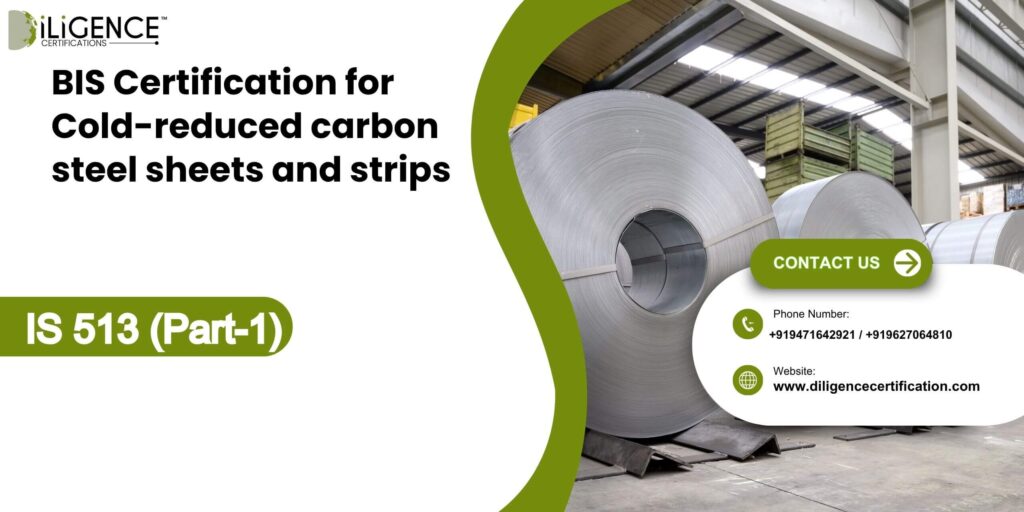
- BIS certification granted as per IS 513 (Part-1): 2016 is termed for cold-reduced carbon steel sheets and strips.
- The standard promotes the use of a defined level of quality with respect to chemical, mechanical, and surface properties.
- It is essential for automotive, appliance, and engineering applications.
- BIS certification is obtained through audits, testing, traceability, and then issuance of the licence.
- It is beneficial for market credibility, compliance, and competition.
Introduction
A manufacturer of steel located in Pune lost a significant automotive contract because their cold-reduced steel sheets did not have BIS certification in accordance with IS 513 (Part-1): 2016. The rejection produced both lost revenue and lost reputation. When precision is important, such as for cold forming or cold drawing, this type of certification is not optional; it is essential. BIS ensures that the steel passes strict tests for chemical, mechanical, and surface quality. For manufacturers and suppliers, having BIS certification is more than just a step toward regulatory compliance —it is a trusted validation. Because of this trusted validation, manufacturers and companies are more likely to attract premium-paying customers and secure ongoing contracts. Bureau of Indian Standards
What is IS 513 (Part-1): 2016?
The standard lists the grades, chemical composition, mechanical properties, sizes, and test methods for cold rolled steel intended for forming purposes. It ensures that the materials have a common quality, specificity for processes such as deep drawing, bending or folding, with no risk of failure or surface breaks.
Key Points:

- Covers cold-reduced carbon steel sheets and strips up to about 4 mm thickness.
- Specifies grades such as CR1 to CR5 for varying drawing and forming qualities.
- Defines chemical composition limits and mechanical test requirements.
- Includes surface finish classifications and dimensional tolerances. ISI MARK
- Ensures uniformity and reliability for manufacturers supplying to automotive, electrical, and appliance industries.
Why is BIS Certification Mandatory
In order to demonstrate that cold-reduced carbon steel sheets and strips for cold forming and drawing complies with the national safety and quality standards set forth under IS 513 (Part-1): 2016, BIS certification is required. The Government of India, under the Quality Control Orders (QCOs), made this accreditation mandatory for domestic manufacturers and for imports in order to provide a level playing field in respect of product quality and to protect the end-users of the products.
Key reasons
- Quality assurance: Provides assurance that intermediates meet the chemical, mechanical, and surface, deal requirements of the standard.
- Consumer and industry safety: Prevents structural failures or cracks during forming, drawing, or pressing operations.
- Regulatory compliance: Required under the Steel and Steel Products (Quality Control) Order issued by the Ministry of Steel.
- Market credibility: Provides the right to jump into the market with the BIS Standard Mark, which is recognized and trusted by OEMs and buyers throughout India.
- Import control: Ensures that imports are adhering to Indian verifiable standards in order to ensure fair competition and product reliability.
Importance & Benefits of BIS Certification
| Importance | Benefits |
| Ensures compliance with BIS and government quality orders | Legal approval to manufacture and sell in the Indian market |
| Guarantees consistent material quality | Fewer rejections and higher customer satisfaction |
| Required by OEMs and major buyers | Builds strong market reputation and client trust |
| Standardizes production and testing | Improves efficiency and reduces quality variations |
| Controls substandard imports | Protects domestic manufacturers and ensures fair competition |
| Aligns with global standards | Enhances export potential and international acceptance |
Step-by-Step Process of BIS Certification

Step1:Documentation
- Collect all mandatory documents such as factory license, test reports, and quality manuals.
- Ensure product details, process flow, and machinery lists are clearly defined.
- Verify calibration and maintenance records of testing equipment.
- Prepare internal quality and traceability records for BIS scrutiny.
Step2:Product Testing
- Send product samples to a BIS-recognized laboratory for testing.
- Tests must comply strictly with the applicable Indian Standard (e.g., IS 513 (Part-1): 2016).
- Testing covers chemical composition, mechanical properties, and surface finish.
- Obtain a certified test report to attach with your BIS application.
Step3:Application Submission
- BIS registration application is to be submitted online through the BIS portal.
- Upload all your supporting documents, test reports, and factory details.
- Make the application and inspection fee payments if applicable.
- Accuracy and completeness are two main points that help the application to be processed without getting rejected or delayed.
Step4:Scrutiny and Inspection
- BIS officials scrutinize the documents and product test reports submitted by the applicant.
- A factory inspection to confirm manufacturing capability and quality systems will be arranged.
- Inspectors evaluate raw material control, testing procedures, and product traceability.
- Non-conformities if found should be fixed before the issuance of approval.
Step5:Grant of License
- After a successful verification of compliance, BIS grants the license to employ the Standard Mark (ISI)
- The license indicates the product scope, grade, size range, and standard reference.
- The manufacturer is obliged to keep up with the quality control and proper record-keeping.
- BIS periodically performs surprise checks to make sure the standards are still being followed lab followed.
Documents required for BIS Certification
| Document Type | Description |
| Factory License | Proof of legal manufacturing operations and address. |
| Product Test Report | Issued by a BIS-recognized lab as per relevant IS standard. |
| Manufacturing Process Flow | Step-by-step outline of production and quality control. |
| Quality Control Plan | Details of in-house testing, inspection, and calibration systems. |
| Raw Material Records | Source, grade, and inspection details of input materials. |
| Machinery & Equipment List | List of production and testing equipment with calibration status. |
| Authorized Signatory ID | Proof of identity and authorization letter from the company. |
| Trademark or Brand Certificate | Proof of ownership of the brand to be marked with ISI logo. |
| Layout & Location Map | Factory layout showing manufacturing and testing areas. |
| Previous Certifications (if any) | Copies of ISO or previous BIS licenses for reference. |
Timelines, Costs, Validity & Renewal
- Timeline: Generally 30-45 days for Indian manufacturers, but may take 4-6 months for foreign applications.
- Costs: Funds the application costs, candidacy testing, inspector visits and annual license fee (scope dependent).
- Validity: Valid for 2 years and inspected as long as in compliance.
- Renewal: When updated reports are available, apply before the expires to recover for maintains for a duration of 5 year.
Why Choose Diligence Certifications
- Expertise: Substantive experience in the application for BIS certification of steel and alloy products under IS 513 (Part-1): 2016.
- Full-Service: Field assistance including: documentation preparedness, product testing, audit preparation, and post-approval compliance.
- Quick Approvals: The ability to work directly with BIS officials to ensure conformity and limited delays.
- Technical Guidance: Comprehensive expertise on material grades, test parameters, and definition of scope to significantly avoid rejection.
- Dependable After-Service: Ongoing support for any management of surveillance audits, renewals, and subsequent request for expanded scope.
Conclusion
BIS certification for cold-reduced carbon steel sheets and strips in accordance with IS 513 (Part-1): 2016 Congratulations now means that your product has been proven to meet Indian national quality and safety standards. Furthermore, the BIS mark on your product brings you greater credibility with OEMs or potential customers and minimizes the risk of your product being rejected which makes it easier for your product to enter the market. A BIS certification represents proof of compliance for manufacturers as well as confidence and technical capability. Diligence Certifications will assist you through the process with speed, precision, and compliance and again, to allow your organization to continue with its affirmation of quality assurance, ultimately building trust in the marketplace.
Frequently Ask Questions
What is BIS certification for cold-reduced carbon steel sheets and strips?
BIS certification is an official recognition from the Bureau of Indian Standards (BIS) that indicates that metal sheets and strips are in line with the requirements of IS 513 (Part-1): 2016 standards and thus can be used for cold forming and drawing applications.
Why is BIS certification compulsory for this product?
The Ministry of Steel by the Quality Control Order (QCO) has made it compulsory to have a BIS certificate to ensure product quality, prevent import products of inferior quality, and guarantee the safety of the final consumers.
What kind of industries need BIS-certified cold-reduced steel sheets?
BIS certified metal sheets are majorly used in the industries of automotive, appliance, and engineering, where accuracy in the processes of forming, drawing, and bending is highly required.
What grades are mentioned in IS 513 (Part-1): 2016?
This standard defines the grades from CR0 up to CR5, prescribing various levels of formability and drawing quality which can be used for different purposes.
What are the tests for BIS certification?
Testing methods cover the evaluation of the material's chemical composition, tensile and yield strength measurement, elongation, surface finish, and size accuracy.
How long does it take to get BIS certification?
By and large, in the case of Indian factories, the time period needed is around 30 to 45 days. The waiting time for foreign producers can be as long as 4–6 months due to sample testing and inspection from the area.
What documents are required for the BIS application?
Major documents are a factory license, product test reports, process flow chart, quality control plan, equipment list, and brand authorization certificate.
What is the validity of the BIS license?
The BIS license is valid for two years, and it can be extended to a maximum of five years if the conditions of compliance and updated test reports are met.
If a manufacturer does not maintain BIS compliance, what are the consequences?
Non-compliance by a manufacturer may lead to actions such as suspension or cancellation of the license, product recall, and imposition of fines as outlined by QCO regulations.
How can Diligence Certifications help in obtaining BIS certification?
Diligence Certifications is the perfect partner to get a BIS certificate accomplished. The company provides the following services for you: document preparation assistance, testing coordination, audit support, and license submission along with post-compliance.