 BIS Certification
 CDSCO
CDSCO
 PESO
PESO
 CPCB
CPCB
 LMPC
LMPC
 WPC Approval
 Global Approvals
 TEC
TEC
 ARAI
ARAI
 BEE
BEE
 ISO Certification
 DGCA Certification
 NOC For Steel
 APEDA Registration













 Business Registration
 FSSAI Mark Certification










 (32).jpg)
 Legal Services
 Trademark Registration
 Copyright Registration
 Patent Registration
 By
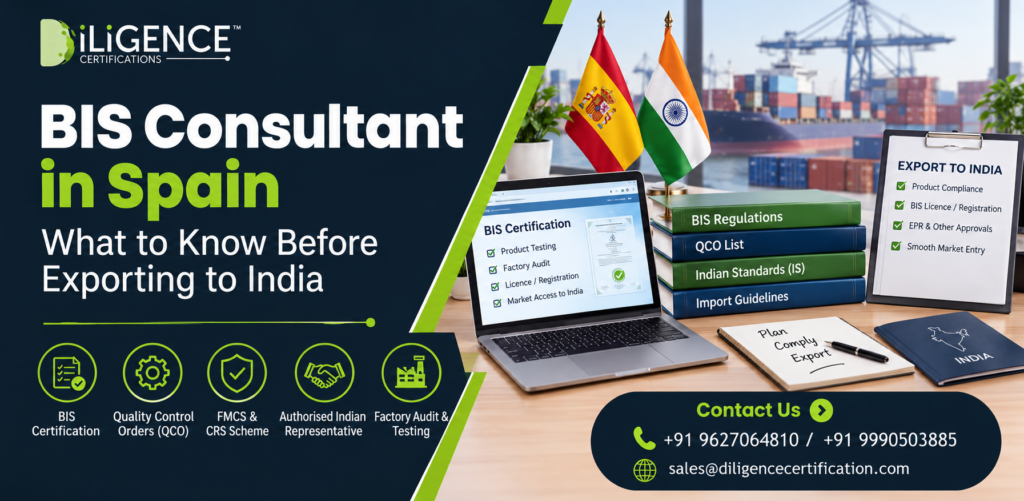
By - A BIS consultant in Spain helps Spanish manufacturers get the BIS licence or registration they need to sell their products in India.
- CE marking does not replace BIS. If your product is covered by a Quality Control Order you must get BIS certification separately.
- Most products go through FMCS. Electronics and IT goods go through CRS. You must appoint an Authorised Indian Representative.
- Remember, only the manufacturer can hold the BIS licence. Each factory needs its approval. Importers and distributors cannot apply on your behalf.
- It’s best to start with a consultant who first checks your product explains all costs clearly. Doesn’t promise fixed dates or guaranteed approval.
Introduction
A few months ago, a Spanish factory owner wrote to us with a simple question. His distributor in India had placed a big order, but the Indian importer was now asking for a “BIS licence”. He had never heard of it. His products already had CE marking, and he thought that was enough.
It was not The factory owner lost two weeks just finding out what BIS was. Those two weeks could have gone into the application. this is the story of many exporters. When people search for a BIS consultant in Spain they usually have one problem: an Indian buyer is. Nobody in the company knows how BIS works.
This guide explains the process, in plain words so you know what to expect before you speak to any consultant.
What Is a BIS Consultant in Spain?
A BIS consultant in Spain helps Spanish manufacturers get certification, from the Bureau of Indian Standards so their products can be sold in India. The consultant checks whether your product needs BIS certification. The consultant finds the Indian Standard. The consultant arranges an Authorised Indian Representative. The consultant prepares the required documents. The consultant applies on the BIS portal. The consultant supports you during the factory audit and product testing. The consultant can be based in India or Spain. The consultant must understand BIS rules well.
Think of the consultant as a guide who has walked this road before. You still run your factory, but they tell you which turn to take and which papers to carry.
Why Spanish Manufacturers Need BIS Certification
India does not accept every product just because it is safe in Europe. For many product types, the Indian government has issued Quality Control Orders (QCOs). A QCO says that a product must follow a specific Indian Standard and carry the BIS mark before it can be imported or sold in India.
In recent years, India has added many more products under such rules. These include items like steel products, electrical appliances, fasteners and hand tools, among others. The list keeps changing, so you should always check it for your own product.
Here is the point many European companies miss. CE marking is a European requirement. It does not replace BIS. Your Indian importer cannot clear the goods if your product falls under a QCO and you do not hold the right BIS licence or registration.
For a Spanish exporter, the risk is not a fine on day one. It is a container waiting at an Indian port while your buyer asks for answers you do not have.
Which BIS Scheme Applies to Your Product?
BIS has more than one route. The correct one depends on what you make.If you are not sure which scheme fits, do not guess. A wrong choice at the start can cost you months later.
FMCS (ISI Mark, Scheme I)
The Foreign Manufacturers Certification Scheme (FMCS) has been running since the year 2000. Under it, BIS gives a licence to a foreign manufacturer to use the Standard Mark on a product that meets an Indian Standard. According to the BIS website, it covers all products except Electronics and IT goods notified by MeitY. The licence is handled by the Foreign Manufacturers Certification Department in New Delhi.
CRS (Electronics and IT Goods)
The Compulsory Registration Scheme (CRS) is for electronics and IT products notified by the Government of India. It works differently from FMCS. The focus is mainly on testing the product in an Indian lab and registering it with BIS.
7 Steps to Get BIS Certification from Spain
The steps below apply mostly to FMCS. Small details change from one product to another.
Step 1: Check if your product needs BIS
Start with your product name and its HS code. Match it with the current QCO list. If it is not on the list, BIS may not be compulsory, though your buyer may still ask for it.
Ask your Indian buyer for the exact product description and HS code they use for customs. Many delays start because the two sides use different names for the same product.
Step 2: Find the right Indian Standard
Every BIS licence is tied to an Indian Standard (IS code). Many Indian Standards are close to European ones, but not identical. Small differences in tests or limits can change your product design or test plan.
Step 3: Choose an Authorised Indian Representative
An Authorised Indian Representative (AIR) is a person or company that is based in India and talks to BIS on your behalf. BIS rules say that every manufacturer must pick an Authorised Indian Representative. Pick one carefully. That Authorised Indian Representative will be with you, for the time you have the licence.
Step 4: Gather your documents
You will usually need information about your factory, your manufacturing process, the testing equipment you use details about the product, brand information and the Authorised Indian Representative authorisation letter. All documents must be, in English. Missing or incorrect papers are the cause of delays.
Step 5: Apply on the BIS online portal
manufacturers use the Manak Online system to apply. Your consultant or the Authorised Indian Representative normally helps with filling the form and uploading the files.
Step 6: Factory audit and product testing
BIS checks whether your factory can make the product consistently. Your product is also tested in a BIS‑recognised laboratory as required. Remember that the factory visit is arranged for your plant in Spain so your team must be ready with records, test equipment and trained staff.
Step 7: Get the licence. Keep it active
After approval you receive the licence and can use the BIS mark. The work does not end there. BIS may do follow‑up checks. Take market samples. Licences must also be renewed on time so check the validity period, on the BIS website.
What Makes Spain-Based Exporters Different?
Most BIS guides are written for Chinese, German or US companies. Spanish manufacturers face a few practical points that rarely get discussed.
- Time difference. India is about 3.5 to 4.5 hours ahead of Spain, depending on the season. Calls with BIS-related teams need planning.
- Language. BIS forms and communication are in English. Your technical team may need help preparing English documents.
- Spanish factory audits. The audit takes place at your site, so you need a plan for travel arrangements, interpreters and record-keeping.
- European habits. Many Spanish companies already follow ISO and EN standards. This helps, but you still have to show compliance with the Indian Standard.
- Only the manufacturer can hold the licence. Traders, distributors or importers cannot apply in your place. Each manufacturing site also needs its own approval.
Common Mistakes Spanish Exporters Make
The same few errors keep coming up.
- Thinking CE marking is enough.
- Waiting until the Indian buyer places a big order. Certification can take several months, sometimes longer, depending on testing and audit schedules.
- Choosing an AIR only because the fee is low.
- Sending incomplete or mismatched documents.
- Ignoring the licence after approval, which can cause trouble at renewal.
- Relying on old blog posts. Rules and dates have changed many times, as the Scheme X story shows.
How to Choose a BIS Consultant for Spanish Manufacturers
Before you sign with anyone, ask these questions.
- Can they tell you in writing whether your product needs BIS, and under which scheme?
- Will they explain every fee and cost clearly, including testing, audit and AIR charges?
- Do they speak to you in simple English and reply on time?
- Will they support you after the licence is issued?
- Do they avoid big promises? Nobody can guarantee BIS approval or a fixed date, because BIS makes the final decision.
If an agent promises a very fast licence at a very low price, be careful.
Why Choose Diligence Certifications for BIS Consultant in Spain Certification?
The right partner saves you time and prevents costly mistakes. Here is how Diligence Certifications works with foreign manufacturers.
- Product check first. We study your product, HS code and the latest rules before suggesting any route.
- One team for the whole process. From scheme selection and documents to the application and follow-up, you deal with one team.
- Plain communication. We explain each step in simple language, so your technical and management teams stay on the same page.
- Clear costs. We tell you what is included and what is paid to third parties, so there are no surprises later.
- Honest advice. If BIS is not required for your product, we will tell you that.
Conclusion
BIS certification is not very hard once you know the steps. Problems start when companies rely on data late or choose a consultant who only promises quick results. A careful BIS consultant, in Spain will examine your product explain the scheme and stay with you from the paperwork to the licence renewal.
If an Indian buyer is waiting for your reply talk to the Diligence Certifications team today. Send us your product details. We will clearly state what BIS certification requires for your product.
Frequently Asked Questions
1. What is the difference between FMCS and CRS for Spanish manufacturers?
FMCS covers most products, such as steel, appliances and fasteners, and gives the manufacturer a BIS licence with the ISI mark. CRS is only for electronics and IT goods notified by the Government of India, and it mainly needs testing and registration.
2. Can I use a BIS consultant in Spain who is based in India?
Yes. Choose a consultant for their BIS knowledge and quick replies, not their location. Make sure they are available during your working hours.
3. Who pays for the factory audit and product testing?
The applicant, which is the Spanish manufacturer, normally pays these costs. Ask your consultant for a full list of costs in writing before you start.
4. What happens if I export to India without a required BIS licence?
The Indian importer may not be able to clear the goods at customs. This can delay shipments and cause losses. Check your product against the Quality Control Orders before you ship.
5. Does one BIS licence cover all my factories in Spain?
No. The licence is given for a specific manufacturing site, so each factory needs its own approval.
6. How do I know if my product needs BIS certification?
Check your product’s HS code against the current Quality Control Orders. You can also ask your Indian importer what they need for customs. A consultant can confirm this for you in writing.
7. What documents are needed for BIS certification?
Usually you need details of your factory, manufacturing process, test equipment, product information, brand details and the Authorised Indian Representative’s authorisation letter. The exact list depends on the product and scheme.
8. Can I apply for BIS without a consultant?
A consultant is not compulsory, but you must appoint an Authorised Indian Representative. Many manufacturers hire a consultant because the forms, testing and audit are easy to get wrong.
9. Does the BIS licence need to be renewed?
Yes. The licence is valid for a fixed period and must be renewed on time. BIS can also do follow-up checks and take samples, so check the current validity on the BIS website.
10. Is Scheme X certification compulsory for machinery exported to India?
As per recent industry reports, the mandatory order was rescinded in January 2026, and BIS issued voluntary guidelines in August 2026. Rules change often, so confirm the status for your exact product before you decide.