

 BIS Certification
 CDSCO
CDSCO
 CPCB
CPCB
 LMPC
LMPC
 WPC Approval
 Global Approvals
 TEC
TEC
 ARAI
ARAI
 BEE
BEE
 ISO Certification
 DGCA Certification
 NOC For Steel
 APEDA Registration













 Business Registration
 FSSAI Mark Certification










 Legal Services
 Trademark Registration
 Copyright Registration
 Patent Registration
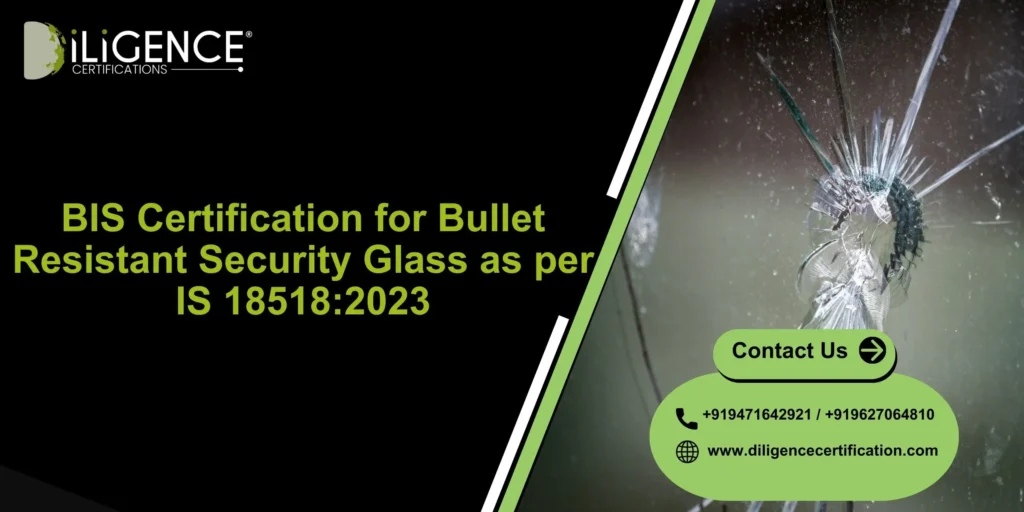
- BIS for Bullet Resistant Glass IS 18518:2023 sets the quality and performance requirements for Bullet Resistant Security Glass used in high-security areas.
- Manufacturers must obtain BIS certification before selling or supplying bullet resistant glass in the Indian market where compliance is required.
- The certification ensures the glass can withstand firearm impact and provide protection in high-risk environments.
- Testing is conducted in BIS-recognized laboratories to verify strength, durability, and ballistic resistance.
- BIS certification improves product credibility, market acceptance, and safety assurance.
Introduction | BIS for Bullet Resistant Glass
Security has become a top priority in modern infrastructure. Government buildings, banks, embassies, airports, military facilities, and high-security offices require strong protection systems to safeguard people and assets. One of the most important components used in such environments is bullet resistant security glass.
BIS for Bullet Resistant Glass is designed to resist the impact of bullets and prevent penetration, providing protection against armed attacks. However, the effectiveness of such glass depends on its quality, design, and manufacturing standards.
To ensure safety and reliability, the Bureau of Indian Standards (BIS) introduced IS 18518:2023, which specifies the quality and performance requirements for bullet resistant security glass in India. Manufacturers must comply with these standards and obtain BIS certification to ensure their products meet the required safety benchmarks.
In this blog, we will explain BIS Certification for Bullet Resistant Security Glass as per IS 18518:2023, including its importance, benefits, certification process, and challenges.
What is BIS for Bullet Resistant Glass (IS 18518:2023)?
BIS for Bullet Resistant Glass is an official approval issued by the Bureau of Indian Standards (BIS) confirming that a product meets the specified Indian standards for safety, quality, and performance.
BIS for Bullet Resistant Glass Under IS 18518:2023, the standard defines the technical requirements, testing procedures, and performance criteria for bullet resistant security glass.
This standard ensures that the glass:
- Provides protection against arm attacks
- Maintains structural integrity after impact
- Meets specific ballistic resistance situations
- Offers continuity and trustability for security operations
Bullet resistant glass is typically made using multiple layers of laminated glass and polycarbonate materials, which absorb and disperse the energy of bullets.
Once a manufacturer obtains BIS certification, they are allowed to use the ISI mark, which indicates that the product complies with Indian quality standards.
Why BIS for Bullet Resistant Glass is Required
BIS for Bullet Resistant Glass is essential for manufacturers producing bullet resistant security glass in India. The certification ensures that the product is safe, reliable, and capable of performing under critical security conditions.
Key Reasons for BIS for Bullet Resistant Glass
1. Ensures Safety norms The Certification guarantees that the glass meets strict ballistic resistance conditions.
2. Legal Compliance Manufacturers must misbehave with BIS norms where applicable to vend their products in the Indian request.
3. Quality Assurance BIS testing ensures that the glass performs effectively during real- life security pitfalls.
4. Market Acceptance products gain advanced trust among buyers, government agencies, and institutions.
5. Protection in High- Risk Areas pellet resistant glass is used in locales where security pitfalls are possible, making compliance extremely important.
Importance and Benefits of BIS for Bullet Resistant Glass
| Importance | Benefits |
| Ensures product safety | Protects people and assets from firearm threats |
| Maintains quality standards | Guarantees reliable performance |
| Builds customer trust | Improves brand reputation |
| Required for government procurement | Expands business opportunities |
| Ensures regulatory compliance | Avoids penalties and legal issues |
| Supports market competitiveness | Helps manufacturers stand out |
| Encourages product reliability | Reduces risk of product failure |
Step-by-Step Process of BIS Certification
Step1:Documentation
- Collect required technical documents
- Prepare product specifications
- Gather company registration details
- Ensure documents follow BIS format
Step2:Product Testing
- Send samples to a BIS-approved lab
- Conduct safety and quality tests
- Receive test reports
- Confirm compliance with BIS standards
Step3:Application Submission
- Fill out the BIS application form
- Upload all required documents
- Attach valid test reports
- Pay the necessary BIS fees
Step4:Scrutiny and Inspection
- BIS reviews submitted documents
- Authority verifies test results
- Factory/product inspection may occur
- Clarifications requested if needed
Step5:Grant of License
- BIS approves the application
- License number is issued
- Product can carry BIS mark
- Renewal required before expiry
Documents Required for BIS Certification
| Category | Documents Required |
| Business Documents | Business license/registration, ISO certificate, organizational details |
| Manufacturer Details | Factory layout, process flow chart, machinery list, production details |
| Product Documents | Product specifications, component list, user manual, model details |
| Testing Documents | Test report from BIS-recognized lab, sample details, test request form |
| Legal & Compliance | Authorization letter, brand ownership proof, trademark certificate (if any) |
| Import/Foreign Manufacturer (If applicable) | AIR (Authorized Indian Representative) details, contract agreement, overseas manufacturer documents |
Timelines, Costs, Validity & Renewal
- Timelines: Usually from 20 to 30 days, with only 7-15 days for the testing.
- Costs: The cost of the government and the test varies depending on the product. There can be some additional charges though.
- Validity: The validity period is 2 years in most situations.
- Renewal: The renewal is done before the expiration; there should be updated documents/tests; the renewal
Challenges of Getting This Certification Without a Consultant
BIS for Bullet Resistant Glass certification process seems straightforward, many manufacturers face difficulties when applying without professional guidance.
Common Challenges
1. Complex Documentation Preparing specialized documents and compliance reports can be delicate for new aspirants.
2. Understanding BIS norms Manufacturers may struggle to completely understand the detailed conditions of IS 185182023.
3. Product Testing Issues Incorrect sample medication or failure in testing can delay the Certification process.
4. Plant Compliance Conditions Manufacturers must insure their installation meets BIS examination standards
5. Time- Consuming Process Without proper knowledge, the Certification process can take longer than anticipated.
6. Threat of operation Rejection Deficient or incorrect Documentation can lead to rejection of the operation.
Because of these challenges, numerous businesses choose to work with Certification experts.
Why Choose Diligence Certification for BIS Certification
Obtaining BIS certification can be complicated without expert assistance. Diligence Certification provides professional support to help businesses achieve certification smoothly and quickly.
Benefits of Choosing Diligence Certification
1. Expert Guidance Our educated platoon understands the BIS Certification process in detail.
2. Complete Documentation Support We help in preparing all needed documents directly.
3. Testing Collaboration We help coordinate product testing with BIS- approved laboratories.
4. Faster blessing Process Our helps reduce detainments and speed up Certifications.
5. End- to- End backing From operation to license blessing, we give complete support.
6. Reliable Compliance Support We ensure that your product meets all conditions under IS 185182023.
With professional backing, manufacturers can avoid gratuitous detainments and gain Certification more efficiently.
Conclusion
Bullet resistant security glass plays a crucial role in protecting people and property in high-risk environments. To ensure that such glass provides reliable protection, it must meet strict quality and performance standards.
IS 18518:2023 establishes the requirements for bullet resistant security glass in India, ensuring that the product can withstand firearm impacts and maintain structural integrity.
Obtaining BIS Certification for Bullet Resistant Security Glass not only ensures compliance with Indian standards but also builds trust among customers and government agencies. Certified products offer greater safety, reliability, and market acceptance.
However, the certification process can be complex without proper knowledge and guidance. Working with experienced consultants like Diligence Certification can help manufacturers achieve BIS certification efficiently while ensuring full compliance with the standard.
Frequently Asked Questions (FAQs)
What is IS 18518:2023?
IS 18518:2023 is the Indian standard that specifies quality and performance requirements for bullet resistant security glass.
What is bullet resistant security glass?
It is specially designed laminated glass that can resist firearm impacts and provide protection in high-security areas.
Who issues BIS certification in India?
The certification is issued by the Bureau of Indian Standards (BIS).
Why is BIS certification important for bullet resistant glass?
It ensures that the product meets safety and performance standards required for security applications.
Where is bullet resistant glass commonly used?
It is used in banks, embassies, military buildings, airports, and high-security facilities.
Does bullet resistant glass completely stop bullets?
It is designed to resist and absorb bullet impact depending on its resistance level.
How long does BIS certification take?
The timeline depends on documentation, testing, and inspection processes.
Is factory inspection required for BIS certification?
Yes, BIS officials inspect the manufacturing facility before granting certification.
Can foreign manufacturers apply for BIS certification?
Yes, foreign manufacturers can apply through the appropriate BIS certification scheme.
How can Diligence Certification help with BIS certification?
Diligence Certification provides expert support for documentation, testing coordination, and the entire certification process.