


 BIS Certification
 CDSCO
CDSCO
 CPCB
CPCB
 LMPC
LMPC
 WPC Approval
 Global Approvals
 TEC
TEC
 ARAI
ARAI
 BEE
BEE
 ISO Certification
 DGCA Certification
 NOC For Steel
 APEDA Registration











 Business Registration
 FSSAI Mark Certification



 (32).jpg)
 Legal Services
 Trademark Registration
 Copyright Registration
 Patent Registration
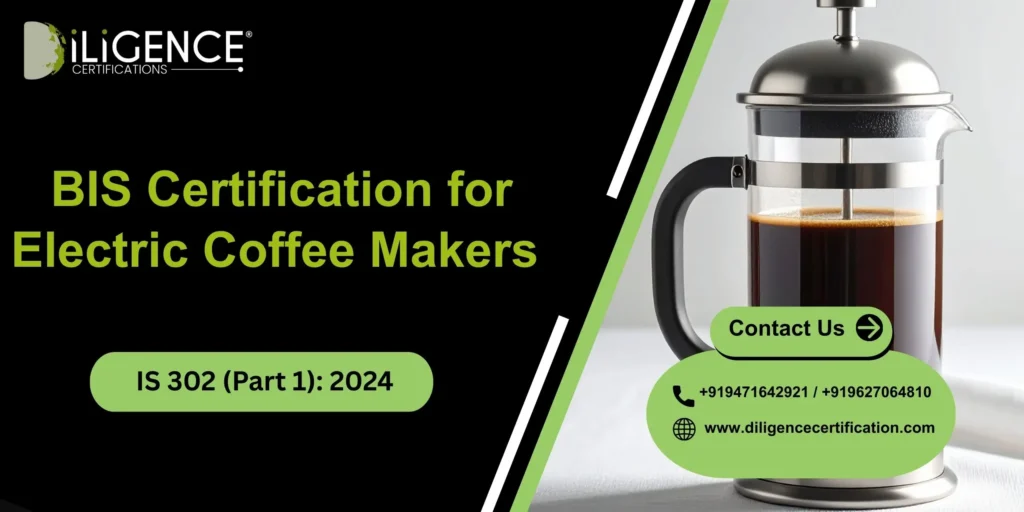
- Mandatory Safety Compliance BIS for Electric Coffee Makers Certification provides assurance that electric coffee makers conform to essential standards of electrical and fire safety as per IS 302 (Part 1): 2024.
- Legal Market Access in India Certified coffee makers can be manufactured, imported, and sold in the Indian market.
- Protection Against Electrical Hazards The standard emphasizes insulation, overheating protection, and protection against electric shock.
- Quality & Performance Assurance BIS approval ensures the availability of consistent product quality, performance, and safe usage.
- Helps to Build Consumer Trust ISI Marking stamps its authority and inducement for building consumer trust for safer and dependable products.
Introduction | BIS for Electric Coffee Makers
The adoption of electric coffee makers among Indians has gained immense popularity over the years. This is due to the rising lifestyle pattern and customer need for convenience products, as a result of which electric coffee makers are no longer considered luxury goods but are turning out to be daily-use electrical appliances. However, this has raised many concerns regarding their quality.
In order to ensure consumer safety and the quality of the product, the Government of India has made Bureau of Indian Standards (BIS) Certification compulsory for a range of household electric appliances, which includes electric coffee makers. As per the new regime, electric coffee makers are required to conform to the requirements of IS 302 (Part 1): 2024, which specifies general requirements for the safety of household electric appliances.
What is BIS Certification for Electric Coffee Makers?
BIS for Electric Coffee Makers Certification is a form of confirmation of the Bureau of Indian Standards stating the tested product meets Indian standards of safety, quality, and performance.
For electric coffee makers, certification is carried out under the following standards:
IS 302 (Part 1): 2024 – General Requirements
This standard covers electrical safety, mechanical strength, heat resistance, insulation, electric shock protection, and safety of use of appliances.
Only after the certification can the manufacturers/exporters use the ISI mark on their products; the mark is a sign that the products are safe for use in the Indian market.
Key Features of IS 302 (Part 1): 2024 for Electric Coffee Makers
- Electrical Safety Protection Guarantees safety against electric shock by virtue of good insulation, earthing, or good construction.
- Overheating & Thermal Control Coffee machines need functional temperature control mechanisms in order to avoid the risk of fires and overheating.
- Strength & Stability The appliance should be able to withstand normal use, unintended collisions, and other operating-related stresses.
- Using Safe Materials Plastic, metallic, and internal parts require heat, corrosion, and distortion resistance.
- Clear Marking / Instructions Mandates for labeling, voltage, warning labels, and operator manuals are required.
Why BIS Certification is Required
BIS for Electric Coffee Makers Certification is not optional but a legal and commercial compulsion. Here is why that matters:BIS for Electric Coffee MakersBIS Certification is not optional but a legal and commercial compulsion. Here is why that matters:
- Legal Compliance in India The sale of non-certified electric coffee makers is illegal in India, resulting in possible punishment, seizure, or banning.
- Customer Safety Assurance Protects against electrical accidents like short circuiting, overheating, and electrical shocks.
- Mandatory for Imports Foreign-made coffeemakers have to be certified by BIS prior to passing the Indian customs.
- Market Acceptance. The retailing, distributing, and online shopping industry prefers to have BIS-approved products.
- Brand Reputation & Trust The ISI Mark adds credibility and customer confidence to your product.
Importance vs Benefits of BIS Certification
| Importance | Benefits |
| Ensures compliance with Indian safety laws | Avoids legal penalties and product recalls |
| Protects users from electrical hazards | Reduces liability and consumer complaints |
| Mandatory for manufacturing & imports | Enables smooth market entry |
| Confirms product quality standards | Enhances brand image and trust |
| Required for ISI Mark usage | Improves sales and acceptance |
BIS Certification Process
Step1:Documentation
- Collect required technical documents
- Prepare product specifications
- Gather company registration details
- Ensure documents follow BIS format
Step2:Product Testing
- Send samples to a BIS-approved lab
- Conduct safety and quality tests
- Receive test reports
- Confirm compliance with BIS standards
Step3:Application Submission
- Fill out the BIS application form
- Upload all required documents
- Attach valid test reports
- Pay the necessary BIS fees
Step4:Scrutiny and Inspection
- BIS reviews submitted documents
- Authority verifies test results
- Factory/product inspection may occur
- Clarifications requested if needed
Step5:Grant of License
- BIS approves the application
- License number is issued
- Product can carry BIS mark
- Renewal required before expiry
Documents Required for BIS Certification
| Category | Documents Required |
| Business Documents | Business license/registration, ISO certificate, organizational details |
| Manufacturer Details | Factory layout, process flow chart, machinery list, production details |
| Product Documents | Product specifications, component list, user manual, model details |
| Testing Documents | Test report from BIS-recognized lab, sample details, test request form |
| Legal & Compliance | Authorization letter, brand ownership proof, trademark certificate (if any) |
| Import/Foreign Manufacturer (If applicable) | AIR (Authorized Indian Representative) details, contract agreement, overseas manufacturer documents |
Timelines, Costs, Validity & Renewal
- Timelines: Usually from 20 to 30 days, with only 7-15 days for the testing.
- Costs: The cost of the government and the test varies depending on the product. There can be some additional charges though.
- Validity: The validity period is 2 years in most situations.
- Renewal: The renewal is done before the expiration; there should be updated documents/tests the renewal
Challenges of BIS Certification Without a Consultant
Many manufacturers and importers try to get BIS Certification on their own, but they usually face serious difficulties:
- Complex Documentation Technical forms, test reports, declarations can be understood in their meaning.
- Product Testing Gone Wrong This may also result in rejection if the wrong test parameters or labs are selected.
- Frequent Rejection of Applications Even minor mistakes can result in several weeks or months of delay.
- Issues of Factory Inspection Non-compliance at the time of inspection will lead to a halt in the certification process.
- Time & Resource Drain The business loses its focus on operations while handling the regulatory procedures.
Why Choose Diligence Certificate Consultancy?
When it comes to BIS Certification, the right guidance is what makes all the difference. This is where Diligence Certificate Consultancy comes into the picture with their customized support for your product as well as the business model.
What makes Diligence Certificate Consultancy stand out?
- End-to-End BIS Support From application filing to ISI Mark approval—handled professionally.
- Expert Technical Guidance Accurate interpretation of IS 302 (Part 1): 2024 requirements.
- Testing & Lab Coordination Assistance with BIS-recognized labs for faster test approvals.
- Factory Inspection Preparation Ensures your manufacturing unit meets BIS expectations.
- Time-Saving & Hassle-Free Process Faster approvals with minimal delays and rejections.
Conclusion
BIS for Electric Coffee Makers under IS 302 (Part 1): 2024 is now compulsory. It is not a voluntary but a necessary criterion for conducting business in India. It will not only provide protection to your consumers but will also enhance your brand identity.
Although obtaining a certificate can be a complex procedure, with the help of an expert consultant like Diligence Certificate Consultancy, one can ensure a hassle-free certificate approval process.
Frequently Asked Questions (FAQs)
Is BIS Certification mandatory for electric coffee makers in India?
Yes, BIS Certification is mandatory to legally manufacture, import, or sell electric coffee makers in India.
Which standard applies to electric coffee makers for BIS Certification?
Electric coffee makers must comply with IS 302 (Part 1): 2024 for general electrical safety requirements.
How valid is BIS Certification for electric coffee makers?
The BIS Certification has a typical validity of 1-2 years and can be further extended before the expiry date.
Who is eligible to apply for BIS Certification for Coffee Makers?
The application is open for foreign makers who have Indian representatives too.
Is BIS certification mandatory for imported electric coffee makers in India?
Import coffee machines in India require BIS certification for customs clearance.
What is the ISI Mark for Electric Coffee Makers?
The ISI Mark is a sign that the coffee machine meets BIS safety and quality standards.
What is the duration of BIS Certification for Coffee Makers?
The process generally takes 4 to 6 weeks, depending on the results obtained in the process.
Which documents are required in BIS Certification?
The essential documents that need to be provided or offered or furnished, as stated under the Missionary Act.
Is it possible to achieve BIS Certification without a consultant?
Yes, but this requires a process which may result in either delays or disqualifications if not done by experts.
Why do you want a BIS consultant for electric coffee makers?
A consultant from the BIS helps in fast approval, proper documentation, and coordination with the BIS authorities.