



 BIS Certification
 CDSCO
CDSCO
 CPCB
CPCB
 LMPC
LMPC
 WPC Approval
 Global Approvals
 TEC
TEC
 ARAI
ARAI
 BEE
BEE
 ISO Certification
 DGCA Certification
 NOC For Steel
 APEDA Registration













 Business Registration
 FSSAI Mark Certification











 Legal Services
 Trademark Registration
 Copyright Registration
 Patent Registration
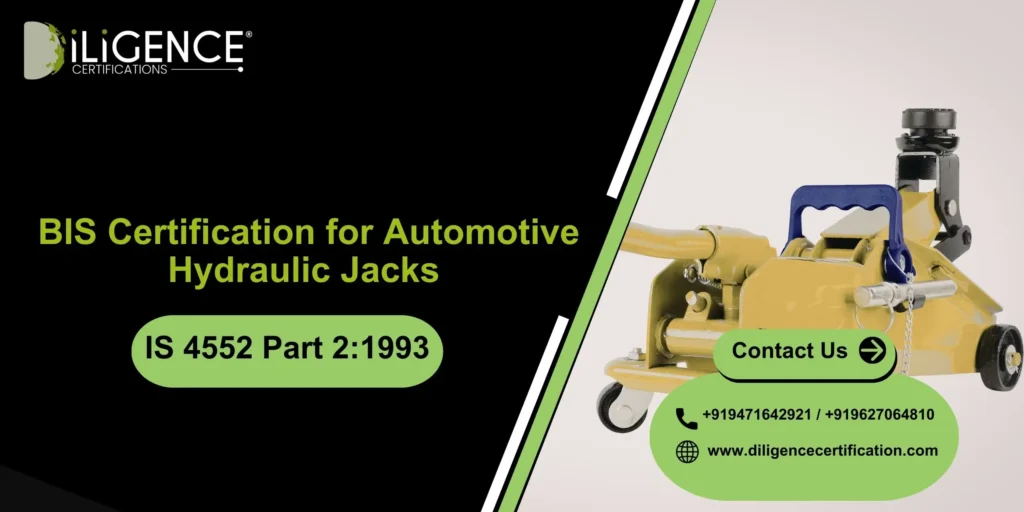
- BIS for Hydraulic Jacks meet safety and quality standards for automotive use in India.
- IS 4552 (Part 2):1993 specifically defines requirements for hydraulic jacks used in vehicles.
- Certification is mandatory for manufacturers selling hydraulic jacks in the Indian market under quality control orders (if notified).
- The process involves product testing, factory inspection, and license approval from the Bureau of Indian Standards.
- Proper certification builds trust, reduces product liability risks, and improves market acceptance.
Introduction | BIS for Hydraulic Jacks
In the automotive industry, safety and reliability are critical, especially when it comes to equipment used for lifting vehicles. Hydraulic jacks are essential tools used in garages, service centers, and even by individual vehicle owners. However, a poorly designed or low-quality hydraulic jack can lead to serious accidents and damage.
To ensure safety and standardization, the Indian government has established specific guidelines under IS 4552 (Part 2):1993. This standard governs the design, performance, and safety requirements of hydraulic jacks used in automobiles. Manufacturers who want to sell their products in India must comply with these standards and obtain BIS (Bureau of Indian Standards). certification.
This blog provides a complete guide to BIS certification for automotive hydraulic jacks in simple and easy language, covering its importance, benefits, process, and challenges.
What is BIS for Hydraulic Jacks?
BIS for Hydraulic Jacks is a mark of quality issued by the Bureau of Indian Standards, which confirms that a product meets the required Indian safety and performance standards.
For BIS for Hydraulic Jacks specifies:
- Load-bearing capacity requirements
- Structural strength and stability
- Hydraulic system performance
- Safety features and operational reliability
- Marking and labeling requirements
Once a product passes all needed tests and examinations, the manufacturer is granted a BIS license and can use the ISI mark on their product. This mark assures guests that the hydraulic jack is safe and dependable.
Why BIS for Hydraulic Jacks is Required
BIS for Hydraulic Jacks is not just a regulatory requirement but a crucial step for ensuring product quality and user safety.
Key Reasons:
- Safety Assurance Prevents accidents caused by outfit failure
- Legal Compliance Meets Indian nonsupervisory conditions
- Market Access Allows products to be vended across India
- Consumer Trust Builds confidence among buyers
- Quality Standardization Ensures invariant product quality
Without BIS certification, manufacturers may face penalties, product recalls, or restrictions on selling their products.
Importance and Benefits BIS for Hydraulic Jacks
| Importance of BIS Certification | Benefits for Manufacturers |
| Ensures product safety for users | Builds brand credibility |
| Standardizes product quality | Increases customer trust |
| Mandatory for regulated products | Enables entry into Indian market |
| Reduces risk of product failure | Minimizes legal liabilities |
| Promotes fair competition | Enhances business growth |
| Improves product reliability | Boosts export opportunities |
| Helps in regulatory compliance | Strengthens market reputation |
Step-by-Step Process of BIS for Hydraulic Jacks
Step1:Documentation
- Collect required technical documents
- Prepare product specifications
- Gather company registration details
- Ensure documents follow BIS format
Step2:Product Testing
- Send samples to a BIS-approved lab
- Conduct safety and quality tests
- Receive test reports
- Confirm compliance with BIS standards
Step3:Application Submission
- Fill out the BIS application form
- Upload all required documents
- Attach valid test reports
- Pay the necessary BIS fees
Step4:Scrutiny and Inspection
- BIS reviews submitted documents
- Authority verifies test results
- Factory/product inspection may occur
- Clarifications requested if needed
Step5:Grant of License
- BIS approves the application
- License number is issued
- Product can carry BIS mark
- Renewal required before expiry
Documents Required for BIS Certification
| Category | Documents Required |
| Business Documents | Business license/registration, ISO certificate, organizational details |
| Manufacturer Details | Factory layout, process flow chart, machinery list, production details |
| Product Documents | Product specifications, component list, user manual, model details |
| Testing Documents | Test report from BIS-recognized lab, sample details, test request form |
| Legal & Compliance | Authorization letter, brand ownership proof, trademark certificate (if any) |
| Import/Foreign Manufacturer (If applicable) | AIR (Authorized Indian Representative) details, contract agreement, overseas manufacturer documents |
Timelines, Costs, Validity & Renewal
- Timelines: Usually from 20 to 30 days, with only 7-15 days for the testing.
- Costs: The cost of the government and the test varies depending on the product. There can be some additional charges though.
- Validity: The validity period is 2 years in most situations.
- Renewal: The renewal is done before the expiration; there should be updated documents/tests; the renewal
Challenges of Getting this Certification Without a Consultant
While the process may seem straightforward, many manufacturers face difficulties when applying independently.
Common Challenges:
- Complex Documentation: Preparing accurate and complete documents can be confusing
- Technical Understanding: Interpreting IS standards requires expertise
- Testing Delays: Incorrect samples can lead to rejection and re-testing
- Factory Compliance Issues: Lack of proper quality control systems
- Coordination with BIS: Managing communication and follow-ups can be time-consuming
- Application Errors: Small mistakes can lead to rejection or delays
Without professional guidance, the certification process can become lengthy and costly.
Why Choose Diligence Certification for This Certification
Diligence Certification provides end-to-end support for obtaining BIS certification for hydraulic jacks.
Key Advantages:
- Expert Guidance: Deep understanding of IS 4552 (Part 2):1993 requirements
- Documentation Support: Accurate preparation and submission of documents
- Testing Assistance: Coordination with BIS-approved laboratories
- Factory Readiness: Guidance on improving manufacturing and quality systems
- Faster Approval: Streamlined process to reduce delays
- End-to-End Service: From application to license grant
With professional support, manufacturers can focus on production while ensuring compliance with BIS standards.
Conclusion
BIS Certification for automotive hydraulic jacks under IS 4552( Part 2) 1993 is essential for icing safety, quality, and nonsupervisory compliance in the Indian request. It not only protects end- druggies from implicit hazards but also enhances the credibility and competitiveness of manufacturers.
Although the Certification process involves multiple ways, proper planning and expert backing can make it smooth and effective. Partnering with a dependable consultancy like Diligence Certification can help businesses avoid detainments, reduce pitfalls, and achieve Certification briskly.
In the moment’s competitive request, compliance is n’t just a demand, it is a strategic advantage.
Frequently Asked Questions (FAQs)
Is BIS certification mandatory for hydraulic jacks?
Yes, if covered under Quality Control Orders, certification is mandatory for selling in India.
What is IS 4552 (Part 2):1993?
It is the Indian standard specifying requirements for hydraulic jacks used in automobiles.
Who issues BIS certification?
The Bureau of Indian Standards issues the certification.
How long does the certification process take?
It typically takes 4–8 weeks, depending on documentation and testing.
What documents are required for BIS certification?
Documents include application form, test reports, manufacturing details, and quality control records.
What is the ISI mark?
It is a quality certification mark indicating compliance with Indian standards.
Can foreign manufacturers apply for BIS certification?
Yes, through the Foreign Manufacturers Certification Scheme (FMCS).
What happens if a product fails testing?
The manufacturer must correct issues and resubmit samples for testing.
Is factory inspection mandatory?
Yes, BIS conducts inspections before granting certification.
Can certification be renewed?
Yes, BIS licenses must be renewed periodically to maintain compliance.