



 BIS Certification
 CDSCO
CDSCO
 CPCB
CPCB
 LMPC
LMPC
 WPC Approval
 Global Approvals
 TEC
TEC
 ARAI
ARAI
 BEE
BEE
 ISO Certification
 DGCA Certification
 NOC For Steel
 APEDA Registration











 Business Registration
 FSSAI Mark Certification











 Legal Services
 Trademark Registration
 Copyright Registration
 Patent Registration
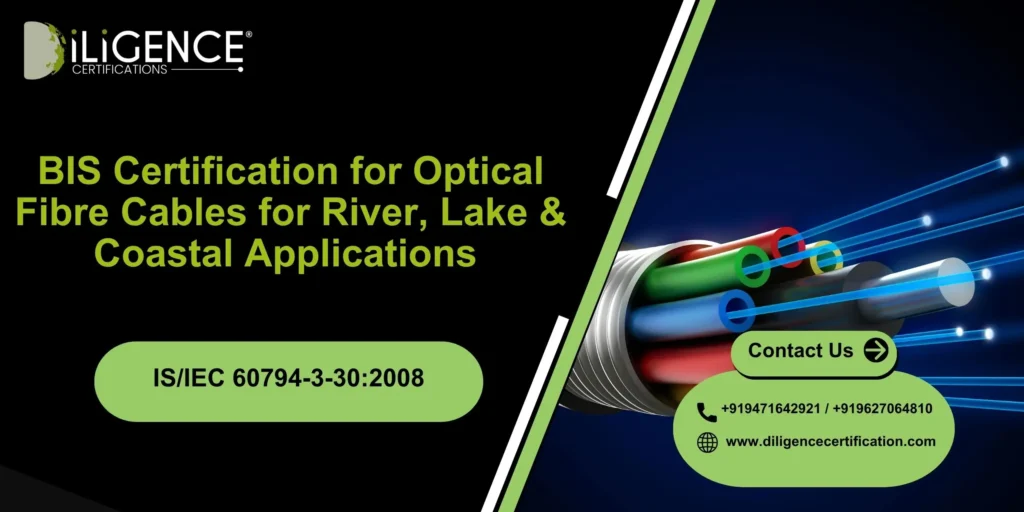
- BIS for Optical Fibre Cables IS/IEC 60794-3-30:2008 specifies requirements for optical fibre cables used in water-based environments like rivers, lakes, and coastal areas.
- BIS certification ensures these cables meet Indian quality, safety, and durability standards.
- These cables are designed to withstand harsh environmental conditions such as moisture, pressure, and corrosion.
- Certification is mandatory for manufacturers who want to sell or distribute such cables in India under regulated categories.
- Proper compliance improves product reliability, market trust, and eligibility for government and large infrastructure projects.
Introduction | BIS for Optical Fibre Cables
With the rapid expansion of telecommunications and digital infrastructure, optical fibre cables have become the backbone of modern connectivity. In regions where communication lines need to pass through rivers, lakes, and coastal zones, specialized outdoor optical fibre cables are required. These environments pose unique challenges such as water pressure, corrosion, and physical damage risks.
To ensure safety, durability, and performance, India follows specific standards for such cables. One of the most important standards is IS/IEC 60794-3-30:2008, which defines the requirements for optical telecommunication cables used in water-crossing and coastal applications.
BIS for Optical Fibre Cables for these cables is essential for manufacturers to ensure compliance with Indian regulations and to build trust in the market. This blog provides a complete guide to BIS certification for optical fibre cables under this standard in a simple and easy-to-understand language.
What is BIS for Optical Fibre Cables IS/IEC 60794-3-30:2008?
BIS for Optical Fibre Cables IS IEC 60794-3-302008 is an Indian standard aligned with transnational guidelines that focuses on out-of-door optic fibre lines specifically designed for installation in water surroundings similar as
- Rivers
- Lakes
- Coastal areas
- Submerged or incompletely submerged zones
This standard comes under the broader series of optical fibre cable standards and defines the construction, mechanical properties, environmental resistance, and performance requirements of these cables.
The standard ensures that the cables:
- Are resistant to water ingress
- Can handle mechanical stress and pressure
- Maintain signal quality even in harsh conditions
- Have proper protective layers against environmental damage
In simple terms, it guarantees that the cables are strong, durable, and reliable enough to operate in challenging water-based environments.
Why BIS for Optical Fibre Cables is Required
BIS for Optical Fibre Cables plays a crucial role in ensuring that optical fibre cables meet the required quality and safety benchmarks before entering the Indian market.
Key Reasons for BIS for Optical Fibre Cables
- Ensures compliance with Indian standards
- Confirms product quality and durability
- Protects end-users from substandard products
- Required for government tenders and infrastructure projects
- Enhances brand credibility and trust
Key Points
- Without BIS certification, manufacturers may face restrictions in selling their products in India.
- Certified products are preferred by telecom companies and government bodies.
- It helps in reducing failure rates and maintenance costs.
- Certification acts as proof of technical compliance and testing.
Importance and Benefits of BIS Certification
| Importance of BIS Certification | Benefits for Manufacturers |
| Ensures compliance with IS/IEC standards | Easy market access across India |
| Validates product quality and safety | Builds trust among customers |
| Mandatory for regulated products | Competitive advantage in tenders |
| Reduces risk of product failure | Improves brand reputation |
| Protects end-users and infrastructure | Higher chances of business growth |
| Standardizes manufacturing practices | Long-term cost savings |
Step-by-Step Process of BIS for Optical Fibre Cables
Step1:Documentation
- Collect required technical documents
- Prepare product specifications
- Gather company registration details
- Ensure documents follow BIS format
Step2:Product Testing
- Send samples to a BIS-approved lab
- Conduct safety and quality tests
- Receive test reports
- Confirm compliance with BIS standards
Step3:Application Submission
- Fill out the BIS application form
- Upload all required documents
- Attach valid test reports
- Pay the necessary BIS fees
Step4:Scrutiny and Inspection
- BIS reviews submitted documents
- Authority verifies test results
- Factory/product inspection may occur
- Clarifications requested if needed
Step5:Grant of License
- BIS approves the application
- License number is issued
- Product can carry BIS mark
- Renewal required before expiry
Documents Required for BIS Certification
| Category | Documents Required |
| Business Documents | Business license/registration, ISO certificate, organizational details |
| Manufacturer Details | Factory layout, process flow chart, machinery list, production details |
| Product Documents | Product specifications, component list, user manual, model details |
| Testing Documents | Test report from BIS-recognized lab, sample details, test request form |
| Legal & Compliance | Authorization letter, brand ownership proof, trademark certificate (if any) |
| Import/Foreign Manufacturer (If applicable) | AIR (Authorized Indian Representative) details, contract agreement, overseas manufacturer documents |
Timelines, Costs, Validity & Renewal
- Timelines: Usually from 20 to 30 days, with only 7-15 days for the testing.
- Costs: The cost of the government and the test varies depending on the product. There can be some additional charges though.
- Validity: The validity period is 2 years in most situations.
- Renewal: The renewal is done before the expiration; there should be updated documents/tests; the renewal
Challenges of Getting this Certification Without a Consultant
While the process may seem straightforward, manufacturers often face several challenges when applying on their own.
Common Challenges
- Lack of clarity on documentation requirements
- Difficulty in understanding technical standards
- Errors in application submission
- Delays in testing and approvals
- Issues during factory inspection
- Rejection due to non-compliance
Detailed Issues
- Technical Complexity The standard includes detailed technical requirements that are difficult to interpret without expertise.
- Documentation Errors Incomplete or incorrect documentation can lead to delays or rejection.
- Testing Coordination Managing sample testing with approved labs can be time-consuming.
- Compliance Gaps Many manufacturers are unaware of minor compliance requirements that can lead to failure.
- Time Consumption The process can take significantly longer without proper guidance.
Why Choose Diligence Certification for This Certification
Choosing the right consultant can make the certification process smooth and hassle-free. Diligence Certification offers expert support for BIS certification with a focus on efficiency and accuracy.
Key Reasons to Choose Diligence Certification
- Expert knowledge of BIS standards and procedures
- End-to-end support from application to approval
- Assistance in documentation and compliance
- Coordination with BIS authorities and labs
- Faster processing and reduced delays
What You Get
- Proper guidance on BIS for Optical Fibre Cables IS/IEC 60794-3-30:2008 requirements
- Error-free documentation
- Support during factory inspection
- Regular updates on application status
- High success rate in approvals
Diligence Certification helps manufacturers save time, reduce errors, and ensure a smooth certification process.
Conclusion
BIS for Optical Fibre Cables used in river, lake, and coastal applications under IS/IEC 60794-3-30:2008 is essential for ensuring product quality, safety, and reliability. These cables operate in some of the most challenging environments, making compliance with standards critical.
For manufacturers, certification not only ensures legal compliance but also opens doors to larger business opportunities, including government projects and high-value contracts.
While the certification process can be complex, proper guidance and expert support can simplify it significantly. By ensuring compliance and quality, businesses can build trust, enhance their reputation, and achieve long-term growth in the competitive telecom industry.
Frequently Asked Questions (FAQs)
What is IS/IEC 60794-3-30:2008?
It is a standard for optical fibre cables used in water environments like rivers and coastal areas.
Is BIS certification mandatory for these cables?
Yes, it is mandatory for regulated products to be sold in India.
What type of cables are covered under this standard?
Outdoor optical fibre cables designed for water crossings and coastal applications.
How long does BIS certification take?
It typically takes a few weeks to months depending on compliance and documentation.
What documents are required for certification?
Factory details, product specifications, and quality control documents are required.
Can foreign manufacturers apply for BIS certification?
Yes, foreign manufacturers can apply through authorized representatives.
What happens if a product fails testing?
The manufacturer must correct issues and reapply for testing.
Is factory inspection mandatory?
Yes, BIS conducts a factory inspection before granting certification.
What is the validity of BIS certification?
The certification is valid for a specific period and must be renewed.
Why should I hire a consultant for BIS certification?
A consultant helps avoid errors, speeds up the process, and ensures successful approval.