



 BIS Certification
 CDSCO
CDSCO
 CPCB
CPCB
 LMPC
LMPC
 WPC Approval
 Global Approvals
 TEC
TEC
 ARAI
ARAI
 BEE
BEE
 ISO Certification
 DGCA Certification
 NOC For Steel













 Business Registration












 Legal Services
 Trademark Registration
 Copyright Registration
 Patent Registration
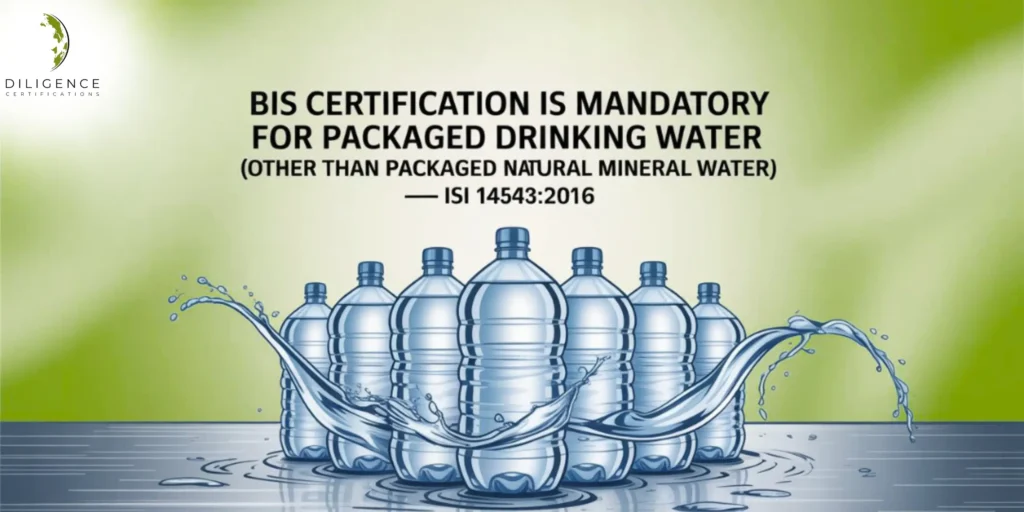
- BIS for packaged Drinking Water is legally mandatory if you want to sell packaged drinking water in India — without it, your product can’t enter the market.
- It falls under IS 14543, a specific standard that ensures your water is safe, processed, and suitable for human consumption.
- The certification process involves multiple steps — from setting up an in-house lab and testing water samples to submitting documents and clearing BIS inspections.
- For foreign brands– certification must be done through the FMCS route, and it’s mandatory to appoint an Indian Authorized Representative (AIR).
Introduction:

If you’re planning to sell packaged drinking water in India, one thing you can’t skip is BIS certification. It’s not just paperwork — it’s a legal requirement that shows your water meets the quality and safety standards set by the Indian government. Without it, you simply can’t operate in the market. This certification, under IS 14543, is what gives your product the right to carry the ISI mark — something most consumers look for before buying bottled water. It’s about more than compliance — it’s about trust.
What is a BIS Certification and why is it important?
A BIS Certification is compulsory to ensure drinking water is safe and clean and meets the agreed national and international standards for quality. This is not just a standard—it’s about public health.
Why is BIS certification mandatory?
BIS certification for packaged drinking water is essential in India because it’s the official proof that your drinking water is safe and meets Government-set quality standards. If you don’t have BIS, there’s no way you will be able to sell bottled water—retail, e-commerce or to large buyers like railways or hospitals. The ISI mark on your bottle gives an impression of confidence in what they are buying. In short, BIS certification not only legalizes your business but also provides trust for your customer in the water you designate as safe for drinking.
Who Needs BIS for Packaged Drinking Water?
All manufacturers, bottlers, and suppliers producing or selling packaged drinking water in India must obtain BIS certification. According to IS 14543:2016, no packaged drinking water can be sold on the Indian market or in India without the ISI mark from BIS. This assures that the water sold meets safety, hygiene, and quality standards to protect the health of consumers. All packaged water brands sold domestically or imported must first have this certification prior to distribution.
BIS Standards For Packaged Drinking Water
BIS Standards for Packaged Drinking Water (IS 14543:2016)
According to IS 14543:2016, the Bureau of Indian Standards (BIS) established specifications to ensure the packaged drinking water is safe and hygienic.
Highlights:
- Water Treatment: Must be treated by RO, UV, filtration, and ozonation to remove pathogenic bacteria, viruses, and chemical contaminants.
- Limits of Quality: Arsenic, lead, and fluoride levels must be within acceptable BIS limits.
- Packaging: Only food grade, tamper-proof bottles or pouches and nothing that compromises water quality.
- Labeling: Each container must have an ISI mark, source of water, manufacturing and expiry dates, and the rest of the information required by BIS rules.
- Testing: Manufacturers must send samples for testing to make sure they are keeping their bottled water standards.
- Certification: Packaged drinking water cannot be manufactured or sold in India without BIS ISI certification.
7-Step BIS Certification Process for Packaged Drinking Water
1. Set Up Your In-House Lab
The BIS scheme requires basic water testing equipment on-site. Tests must follow IS 14543 parameters, including:
- pH
- TDS
- Microbial content
- Heavy metals like lead and arsenic
2. Source Water & Perform Pre-Testing
Use a NABL-accredited lab to test your raw water. Ensure results meet the standard.
3. Apply Online on BIS Portal
Submit Form V, lab test reports, plant layout, process flow diagram, and quality manuals. Pay the government fees (approx. ₹10,000 – ₹20,000).
4. Pre-Licence Inspection by BIS Officer
A BIS officer visits your facility to verify equipment, hygiene practices, water source, and documentation.
5. Sample Testing by BIS
Samples of packaged water are drawn during the inspection and sent to a BIS-recognized lab.
6. Grant of Licence (if approved)
If your product passes all tests, BIS grants a licence valid for 1 year. You’re now allowed to use the ISI Mark on your packaging.
7. Annual Renewal & Surveillance
Annual renewal requires regular surveillance inspections and quarterly testing reports from your in-house lab.

Benefits of BIS Certification for Packaged Drinking Water
- It gives you the legal right to sell.
Without BIS certification, you simply can’t manufacture or sell bottled water in India. It’s not a choice — it’s a basic legal requirement. - Retailers and platforms will ask for it.
From local distributors to Flipkart and Amazon, everyone checks for BIS approval before listing a product. No certification, no entry. - You can supply to government buyers.
Whether it’s a railway station, a hospital, or a school — if it’s a government tender, BIS certification is the first thing they’ll check. - Your product meets official safety standards.
BIS certification ensures your water is tested for things like bacteria, heavy metals, and chemical safety — as per Indian quality norms. - It shows you’re serious about quality.
The ISI mark isn’t just a logo. It tells your customers that your product is genuine, safe, and held to national standards — and that matters.
BIS Compliance Guide for International Manufacturers
If you are a bottled water brand or manufacturer outside of India and want to sell in India, you need to obtain BIS Certification under the Foreign Manufacturers Certification Scheme (FMCS). Without BIS Certification, your product will not pass through customs or into your customer’s hands legally.
Here’s a step-by-step guide made simple:
Appoint an Indian Authorized Representative (AIR)
Before anything else, you need to appoint an Authorized Indian Representative (AIR). This is a mandatory step for all foreign applicants.
- The AIR acts as your legal contact point in India
- They handle communication with BIS, documentation, and local coordination
- Must be an Indian citizen or an Indian-registered company
Submit Application Under FMCS (IS 14543)
Next, apply online through the BIS FMCS portal and select the correct standard — in this case, IS 14543 for packaged drinking water.
- Upload documents: factory details, water treatment process, lab test reports, labels, etc.
- Pay applicable fees (in USD) for application, audit, and licensing
Make sure your documents clearly show full compliance with Indian safety and labeling rules.
Product Sample Testing in BIS-Recognized Indian Lab
Your product must be tested inside India, even if it’s already tested abroad.
- Samples are sent to a BIS-approved lab in India
- The water must pass all quality, microbiological, and packaging tests under IS 14543
- Testing turnaround time: typically 3–4 weeks
Factory Inspection by BIS Officials
Once your documents and samples are cleared, BIS will send inspectors to your manufacturing unit abroad.
- They check your water treatment system, cleanliness, SOPs, and packaging
- Inspectors may suggest corrective actions before approval
- All costs (travel, stay, inspection) are borne by the manufacturer
Grant of BIS License & Use of ISI Mark
If everything is approved:
- BIS grants your factory a license with a CM/L number
- You are now legally allowed to print the ISI mark on each bottle sent to India
- The mark is mandatory for custom clearance and sale in the Indian market
Eligibility Criteria for BIS Certification of Packaged Drinking Water
To get BIS certification for packaged drinking water, there are eligibility criteria that must be met as per IS 14543:2016.
Who is Eligible?
- Manufacturers of Packaged Drinking Water – Any entity that processes, bottles, and seals drinking water for distribution in India.
- Importers or Foreign Brands – Any foreign entity who wants packaged drinking water to be sold in India must have BIS certification prior to distribution.
- Manufacturing Unit with Facilities – The plant should have proper water treatment systems (RO, UV, ozonation), quality control lab, and hygienic filling facilities.
- Complies with the corresponding Indian Standards – The water complied with all the physical, chemical, and microbiological tests as per IS 14543:2016.
- Food-grade Packaging – Packaged in food-grade and tamper-proof bottle or pouch.
- Testing of Lab Sample by Lab Recognized by BIS – Must have water samples tested and passed before proceeding with certification.
Documents Required for BIS Certification (IS 14543) – National & International
For Indian Manufacturers (Domestic Applicants):
- Business & Factory Documents
- Company registration certificate.
- Factory address and layout plan
- Company registration certificate.
- Production & Quality Details
- List of machinery and equipment
- In-house lab equipment details
- Internal test reports (as per IS 14543)
- Water source approval/NOC
- List of machinery and equipment
- Labeling & Packaging
- Draft label showing ISI mark placement
- Product details: size, batch, MRP, expiry
- Manufacturer’s name & address
- Draft label showing ISI mark placement
- Legal & Technical Declarations
- Application Form VI
- Undertaking of conformity to standards
- Person in charge of quality assurance
- Application Form VI
For Foreign Manufacturers (FMCS Applicants):
- Company & Factory Documents
- Certificate of Incorporation
- Factory address proof
- Factory layout and process flow
- Certificate of Incorporation
- Product & Lab Reports
- Product specifications
- In-house/third-party test reports
- Calibration certificates of lab equipment
- Product specifications
- Label Compliance
- Label design with ISI mark & CM/L number
- Exporter/importer details
- Volume, expiry, and packaging info
- Label design with ISI mark & CM/L number
- AIR (Authorized Indian Representative)
- AIR agreement & Power of Attorney
- ID and address proof of AIR
- AIR agreement & Power of Attorney
- BIS Application & Declarations
- BIS Application Form VI
- Declarations of compliance
- Factory ownership or legal occupancy proof
- BIS Application Form VI
5 Common Reasons for BIS Certification Rejection
1. Poor In-House Testing Setup
BIS inspectors are strict about lab calibration and SOPs.
2. Contaminated Water Source
Even borewell water can fail if not properly filtered.
3. Non-compliant Labels
Using terms like “mineral water” instead of “packaged drinking water” can get you rejected.
4. Incomplete Documents
Missing annexures or flowcharts can delay approval.
5. Lack of Trained Personnel
Operators must understand SOPs and testing methods.
Why Packaged Drinking Water Brands Trust Diligence Certification for BIS Approval?
Packaged drinking water brands trust Diligence Certification, because of our track record, and our simple approach to BIS compliance. Obtaining BIS certification (especially for IS 14543:2016) requires significant documentation, product testing, and taking BIS guidelines seriously. Even just one error can lead to weeks of delays or outright rejections.
Here’s why brands have decided to go with Diligence Certification:
- Specialized Knowledge: Diligence Certification has specialized knowledge of BIS regulations regarding packaged drinking water, and is familiar with IS 14543.
- End-to-End Assistance: We support you through every aspect of the certification process, from lab testing, to document preparation, to factory audits, to ISI approval.
- Faster Approvals: The time to approvals can be slow, but Diligence Certification carefully coordinates each client’s case with BIS accredited labs to minimize delays.
- Support for both Indian & Foreign Brands: Diligence Certification is equipped to support both Indian manufacturers, and importers.
- Zero errors: Diligence checks & double checks every document, and we assure you that we do not make quick edits a second time!
- Proven Track Record: Diligence Certification has a reliable process, and is trusted by several leading water brands in Canada a to achieve their BIS compliance with minimal disruption.
Frequently Asked Questions
Is BIS Certification mandatory for water jars?
Yes. You can use a BIS-certified co-packer and apply for your own private label licence.
Can I outsource manufacturing and still get BIS?
Yes. You can use a BIS-certified co-packer and apply for your own private label licence.
How long does the certification process take?
Typically 30–45 working days, provided your facility is audit-ready.
Is mineral water covered under the same standard?
No. Mineral water falls under IS 13428, a separate BIS standard.
What happens if the BIS licence expires?
You must halt production until it’s renewed. BIS regularly conducts surprise inspections.
Do I need both BIS and FSSAI for bottled water?
Yes. BIS certifies product quality, and FSSAI licenses your food business. You need both to operate legally in India.
Is BIS certification plant-specific?
Yes, BIS is issued for each manufacturing location. A new plant needs its own separate BIS licence.
Can small brands manage BIS costs?
Absolutely. Many startups begin by partnering with BIS-certified plants. It’s cost-effective and fully legal.
How long is BIS valid?
BIS is valid for 1 year. It must be renewed annually with fresh tests and documents.
Can I sell water online without BIS?
No. Whether offline or online, BIS is mandatory. Platforms may block non-certified listings.