



 BIS Certification
 CDSCO
CDSCO
 CPCB
CPCB
 LMPC
LMPC
 WPC Approval
 Global Approvals
 TEC
TEC
 ARAI
ARAI
 BEE
BEE
 ISO Certification
 DGCA Certification
 NOC For Steel
 APEDA Registration

















 Business Registration
 FSSAI Mark Certification











 Legal Services
 Trademark Registration
 Copyright Registration
 Patent Registration
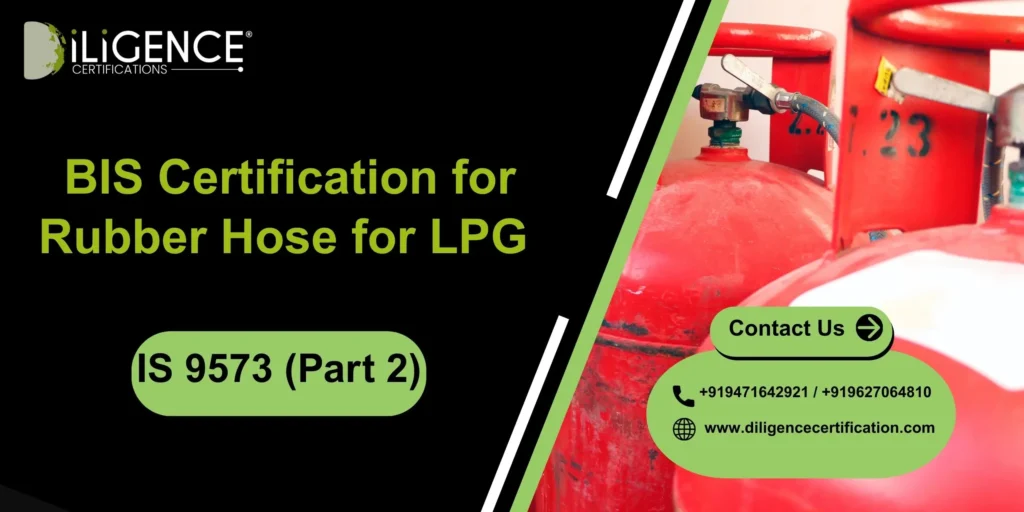
- Compulsory BIS compliance is a must for safety This makes BIS for Rubber Hose for LPG mandatory under IS 9573 (Part 2) for rubber hoses used with LPG. This ensures the resistance of hoses against leakage, fire hazards, and failure related to pressure.
- Defined Technical & Quality Parameters Among others, the standard covers the material formulation, reinforcement, working pressure, bursting pressure, flexibility, and aging performance of LPG rubber hoses.
- Testing Through Laboratories Recognized by BIS The samples need to be taken to various tests, such as hydrostatic pressure, leakage, tensile strength, and flame resistance, conducted in approved laboratories at the BIS.
- ISI Mark for Market Entry in India Only accredited rubber hoses can bear the ISI mark, basically a must for manufacturing, selling, or importing LPG hoses within the Indian market.
- Improved Consumer Trust & Regulatory Acceptance Assured safety, durability, and conformity with Indian regulations due to BIS certification make the rubber hoses for LPG gain higher acceptance from gas agencies, distributors, and consumers.
Introduction | BIS for Rubber Hose for LPG
Liquefied Petroleum Gas (LPG) is being utilised extensively in India as a fuel for domestic as well as small-scale industrial use. LPG is being employed in every household in the form of cooking ranges in kitchens, as well as in hotels, canteens, and food processing plants. LPG is a highly inflammable fuel and is capable of causing severe accidents even in the form of a leakage. Among all the LPG-related fittings and apparatus, the rubber hose is the most prone to failure as it connects the gas to the appliance.
In order to alleviate the concerns related to the safety aspect as well as to ensure uniformity in the quality of the product, the Bureau of Indian Standards has made the following certification compulsory for rubber hoses used for LPG in the standard IS 9573 (Part 2)
What is BIS for Rubber Hose for LPG (IS 9573 Part 2)?
BIS for Rubber Hose for LPG as defined by IS 9573 (Part 2), is relevant to rubber hoses intended to be used with liquefied petroleum gas. This part of the standard primarily addresses rubber hoses intended to be used with domestic or industrial LPG systems where safety, flexibility, or durability is of prime importance.
The certified mark verifies that the rubber hose meets the following parameters:
- It is manufactured using approved rubber compounds
- Can withstand conditions of pressure and temperature of LPG safely
- Resistant to aging, cracks, and leakage
- Meets fire safety and performance standards
After that, the certified item gets permission to use the ISI Mark, which serves as tangible evidence of its conformity with Indian standards for safety.
What BIS for Rubber Hose for LPG & Key Features of IS 9573 (Part 2)
Here below are some of the most important technical and compliance aspects delineated under IS 9573 (Part 2):
1. Material Requirements & Construction The standard prescribes the quality of the rubber compounds for the inner lining, reinforcement, and outer cover. The LPG-recovering hoses have to be compatible with LPG and resist any possible chemical reactions.
2. Pressure And Performance Standards
IS 9573 (Part 2) specifies the following
- Working pressure
- Proof pressure
- Bursting Pressure
They provide that the hose will not break or leak while it is in use with LPG.
3. Leakage and Flame Resistance Tests The approved hoses shall be tested for leakage as well as resistance to flame to reduce the risks associated with fire resulting from accidents.
4. Flexibility & Bending Test The hose cannot be rigid, even in normal operating conditions, to facilitate installation and prevent cracks and deformation.
Why BIS Certification is Mandatory – Key Reasons
1. Safety of LPG is a National Issue Due to the dangers probable with the leakage of LPG, the Government makes it mandatory to have the BIS certification.
2. Legal Requirement for Market Entry In India, manufacturing, sale, or import of LPG Rubber Hoses that is not certified by BIS is a punishable offense which can result in penalties, seizure, or shutting down of businesses.
3. Prevention of Substandard Products Certification prevents low-quality and unsafe hoses from being distributed in the marketplace.
4. Accountability of Manufacturers and Importers BIS Licensing provides traceability, factory audit, and compliance.
5. Consumer Confidence & Trust This is an assurance to consumers that the product is safe for use.
Importance vs Benefits
| Importance | Benefits |
| Ensures LPG leakage prevention | Reduces risk of fire accidents |
| Enforces uniform quality standards | Improves product reliability |
| Mandatory legal compliance | Avoids fines and legal action |
| Regular testing and surveillance | Maintains consistent quality |
| Protects end-user safety | Builds brand trust and reputation |
BIS for Rubber Hose for LPG Process
Step1:Documentation
- Collect required technical documents
- Prepare product specifications
- Gather company registration details
- Ensure documents follow BIS format
Step2:Product Testing
- Send samples to a BIS-approved lab
- Conduct safety and quality tests
- Receive test reports
- Confirm compliance with BIS standards
Step3:Application Submission
- Fill out the BIS application form
- Upload all required documents
- Attach valid test reports
- Pay the necessary BIS fees
Step4:Scrutiny and Inspection
- BIS reviews submitted documents
- Authority verifies test results
- Factory/product inspection may occur
- Clarifications requested if needed
Step5:Grant of License
- BIS approves the application
- License number is issued
- Product can carry BIS mark
- Renewal required before expiry
Documents Required for BIS Certification
| Category | Documents Required |
| Business Documents | Business license/registration, ISO certificate, organizational details |
| Manufacturer Details | Factory layout, process flow chart, machinery list, production details |
| Product Documents | Product specifications, component list, user manual, model details |
| Testing Documents | Test report from BIS-recognized lab, sample details, test request form |
| Legal & Compliance | Authorization letter, brand ownership proof, trademark certificate (if any) |
| Import/Foreign Manufacturer (If applicable) | AIR (Authorized Indian Representative) details, contract agreement, overseas manufacturer documents |
Timelines, Costs, Validity & Renewal
- Timelines: Usually from 20 to 30 days, with only 7-15 days for the testing.
- Costs: The cost of the government and the test varies depending on the product. There can be some additional charges though.
- Validity: The validity period is 2 years in most situations.
- Renewal: The renewal is done before the expiration; there should be updated documents/tests the renew
Challenges of Obtaining BIS Certification Without a Consultant
Although it looks easy on paper, the following are some of the challenges that they usually face while applying on their own:
1. Technical Interpretation Issues Understanding the clauses in IS 9573 (Part 2) and aligning the manufacturing process may be difficult.
2. Sample Testing Failures Failure of lab analysis may result from improper preparation of the samples or the absence of previous tests.
3. Documentation Errors Incomplete and inaccurate application forms could very well lead to a rejection of applications.
4. Readiness to Audit Factory A number of units are not entirely ready for BIS inspections, resulting in non-conformities.
5. Time Delays And Reapplications Without the help of an expert, certification might range from several months to a year and beyond.
Why Choose Diligence Certificate Consultancy?
Accurate selection of the consultant saves time, cost, and stress. Diligence Certificate Consultancy offers one-stop BIS for Rubber Hose for LPG support with proven competence.
1. End-to-End BIS Support Everything is handled professionally, from filing the application to the grant of a license.
2. Pre-Testing & Technical Guidance We ensure your LPG rubber hose will meet IS 9573 before lab testing.
3. Accuracy of Documentation Our experts will prepare and check all the documents to avoid rejections.
4. Preparation for Factory Audit From audit readiness and compliance checks to taking corrective action, we will assist you.
5. Faster Approval & Peace of Mind With our experience, certification timelines are reduced drastically.
Conclusion
The BIS for Rubber Hose for LPG as per IS 9573 (Part 2) is not simply a formality for the sake of regulatory compliance but an essential requirement on safety considerations. It would protect consumers from risks associated with LPG while allowing manufacturers and importers to operate legally and with confidence in the Indian market.
Trying to get accredited without professional assistance generally results in delays, failures in tests, and higher costs than necessary. Partnering with Diligence Certificate Consultancy means the complete confidence of a smooth, compliant, and efficient certification journey.BIS for Rubber Hose for LPG under IS 9573 (Part 2) is imperative if you want to sell safe, trusted, and legally approved LPG rubber hoses in India. And the right consultant makes all the difference.
Frequently Asked Questions (FAQs)
What is BIS Certification of LPG Rubber Hose?
BIS Certification for LPG rubber hose is a guarantee that the product meets the standards laid down in IS 9573 (part 2) by the Bureau of Indian Standards, relating to the quality and use of LPG,” it said in a statement.
Is BIS certification necessary for rubber hoses used with LPG in India?
Yes, it is compulsory that it should be BIS certified. It is an offense in India to manufacture, import, and sell an LPG rubber hose that is not ISI certified.
What does IS 9573 (Part 2) cover?
IS 9573 (Part 2) specifies the technical requirements of material quality, resistance to pressure, prevention of leakage, flame resistance, flexibility, and marking of the rubber hoses that are to be used for the transportation of liquefied petroleum gas.
Who requires BIS certification of LPG rubber hoses?
All rubber hose manufacturers or importers who supply these products for LPG services require BIS certification, after which they can be marketed in India.
What tests are performed for the BIS Certification for the LPG Rubber Hoses?
The hose is subjected to tests for hydrostatic pressure, hydrostatic burst pressure, free-leakage testing, tensile strength, aging, flexibility, and flame resistance at BIS recognized labs, as per IS 9573 (Part 2).
BIS certification for LPG rubber hose: How long does it take?
The entire certification may take anything from 30 to 90 days, depending on testing, paperwork, and factory inspection.
If LPG rubber hose is not BIS-certified, what will happen to it?
Unqualified sales of LPG rubber hoses can result in lawsuits, fines, product recall, disruption of business, and lack of market credibility.
Is BIS Certification required for imported LPG rubber hoses?
Yes, the imported LPG rubber hoses must also meet the requirements of IS 9573 (part 2) and get the certification of BIS in order to be subsequently sold and/or distributed in India.
How valid is the BIS license for LPG rubber hoses?
The BIS license typically holds validity for a period ranging from 1 – 2 years and can be extended after conducting surveillance audits as well as sample testing.
Why should manufacturers prefer the BIS consultant for the certification of LPG Rubber Hose?
A BIS consultant can help prevent testing failures, documentation inaccuracies, audit ineligibility, and time wastage, thus allowing faster approval, better costs, and easy certification.