



 BIS Certification
 CDSCO
CDSCO
 CPCB
CPCB
 LMPC
LMPC
 WPC Approval
 Global Approvals
 TEC
TEC
 ARAI
ARAI
 BEE
BEE
 ISO Certification
 DGCA Certification
 NOC For Steel
 APEDA Registration
















 Business Registration
 FSSAI Mark Certification












 Legal Services
 Trademark Registration
 Copyright Registration
 Patent Registration
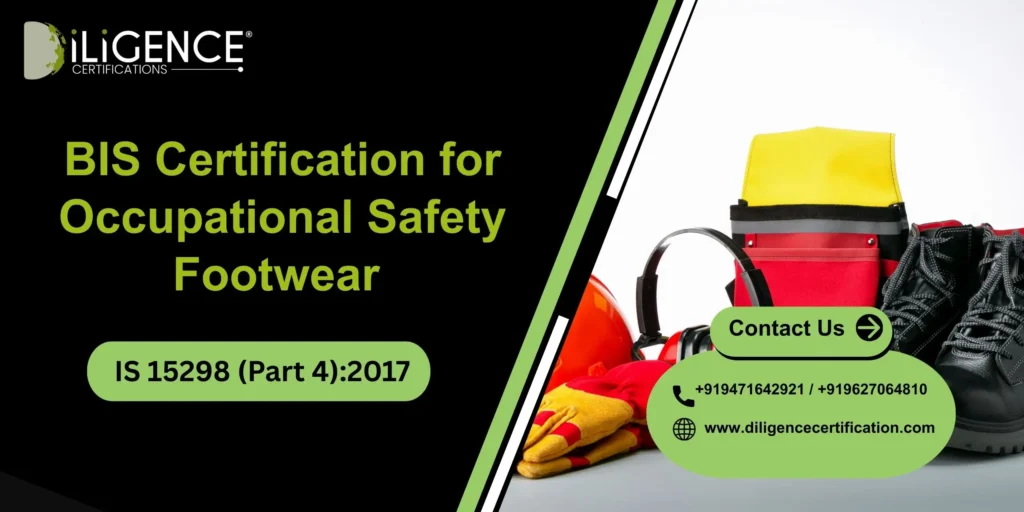
- BIS instrument for PPE Protective Footwear under IS 15298( Part 3) 2019 is further than a nonsupervisory checkbox. It’s a safeguard for workers, a credibility marker for manufacturers, and a gateway to serious business openings in India.
- Formalized Performance Testing Footwear must pass impact resistance, contraction, sole strength, slip resistance, and penetration tests as defined under IS 15298( Part 4) 2017.
- Quality- Controlled Manufacturing BIS for Safety Footwear blessing involves plant examination and verification of harmonious product, testing installations, and quality control systems.
- Request Access & Legal Protection footwear is accepted in government tenders, PSUs, and large artificial systems while guarding manufacturers from penalties and product bans.
- Trust, Reliability & Brand Credibility BIS- marked occupational footwear builds buyer confidence, reduces product failures, and strengthens long- term brand character.
Introduction | BIS for Safety Footwear
Occupational footwear does n’t generally get attention until a commodity goes wrong. A persecuted toe on a construction point. A chemical splash in a plant. A slip that could have been avoided with the right sole grip. In artificial surroundings, footwear is n’t an appurtenant — it’s a safety system.
In India, PPE occupational footwear is regulated under IS 15298( Part 4) 2017, and compliance is executed through obligatory Bureau of Indian Standards instruments. This standard applies to defensive footwear designed to guard workers against mechanical, chemical, electrical, and slip- related hazards across diligence like manufacturing, construction, oil painting & gas, logistics, and heavy engineering.
What Is BIS Certification for PPE Occupational Footwear
BIS for Safety Footwear instrument is a conformity assessment issued by the Bureau of Indian norms attesting that a product complies with the applicable Indian Standard. For occupational footwear, IS 15298( Part 4) 2017 BIS for Safety Footwear defines performance conditions, test styles, marking morals, and quality controls.
- Obligatory Compliance PPE occupational footwear can not be fairly manufactured, vended, or imported in India without a BIS instrument.
- Product Performance Testing Footwear is tested for toe protection, sole strength, slip resistance, penetration resistance, and impact immersion.
- Material Safety Validation Upper accoutrements , soles, and defensive factors are estimated for continuity, resistance, and safe composition.
- Plant Surveillance & Quality Control BIS conducts plant examinations to corroborate harmonious manufacturing practices and in- house testing capability.
- Formalized Marking & Traceability footwear must carry the ISI mark, license number, size, and manufacturer details for responsibility.
Importance vs Benefits of BIS for Safety Footwear
| Importance | Benefits |
| Ensures minimum safety standards for workers | Reduced workplace injuries and incidents |
| Mandatory under Indian regulations | Protection from legal penalties and bans |
| Verifies product durability and performance | Fewer product failures and returns |
| Controls manufacturing consistency | Improved production discipline |
| Builds trust with buyers and regulators | Stronger brand credibility |
Step-by-Step Process of BIS for Safety Footwear Certification
Step1:Documentation
- Collect required technical documents
- Prepare product specifications
- Gather company registration details
- Ensure documents follow BIS format
Step2:Product Testing
- Send samples to a BIS-approved lab
- Conduct safety and quality tests
- Receive test reports
- Confirm compliance with BIS standards
Step3:Application Submission
- Fill out the BIS application form
- Upload all required documents
- Attach valid test reports
- Pay the necessary BIS fees
Step4:Scrutiny and Inspection
- BIS reviews submitted documents
- Authority verifies test results
- Factory/product inspection may occur
- Clarifications requested if needed
Step5:Grant of License
- BIS approves the application
- License number is issued
- Product can carry BIS mark
- Renewal required before expiry
Documents Required for BIS Certification
| Category | Documents Required |
| Business Documents | Business license/registration, ISO certificate, organizational details |
| Manufacturer Details | Factory layout, process flow chart, machinery list, production details |
| Product Documents | Product specifications, component list, user manual, model details |
| Testing Documents | Test report from BIS-recognized lab, sample details, test request form |
| Legal & Compliance | Authorization letter, brand ownership proof, trademark certificate (if any) |
| Import/Foreign Manufacturer (If applicable) | AIR (Authorized Indian Representative) details, contract agreement, overseas manufacturer documents |
Timelines, Costs, Validity & Renewal
- Timelines: Usually from 20 to 30 days, with only 7-15 days for the testing.
- Costs: The cost of the government and the test varies depending on the product. There can be some additional charges though.
- Validity: The validity period is 2 years in most situations.
- Renewal: The renewal is done before the expiration; there should be updated documents/tests; the renewal
Challenges of Obtaining BIS Certification Without a Consultant
Numerous manufacturers essay the BIS for Safety Footwear process singly, assuming it’s a simple operation- and- test exercise. In practice, this approach frequently leads to detainments, rejections, and reprise costs.
- Incorrect Product Bracket Misinterpreting whether the footwear falls under Part 4 or another PPE order.
- Deficient Attestation Missing test protocols, estimation records, or plant layout details.
- Test Failure Due to Specification Gaps Minor material or design mismatches causing lab test failure.
- Plant examinationNon-Conformities Issues with process control, recordkeeping, or testing structure.
- Extended blessing Timelines Detainments caused by back- and- forth interpretations and corrective conduct.
Why Choose Diligence Certification for BIS Compliance
The Diligence Certification instrument works with PPE manufacturers, importers, and exporters who need clarity, speed, and nonsupervisory confidence.
- Standard Interpretation Expertise Clear guidance on IS 15298( Part 4) 2017 BIS for Safety Footwear conditions specific to your product.
- End- to- End Attestation Support From operation form to test collaboration and license entitlement.
- Pre-Inspection Readiness Checks relating gaps before BIS plant examination.
- Lab Coordination & Test Strategy Minimizing retesting and avoiding gratuitous failures.
- Time-Effective Process operation Faster blessings with smaller compliance surprises.
Conclusion
BIS for Safety Footwear under IS 15298( Part 4) 2017 is a critical compliance demand embedded in worker safety and product trustability. It protects druggies, strengthens manufacturer credibility, and ensures request access in a tightly regulated terrain.
While the process involves specialized testing, attestation, and examinations, the long- term benefits outweigh the trouble. Manufacturers who approach instruments strategically — rather than reactively — avoid detainments, reduce threat, and make trust with buyers and controllers likewise.
Frequently Asked Questions (FAQs)
Is BIS instrument obligatory for all safety footwear in India?
Yes, PPE occupational footwear covered under IS 15298( Part 4) 2017 requires an obligatory BIS instrument.
Can imported safety footwear be vended without BIS blessing?
No. Imported PPE footwear must also be BIS certified before trade in India.
How long does a BIS instrument take for occupational footwear?
Generally 3 – 5 months, depending on testing, attestation, and examination readiness.
What happens if footwear fails BIS lab testing?
The manufacturer must correct the issue and pretest, which adds time and cost.
Is plant examination mandatory?
Yes. BIS conducts plant examinations to corroborate quality control systems.
Does the BIS instrument need renewal?
Yes. Licenses are granted for a defined period and bear renewal with continued compliance.
Can startups apply for a BIS instrument?
Yes, they meet testing and manufacturing conditions.
Is ISI marking needed on footwear?
Yes. pukka products must carry the ISI mark and license number.
Can one BIS license cover multiple footwear models?
Only if models are technically analogous and approved under the same compass.
Why use an adviser for a BIS instrument?
To avoid detainments, reduce rejection threat, and insure correct interpretation of norms.