



 BIS Certification
 CDSCO
CDSCO
 CPCB
CPCB
 LMPC
LMPC
 WPC Approval
 Global Approvals
 TEC
TEC
 ARAI
ARAI
 BEE
BEE
 ISO Certification
 DGCA Certification
 NOC For Steel
 APEDA Registration














 Business Registration
 FSSAI Mark Certification











 Legal Services
 Trademark Registration
 Copyright Registration
 Patent Registration
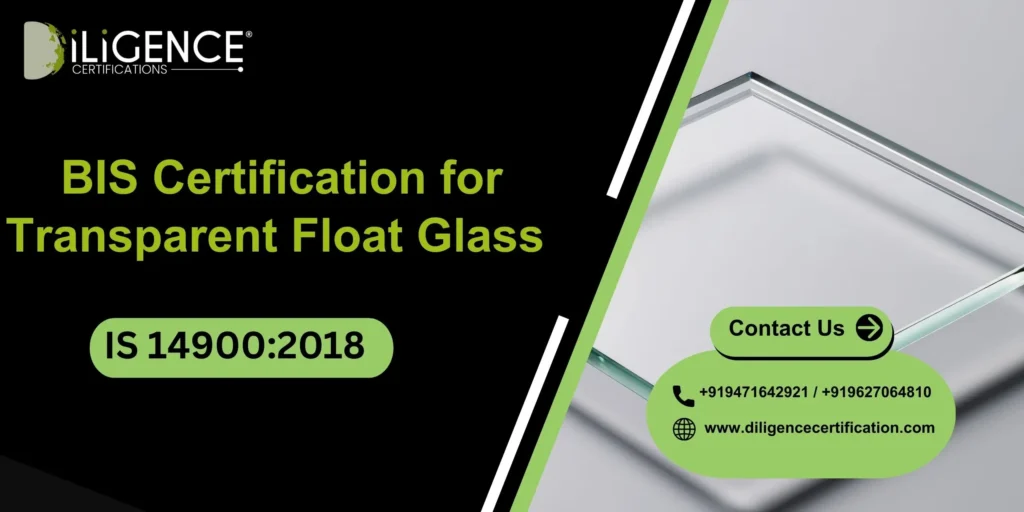
- Guarantees Compliance with Indian Quality Standards BIS for Transparent Float Glass certification for IS 14900:2018 ensures that the float glasses have complied with the required standards for the tolerance of thickness, optical parameters, flatness, and the final surfaces.
- Mandatory for Manufacturing and Import in India The transparent float glass, if intended for sale or distribution in India, must be BIS certified. The sellers and importers are obligated to procure the certificate before making the product available to the Indian market.
- It ensures Safety, Durability, and PerformanceCertified transparent float glass is subjected to rigorous tests on strength properties, optical distortion, edges, and dimensional accuracy and can be applied anywhere.
- BIS Certified Laboratories Testing Specimens are subjected to tests in laboratories approved by BIS to confirm their compliance with IS 14900:2018 specifications, such as variation in thickness, transmission of light, and other surface characteristics.
- Increases Market Acceptance and Consumer Trust The BIS Standard Mark satisfies the customer, manufacturer, and government requirements and provides assurance to the customer and authorities about the reliability and quality of the product in the global market.
Introduction | BIS for Transparent Float Glass
Transparent float glass is widely demanded in modern construction, automotive industry, interior design, solar panels, and furniture manufacturing. In spite of its popularity in various sectors due to its characteristics of transparency, smoothness, homogeneity, and strength, it is an important safety product, whose defects may pose threatening dangers such as shattering, distorting, or collapsing.
For ensuring consistency, safety, and reliability, the Government of India makes this quality compliance mandatory through BIS Certification for Transparent Float Glass: IS 14900:2018. This certification is provided by the Bureau of Indian Standards and ensures that the particular product or goods meet the Indian Standards specified for Optical Quality and other parameters.
What Is BIS Certification for Transparent Float Glass & Its Key Features
BIS Certification for Transparent Float Glass based on IS 14900:2018 is a quality assurance process for ensuring that the transparent float glass complies with certain standardized criteria pertaining to its properties and performance.
Important Features of BIS Certification under IS 14900:2018
- Standardized Quality and Manufacturing It also makes sure that the production of float glass is carried out in a regulated process to maintain consistency in thickness, flatness, and surface quality.
- optical and visual parameters IS 14900:2018 also contains standards for the optical defects of clarity/bubbles, scratches, inclusion, and optical distortion of the lens.
- Dimensional Accuracy & Thickness Tolerance Specifies the deviations in thickness and dimensions to facilitate compatibility with architectural and industrial requirements.
- Mandatory Testing & Inspection Testing & inspection Glass samples are required to be tested in BIS recognized laboratories, and the manufacturing units are required to undergo factory inspection before the approval for certification is obtained.
- Use of BIS Standard Mark With the certification, the company qualifies to use the BIS Standard Mark, indicating they meet the requirements of quality assurance on the part of the buyer.
Why BIS Certification Is Required & Key Reasons for Compliance
The BIS certification for transparent float glass is not only a paperwork requirement for the government; it has several other concerns and applications.
Why BIS Certification is Compulsory
- Is Responsible for Ensuring Consumer and Structural Safety Poor quality glass can be fragile or cause optical distortions. BIS certification eliminates such risks because the product has to meet strict standards.
- Legal Compliance in the Indian Market Manufacturing, importing, or selling any transparent float glass that does not comply with certifications may invoke penalties, product confiscation, and litigation.
- Prevents Substandard and Counterfeit Products Certification also protects against poor-quality glass imports or domestically produced glass which does not conform to standards in India.
- Supports Infrastructure and Construction Quality certified glass promotes safe structures, automobiles, and installation methods to satisfy country-wise quality standards.
- Enhances Trust Among Consumers as Well as the Authorities Architects, construction companies, government agencies, and major buyers favor BIS-certified materials for their reliability.
Importance vs Benefits of BIS Certification
| Importance | Benefits |
| Ensures compliance with IS 14900:2018 | Smooth market entry across India |
| Guarantees optical clarity and safety | Reduced product rejection and complaints |
| Mandatory for legal manufacturing and import | Avoidance of penalties and legal risks |
| Confirms uniform thickness and surface quality | Higher customer confidence and repeat business |
| Prevents circulation of inferior glass | Competitive advantage over non-certified brands |
BIS Certification Process
Step1:Documentation
- Collect required technical documents
- Prepare product specifications
- Gather company registration details
- Ensure documents follow BIS format
Step2:Product Testing
- Send samples to a BIS-approved lab
- Conduct safety and quality tests
- Receive test reports
- Confirm compliance with BIS standards
Step3:Application Submission
- Fill out the BIS application form
- Upload all required documents
- Attach valid test reports
- Pay the necessary BIS fees
Step4:Scrutiny and Inspection
- BIS reviews submitted documents
- Authority verifies test results
- Factory/product inspection may occur
- Clarifications requested if needed
Step5:Grant of License
- BIS approves the application
- License number is issued
- Product can carry BIS mark
- Renewal required before expiry
Documents Required for BIS Certification
| Category | Documents Required |
| Business Documents | Business license/registration, ISO certificate, organizational details |
| Manufacturer Details | Factory layout, process flow chart, machinery list, production details |
| Product Documents | Product specifications, component list, user manual, model details |
| Testing Documents | Test report from BIS-recognized lab, sample details, test request form |
| Legal & Compliance | Authorization letter, brand ownership proof, trademark certificate (if any) |
| Import/Foreign Manufacturer (If applicable) | AIR (Authorized Indian Representative) details, contract agreement, overseas manufacturer documents |
Timelines, Costs, Validity & Renewal
- Timelines: Usually from 20 to 30 days, with only 7-15 days for the testing.
- Costs: The cost of the government and the test varies depending on the product. There can be some additional charges though.
- Validity: The validity period is 2 years in most situations.
- Renewal: The renewal is done before the expiration; there should be updated documents/tests the renewal
Challenges of Obtaining BIS Certification Without a Consultant
Though BIS certification is required, it may become a complicated process if done without proper guidance.
Common Problems in Manufacturing & Importing
- Lack of Technical Understanding of IS 14900:2018 Incorrect test parameters or understanding test documentation requirements frequently results in test failure.
- Complex Documentation Process The preparation of factory layouts, quality manuals, test reports, and statements of compliance involves accuracy and know-how.
- Coordination with BIS Recognized Laboratories Choosing the appropriate lab, following through on sample submissions, and even results interpretation may be complex.
- Issues related to Factory Inspection Readiness Officials from BIS carry out strict checks. Wherever there is a loophole in quality control systems, it leads to non-conformity.
- Longer Timelines and Cost Overruns Errors, re-testing, and resubmissions lead to longer certification processes and costs.
Why Choose Diligence Certificates Consultancy for BIS Certification
Diligence Certificates Consultancy is expertise in providing comprehensive BIS certification services to manufacturers and importers to achieve it easily without any tension.
- Technical Knowledge on IS 14900:201 Our team is fully aware of every clause, test requirement, as well as the compliance aspect of the transparent float glass norms.
- End to End Certification Support From documentation to sample testing, as well as BIS coordination and factory inspection, we cover it all.
- Fast approval with fewer errors It decreases the possibilities of rejection and helps in faster certification processes.
- Personalized Client Service Every client is provided with customized advice and updates. Moreover, the communication is transparent. Cost-Effective & Reliable Service
Conclusion
BIS Certification for Transparent Float Glass that conforms to IS 14900:2018 is a mandatory strategic requirement for Indian manufacturers or importers. It is based on safety standards to ensure that customers are not exposed to substandard products through buildings.
Although it might be a bit complicated to get certification, it becomes easy to handle it with the help of a professional consultancy firm such as Diligence Certificates. You are able to focus on developing your business while also complying with all BIS norms.
Frequently Asked Questions (FAQs)
What is BIS Certification for Transparent Float Glass?
BIS Certification for Transparent Float Glass is an obligatory quality approval process that verifies if the float glass meets the IS 14900:2018 specifications regarding the thickness, optical clarity, surface quality, and performance characteristics.
Is it necessary to have BIS Certification for Transparent Float Glass in India?
Yes, BIS Certification is mandatory for manufacturing, importing, and selling transparent float glass in India, as govt. has imposed a quality control order on it.
Which is the Indian Standard for Transparent Float Glass?
The relevant Indian Standard is IS: 14900:2018. This standard includes technical specifications such as dimension, visual defects, thickness tolerance, and quality parameters.
Which authority provides BIS Certification for Transparent Float Glass?
BIS Certification is granted only after testing and inspection of factories by the Bureau of Indian Standards (BIS).
List the testing requirements in IS 14900:2018?
Testing includes thickness variation, visual & optical defects, dimensional accuracy, flatness, & surface quality, which are carried out in BIS recognized labs.
Can Importers Apply for BIS Certification for Transparent Float Glass?
Yes, the importers have to get BIS certification from the Foreign Manufacturers Certificate Scheme (FMCS) before importing the transparent float glasses into India.
How long does it take to get BIS Certification for Transparent Float Glass?
The certification procedure generally requires 4 to 8 weeks, depending upon documentation accuracy, testing samples, and factory readiness for inspections.
What if Transparent Float Glass is sold without BIS certification?
Sale of non-certified glass may result in penalty, confiscation of goods, revocation of licenses, and legal action against the manufacturer as per the rules and regulations of BIS.
What are the documents necessary for BIS Certification of Transparent Float Glass?
These documents include: factory registration documents, production process information, quality control documents, test reports, product specifications, and letters of authorization.
Why do manufacturers need to engage a BIS consultant for IS 14900:2018 certification?
A consultant for BIS helps to eliminate errors, minimize the time required for approvals, ensure adherence to standards, and coordinate testing and inspection.