


 BIS Certification
 CDSCO
CDSCO
 CPCB
CPCB
 LMPC
LMPC
 WPC Approval
 Global Approvals
 TEC
TEC
 ARAI
ARAI
 BEE
BEE
 ISO Certification
 DGCA Certification
 NOC For Steel
 APEDA Registration










 Business Registration
 FSSAI Mark Certification









 Legal Services
 Trademark Registration
 Copyright Registration
 Patent Registration
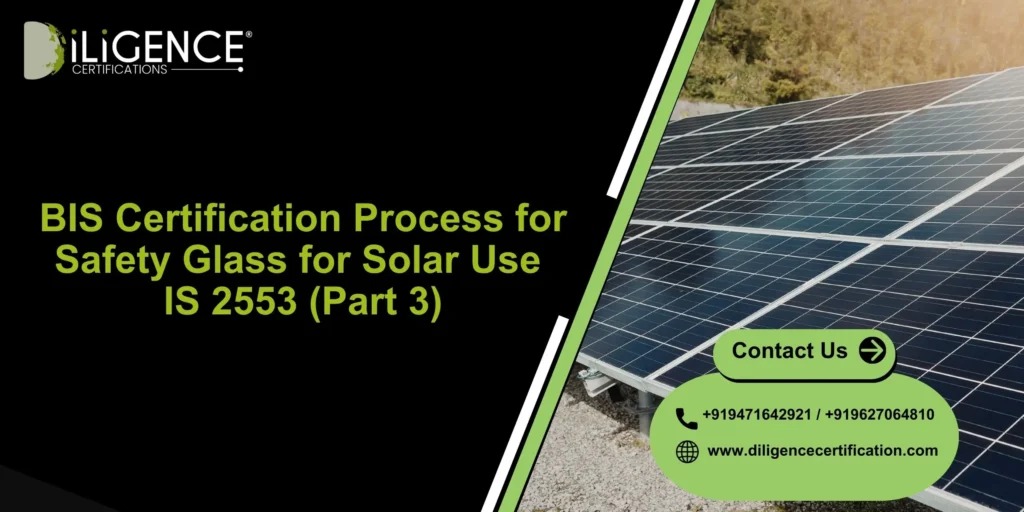
- BIS Process for Safety Glass IS 2553 (Part 3) specifies quality and safety requirements for safety glass used in solar applications, especially in solar panels and photovoltaic modules.
- Manufacturers must obtain certification from the Bureau of Indian Standards (BIS) to legally sell regulated products in India.
- The certification ensures that solar safety glass meets strict strength, durability, and transparency standards.
- BIS certification requires product testing in BIS-recognized laboratories, factory inspection, and compliance verification.
- The certified product carries the ISI Mark, which assures customers of quality, safety, and reliability.
Introduction | BIS Process for Safety Glass
Solar energy is becoming one of the most important renewable energy sources in India and across the world. Solar panels are widely used in homes, industries, and large solar farms to generate clean electricity. One of the key components of a solar panel is safety glass, which protects the photovoltaic cells from environmental damage while allowing sunlight to pass through efficiently.
To ensure that this glass is safe, durable, and suitable for solar applications, India has established a specific standard called IS 2553 (Part 3). BIS Process for Safety Glass provides the technical requirements that manufacturers must follow when producing safety glass for solar modules.
To sell or distribute this product in India, manufacturers must obtain BIS Certification Process for Safety Glass for Solar Use – IS 2553 (Part 3)This certification confirms that the product meets national quality and safety standards and can be trusted for long-term solar use.
This article explains everything you need to know about BIS certification for safety glass used in solar applications, including its importance, benefits, certification process, and common challenges faced by manufacturers.
What is BIS Process for Safety Glas?
BIS Process for Safety Glass is a quality assurance system implemented by the Bureau of Indian Standards, which is the national standards authority in India. It ensures that products sold in the Indian market comply with established safety, performance, and quality standards.
BIS Process for Safety Glass Under IS 2553( Part 3), manufacturers of safety glass used in solar operations must follow specific specialized specifications. These include conditions related to
- Mechanical strength
- Impact resistance
- Light transmission parcels
- Thermal stability
- Resistance to environmental conditions
Once a manufacturer complies with these conditions and successfully completes testing and examination procedures, BIS grants the ISI Certification mark for the product.
The ISI mark indicates that the safety glass has been completely tested and approved according to Indian standards
Why BIS Process for Safety Glass is Required
1. Ensures Product Safety Safety glass used in solar modules must be strong enough to repel environmental factors similar as wind, rain, hail, and temperature changes. BIS Certification ensures that the glass meets these safety standards
2. Guarantees Product Quality BIS Process for Safety Glass IS 2553( Part 3) defines strict manufacturing and testing parameters that insure harmonious product quality.
3. Obligatory Compliance for Manufacturers In numerous cases, manufacturers must misbehave with BIS regulations before their products can be fairly vended in India.
4. Builds client Trust The ISI mark handed by BIS helps guests identify certified and dependable products.
5. Supports Solar Industry Growth Formalized safety glass improves the performance and lifetime of solar panels, which supports the growth of the renewable energy sector.
Importance and Benefits of BIS Process for Safety Glass
| Importance | Benefits |
| Ensures compliance with Indian safety standards | Improves product reliability |
| Confirms product quality through testing | Enhances brand reputation |
| Protects consumers from substandard products | Increases customer confidence |
| Enables legal sale in the Indian market | Helps manufacturers enter new markets |
| Ensures durability of solar safety glass | Reduces product failure and maintenance costs |
BIS Certification Process for Safety Glass under IS 2553 (Part 3)
The process for obtaining BIS certification involves several steps. Manufacturers must follow a structured procedure to ensure compliance with the required standards.
1. Application Submission
The manufacturer submits an application to the Bureau of Indian Standards with details about the product, manufacturing process, and factory location.
2. Documentation Review
BIS officials review all submitted documents to verify that the manufacturer meets the required guidelines.
3. Product Testing
Samples of the safety glass are sent to BIS-recognized laboratories where they undergo testing according to IS 2553 (Part 3) standards.
4. Factory Inspection
BIS inspectors visit the manufacturing unit to verify the production process, quality control systems, and infrastructure.
5. Grant of BIS Certification
If the product passes all tests and inspections, BIS grants the ISI mark license to the manufacturer.
6. Continuous Surveillance
After certification, BIS may conduct periodic inspections and product testing to ensure ongoing compliance.
Challenges of Getting BIS Certification Without a Consultant
Many manufacturers face difficulties when applying for BIS Process for Safety Glass on their own. The process can be complex and time-consuming.
1. Complex Documentation The operation requires several specialized documents and compliance reports that must be set rightly.
2. Understanding BIS Regulations Manufacturers frequently struggle to understand the detailed nonsupervisory conditions under IS 2553( Part 3).
3. Product Testing Issues Failing laboratory tests can delay Certifications and increase costs.
4. Time- Consuming Procedures The Certification process involves multiple stages, which can take several months if not managed duly.
5. Threat of operation Rejection Incorrect operations or deficient documents may lead to detainments or rejection by BIS.
Because of these challenges, numerous companies prefer working with educated Certification advisers .
Why Choose Diligence Certification for BIS Certification
BIS Process for Safety Glass can be a complicated process, but working with a professional consultant can make it much easier.
Diligence Certification provides complete assistance to manufacturers seeking BIS certification for safety glass under IS 2553 (Part 3).
1. Expert Guidance The platoon understands BIS regulations and provides step- by- step support throughout the Certification process.
2. Documentation backing They help prepare accurate documents to avoid operation rejection.
3. Smooth Testing Process industriousness assists in coordinating product testing with BIS- approved laboratories.
4. Faster Certification With professional support, the entire Certification process can be completed more efficiently.
5. End- to- End Compliance Support From operation submission to final blessing, industriousness provides complete Certification backing.
Conclusion
BIS Process for Safety Glass a crucial role in protecting solar modules and ensuring their long-term performance. Because solar panels operate in challenging environmental conditions, the glass used in them must meet strict quality and durability standards.
The IS 2553 (Part 3) standard ensures that safety glass used in solar applications meets these requirements. Obtaining BIS Certification for Safety Glass for Solar Applications confirms that the product complies with national safety standards and can be trusted by consumers.
Manufacturers who obtain BIS Process for Safety Glass benefit from improved product credibility, legal compliance, and increased market acceptance. However, the certification process can be complex without professional guidance.
Working with experienced consultants like Diligence Certification can help manufacturers complete the certification process smoothly and efficiently while ensuring full compliance with BIS regulations.
Frequently Asked Questions (FAQs)
What is IS 2553 (Part 3)?
IS 2553 (Part 3) is an Indian standard that specifies requirements for safety glass used in solar applications.
Who issues BIS certification for safety glass?
BIS certification is issued by the Bureau of Indian Standards.
Is BIS certification mandatory for safety glass used in solar panels?
Yes, manufacturers must comply with BIS standards when the product falls under mandatory certification requirements.
What is the ISI mark in BIS certification?
The ISI mark indicates that the product meets Indian safety and quality standards.
How long does it take to get BIS certification?
The certification process usually takes several weeks to a few months depending on testing and inspection.
What documents are required for BIS certification?
Documents include factory details, product specifications, testing reports, and quality control information.
Why is safety glass important in solar panels?
Safety glass protects solar cells from damage while allowing sunlight to pass through efficiently.
Can foreign manufacturers apply for BIS certification?
Yes, foreign manufacturers can apply through the BIS Foreign Manufacturers Certification Scheme.
What happens if a product fails BIS testing?
The manufacturer must correct the issues and submit new samples for testing.
Can a consultant help with BIS certification?
Yes, certification consultants simplify the process by assisting with documentation, testing, and compliance.