



 BIS Certification
 CDSCO
CDSCO
 CPCB
CPCB
 LMPC
LMPC
 WPC Approval
 Global Approvals
 TEC
TEC
 ARAI
ARAI
 BEE
BEE
 ISO Certification
 DGCA Certification
 NOC For Steel
 APEDA Registration














 Business Registration
 FSSAI Mark Certification











 Legal Services
 Trademark Registration
 Copyright Registration
 Patent Registration
- BIS certification is essential for Indian manufacturers as it ensures quality, safety, and legal compliance under the BIS Act, 2016.
- The registration is a way of guaranteeing product quality, safety, and conformity to the relevant Indian Standards through testing and evaluation.
- It is mandatory for Indian manufacturers to file an application under the right BIS scheme that includes ISI Mark Certification or Compulsory Registration Scheme (CRS).
- Good paperwork, the correct selection of the standard, and passing the test are some of the factors without which it would be difficult to get a permit and if the application is rejected.
- BIS registration is instrumental in enhancing customer loyalty, brand power, easier access to the market, and business sustainability in the long run.
Introduction
BIS registration for Indian manufacturer is essential as it ensures quality, safety, and legal compliance under the BIS Act, 2016. BIS registration for Indian manufacturer guarantees that products manufactured in India conform to applicable Indian Standards through testing and certification.
Indian manufacturers producing goods in sectors such as electronics, electrical equipment, industrial products, consumer goods, and construction materials must have a BIS registration. Without the BIS approval, manufactures will not be allowed to manufacture, store, distribute, or sell certain products in India. Bureau of Indian Standrads
This is the manual of a factory-based Indian manufacturing company, MSMEs, startups, and compliance managers. It provides them with a clear, step-by-step understanding of the BIS registration of Indian manufacturers.
Understanding the importance of BIS registration for Indian manufacturer helps businesses avoid penalties and ensures smooth entry into the Indian market.
What Is BIS Registration?
BIS Registration for Indian Manufacturer is the official green light given by the Bureau of Indian Standards that a product meets the relevant Indian Standard (IS). In essence, the manufacturer is allowed to put the BIS Standard Mark or ISI Mark on the product.BIS registration is a kind of a quality test and safety check certificate that both the regulators and the consumers can see as per Indian norms.For any regulated product, BIS registration for Indian manufacturer serves as official approval for lawful manufacturing and sale in India.
Difference Between BIS Registration and BIS Certification
BIS Registration for Indian Manufacturer is more of a regulatory step for products controlled under the Compulsory Registration Scheme (CRS) such as electronics and IT products. BIS certification under the ISI mark scheme is a more detailed process involving licensing, factory inspection, continued surveillance, and periodic testing. That is, Compliance is assured in both cases but they differ in procedure and level of monitoring. Role of the Bureau of Indian Standards BIS plays the role of a regulatory body by implementing many functions such as:
- Developing Indian Standards
- Offering BIS registration and licenses
- Recognizing testing laboratories
- Conducting factory inspections
- Tracking certified industries
- Enforcing
Why BIS Registration Is a Must for Indian Manufacturers
Legal Requirement Under BIS Act, 2016
The BIS Act, 2016, is a law that gives the Government the power to require a product certification or registration (depending on the case), which, in its opinion, has an impact on the safety and general welfare of the public. For a product that is the subject of a notification, an Indian manufacturer is obliged to have a BIS registration. The manufacture or sale of products without prior permission from BIS is considered illegal and therefore, the offenders are subject to punishment by law.
Product Quality and Safety Assurance
BIS registration is essentially the tool that ensures that products:
- Meet minimum quality benchmarks
- Are safe for consumers
- Conform to standardized technical specifications
This helps prevent the circulation of substandard or dangerous products in the market.
Penalties for Non-Compliance
Failure to obtain BIS registration can lead to:
- Money fines
- Confiscation of goods<
- Closure of the manufacturing unit
- Being taken to court and prosecuted under the BIS Act
- Loss of reputation
Who Needs BIS Registration in India?
Several manufacturers in India are required to have BIS registration.
Indian Manufacturing Companies
Any manufacturing unit that produces regulated products must obtain BIS certification should the products be destined for the market.
MSMEs and Startups
Question of necessity of BIS registration is not out of the scope for small businesses, startups, and micro-enterprises. Even if you are a small-scale manufacturer, you must work in such a way that the product, if it is included in mandatory BIS norms, complies with them.
Product Categories Covered Under Mandatory BIS Nornis
Products that may need BIS registration are, in general, the following:
- Electrical appliances and equipment
- Electronics and IT products
- Cement and steel products
- Home appliances
- Industrial and mechanical equipment
Manufacturers must know if their products are covered by the mandatory BIS certification or registration schemes
Types of BIS Registration for Indian Manufacturers
The installation of a BIS Registration for Indian Manufacturer system for a product manufacturer in India is different from the application of a registration scheme for a product category.
ISI Mark Certification Scheme
The ISI Mark Certification Scheme is a pioneer and the most visible one out of the various BIS schemes. The products to which it is extended include:
- Insulated electrical wires and cables
- Cement and other building materials
- Steel products
- Gas cylinders
- Pressure cookers
Some of the important features of this program are:
- BIS officials’ mandatory factory inspection
- Examination of the production process and quality control systems
- Continuous monitoring and testing of samples
The ISI mark is the mark that approved products carry; it is a sign of quality and safety
Compulsory Registration Scheme (CRS)
The Compulsory Registration Scheme is essentially a scheme which covers the electronics and IT products that consist of the following:
- LED lighting products
- Mobile phones
- Laptops and tablets
As per CRS:
- It is compulsory that the products should be tested.
- Registration is carried out on the basis of the test reports from the laboratories recognized by BIS
- Factory inspection for the purpose of routine
BIS Registration Process for Indian Manufacturer (Step-by-Step)
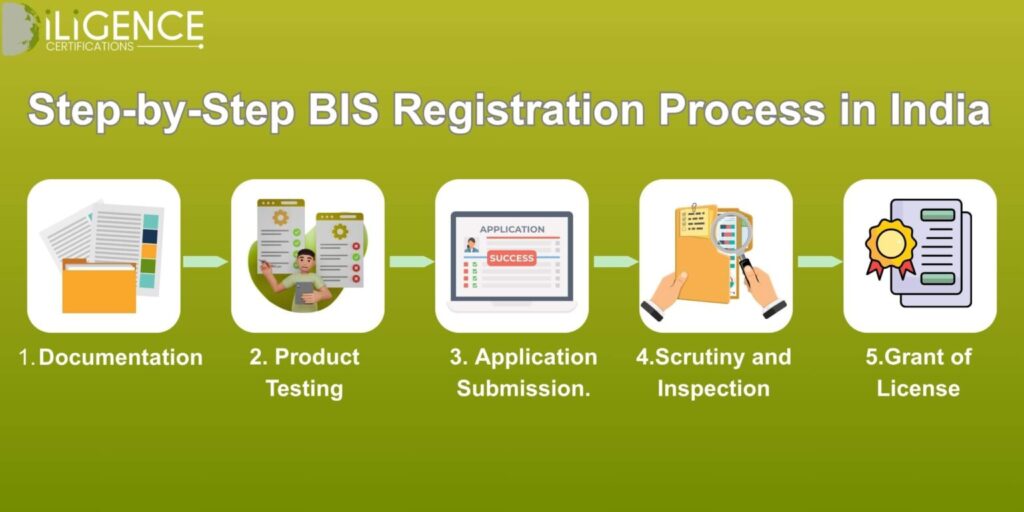
The BIS Registration for Indian Manufacturer process for Indian manufacturer involves multiple compliance steps, starting from standard identification to final approval.
Step 1: Identify Applicable Indian Standard (IS Code)
The manufacturer needs to:
- Find out if the product was covered under BIS mandatory norms
- Choose the correct Indian Standard (IS) that is applicable to the product
Not choosing the right IS code is frequently a problem leading to an objection.
Step 2: Product Testing in BIS-Recognized Laboratory
- Samples of the product are collected and sent to a laboratory approved by BIS
- Testing is done strictly according to the standard IS mentioned in the request
- If the product complies, a detailed test report is generated
Test reports should be valid when the application is submitted.
Step 3: Document Preparation
The BIS Registration for Indian Manufacturer, through the company secretary and other key personnel, must create the required documents that include but are not limited to:
- Information about the company and factory
- Details about the manufacturing process
- Quality control procedures
Any inconsistency can bring about delay or rejection of the application.
Step 4: Online Application Filing
BIS application is done online through the official BIS online portal. The process involves:
- Uploading the documents and test reports
- Entering product and factory details
- Government fee payment
Besides doing it correctly, it is very important to avoid any mistake which may cause you to be objected.
Step 5: Factory Inspection (If Required)
For ISI Mark Certification:
- Factory inspection is conducted by BIS officers on-site
- They verify the manufacturing facilities, machinery, and testing equipment
- Besides that, quality control and raw material handling are looked into
Usually, CRS registration is a step that does not need factory inspection.ISI Mark
Step 6: Grant of BIS Registration
If BIS is content with the results of testing, the documents, and the inspection, it will:
- Grant registration or license
- The manufacturer gets the permission to put the mark BIS or ISI on the products
7. Documents to be Submitted for Getting BIS Registration in India
Proper documentation is a crucial part of BIS registration for Indian manufacturer, as incomplete records often lead to objections or rejection.
| Document | Description |
| Certificate of incorporation or firm registration | Proof of legal registration of the manufacturing entity |
| Factory address proof | Valid address proof of the manufacturing unit |
| Manufacturing process flow chart | Step-by-step process of product manufacturing |
| Factory layout diagram | Diagram showing production areas and machinery setup |
| Product test reports from BIS-recognized lab | Evidence of product compliance with applicable Indian standards |
| Authorized signatory ID proof | Identity proof of the authorized representative |
| Authorization letter | Document authorizing the signatory to submit BIS application |
If the components are sourced from the foreign country or a part of the process is outsourced, you may have to disclose
BIS Registration Timeline for Indian Manufacturers
Average timelines are:
- CRS registration: 20 to 30 working days
- ISI Mark certification: 45 to 90 working days
Factor Affecting Timeline
- Product complexity
- Duration of laboratory testing
- Accuracy of documents
- Factory inspection observations
- Response time to BIS queries
BIS Registration Cost in India
The cost of BIS registration for Indian manufacturer depends on:
- Product category
- Number of product models
- Applicable BIS scheme
Cost components comprise:
- BIS application fees
- Testing charges payable to laboratories
- Annual license fee (ISI scheme)
- Inspection charges
- Consultant fees (if applicable)
It is not a case of a set amount; the cost is different for each case.
Validity and Renewal of BIS Registration
- CRS registration is generally valid for two years
- ISI licenses are valid for one to two years
Manufacturers must apply for renewal before expiry to ensure uninterrupted compliance
Common Challenges Faced by Indian Manufacturers
Indian manufacturers often face issues such as:
- Selecting the wrong IS standard
- Product failure during testing
- Incomplete or inconsistent documentation
- Delays in laboratory testing
- Poor preparation for factory inspection
Early planning and expert guidance can significantly reduce these challenges.
Benefits of BIS Registration for Indian Manufacturer
BIS Registration for Indian Manufacturer opens up a plethora of advantages for the Indian manufacturers such as :
- Customer confidence through increased trust
- Brand credibility gets enhanced
- Distributors and retailers can accept your brand more easily
- Retains competitive advantage in regulated sectors
Moreover, compliance acts as a catalyst for business growth and mades the business export-ready
Why Hire a BIS Registration Consultant?
Manufacturers may decide to file an application on their own, nevertheless a BIS consultant aids in substantially:
- Locating the exact standards and schemes
- Testing vendor coordination to save time
- Documentation preparation with high accuracy
- Professional communication handling with BIS
Augmenting the factory operations with the peace of mind that everything is in place is the manufacturer’s choice by availing of a
Conclusion
BIS registration for Indian manufacturer is not only a mandatory legal requirement but also a strategic step toward quality assurance, consumer trust, and sustainable business growth. With proper planning, expert guidance, and accurate documentation, BIS registration for Indian manufacturer can be completed smoothly and efficiently. It is a process that is dependent on a technical understanding and has to be carried out with great accuracy from a regulatory point of view, starting with the selection of the right BIS scheme and eventually completing the testing and inspection.
Indian manufacturers who are registered with BIS are not only legally compliant but also have an advantage of increased consumer trust, better product quality perception, and a more stable market position. BIS registration can be carried out successfully and in a timely manner if one is well prepared and has the support of an expert, thus it can be considered as a step towards business sustainability in the Indian market.
Frequently Ask Questions
What is BIS registration for Indian manufacturers?
BIS registration is the official approval from the Bureau of Indian Standards (BIS) that a product meets the relevant Indian Standards (IS) and can be legally manufactured and sold in India.
Is BIS certification mandatory for all products in India?
No, BIS certification is mandatory only for products listed under the Compulsory Registration Scheme (CRS) or those requiring ISI mark certification according to BIS notifications.
What is the difference between BIS registration and BIS certification?
BIS registration (CRS) is a regulatory approval for electronics and IT products, while BIS certification (ISI mark) involves licensing, factory inspection, continuous monitoring, and periodic testing for certain products.
Which products require BIS registration in India?
Products like electrical appliances, electronics and IT goods, cement, steel, home appliances, and industrial machinery often require BIS registration or certification.
How do Indian manufacturers apply for BIS registration?
Manufacturers must identify the applicable IS standard, test their product in a BIS-recognized lab, prepare documents, file an online application, and undergo factory inspection (if required).
What documents are needed for BIS registration?
Documents include certificate of incorporation, factory address proof, manufacturing process flow chart, factory layout diagram, product test reports, and authorization letters for signatories.
How long does BIS registration take for Indian manufacturers?
CRS registration usually takes 20–30 working days, while ISI mark certification can take 45–90 working days, depending on product complexity and documentation accuracy.
What are the benefits of BIS registration for manufacturers?
It enhances product quality perception, builds customer trust, ensures legal compliance, improves brand credibility, and facilitates easier market access.
What happens if a manufacturer sells products without BIS registration?
Non-compliance can lead to fines, confiscation of goods, closure of the manufacturing unit, legal prosecution under the BIS Act, and reputational damage.
Can manufacturers hire a consultant for BIS registration?
Yes, BIS consultants can assist with locating the right standards, coordinating testing, preparing documents accurately, and communicating with BIS, ensuring smooth registration.