

 BIS Certification
 CDSCO
CDSCO
 CPCB
CPCB
 LMPC
LMPC
 WPC Approval
 Global Approvals
 TEC
TEC
 ARAI
ARAI
 BEE
BEE
 ISO Certification
 DGCA Certification
 NOC For Steel
 APEDA Registration







 Business Registration
 FSSAI Mark Certification
 Legal Services
 Trademark Registration
 Copyright Registration
 Patent Registration
- It is the main requirement for the manufacturing and selling of drugs, medical devices, and regulated products in India that is done in a legal manner.
- It guarantees that the safety, quality, and performance standards specified by CDSCO are met.
- It is a certification that is valid and necessary for pharmaceutical companies, medical device manufacturers, API producers, and a limited number of cosmetic manufacturers.
- The certification journey involves identifying the category of the product, preparing the required documents, submitting the application through the SUGAM portal, and the final stage is an audit.
- This is a great tool for the manufacturers to gain market trust and comply with their regulatory obligations.
Introduction
CDSCO certification is a significant instrument in guaranteeing that the pharmaceuticals, medical devices, and other regulated commodities are in accordance with the safety and quality standards set at the national level. As the main regulatory entity under the Health Ministry, the Central Drugs Standard Control Organization is the power that grants approvals, issues licenses, and verifies the compliance of manufacturers all over India. It is very important for firms to acquire CDSCO certification if they wish to be engaged in the legal production and marketing of regulated healthcare products. In this way, they are able to retain their trustworthiness, ensure consumer safety, and function within the regulations laid down by India. Central Drugs Standard Control Organization
What Is CDSCO Certification?
CDSCO certification is fundamentally an official instrument which signifies that the products like drugs, medical devices, cosmetics, and the rest of items regulated by the Central Drugs Standard Control Organization of India (CDSCO) are meeting the safety and quality standards set up. The certification serves as a license that manufacturers may use to lawfully execute production and marketing activities of such products in India by offering a product that meets the country’s regulations.
Key Points:
- It is an approval given to a product or a service by the Central Drugs Standard Control Organization which is under the Ministry of Health.
- It is aimed at guaranteeing the safety, quality, and regulatory compliance of the product.
- Essential to be obtained for pharmaceutical products, medical devices, in vitro diagnostic products, and certain types of cosmetics.
- The activities under the scope of this account comprise licensing, product registration, and audits.
- It is a must-have for manufacturers to make their products available to the local market and thus are allowed to sell and distribute such regulated products in India.
Importance and Benefits of CDSCO Certification
| Importance | Benefits |
| Ensures product safety and quality | Establishes trust and confidence in consumers |
| Acts as a legal authorization for the production and marketing of products | Allows access to both domestic and foreign markets |
| Assures that the company is following the regulatory standards | Decreases the chances of recall, fines, and legal troubles |
| Facilitates the implementation of quality management systems | Improves operational efficiency and product reliability |
| Covers drugs, medical devices, cosmetics, and biologicals | Strengthens brand reputation and market credibility |
Who Needs CDSCO Certification in India?
Manufacturers of drugs, medical devices, cosmetics, diagnostics, and biological products must obtain CDSCO certification to operate legally in India. The need depends on product type and level of regulatory risk.
Key Points:
- Manufacturers of pharmaceutical drugs and APIs.
- Medical device manufacturers of Class A, B, C, and D devices.
- IVD kit and reagent manufacturers.
- COSMETIC production regulated by the CDSCO.
- Vaccine, blood, and biologic therapy manufacturers.
Types of CDSCO Certifications for Indian Manufacturers
CDSCO provides different types of certifications based on the activities performed by the entity such as manufacturing, importing, testing, or distributing regulated healthcare products. Each certificate is a guarantee that the holder conforms to India’s drug and medical device regulations.
- Manufacturing License
It is a license to be held by Indian manufacturers who produce drugs, medical devices, cosmetics, or other regulated products. The main point of it is to ensure that the production facility is meeting the set quality and safety standards. - Import License
Needed when manufacturers import finished products, raw materials, or components. It permits the legal import of drugs, medical devices, or cosmetics into India. - Test License
A test license is a permit that is given to a manufacturer when it is necessary to produce or import only a few products solely for research, testing, clinical trials, or evaluation purposes and not for sale. - Registration Certificate
It is a must-have for the products that need to be registered with CDSCO prior to manufacturing, importing, or marketing. The biggest application of this is in the cases of certain medical devices and pharmaceuticals. - Loan License
Allows a manufacturer to produce products using another company’s facility. The applicant does not own the plant but operates under regulatory approval. - Wholesale Drug License
Required for companies involved in the wholesale distribution of drugs. Manufacturers who also distribute their own products may need this license. - Notified Body Certification
It is a certification that is applicable to some Class A and Class B medical devices. A notified body assesses the manufacturer’s quality management system, for instance, ISO 13485, in order to verify safety and conformity of the product.
CDSCO Certification Process for Indian Manufacturers
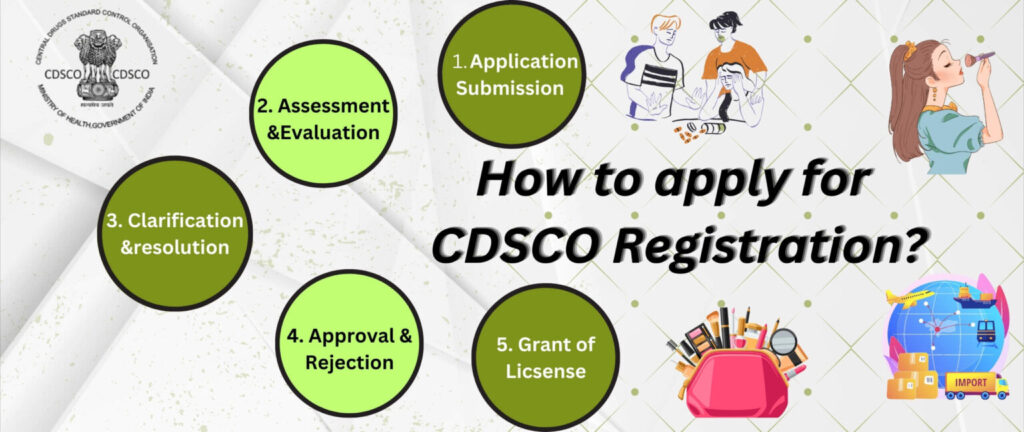
Step 1: Determine Product Classification
- Identify if the product is a drug, medical device, cosmetic, or biological.
- For medical devices, classify into Class A, B, C, or D based on risk.
- Moreover, find out if the product is listed or not in the CDSCO regulations.
- The type of the license or certificate issued will be dependent on that information.
Step 2: Prepare Required Documentation
- The primary thing is to review the manufacturing and quality systems and gather all the necessary data.
- Also, include the device master file, plant master file, and safety data.
- Prepare ISO certifications or clinical evaluation reports if applicable.
- Ensure all forms and declarations are complete and accurate.
Step 3: Submit Application via SUGAM Portal
- Create an account on the CDSCO SUGAM portal.
- Upload all required documents digitally.
- Pay applicable fees online.
- Track application status through the portal.
Step 4: Technical Review by CDSCO
- CDSCO examines submitted documents for completeness.
- Queries may be raised for missing or unclear information.
- Manufacturers provide more evidence to the queries raised.
- It is a confirmation that the product meets the regulatory and safety standards.
Step 5: Inspection or Audit (if applicable)
- CDSCO might perform an on-site inspection at a factory or laboratory.
- It helps to confirm the manufacturing practices and quality systems in place.
- ISO or GMP standards compliance is also checked.
- Any non-compliance issues must be resolved before the approval is granted.
Step 6: Grant of CDSCO Certification
- CDSCO issues the appropriate license or registration certificate.
- Manufacturers can legally produce, import, or market the product.
- Certification has a validity period and may require renewal.
- Post-market compliance and reporting requirements begin.
Estimated Timelines for CDSCO Certification
1. Manufacturing License
- Low-risk products (Class A/B devices, simple drugs): 2–4 months
- High-risk products (Class C/D devices, complex drugs): 4–6 months
- Includes document review and possible inspection
- Delays may occur if queries arise or documents are incomplete
2. Import License
- Simple imports: 1–2 months
- Complex or high-risk products: 3–4 months
- Depends on completeness of documentation and regulatory checks
- Can be faster if similar products are already registered
3. Test License
- Small-scale production/testing: 1–2 months
- Quicker review due to limited commercial scope
- May require additional safety or trial data
- Issued primarily for research or evaluation purposes
4. Registration Certificate
- Low-risk products: 2–3 months
- High-risk or new devices: 4–6 months
- Time includes technical review by CDSCO
- Delays possible if additional clinical or safety data is requested
5. Loan License
- Typically 2–3 months
- Depends on facility inspection and document verification
- Faster if the host facility already has a valid manufacturing license
- Renewal timelines similar to manufacturing licenses
6. Wholesale Drug License
- Usually 1–2 months
- Minimal technical review required
- Dependent on state-level approvals in addition to CDSCO
- Quicker if the manufacturer already holds a valid manufacturing license
7. Notified Body Certification
- Low-risk devices (Class A/B): 2–3 months
- Moderate-risk devices may take 3–4 months
- Assessment focuses on quality management system compliance
- Delays possible if ISO or documentation gaps are identified
Documents Required for CDSCO Certification
| Document | Purpose |
| Manufacturing/Plant Master File | Details of facility, processes, and equipment; demonstrates GMP compliance |
| Quality Management System Certificate (ISO 13485) | Ensures proper quality controls; mandatory for medical devices |
| Device/Product Master File | Technical specifications, design, and performance/safety data |
| Clinical Evaluation/Trial Reports | Evidence of safety and efficacy; required for high-risk devices and new drugs |
| Safety & Performance Data | Validates product safety; includes lab tests and stability reports |
| Free Sale Certificate | Confirms legal sale in another market; needed for imports |
| Undertaking & Authorization Letters | Confirms applicant’s responsibility; signed by authorized personnel |
| Labeling & Packaging Details | Ensures compliance with CDSCO labeling and packaging guidelines |
Why Choose Diligence Certifications
- Imparts essential knowledge and offers prompt assistance in terms of regulations to be followed by the CDSCO.
- Ensures that the product is properly classified and all the paperwork is accurate.
- Reduces the likelihood that the submission will be rejected or that there will be wait times.
- Makes it easier for the approval process to take place resulting in less time-to-market.
- Extends the privilege of complete support beyond just the renewals, audits, and regulatory updates.
- Gives manufacturers the freedom to focus on their core business while the compliance experts handle the matters.
- Assists in the upkeep and growth of the manufacturer’s prestige and trust in the market.
Cost of CDSCO Certification
| Cost Component | Details |
| Application Fees | Mandatory fees paid to CDSCO during submission; varies by product type and license class |
| Testing and Audit Costs | Charges for laboratory testing, clinical evaluation, and facility inspections |
| Documentation & Consultant Fees (Optional) | Costs for preparing technical documents, hiring regulatory consultants, or legal assistance |
Conclusion
CDSCO certification is a must-have for Indian manufacturers if they want to produce, import, and market drugs, medical devices, cosmetics, and biological products in a legal manner. It is a safety measure that also ensures quality and compliance with regulations, and at the same time, it raises the credibility of the brand in the market and consumer trust. Going through the correct steps—starting with product classification and documentation and ending with application submission and inspection—allows the manufacturers to stay away from the situations of having their time delayed or getting into trouble with the law. Working with professional consultants like Diligence Certifications can make the journey easier and less risky and at the same time, it can let the companies keep working on what they are good at, and still, be sure that they are fully following the CDSCO regulations.
Frequently Ask Questions
What is CDSCO certification?
CDSCO certification is the approval of the regulatory agency that is a direct consequence of the later activities, manufacturing, importing, or selling drugs, medical devices, cosmetics, and biological products in India.
Who should have a CDSCO certification in India?
The firms that produce drugs, medical devices(Class A–D), cosmetics, vaccines, blood products, and APIs are the ones who have to obtain the green signal from the CDSCO.
What are the CDSCO certification alternatives?
The main ones are factory, import, test, registration, loan factory, and wholesale drug licenses.
What criteria does CDSCO use to categorize medical devices?
CDSCO divides medical devices into different classes according to their application and the impact on the patients. These classes include Class A(low risk), B(low–moderate), C(moderate–high), and D(high risk).
What things must a person bring to get CDSCO certification?
The list includes technical dossier requirements, a quality management system standard, test reports, a manufacturing license, and details of the device/drug.
How much time will be needed to get a CDSCO certification?
The period may be very different for the products and/or license categories and can be as short as two days and as long as a few months.
What is the money needed for CDSCO certification?
The price to fulfill the requirements varies a lot among the application submission fee, testing fee, auditing fee, and also optional consultant and documentation fees.
Are Indian manufacturers required to have a QMS such as ISO 13485 for CDSCO approval?
The answer is yes, as most medical device manufacturers need to comply either with ISO 13485 or other equivalent quality management standards.
Can consultants make it easier for the CDSCO approval?
Yes, regulatory consultants facilitate the processes of classification, documentation, submission, audits, and obtaining approval activities that lead to a fast track of the whole process.
Is it mandatory to have a CDSCO certification if one wants to sell medical devices in India?
According to the law, medical devices that are notified must be marketed in India with a CDSCO-certified certification.