BIS Certification
 CDSCO
CDSCO
 PESO
PESO
 CPCB
CPCB
 LMPC
LMPC
 WPC Approval
 Global Approvals
 TEC
TEC
 ARAI
ARAI
 BEE
BEE
 ISO Certification
 DGCA Certification
 NOC For Steel
 APEDA Registration























 Business Registration
 FSSAI Mark Certification












 (32).jpg)
 Legal Services
 Trademark Registration
 Copyright Registration
 Patent Registration
 By
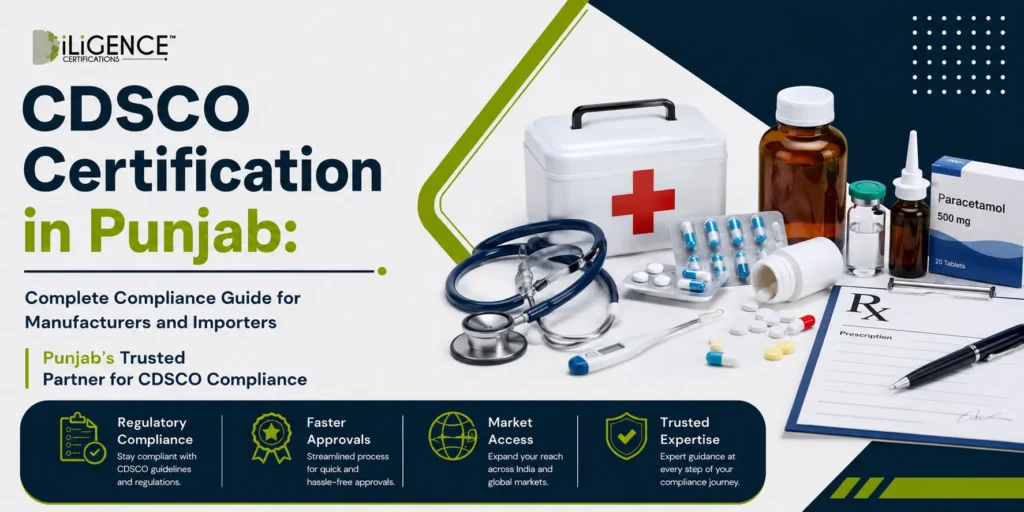
By - CDSCO certification in Punjab is mandatory for regulated medical equipment, medicines, cosmetics, diagnostic tools, and other healthcare products prior to their marketing.
- Manufacturers and importers located in Punjab, along with health care providers, should ensure that they obtain the CDSCO approval via the right process.
- The right documentation will help avoid issues.
Introduction
A supplier of healthcare equipment from Mohali has recently been contacted by an established hospital group seeking bulk procurement of their diagnostic products. The prices were reasonable, packaging was decent, and the buyer seemed willing to proceed. However, during the last stage of compliance, one question was asked - “Do you have the necessary CDSCO approval?”
The supplier was ready to provide the GST numbers, company registration numbers, and brochure, but they didn’t have CDSCO license. The order was instantly halted.
It is something that frequently happens to many firms in Punjab. Businesses usually take care of production, importation, branding, and distribution but forget about certification until the very last moment. In case of products related to healthcare sector, it can lead to sales failure, delays in importations and even reputational problems.
Certification by CDSCO in Punjab is a mandatory procedure for all companies who deal with healthcare products and other regulated products, such as medical devices, drugs, cosmetics, in-vitro diagnostics, etc. It is applicable to any company from Ludhiana, Amritsar, Jalandhar, Mohali, Patiala, Bathinda, and any other location within Punjab territory.
What is CDSCO Certification in Punjab?
CDSCO Approval in Punjab
CDSCO Approval is basically an approval from Central Drugs Standard Control Organisation required for those products which come under Indian Healthcare Regulations. The Central Drugs Standard Control Organisation is working under Ministry of Health and Family Welfare in India for controlling drugs, medical devices, cosmetic items, diagnostic and clinical related products.
For business firms of Punjab, CDSCO Approval means something more than just a regulatory approval. This means that the product has been checked against the relevant regulatory requirements and approved for placement in the Indian market after fulfilling certain criteria.
Simply, CDSCO Approval acts as a gatekeeper for market entry for any such product.
Why CDSCO Certification is Important for Punjab Businesses
There is a rich background of pharmaceutical trading, hospital supply chain management, diagnostic products distribution, cosmetic imports, and healthcare startups in Punjab. Places like Mohali, Ludhiana, and Jalandhar have a vibrant connection with healthcare procurement, hospital supply chain, and medical products distribution.
Here are four benefits to CDSCO Certification in Punjab for such companies.
First, CDSCO certification will help ensure regulatory compliance. Items falling under CDSCO cannot be marketed without certification.
Second, it improves the purchasing power of buyers. Regulatory documents are requested by hospitals, distributors, governments, and online shopping platforms before adding products to their platform.
Third, it reduces risks in doing business. Non-compliance can lead to the seizure of goods, penalties or even product recalls.
Fourth, it ensures sustained market credibility. Unlike in other industries, trust in healthcare does not depend only on branding.
Who Needs CDSCO Certification in Punjab?
CDSCO Certification may be required by different types of businesses depending on the product category.
| Business Type | CDSCO Requirement |
| Medical device manufacturers | Required if product is regulated |
| Medical device importers | Required before import and sale |
| Pharmaceutical companies | Required for drugs and formulations |
| Cosmetic importers | Required for imported cosmetics |
| Diagnostic kit suppliers | Required for regulated IVD products |
| Hospital equipment distributors | Depends on product classification |
| Foreign manufacturers | Need Indian authorised agent support |
| Healthcare start-ups | Required before commercial launch |
A common mistake is assuming that only large manufacturers need CDSCO approval. In reality, importers, brand owners, distributors and authorised Indian agents may also need compliance depending on the role they play in the supply chain.
Products Covered Under CDSCO Certification
CDSCO regulates various product categories in the healthcare industry. The following are the main product categories that are relevant for companies operating in Punjab:
Medical Devices
The term ‘medical devices’ refers to various products used for diagnosing, preventing, monitoring, treating, or supporting diseases. Some examples of medical devices are:
- Surgical devices
- Diagnosis equipment
- Syringe & needles
- Blood pressure monitor
- Orthopedic implants
- Patient monitors
- Hospital devices
- Healthcare personal protective equipment
- Drugs & Pharmaceuticals
Some drug-related licenses may be related to:
- Medicines
- New drugs
- Vaccines
- Biological products
- Prescribed medicines
- OTC products
- Cosmetics
- Registration under CDSCO may be required for imported cosmetic products to be sold in India.
Some examples of such products are:
- Skin care products
- Hair care products
- Beauty cream products
- Make-up products
- Personal care products
- In-Vitro Diagnostics
Diagnostic products may comprise:
- Testing kits
- Reagents
- Diagnosis equipment
- Products used in pathology laboratories
Medical Device Classification Under CDSCO
There are classifications of medical devices used in India depending upon their risk factors. Such classification determines the path for the submission, the type of document to be prepared, and the reviewing body involved in the process of certification.
| Class | Risk Level | Common Examples |
| Class A | Low risk | Surgical dressings, basic instruments |
| Class B | Low to moderate risk | Syringes, suction equipment, diagnostic products |
| Class C | Moderate to high risk | Monitoring devices, implants, advanced equipment |
| Class D | High risk | Life-supporting devices, high-risk implants |
Accurate classification is the very first serious consideration in the certification process through the CDSCO in Punjab. Incorrect classification may cause unnecessary questions from CDSCO, and even rejection of an application for re-filing.
In fact, an importer in Punjab may classify a certain product as being a mere diagnostic equipment; however, CDSCO may classify it otherwise.
Documents Required for CDSCO Certification in Punjab
Documentation depends on product category, applicant type and approval route. However, most applications require a combination of company, product, quality and regulatory documents.
Company Documents
- Certificate of incorporation
- GST registration
- PAN card
- Business address proof
- Authorisation letter
- Details of authorised signatory
Product Documents
- Product specification
- Intended use
- Product labels
- Instructions for use
- Product brochure
- Technical file
- Risk analysis documents
Quality Documents
- ISO 13485 certificate, where applicable
- Quality Management System details
- Manufacturing process flow
- Sterilisation details, if applicable
- Shelf-life details
- Test reports
Import Documents
- Free Sale Certificate
- Power of Attorney
- Manufacturing site details
- Foreign manufacturer authorisation
- Product registration documents from country of origin
- Import licence-related documents
Incomplete documentation is one of the biggest reasons for delay. A file may look complete from a business point of view, but regulators review it from a safety, technical and legal perspective.
CDSCO Certification Process in Punjab
The process is not the same for every product. A Class A medical device, imported cosmetic and new diagnostic kit may follow different routes. Still, the general process follows these stages.
Step 1: Product Classification
The product must first be checked under CDSCO rules. This includes identifying whether it is a medical device, drug, cosmetic, diagnostic product or another regulated item.
For medical devices, risk class must be confirmed. For cosmetics, product composition, claim and import status need review. For drugs, the regulatory pathway depends on formulation and intended use.
Step 2: Documentation Preparation
After classification, documents are prepared according to the applicable form and checklist. This stage requires technical accuracy.
Many businesses in Punjab face delays because they submit marketing documents instead of regulatory documents. A brochure is not a technical file. A label image is not a complete labelling compliance document.
Step 3: Online Application Filing
Applications are filed through the relevant CDSCO online system. Medical device import applications generally follow prescribed forms, such as MD-14 for import licence application and MD-15 for licence grant.
Step 4: Regulatory Review
The authority reviews the application, documents, product details and technical information. If anything is missing or unclear, a query may be raised.
Step 5: Query Handling
Queries must be answered carefully. A weak or incomplete reply can extend the approval timeline. The response should directly address the authority’s concern and attach corrected documents wherever required.
Step 6: Grant of Approval
Once the review is completed successfully, the relevant certificate, registration or licence is granted. After approval, the business must continue to follow post-approval compliance conditions.
CDSCO Registration for Medical Device Importers in Punjab
Punjab has many businesses that import devices from countries such as China, Germany, South Korea, Japan, the USA and Europe. For such importers, CDSCO approval is especially important.
The importer usually needs an authorised Indian agent, manufacturer documents, product technical details and import licence application. MD-14 is used for application and MD-15 is issued as the import licence for medical devices.
Before shipment planning, the importer should confirm whether the device is regulated, what class it falls under and whether all foreign manufacturer documents are available. Importers often lose time because the overseas manufacturer provides commercial invoices but delays regulatory documents.
CDSCO Certification for Cosmetics in Punjab
Cosmetic importers in Punjab also need to be careful. A product may be sold as a beauty or personal care item, but if it falls under the legal definition of cosmetic and is imported into India, registration may be required.
Important checks include:
- Ingredient review
- Product label review
- Claims review
- Manufacturer details
- Country of origin documents
- Brand and variant details
For example, a cosmetic brand importing multiple shades or variants may need proper product-wise documentation. Small label errors can create avoidable compliance issues.
Timeline for CDSCO Certification in Punjab
The timeline depends on product category, risk class, document readiness and query response time.
| Activity | Estimated Timeline |
| Product classification | 2-5 working days |
| Document checklist preparation | 3-7 working days |
| Technical file compilation | 1-3 weeks |
| Online application filing | 2-5 working days |
| Regulatory review | Case-specific |
| Query response | Depends on query complexity |
| Final approval | Depends on product and authority review |
No responsible consultant should promise one fixed timeline for every CDSCO application. A low-risk device with complete documents may move faster than a higher-risk or imported product with incomplete technical records.
Cost Factors for CDSCO Certification in Punjab
The cost of CDSCO Certification in Punjab depends on several factors:
- Product category
- Medical device risk class
- Number of products or variants
- Import or manufacturing route
- Government fee
- Testing requirement
- Documentation complexity
- Consultant support
- Query handling requirement
A business should not calculate CDSCO cost only as a government fee. The real cost also includes document preparation, technical review, application accuracy and delay prevention.
Common Mistakes During CDSCO Approval
Wrong Product Classification
This is the most common issue. If the product is classified incorrectly, the whole application may follow the wrong path.
Incomplete Technical File
Many applicants submit basic product details but miss risk analysis, intended use, labelling details or quality documents.
Poor Label Review
Healthcare product labels must be reviewed carefully. Incorrect claims, missing information or misleading statements may lead to objections.
Weak Query Response
A query response should not be casual. It must be technical, clear and supported with corrected documents.
Applying Too Late
Businesses often start compliance after receiving a purchase order. By that time, buyer pressure is already high. CDSCO planning should begin before launch or import.
Benefits of CDSCO Certification in Punjab
CDSCO approval offers direct business advantages.
- Legal permission for regulated product sale
- Better acceptance by hospitals and distributors
- Reduced risk of import hold or market blockage
- Stronger brand credibility
- Easier participation in institutional procurement
- Improved trust among doctors, labs and healthcare buyers
- Better long-term compliance record
For healthcare businesses, compliance is not paperwork. It is business protection.
Why Choose Diligence Certification?
Diligence Certification helps manufacturers, importers, start-ups, distributors and authorised Indian agents with end-to-end CDSCO support.
Our assistance includes:
- Product classification
- Regulatory pathway identification
- Documentation preparation
- MD-14 and MD-15 import licence support
- Cosmetic registration assistance
- Medical device compliance support
- Query handling
- Application coordination
- Post-approval guidance
A Punjab-based business may have a strong product, but without proper regulatory handling, the product may not reach the market on time. Diligence Certification helps reduce that gap between business planning and legal market entry
Conclusion
CDSCO Certification in Punjab is a critical requirement for businesses dealing with regulated medical devices, drugs, cosmetics, diagnostics and healthcare products. It protects the business from compliance risk and helps build trust with hospitals, distributors, buyers and regulatory authorities.
For manufacturers, importers and healthcare start-ups in Punjab, the best approach is to begin with correct product classification, prepare complete documents and file the application through the correct regulatory route.
Diligence Certification assists Punjab-based businesses with CDSCO classification, documentation, application filing, import licence support and query handling. For smooth regulatory approval, connect with Diligence Certification before launching, importing or distributing your healthcare product.
Frequently Asked Questions
Is CDSCO Certification Mandatory in Punjab?
Yes, CDSCO Certification in Punjab is mandatory for regulated medical devices, drugs, cosmetics, diagnostics and healthcare products before their manufacture, import, distribution or sale in India.
Who can apply for CDSCO Certification in Punjab?
Manufacturers, importers, authorized Indian agent, healthcare startups, cosmetic importers and medical device companies can apply depending upon product category and business role.
What is the duration of the process?
Duration varies according to product category, risk class, completeness of application and clarifications from the authorities. It usually takes more time to process an incomplete or incorrect filing than a complete one.
What is MD-14 and MD-15 in CDSCO?
MD-14 is the application form for import license for medical devices while MD-15 is the import license for medical devices.
Are Cosmetics covered under CDSCO?
Yes, imported cosmetics are included in the CDSCO regulation framework. Cosmetics importers must ensure compliance with all registration and labeling requirements for their products.
Is ISO 13485 required for medical devices?
ISO 13485 is commonly required for medical device quality management documentation, especially for regulated manufacturers and import-related approvals.
Can a Punjab importer sell medical devices without CDSCO approval?
No, regulated medical devices should not be imported or sold without the applicable CDSCO licence or approval. Doing so may lead to regulatory action.
Why is device classification important?
Device classification decides the approval route, authority, documents, fees and review level. Wrong classification may delay or weaken the application.
Can more than one certification be provided for different products simultaneously at CDSCO, Punjab?
Yes, but in the case where both products fall under the same category and having the same license number and manufacturing location along with certification.
In case of any doubt regarding the process of certification at CDSCO, how will you handle the situation?
In case there is any doubt about the process of certification at CDSCO, then it becomes a necessity to clarify it.