BIS Certification
 CDSCO
CDSCO
 PESO
PESO
 CPCB
CPCB
 LMPC
LMPC
 WPC Approval
 Global Approvals
 TEC
TEC
 ARAI
ARAI
 BEE
BEE
 ISO Certification
 DGCA Certification
 NOC For Steel
 APEDA Registration























 Business Registration
 FSSAI Mark Certification












 (32).jpg)
 Legal Services
 Trademark Registration
 Copyright Registration
 Patent Registration
 By
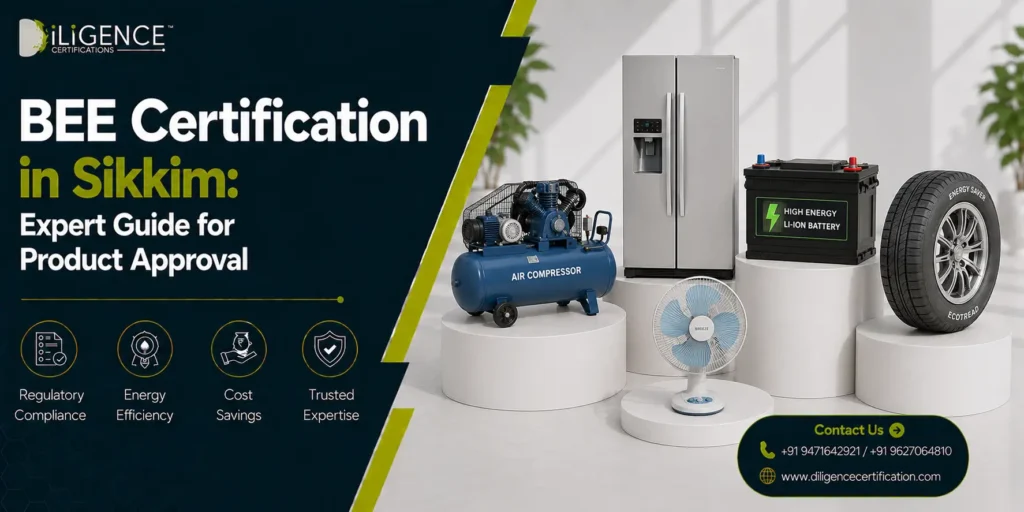
By - BEE certification in Sikkim, It becomes essential to go for especially for manufacturing units, importers, dealers, and brands supplying energy using products into the Indian market.
- Some examples of these energy using products include air conditioning units, refrigerators, fans, LEDs, chillers, deep freezing units, motors, and transformers.
- Diligence Certification is helpful for businesses that need assistance regarding the documentation process, BEE portal submission, model and label approvals.
Introduction
Once there was an electrical appliance distributor based in Gangtok who wanted to add these products in hotel establishments, retail counters, and local dealers across Sikkim. There seemed to be good reasons too since the products were refrigerators, commercial coolers, induction hobs, LED lights, and fans. Price-wise, they were competitive, packaged well, and even the sales team had started getting inquiries.
The distributor had all the paperwork like GST details, invoices, product brochure, and brand documentation. But what was lacking on their side was appropriate certification and labeling from BEE. And due to this, the buyer decided not to place an order as he would not want to stock electrical appliances without efficiency certification.
BEE Certification in Sikkim is very much necessary especially when it comes to regulated products. Because the absence of such certification means your product cannot pass through the dealer network, institutional buyers, e-commerce sites, and retailers.
When you have a product manufactured, imported, private labels, and distributed then BEE Certification will give your product legality, acceptability, and energy-efficiency identity.
What is BEE Certification in Sikkim?
BEE Certification in Sikkim involves the mandatory process of registration and certification of energy-consuming devices and equipment by the Bureau of Energy Efficiency, Government of India.
The major aspects related to BEE certification include energy performance, electricity consumption, product efficiency, and star labelling. The well-known BEE Star Label enables consumers to evaluate the energy performance of different appliances.
The more stars a device has, the better its efficiency. However, there can be slight differences between appliance categories and standards.
Simply put, BEE certification guarantees that the device is certified according to energy-efficient criteria set by the Bureau and, thus, has an entitlement to carry the label, wherever applicable.
For companies in Sikkim, this issue becomes crucial when marketing such appliances in local markets, supplying to hotels, hospitals, government organizations, retail stores, or online platforms.
Why BEE Certification Matters for Businesses in Sikkim
There is a rising need for quality electrical appliances in Sikkim due to tourism, hospitality, commercial premises, health care establishments, educational institutes, and domestic sectors. The hotels in Gangtok and commercial premises in Namchi are always in search of energy-efficient products as electricity rates play an important role in their ongoing operations.
While a hotel purchases a chiller, freezer, refrigerator, or an air conditioner, it considers not only its price. It considers operating cost, efficiency, power usage, and certification. If you offer something cheaper but without BEE Certification, you make your product costly
A BEE-approved product looks more credible because it carries a recognised energy-efficiency label. It also reduces the risk of product rejection during buyer verification.
BEE Certification in Sikkim for Mandatory and Voluntary Products
BEE product categories are usually divided into mandatory and voluntary categories.
Mandatory products must follow BEE registration and labelling requirements before being sold in India. Voluntary products may not be legally compulsory in the same way, but companies still apply for BEE approval to improve buyer confidence and market positioning.
This distinction is important because many businesses assume BEE applies only to large appliances. In practice, BEE compliance may apply to household, commercial, and industrial energy-consuming products depending on the product category and notification status.
Before filing, the first step is product classification. A wrong classification can delay testing, application filing, label approval, and product launch.
Products Commonly Covered Under BEE Certification
The exact requirement depends on the product category and current BEE notification. However, many businesses seeking BEE Certification in Sikkim generally deal with products such as:
| Product Category | BEE Relevance |
| Room air conditioners | Star rating and energy-efficiency declaration |
| Refrigerators | Energy performance and power consumption labelling |
| Ceiling fans | Energy-efficiency rating and star label requirement |
| LED lamps | Performance and energy consumption compliance |
| Distribution transformers | Efficiency testing and registration |
| Electric motors | Energy performance evaluation |
| Agricultural pumps | Efficiency declaration and model approval |
| Chillers | Commercial energy-efficiency compliance |
| Deep freezers | Energy performance-based approval |
| LPG stoves | Efficiency and performance-related labelling where applicable |
| Washing machines | Energy and water efficiency declaration |
| Television sets | Power consumption and efficiency rating |
| Computers | Energy consumption compliance where applicable |
| Ballasts | Electrical performance and energy-efficiency requirements |
| Commercial beverage coolers | Energy-efficiency and model approval requirements |
This table should be treated as a practical reference. Before applying, businesses should confirm whether the product falls under the latest mandatory or voluntary BEE category.
Who Needs BEE Certification in Sikkim?
BEE certification may be required by different types of businesses. The obligation is not limited to factories located inside Sikkim. If your product is sold in Sikkim or anywhere in India under a regulated category, BEE compliance can become necessary.
Manufacturers
Indian manufacturers producing regulated appliances must apply for BEE registration before selling those products under the relevant brand and model.
Importers
Importers of energy-consuming devices to India will be required to register with BEE before their sale, distribution, or publication. The importers will also be required to confirm the accuracy of test results, branding, and other product information in their application.
Brand Owners
Branded products are usually made by third-party manufacturing companies. However, the brand owners are responsible for ensuring that the product models have been correctly registered and branded.
Dealers and Distributors
Dealers may not always file the BEE application directly, but they should verify whether products being sold are compliant. Stocking unapproved products can create commercial risk, especially in institutional and organised retail supply.
Documents Required for BEE Certification in Sikkim
Documentation is one of the most sensitive parts of the BEE process. Many applications are delayed not because the product is poor, but because the documents are incomplete, inconsistent, or incorrectly formatted.
Common documents include:
- Company registration certificate
- GST certificate
- Factory licence, where applicable
- Brand ownership document or trademark certificate
- Authorisation letter, if filed by an authorised representative
- Product technical specification sheet
- Test report from a BEE-recognised or approved laboratory, as applicable
- Manufacturing unit details
- Quality management certificate, if applicable
- Model details and rating information
- Label sample or artwork
- Importer-exporter code, for importers
- Undertaking and declaration documents
- Authorised signatory ID and address proof
For foreign goods, there might be more documents to be provided by the overseas manufacturer. One must ensure that all the necessary information is verified because any mismatch in brands, models, or ratings can cause an objection.
Process of BEE Certification for Sikkim Step by Step
BEE certification process is complicated, but it becomes easy if done in the right order.
Step 1: Identification of the Product Under BEE
Firstly, one needs to determine whether the product is mandatory or voluntary for BEE certification. In this stage, it is necessary to ascertain the following points.
If classification is wrong, the whole application may move in the wrong direction.
Step 2: Document Preparation
After classification, documents are collected and reviewed. Company details, brand details, factory information, product specifications, and authorisation documents must be aligned.
At this stage, Diligence Certification usually checks whether the applicant is eligible to file the application and whether supporting documents are complete.
Step 3: Product Testing
Testing is required to verify energy performance. The product may need to be tested in a recognised laboratory as per the applicable BEE requirement.
Testing is not only about passing or failing. The test values help decide the energy-efficiency level and star rating eligibility.
Step 4: BEE Portal Registration
The applicant must register on the BEE portal with the required business and brand details. Any mistake in portal registration can affect later model applications.
Step 5: Model Registration
After company or brand registration, the product model is filed for approval. Model number, rating, technical details, test report information, and label details must be submitted correctly.
Step 6: Label Approval
Once the model is approved, the BEE label can be generated or used as per the approved format. The label must not be altered casually because incorrect label use can create compliance issues.
Step 7: Market Compliance and Renewal
BEE compliance does not end after approval. Businesses must track validity, renewal, revised standards, production details, and label usage requirements.
Timeline for BEE Certification in Sikkim
The timeline for BEE Certification in Sikkim depends on product category, testing requirement, document readiness, lab availability, and query handling.
A straightforward application may move faster if the test report and documents are already available. However, if testing is pending or technical details are inconsistent, the process may take longer.
Typical factors affecting timeline include:
- Product category
- Mandatory or voluntary registration status
- Availability of samples
- Testing laboratory schedule
- Accuracy of documents
- BEE portal filing quality
- Query response time
- Brand and model complexity
Businesses should not wait until the product launch date to start BEE compliance. For regulated products, BEE planning should begin before import, production, or large-scale distribution.
Common Mistakes Businesses Make During BEE Registration
Many businesses approach BEE compliance after the product is already in the market. This creates pressure and increases the chance of errors.
Some common mistakes include:
Using Wrong Product Classification
A product may look similar to another category but may fall under a different technical requirement. Wrong classification can result in incorrect testing and filing.
Mismatched Model Numbers
The model number on the test report, label, invoice, packaging, and application must match. Even minor differences can lead to objections.
Incomplete Brand Documents
If the brand ownership or authorisation is not clear, the application may be delayed.
Poor Label Artwork
BEE label format must follow prescribed requirements. Unapproved label changes can create compliance risk.
Late Renewal Planning
Many companies forget validity and renewal timelines. Once validity issues arise, sales and listings may be affected.
Benefits of BEE Certification in Sikkim
BEE certification gives both regulatory and commercial benefits.
Legal Market Access
For mandatory products, BEE approval is required before sale. Without it, the product may face regulatory and buyer-side restrictions.
Better Consumer Trust
Customers understand star labels. A visible rating helps buyers compare energy consumption before purchase.
Stronger Retail Acceptance
Dealers, supermarkets, distributors, and e-commerce platforms prefer compliant products because it reduces business risk.
Lower Buyer Objections
Institutional buyers often ask for compliance documents. BEE approval makes the sales process smoother.
Better Brand Positioning
Energy-efficient products are easier to position as responsible, cost-saving, and quality-focused.
Support for Tender Supply
Government and institutional tenders often require technical and regulatory documents. BEE registration can support eligibility where applicable.
BEE Certification in Sikkim for Importers
Importers need to be more careful because imported product documentation often comes from different sources. The manufacturer may provide technical reports, while the Indian importer handles registration, labelling, and sale.
For importers, the major concerns are:
- Correct importer details
- Foreign manufacturer information
- Product model consistency
- Test report validity
- Brand authorisation
- Label approval before sale
- Customs and market compliance alignment
A common problem is that importers place bulk orders before checking BEE applicability. If the product category requires BEE approval, the shipment may create business pressure before the registration is complete.
The safer approach is to check BEE applicability before import planning.
BEE Certification in Sikkim for Manufacturers
Manufacturers in or supplying to Sikkim should treat BEE approval as part of product development, not as a last-stage paperwork activity.
Before launching a model, manufacturers should confirm:
- Applicable BEE category
- Minimum energy performance requirement
- Testing standard
- Star rating target
- Technical design suitability
- Label placement
- Packaging declaration
- Renewal and production reporting requirements
If the product is designed without considering energy-efficiency thresholds, it may fail testing or receive a lower rating than expected. This can affect pricing, marketing, and dealer acceptance.
How Diligence Certification Helps with BEE Certification in Sikkim
Diligence Certification assists businesses with end-to-end support for BEE Certification in Sikkim. The role is not limited to filing forms. A proper consultant checks the product route, documentation, testing requirement, application details, and post-approval compliance.
Our support includes:
- Product category identification
- Mandatory or voluntary applicability check
- Document checklist preparation
- Brand and company document review
- Testing coordination support
- BEE portal registration assistance
- Model registration filing
- Label approval guidance
- Query handling
- Renewal and compliance support
Conclusion
BEE Certification in Sikkim is important for businesses dealing with regulated appliances, electrical products, and energy-consuming equipment. Whether you are a manufacturer, importer, brand owner, dealer, or supplier, BEE approval helps you sell with confidence and avoid compliance-related delays.
In a market where buyers compare both price and running cost, energy efficiency has become a serious business factor. A product with proper BEE registration and star labelling carries stronger credibility than one sold only on claims.
Diligence Certification supports businesses with product classification, documentation, testing coordination, BEE application filing, model registration, label approval, and renewal assistance.
For expert support with BEE Certification in Sikkim, contact Diligence Certification and get your product compliance process handled with clarity and care.
Frequently Asked Questions
Is BEE Certification in Sikkim mandatory?
BEE Certification in Sikkim is mandatory for products that fall under compulsory BEE categories. If your appliance or equipment is covered under a mandatory category, approval is required before selling it in India.
Who can apply for BEE Certification in Sikkim?
Manufacturers, importers, and brand owners can apply for BEE certification. Dealers should also ensure that products they sell are properly registered and labelled where required.
What is the first step for BEE registration?
The first step is product classification. You must confirm whether your product falls under a mandatory or voluntary BEE category and identify the applicable testing and labelling requirement.
How long does BEE Certification in Sikkim take?
The timeline depends on product category, testing, documents, laboratory availability, and query response. If documents and test reports are ready, the process can move faster.
Can imported products get BEE approval?
Yes, imported products can get BEE approval if they meet the applicable requirements. Importers must provide correct product details, brand authorisation, test reports, and registration documents.
Is BEE certification required for online selling?
If the product falls under a mandatory BEE category, compliance is required regardless of whether it is sold offline or online. E-commerce platforms may also ask for valid compliance details.
What happens if a product is sold without BEE approval?
Selling a mandatory BEE-covered product without approval can lead to regulatory risk, buyer rejection, listing issues, and possible business disruption
Does BEE certification need renewal?
Yes, BEE registration and model approvals may have validity conditions. Businesses should track renewal requirements and revised energy-efficiency standards.