



 BIS Certification
 CDSCO
CDSCO
 CPCB
CPCB
 LMPC
LMPC
 WPC Approval
 Global Approvals
 TEC
TEC
 ARAI
ARAI
 BEE
BEE
 ISO Certification
 DGCA Certification
 NOC For Steel
 APEDA Registration









 Business Registration
 FSSAI Mark Certification



 Legal Services
 Trademark Registration
 Copyright Registration
 Patent Registration
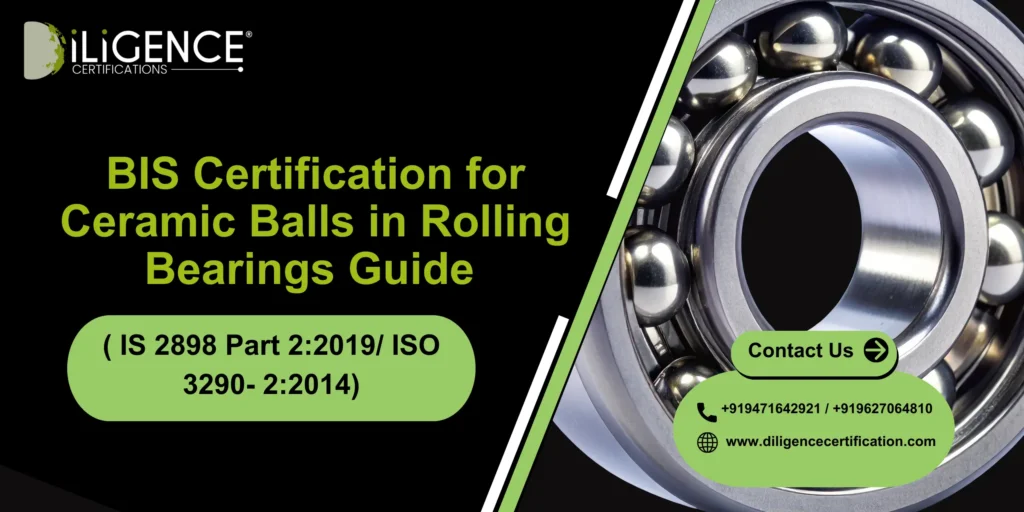
- BIS Certification for Ceramic Balls in Rolling Bearings – Ensures high perfection, thermal resistance, and global quality compliance.
- Importance of Certification – Builds client trust and improves request acceptance.
- needed Documents – Includes company registration , specialized specifications, test reports, and quality control records.
- Step- by- Step Process – Covers testing, Application, examination, and final Approval.
- Benefits of Certification – Ensures continuity, performance, compliance, and import readiness.
Introduction
Ceramic Balls in Rolling Bearings are extensively used in rolling bearings, especially in high- speed, high- temperature, and erosion- resistant Applications. They offer better performance compared to traditional sword balls due to their featherlight nature and superior strength. Still, numerous manufacturers face issues similar to poor face finish, inconsistent size, and low continuity. Bureau of Indian Standards
These problems can lead to machine failure, increased conservation costs, and loss of client trust. ISO Certification
To overcome these challenges, BIS Certification for Ceramic Balls in Rolling Bearings( IS 2898 Part 2:2019/ ISO 3290- 2:2014) becomes essential. It ensures that ceramic balls meet both Indian and transnational standards for quality, perfection, and safety.
Certification not only improves product performance but also builds trust and opens openings in global requests.
What’s BIS Certification for Ceramic Balls in Rolling Bearings?
Ceramic Balls in Rolling Bearings is an official Approval handed by the Bureau of Indian Standards( BIS). It confirms that ceramic balls used in rolling bearings meet defined quality and safety standards.
Key Highlights
- Applicable to ceramic balls used in rolling bearings
- Ensures compliance with IS 2898 Part 22019
- Requires testing in BIS- approved laboratories
- Verifies dimensional delicacy and face finish
- Maintains harmonious product quality
- Builds client confidence and trust
Understanding IS 2898 Part 2:2019( Indian Standard)
IS 2898 Part 2:2019 is the Indian standard that defines the specifications for Ceramic Balls in Rolling Bearings used in rolling bearings. It focuses on icing that products meet public quality and safety requirements.
Key Features of IS 2898 Part 2:2019
- Defines size, forbearance, and dimensional delicacy
- Specifies material quality and strength
- Ensures continuity and cargo- bearing capacity
- Focuses on safety and trustability in machinery
- obligatory for BIS Certification in India
This standard ensures that ceramic balls are suitable for Indian industrial requirements and regulatory compliance.
What’s ISO 3290- 2:2014( International Standard)?
ISO 3290- 2:2014 is an internationally honored standard that defines perfection requirements for Ceramic Balls in Rolling Bearings used in rolling bearings. It ensures high delicacy and thickness across global Applications.
Key Features of ISO 3290- 2:2014
- Defines strict forbearance situations for size and roundness
- Ensures high- quality face finish
- Maintains invariant material thickness
- Supports high- speed and perfection Applications
- Accepted encyclopedically in engineering diligence
IS vs ISO – Why Both standards Matter Together
Using both IS and ISO standards creates a strong and complete quality frame for Ceramic Balls in Rolling Bearings. Each standard has its own Importance, and together they insure that the product meets both public and transnational requirements.
IS 2898 Part 2:2019 focuses on Indian regulatory requirements, icing compliance with original laws and safety standards. ISO 3290- 2:2014 focuses on global perfection and performance standards.
Why Using Both standards is Important
- More product quality with harmonious manufacturing
- Advanced perfection and bettered performance
- Strong trust among domestic and global buyers
- Easy acceptance in transnational requests
- comity with advanced machinery
Manufacturers following both standards gain a strong competitive advantage.
Why BIS Certification is Important
BIS Certification plays a Key part in icing that Ceramic Balls in Rolling Bearings meet required quality and safety standards. Without Certification, manufacturers may face rejection, low demand, and reduced client trust.
Key Benefits of BIS Certification
- Quality Assurance – Ensures compliance with IS and ISO standards
- client Trust – Buyers prefer Certified products
- Market Acceptance – Easier to vend in domestic and global requests
- Safety Compliance – Reduces machinery failure risks
- Brand Credibility – Builds a strong request character
- Regulatory Compliance – Meets legal requirements
Key Features of BIS- Certified Ceramic Balls
BIS- Certified Ceramic Balls in Rolling Bearings are designed for high performance and continuity in demanding surroundings.
- High perfection and perfect roundness
- Excellent thermal resistance
- Low disunion for smooth Application
- High wear and tear resistance
- snippersnapper with strong structure
- harmonious quality across batches
These features ensure effective machine performance and longer life.
Who Needs BIS Certification?
BIS Certification is essential for all stakeholders involved in the manufacturing and force of ceramic balls.
Key Stakeholders
- Manufacturers – To prove product quality
- Suppliers & Distributors – To offer dependable products
- Importers – To meet Indian regulations
- Exporters – To meet global standards
Why It Matters
- Reduces product rejection
- Builds client trust
- Ensures compliance
- Expands request reach
Documents Needed for BIS Certification
- Company registration Certification
- Product specifications and specialized details
- Manufacturing process details
- Laboratory test reports
- Quality control records
- Authorization letter
Proper attestation ensures smooth Approval and avoids detainments.
Step- by- Step BIS Certification Process
Step 1 – Document Preparation
Prepare all needed company and product documents directly.
Step 2 – Product Testing
Samples are tested in BIS- approved labs for perfection, continuity, and performance.
Step 3 – Application Submission
Submit the BIS Application with documents and test reports.
Step 4 – Inspection & Verification
BIS officers review documents and check the manufacturing unit.
Step 5 – Certification Approval
After successful verification, BIS subventions Certification and allows BIS marking.
Timeline, Cost, and Renewal
- Timeline – 3 to 4 weeks
- Testing – 1 to 2 weeks
- Cost – Depends on product and testing
- Renewal – needed periodically
Tips to Avoid Detainments
- Submit complete documents
- Use approved laboratories
- Respond snappily to queries
Common Mistakes to Avoid
- Submitting deficient documents
- Usingnon-approved labs
- Ignoring IS and ISO standards
- Poor quality control
- Delayed communication
Avoiding these Mistakes ensures faster Approval.
Why Choose Diligence Certification
- Expert guidance on standards
- Complete attestation support
- Faster Approval process
- Transparent communication
- End- to- end backing
Benefits of BIS Certification
- Improves product quality
- Builds client trust
- Enhances request acceptance
- Reduces failure risks
- Provides competitive advantage
- Supports import openings
- Strengthens brand image
Conclusion
The BIS Certification for Ceramic Balls in Rolling Bearings( IS 2898 Part 2:2019/ ISO 3290- 2:2014) ensures that products meet both Indian and transnational quality standards.
It guarantees high perfection, continuity, and dependable performance in industrial Applications.
By following both IS and ISO standards, manufacturers can ameliorate product quality, make trust, and expand into global requests. Certification is n’t just a demand, it is a smart step toward long- term business growth.
Frequently Asked for Questions
What's BIS Certification for ceramic balls?
It's a Certification that ensures ceramic balls meet IS 2898 Part 22019 quality standards.
Why is BIS Certification important for ceramic balls?
It ensures product quality, safety, and request acceptance.
What does IS 2898 Part 22019 cover?
It defines specifications for ceramic balls used in rolling bearings.
What's ISO 3290- 22014?
It's a transnational standard for perfection and quality of ceramic bearing balls.
Who needs BIS Certification for ceramic balls?
Manufacturers, importers, and suppliers dealing in ceramic balls.
Is testing needed for BIS Certification?
Yes, testing in BIS- approved labs is obligatory.
How long does BIS Certification take?
It generally takes around 3 to 4 weeks.
What documents are needed for Certification?
Company details, product specifications, and test reports are needed.
What are the benefits of BIS Certification?
It improves quality, builds trust, and increases request acceptance.
Can ceramic balls be exported without BIS Certification?
Certification helps in compliance and improves acceptance in global requests.