


 BIS Certification
 CDSCO
CDSCO
 CPCB
CPCB
 LMPC
LMPC
 WPC Approval
 Global Approvals
 TEC
TEC
 ARAI
ARAI
 BEE
BEE
 ISO Certification
 DGCA Certification
 NOC For Steel
 APEDA Registration














 Business Registration
 FSSAI Mark Certification











 Legal Services
 Trademark Registration
 Copyright Registration
 Patent Registration
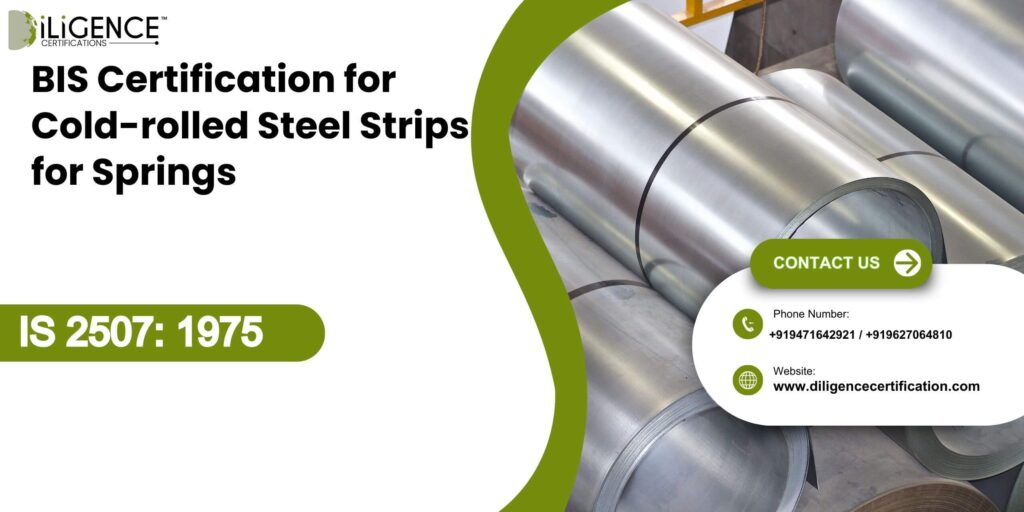
- BIS Certification as per IS 2507:1975 marks the quality of a Cold-rolled Steel Strips for springs.
- The standard stages the product inter alia by addressing the material’s chemical makeup, strength, and surface finish.
- Manufacturers have to pass through a factory audit, product testing, and document verification procedure.
- Certificates are instrumental in OEMs’ trust, which leads to a lessening of the rejection rate and provides a solid ground for the compliance of standards.
- Qualification is largely dependent on factors such as uniform heat treatment, equipment calibration, and process control.
Introduction
Once a spring-component manufacturer from Pune, his business turned upside down when his largest automotive client rejected a whole batch of parts due to the absence of BIS Certification under IS 2507:1975 in the raw material. Though the strips passed his internal quality checks, procurement teams were adamant that the BIS mark was a must. In industries where spring steel is safe and durable, minor deviations in hardness or microstructure can cause the failure of the entire batch. That is the reason why this certification has transitioned from merely being a compliance requirement to becoming a standard expectation within the supply chain. Bureau of Indian Standards
What is IS 2507:1975?
IS 2507:1975 refers to the Indian Standard, which lays down the detailed technical parameters of the cold-rolled steel strip material used for making springs. It categorizes and characterizes the chemical composition, mechanical properties, surface finish, and dimensional tolerance in detail to standardize the spring performance automotive, industrial, and precision usage. The standard facilitates uniform quality from the manufacturers and ensures material safety to the buyers which can go through repeated stress cycles without breaking.

Key Points
- Focuses on the cold-rolled steel strips that are specifically designed for the production of springs.
- It sets the criteria for the tensile strength, hardness, bending performance, and microstructure.
- Limiting the elements such as carbon, manganese, silicon, sulphur, and phosphorus is specified.
- The standards in the document regulate not only the surface finish but the dimensions too, such as thickness and width with camber and surface finish. ISI MARK
- Contributes to the stability of the spring through features such as fatigue resistance and long-term spring memory.
Why is BIS Certification Mandatory
BIS certification has to be there as per the Indian Standard IS 2507:1975, owing to the fact that one of the most common applications of spring steel strips is in safety-critical materials. The stipulation is there to bar low-grade or non-homogeneous steel from being sold. Besides, it guarantees that the mechanical and chemical properties are the same for all the batches.
Key Reasons
- Mandated under Quality Control Orders for safety-critical steel products
- Ensures consistent chemical and mechanical properties across batches
- Prevents circulation of sub-standard or untested spring steel
- Protects OEMs, public agencies, and end-users from performance failures
- Strengthens traceability and accountability in the steel supply chain
Importance and Benefits of BIS Certification
| Importance | Benefits |
| Ensures compliance with IS 2507:1975 for safety-critical spring steel | Reduces rejections and stabilises product quality |
| Guarantees consistent mechanical and chemical properties | Improves OEM approval and supplier credibility |
| Prevents low-grade or untested steel from entering the market | Supports participation in PSU and government tenders |
| Strengthens traceability and structured quality control | Builds trust with buyers and long-term customers |
| Aligns manufacturers with mandatory regulatory requirements | Enhances marketability and competitive advantage |
Step-by-Step Process of BIS Certification

Step1:Documentation
- Collect required technical documents
- Prepare product specifications
- Gather company registration details
- Ensure documents follow BIS format
Step2:Product Testing
- Send samples to a BIS-approved lab
- Conduct safety and quality tests
- Receive test reports
- Confirm compliance with BIS standards
Step3:Application Submission
- Fill out the BIS application form
- Upload all required documents
- Attach valid test reports
- Pay the necessary BIS fees
Step4:Scrutiny and Inspection
- BIS reviews submitted documents
- Authority verifies test results
- Factory/product inspection may occur
- Clarifications requested if needed
Step5:Grant of License
- BIS approves the application
- License number is issued
- Product can carry BIS mark
- Renewal required before expiry
Documents Required for BIS Certification
| Category | Documents Required |
| Business Documents | Business license/registration, ISO certificate, organizational details |
| Manufacturer Details | Factory layout, process flow chart, machinery list, production details |
| Product Documents | Product specifications, component list, user manual, model details |
| Testing Documents | Test report from BIS-recognized lab, sample details, test request form |
| Legal & Compliance | Authorization letter, brand ownership proof, trademark certificate (if any) |
| Import/Foreign Manufacturer (If applicable) | AIR (Authorized Indian Representative) details, contract agreement, overseas manufacturer documents |
Timelines, Costs, Validity & Renewal
- Timelines: Usually from 20 to 30 days, with only 7-15 days for the testing.
- Costs: The cost of the government and the test varies depending on the product. There can be some additional charges though.
- Validity: The validity period is 2 years in most situations.
- Renewal: The renewal is done before the expiration; there should be updated documents/tests; the renewal
Why Choose Diligence Certifications
- Expert team with strong BIS and regulatory knowledge
- Fast, streamlined processing to reduce approval delays
- Accurate documentation and testing coordination
- Transparent guidance with clear communication
- High success rate and complete end-to-end support
Conclusion
Meeting the specification in the case of Cold-rolled Steel Strips for Springs IS 2507:1975 through BIS certification goes beyond being just a legal requirement; it is essentially a very significant quality, safety, and stability factor for the long term in the steel supply chain.Plants that require the provision of structures in support of their documentation, testing preparation, or BIS coordination, Diligence Certifications can be of great help in facilitating the process and thus avoiding expensive delays. Their support turns certification into a manageable, orderly, and much more straightforward task for the manufacturers who want to be fully compliant.
Frequently Ask Questions
What is BIS Certification for IS 2507:1975?
BIS certification refers to the seal of approval that is essentially a must-have for products under IS 2507:1975. It is the certification that the products, i.e. the cold-rolled steel strips for springs, meet the set standards in terms of their chemical, mechanical, and dimensional properties as prescribed by the indicated standard.
Who is required to obtain BIS Certification under IS 2507:1975?
Manufacturers of the locally made cold-rolled spring steel strips should be the first ones to acquire this certification. Importers who bring in such products to India should also get this certification if they want to sell their products in the Indian market.
Is a certification under IS 2507:1975 necessary for the local market if the steel strips are imported?
Yes, indeed. Foreign manufacturers are required to have the certification before they can sell or provide their products in India.
What are the testing requirements for IS 2507:1975?
The applicant has to undergo tensile strength, hardness, bend test, and chemical composition tests while also preparing to be checked for surface finish, thickness, width, as well as camber.
How long is a BIS Certification Process?
The time period of the process varies depending on the availability of the documents, the testing and inspection schedule of the particular day, and so forth, but in general, the time is about 20–30 days.
What kind of paperwork does BIS Certification require?
Factory details, working chart, machinery list, quality records, test reports, product specifications, and compliance certificates are the documents that are required for the certification.
What are the most common grounds for an IS 2507:1975 certification refusal?
The reasons for denial of the certificate application include among those: incorrect heat treatment, uneven hardness, incorrect calibration, various documents issues, and test failures in labs that are recognized by BIS.
Are small or medium-sized manufacturers eligible for this certification?
Yes, undoubtedly. Most MSMEs are on the road to obtaining BIS Certification and thereafter they get the advantage of a broader market and higher OEM approval.
What is the duration of the BIS licence for the IS 2507:1975 standard?
The issue is normally valid for a couple of years and the party concerned should be visiting the authority in charge for licence renewal prior to the expiry date plus the records and test results should be kept updated.
Is BIS licence approval facilitated by Diligence Certifications?
Yes, indeed Diligence Certifications is your one-stop solution for the entire undertaking from paperwork assistance, testing, and coordination, to the finalisation of inspection and licence granting.