



 BIS Certification
 CDSCO
CDSCO
 CPCB
CPCB
 LMPC
LMPC
 WPC Approval
 Global Approvals
 TEC
TEC
 ARAI
ARAI
 BEE
BEE
 ISO Certification
 DGCA Certification
 NOC For Steel
 APEDA Registration

















 Business Registration
 FSSAI Mark Certification











 Legal Services
 Trademark Registration
 Copyright Registration
 Patent Registration
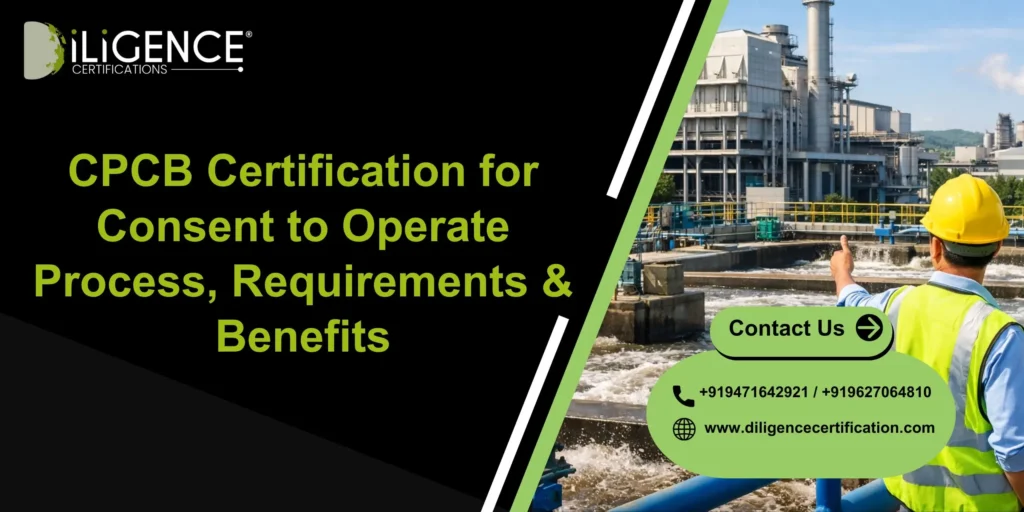
- Consent to Operate Process is a requirement for the industries to carry out their operations in a legal way and at the same time to conform to the environmental pollution control standards laid down by the authorities.
- Make sure that the industries are operating within the law and at the same time meeting all the CPCB pollution control standards.
- Establishes that the systems for air, water, and waste management are working within the allowed limits.
- Stops the incidence of penalties, legal actions, and shutdowns of operation by enforcement of non-compliance with the environmental regulations.
- Promotes the development of environmentally responsible and sustainable industrial activities.

Introduction
Environmental compliance is a fundamental duty that every industrial and commercial organization in India has to assume. It is not only about setting up the factory or unit—it is a must for businesses to show that their activities are not detrimental to the environment. Central Pollution Control Board
CPCB certification for Consent to Operate Process (CTO) is a mandatory legal document that proves not only the operational readiness of the pollution control equipment but also the compliance with the environmental standards. This certificate is unavoidable for industrial activities in different fields such as manufacturing, processing, infrastructure, healthcare, and waste management.
Getting Consent to Operate Process means no hindrance to operations, confidence from regulators, and growth of eco-friendly business.
What Is CPCB Certification for Consent to Operate Process (CTO)?
CPCB Certification for Consent to Operate Process (CTO) is an official permission granted by the CPCB or the respective SPCBs under the Water (Prevention & Control of Pollution) Act, 1974 and the Air (Prevention & Control of Pollution) Act, 1981.
The certificate affirms that:
- Pollution control systems are in place and their operations are in good condition
- Effluent and emission standards are within the prescribed limits
- Waste disposal is done in an environmentally friendly manner
- Environmental monitoring is done through proper systems
- The unit is abiding by all the environmental regulations applicable to it
CTO is granted only after thorough checking that the unit is functioning without causing any harm to the environment.
Importance of CPCB Certification for Consent to Operate Process
If one fails to acquire the CTO certification, he/she may face the following consequences:
- Sophisticated fines and legal punishments
- Operational disruption or total shutdown
- Closure of factories
- Cancellation of business permits and licenses
- Inferior brand reputation
CPCB Consent to Operate Certification is the guarantee of:
- Legitimate industrial operations
- Minimal air and water pollution
- Implementation of safe waste disposal methods
- Protection of the environment and health of the public
- Government’s commitment to transparency and accountability in regulations
Benefits of CPCB Certification for Consent to Operate
| Importance | Benefits |
| Legal compliance | Meets CPCB and SPCB environmental laws |
| Pollution control | Ensures controlled emissions and effluents |
| Business continuity | Prevents shutdowns and legal actions |
| Environmental protection | Promotes sustainable industrial practices |
| Brand credibility | Builds trust with regulators and stakeholders |
Step-by-Step CPCB Certification Process for CTO
Step 1: Documentation
Collect the necessary documents for company registration, site plan, manufacturing process, pollution control equipment, and the environmental management plan.
Step 2: Application Submission
Make the online CTO application through the SPCB/CPCB portal along with the necessary documents and fees.
Step 3: Technical Review
The authorities will assess the situation of emissions, effluent treatment plants, waste management plans, and compliance with regulations.
Step 4: Site Inspection
SPCB may send officials to visit the site to confirm that the pollution control systems and the practices followed are as per the guidelines.
Step 5: Grant of Consent to Operate
CPCB/SPCB after the successful verification will issue the Consent to Operate certificate which permits the operation to be legal.
Documents Required for CPCB Consent to Operate
- Company incorporation certificate
- Consent to Establish (CTE) approval
- Manufacturing process flow chart
- Pollution control equipment details
- Effluent treatment and emission control plans
- Hazardous waste authorization (if applicable)
- Environmental monitoring reports
- Layout plan and site location map
Timeline, Validity & Renewal
- Certification Timeline: 30–60 working days
- Validity: 1–5 years (based on industry category)
- Renewal: Mandatory before expiry with updated compliance data
Conclusion
CPCB Certification for Consent to Operate Process (CTO) is not merely a regulatory obligation but it is a proclamation of being environmentally friendly and practicing sustainability in business. The industries that have a valid CTO are proved to be always in pollution control, have legal compliance, and are contributing to public welfare.
For manufacturers, infrastructure development firms, service providers, and waste management companies, CTO certification is the key to hassle-free operations, protection from regulatory actions, and building a good reputation over time. Compliance with Consent to Operate Process standards not only majorly enhances environmental management but also plays a significant role in the growth of sustainable industries in India.
Frequently Asked for Questions
What is CPCB Consent to Operate (CTO)?
It’s an industry-wide permission that is granted after the pollution control measures have been accomplished.
Is CPCB CTO obligatory for all sectors?
Indeed, all units responsible for air, water, or waste pollution must first acquire CTO for their operations.
Who is the authority that issues the Consent to Operate certificate?
State Pollution Control Board, under the norms of CPCB, is the issuing authority for the certificate.
How long is the CPCB CTO valid?
The period of validity usually varies from 1 to 5 years depending upon the nature of industry.
Can a company run its business without CTO?
No, there would be heavy fines and closure if one operates without CTO.
Is site inspection a must for the approval of CTO?
Yes, inspections are done to check if the pollution control systems are working.
What will happen if CTO expires?
The operations might be ceased and penalties could be imposed till the renewal.
Does the CTO include the management of hazardous waste?
Yes, the handling of hazardous waste will be subject to CTO terms and conditions.
Is it necessary to have a CTO after obtaining Consent to Establish (CTE)?
CTO is necessary after the plant is set up and before the operation starts.
In what way CTO is vital for business reputation?
It showcases environmental concern and the trust will be built among regulators and stakeholders.