




 BIS Certification
 CDSCO
CDSCO
 CPCB
CPCB
 LMPC
LMPC
 WPC Approval
 Global Approvals
 TEC
TEC
 ARAI
ARAI
 BEE
BEE
 ISO Certification
 DGCA Certification
 NOC For Steel
 APEDA Registration


















 Business Registration
 FSSAI Mark Certification













 (32).jpg)
 Legal Services
 Trademark Registration
 Copyright Registration
 Patent Registration
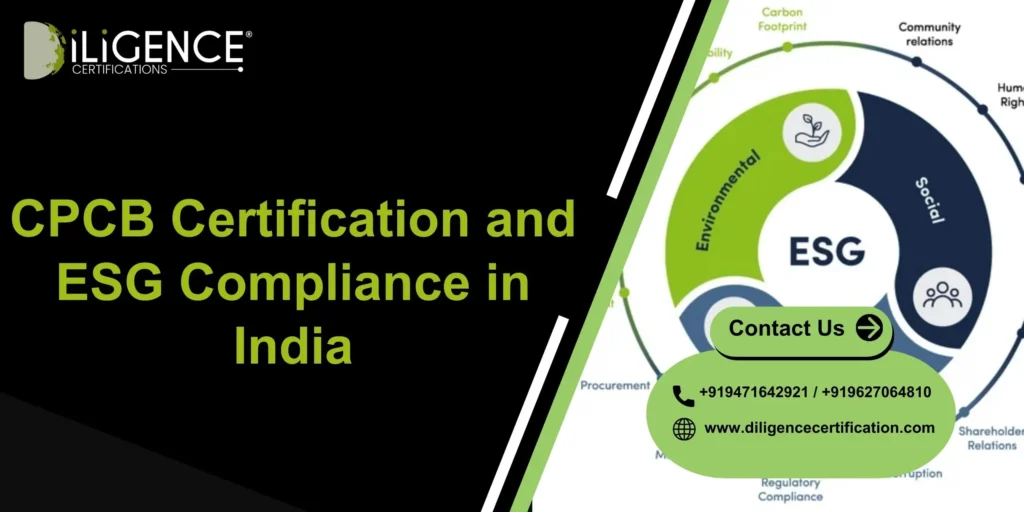
- CPCB Certification and ESG Compliance in India are essentials for industries to think like the government and be sustainable in the long run.
- It minimizes the chances of imposing penalties, receiving legal notices, and the shutting down of operations.
- It allows for the adoption of responsible methods for pollution control and constructing solid waste management systems.
- It earns the confidence of the authorities, investors, and people living nearby.
- It is a contributor to the long-lasting, moral, and sustainable development of the industrial sector in India.

Introduction
Indian industries are now expected to go beyond mere compliance with environmental laws to the point of being able to prove their sustainability, transparency, and accountability amidst the changing regulatory and investment landscape. Neglecting the environment can lead to legal action, harm to one’s image, and consequently the loss of investors’ trust.
On one hand, the Central Pollution Control Board (CPCB) is mainly responsible for the application of environmental laws, and on the other hand, the ESG (Environmental, Social, and Governance) frameworks facilitate companies in their way to practicing responsible and ethical business. Thus, the combination of CPCB Certification and ESG Compliance in India allows the industries to be legal in their operation, to decrease their environmental impact, and to meet the sustainability expectations of the world.
The present article sheds light on how CPCB Certification and ESG compliance, its legal framework, the benefits it brings, and the part it plays in sustainable industrial growth in India.
What is CPCB Certification and ESG Compliance in India?
CPCB Certification and ESG is a regulatory approval provided under the Indian environmental laws such as the Environment (Protection) Act, 1986, and other regulations pertaining to air, water, and waste management. The principal objective of this approval is to monitor industry emissions and ensure their compliance with the predefined standards of pollution control.
ESG Compliance denotes a company’s positive approach towards the environment, people, and politics. The CPCB Certification and ESG is a direct step toward the environmental pillar of ESG, proving the following:
- Air, water, and soil pollution control
- Waste and effluent management in a responsible way
- Monitoring and reporting of the environment on a continuous basis
- Permission to conduct industrial activities
The integration of CPCB Certification and ESG Compliance in India forms a business model that is simultaneously compliance-driven and sustainability-oriented.
Role of CPCB Certification in ESG Framework
To begin with, the CPCB Certification proves to be an environmental, social, and governance (ESG) compliance support mechanism in several aspects, especially in the following areas:
Environmental (E)
- It guarantees the existence of pollution control methods and the efficient use of resources.
- It also brings about responsible waste management practices.
- Moreover, it leads to a reduction in environmental risks and responsibilities.
Social (S)
- Public health and the surrounding communities will be preserved, and industrial practices will be made safe.
- Trust with the stakeholders and the public will be established.
Governance (G)
- It asserts that regulations are being followed.
- Besides, it facilitates the process of making the company’s activities clearer and reporting more accurate.
- Last but not least, it brings about the strengthening of corporate accountability.
Why CPCB Certification is Important for ESG Compliance
Not adhering to CPCB standards can result in:
- Lawsuits, fines, and closure of the factory as penalties.
- The company will be rated negatively in the ESG category, and the investors will have concerns.
- A company can lose its reputation among customers and the trust of its stakeholders.
- Risk of operational and compliance difficulties will increase.
In India, the CPCB certification along with ESG compliance ensures that enterprises not only fulfill their regulatory duties but also get on the sustainability bandwagon that the investors and the global market demand.
Industries Covered Under CPCB Certification and ESG Compliance
CPCB certification is a must for industries that are aligned with ESG in their operations, for example:
- Manufacturing and processing units
- Chemical and pharmaceutical industries
- Textile dyeing and printing units
- Power generation and infrastructure projects
- Waste management, plastic, and e-waste industries
Through the entire process of manufacturing, if the industry is specified to generate emissions, effluents, or regulated waste, it must adhere to the guidelines of CPCB for the purpose of the strengthening of ESG compliance.
Importance and Benefits of CPCB Certification for ESG
| Importance | Benefits |
| Legal compliance | No fines, legal notices, or shutdowns |
| Environmental protection | Less pollution and damage to nature |
| ESG alignment | Better ESG ratings and increased trust of investors |
| Brand credibility | Trust level among regulators and stakeholders is raised |
| Sustainable growth | Responsible and operations over the long run become possible |
Step-by-Step CPCB Certification Process
Step 1: Environmental Assessment
Determine the sources of pollution, the amount of waste generated, and applicable CPCB regulations.
Step 2: Documentation Preparation
Environmental management plans, technical reports and legal documents need to be prepared.
Step 3: Application Submission
Make an application through the CPCB or the respective State Pollution Control Board’s online portal.
Step 4: Scrutiny & Inspection
The authorities will go through the documents and also may inspect the site.
Step 5: Grant of CPCB Certification
The certification will be granted once the compliance verification is done successfully.
Step 6: Renewal & Continuous ESG Compliance
Through consistent monitoring, reporting, and timely renewal, ESG alignment is guaranteed.
Documents Required for CPCB Certification and ESG
- Certificate of Incorporation
- PAN and GST Registration
- Site layout and process flow diagram
- Environmental management plan
- Consent to Establish / Operate
- Monitoring and compliance reports
Timeline, Validity & Renewal
Processing Time: 30–60 working days
Validity: Depending on the industry category and consent type
Renewal: Required before expiry
Amendments: Necessary for the changes of capacity or process
Conclusion
The CPCB Certification and ESG Compliance in India have now become necessities rather than options—they are must-haves for the sustainable, legal, and future-ready industrial operations. The CPCB certification guarantees the observance of the environmental laws, whereas the ESG compliance contributes to establishing corporate responsibility, gaining the trust of investors, and creating long-term value.
The industries which not only incorporate the CPCB compliance into their CPCB Certification and ESG strategy but also avoid the legal risks and rewards of environmental protection and responsible economic growth. The regulatory compliance that is done in line with the ESG principles provides businesses with operational stability, market credibility, and a responsible position in India’s rapidly evolving industrial sector.
Frequenlty Asked for Questions
What is CPCB Certification in India?
CPCB Certification is a guarantee of compliance with the environmental regulations of the country for the industries in respect of air, water, and waste pollution.
How does CPCB Certification support ESG compliance?
It plays a role in achieving the environmental aspect of ESG right away through the pollution control and responsible waste management.
Is CPCB Certification mandatory for ESG reporting?
While ESG practice is optional, CPCB compliance is obligatory and serves to reinforce ESG disclosures.
Which industries require CPCB Certification for alignment with ESG?
Industries like manufacturing, chemicals, textiles, power, waste management, and infrastructure are the ones.
What consequences are there if CPCB regulations are breached?
The industrial sector could get penalties, legal notices, and shutdowns along with bad ESG ratings.
Is there any improvement in investor's confidence due to CPCB Certification?
Certainly, it is a way of showing compliance with regulatory requirements and environmental responsibility to the investors.
How long does it take to get CPCB Certification?
Normally, the procedure lasts for about 30-60 working days.
Is there a need to renew the CPCB Certification?
Certainly, it should be renewed before the expiration date to be legally and ESG compliant.
Is there any possibility of higher ESG scores due to CPCB Certification?
Absolutely, it results us to the transparency of governance and environmental risk management being positively impacted.
What is the significance of CPCB Certification in facilitating sustainable growth?
It provides the guarantee of clean operations, protection of nature, and lasting viability of the industrial sector.