



 BIS Certification
 CDSCO
CDSCO
 CPCB
CPCB
 LMPC
LMPC
 WPC Approval
 Global Approvals
 TEC
TEC
 ARAI
ARAI
 BEE
BEE
 ISO Certification
 DGCA Certification
 NOC For Steel
 APEDA Registration














 Business Registration
 FSSAI Mark Certification












 Legal Services
 Trademark Registration
 Copyright Registration
 Patent Registration
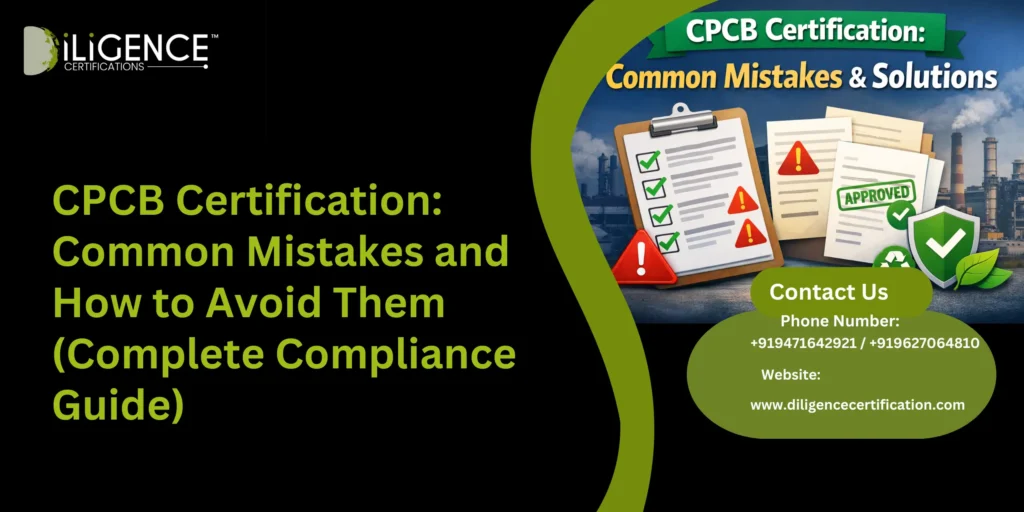
Regulatory Compliance Assurance: The CPCB Certification: Common Mistakes confirms that the concerned industries and facilities adhere to the environmental laws of India as well as the regulations pertaining to pollution control and waste management.
Prevent Penalties and Shutdowns: businesses can be informed of the common mistakes and thus, avoid the penalties, shutdowns, and delays in their operations that might have been caused by incomplete or inaccurate submissions.
Boost Operational Credibility: the business that is duly certified is the one that the regulators, clients, and stakeholders consider trustworthy and it is also the one that shows that it takes environmental compliance seriously.
Environmentally Responsible Operations: right certification practices are an indication of a company’s dedication to pollution control and sustainable processes.
Smooth Approval Process: Knowing the common mistakes will help the companies to prepare their documents very well and thus get the CPCB approval quickly.

Introduction
A metal recycling unit situated in Maharashtra had to deal with continuous rejection of its CPCB Certification Common Mistakes because of technical documents that were not consistent and SPCB consents that were not obtained. The unit had installed pollution control equipment to meet the standards but delays were repeatedly caused by improper ordering of reports, process flow charts, and safety measures. Central Pollution Control Board
This situation indicates how important it is for all businesses that struggle with waste, emissions, or industrial processes to be aware of common mistakes in the CPCB certification. With right preparations, there will be quicker approvals, less fines and more amicable relations with the regulators.
What Is CPCB Certification?
CPCB Certification Common Mistakes is the official recognition given by the Central Pollution Control Board of India to those working in accordance with environmental norms in the country.
- By obtaining such certification, the facility is run by environmentally safe activities.
- Uses proper management and control over hazardous and industrial waste.
- Monitors and accurately reports pollution levels.
- Aims to comply with legal and safety standards.
- Promotes regular practice concerning sustainable business practices.
Without this certificate, there is a threat of getting penalised, closure of businesses, or face legal actions.
Who Needs CPCB Certification: Common Mistakes?
| Business Type | Applicability | Notes |
| Waste Recyclers | Mandatory | For material recovery and processing |
| Dismantlers & Refurbishers | Mandatory | For reuse, repair, and dismantling operations |
| Producers | Mandatory | Must comply under EPR obligations |
| Bulk Waste Handlers | Mandatory | Ensure authorized disposal |
| Importers | Mandatory | Handle regulated waste streams |
Common Mistakes in CPCB Certification
1. Incomplete Documentation
The absence of incorporation certificates, GST, PAN, or SPCB plugins often traps the application in the cycle of rejection.
2. Insufficient Pollution Control Infrastructure
The plants must in advance prove their claim to have sufficient air, water, and hazardous waste management systems.
3. Technical Mismatches
The declared capacities and processes must be in perfect harmony with the actual equipment and operational methods.
4. Ignoring Worker Safety & EHS Compliance
The absence of Environment, Health & Safety (EHS) measures for workers dealing with hazardous materials can be a reason for rejection of the application.
5. Delayed or Inaccurate Responses
Ignoring the CPCB queries or providing wrong information can lead to the application being rejected or the penalties being imposed.
6. Non-Submission of Compliance Reports
The submission of monitoring reports, waste logs, and process audits must be timely and accurate.
How to Avoid Common CPCB Certification: Common Mistakes
Step 1: Pre-Check Your Documents
Check if every document regarding company registration, GST, PAN, site ownership/lease and SPCB consents is valid and up to date.
Step 2: Align Facilities & Processes
CPCB standards should be adhered to by all machinery, recycling methods, and pollution control devices.
Step 3: Prepare Detailed Process Reports
The application should consist of process flow diagrams, monitoring systems, and waste management logs.
Step 4: Implement Worker Safety Measures
Make sure that employees working with hazardous materials have the required EHS documentation and safety protocols.
Step 5: Respond Promptly & Accurately
Send answers to any CPCB questions in time using reliable and detailed information.
Documents Required for CPCB Certification
- Certificate of Incorporation / Firm Registration
- PAN and GST Certificate
- Consent to Establish / Operate from SPCB
- Site ownership or lease agreement
- Technical process flow diagrams
- Machinery and equipment list
- Pollution control systems details
- EHS policy documents
- Authorization letter (if a consultant applies)
Importance and Benefits of Correct CPCB Certification
| Importance | Benefits |
| Regulatory compliance | Avoidance of penalties and closure |
| Environmental safety | Elimination of pollution and dangers |
| Operational continuity | Uninterrupted business operations |
| Market credibility | Trust is established with regulators and clients |
| Sustainability | Assistance to circular economy goals |
Timeline, Validity & Renewal
Processing Timeline: 30–60 working days
Certification Validity: 5 years
Renewal: Apply before expiry with updated compliance documents
Amendment: Required for capacity expansion, location changes, or process modifications
Conclusion
CPCB Certification Common Mistakes is more than a formality—it is a legal requirement to operate in an environmentally friendly manner in India. Knowing the typical errors in CPCB Certification Common Mistakes not only speeds up the approval process but also saves the company from penalties, and enhances its reputation.
Well-organized paperwork, sound technical justification, pollution control measures compliance not only lead to approval but also showcase a company’s dedication to environmental protection and sustainability.
Frequently Asked for Questions
What is CPCB certification?
CPCB certification is a formal recognition that asserts your company is compliant with India's laws for controlling the environment and reducing pollution.
Why do CPCB applications usually get rejected?
Rejections are most often caused by lack of documents, wrong technical details, or absence of SPCB approval.
Is CPCB certification mandatory for all industries?
Yes, it is compulsory for industries that are concerned with waste management, recycling, emissions, or hazardous materials.
Can I apply for CPCB certification without SPCB consent?
No, obtaining the Consent to Establish or Operate from SPCB is a prerequisite for CPCB approval.
How long does it take to get CPCB certification?
The whole process usually takes 30-60 working days, provided that the documents are complete and accurate.
What is the consequence of late submission of CPCB compliance reports?
Late reports may result in fines, rejection, or even shutting down the business.
Does employer's safety issue impact CPCB certification?
Yes, the absence of proper environment, health and safety (EHS) and employee safety practices is a frequent cause of application rejection.
Will there be a possibility of changing CPCB certification later?
Yes, changing of certification will be needed if there is an increase in capacity, change of place, or change in processing.
Is CPCB certification a permanent affair?
No, it typically lasts for no more than five years and renewal application has to be made before the expiration date.
How should a company go about it to avoid making any CPCB certification mistakes?
How should a company go about it to avoid making any CPCB certification mistakes?