



 BIS Certification
 CDSCO
CDSCO
 CPCB
CPCB
 LMPC
LMPC
 WPC Approval
 Global Approvals
 TEC
TEC
 ARAI
ARAI
 BEE
BEE
 ISO Certification
 DGCA Certification
 NOC For Steel
 APEDA Registration













 Business Registration
 FSSAI Mark Certification











 Legal Services
 Trademark Registration
 Copyright Registration
 Patent Registration
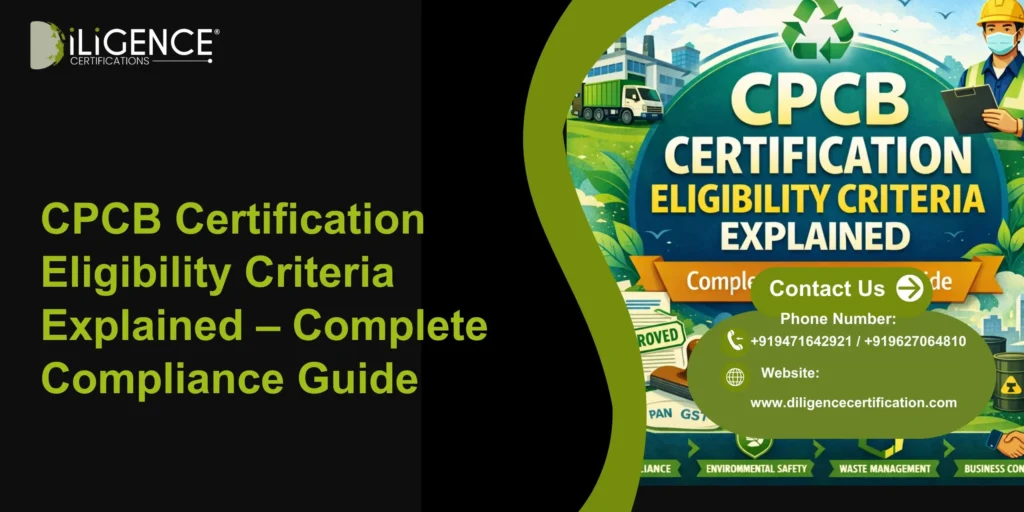
- Mandatory Environmental Compliance: The eligibility requirements for CPCB Certification Eligibility determine the legality of the operations concerning waste management, recycling, dismantling, and pollution control under Indian environmental laws.
- Regulatory Clarity for Businesses: Sizeable and sound firms can easily dodge rejection, penalties, and the running of their businesses due to non-compliance by understanding their eligibility.
- Applies Across Industries: Manufacturers, recyclers, importers, producers, and waste handlers all must conform to the CPCB eligibility standards before applying.
- Supports Sustainable Operations: The government is mandating that the companies which are accepted have to implement eco-friendly procedures that are in sync with the country’s environmental goals.
- Foundation for Legal Authorization: Compliance with the CPCB eligibility standards is the first and most important step towards receiving the grant of permission to operate officially.

Introduction
In Haryana, a recycling plant went through a huge investment in the mechanical and human resources area, but it still got rejected because the application submitted to the Central Pollution Control Board was not complete regarding the eligibility requirements. Although the plant had the necessary technical know-how, the lack of proper consent, infrastructure alignment, and documentation resulted in delays and financial losses. Central Pollution Control Board
The above situation has shown that the CPCB Certification eligibility criteria are not merely the formalities but rather the main support of environmental compliance in India. Only firms whose behavior is environmentally friendly and who have the right qualifications can handle such activities that are sensitive to the environment since the Central Pollution Control Board ensures that.
Knowing in advance the eligibility simplifies the process and saves time, and cost and avoids the regulatory issues while securing the smooth approval.
What Is CPCB Certification Eligibility?
CPCB Certification eligibility standards are a group of qualifications defined by the Central Pollution Control Board (CPCB) to ascertain if a company or a plant is entitled to get permission under different environmental regulations.
These standards are the basis of the applicant’s eligibility and they include the following:
- The business has to be legally registered
- The infrastructure and technology facilities must be adequate
- The organization must adhere to pollution control regulations
- The company must satisfy environmental, health, and safety requirements
- Waste management regulations must be followed
CPCB certification cannot be issued unless the eligibility conditions are met.
Who Needs to Meet CPCB Certification Eligibility Criteria?
The eligibility requirements apply to the following entities:
| Business Type | Eligibility Requirement | Notes |
| Waste Recyclers | Mandatory | For material recovery and processing |
| Dismantlers | Mandatory | For segregation of waste |
| Refurbishers | Mandatory | For reuse and repair activities |
| Producers | Mandatory | Under EPR obligations |
| Importers | Mandatory | For regulated waste streams |
| Collection Centers | Mandatory | Must be linked with authorized recyclers |
Key CPCB Certification Eligibility Criteria Explained
1.Legal Business Registration
The entity to be registered must be legally registered, and this can include a company, partnership, LLP, or proprietorship with a valid PAN number and GST number.
2.Land & Facility Authorization
The operational site must be owned or have a valid lease agreement, and land-use compliance must be in place.
3.Consent from SPCB
Consent to Establish (CTE) and/or Consent to Operate (CTO) from the respective State Pollution Control Board is essential.
4.Technical Capability
It is obligatory for the applicants to exhibit such machines, recycling technologies, pollution control apparatus, and the ability to handle the waste properly as their being compatible.
5.Environmental Safeguards
The installation of pollution control, waste storage, emissions management, and effluent treatment systems of adequate capacity is a must.
6.Worker Safety & EHS Compliance
Provision of an Environment, Health & Safety (EHS) policy and safety measures for handling of hazardous materials workers are required.
Why CPCB Certification Eligibility Is Mandatory
Failure not to satisfy eligibility requirements can lead to:
- Application denial
- Severe fines
- Closure of facilities
- Lawsuit by the government under environmental laws
Sharing the eligibility gives you:
- Legal license to run your business
- Protection of the environment
- Lower risk of regulatory issues
- Easier inspections and quicker renewals
- Sustainability of business in the long run
Documents Required to Prove CPCB Eligibility
- Certificate of Incorporation / Firm Registration
- PAN and GST Certificate
- Site ownership or lease agreement
- Consent to Establish / Operate
- Process flow diagram
- Machinery and equipment list
- Pollution control system details
- EHS policy documents
- Authorization letter (if applicable)
Common Reasons for CPCB Eligibility Rejection
- Inadequate pollution control infrastructure
- Mismatch between declared and actual capacity
- Missing SPCB consent
- Incomplete technical documentation
- Poor safety and waste-handling measures
Importance and Benefits of Meeting CPCB Eligibility
| Importance | Benefits |
| Regulatory compliance | Avoids penalties and shutdowns |
| Environmental safety | Prevents pollution and hazards |
| Business continuity | Ensures uninterrupted operations |
| Market credibility | Builds trust with regulators and clients |
| Sustainability | Supports circular economy goals |
Timeline, Validity & Compliance Continuity
Eligibility Review Timeline: 15–30 working days
Certification Validity: Generally up to 5 years
Renewal: Eligibility has to be kept through the whole period of validity
Amendment: Necessary for increasing the capacity or changing the process
Conclusion
The CPCB Certification Eligibility Criteria are the basic principles that support the legal and environmentally friendly practices in India. The companies that are aware of and are able to take advantage of these prerequisites not only get the green light from the regulatory authorities but also cross the line of eco-friendliness and safety for the public.
Endowments should be viewed not as obstacles but rather as guides to compliant growth for organizations. With the right preparation and professional advice, to achieve CPCB Certification Eligibility will become an easy and tactical step to long-term operational success.
Frequenlty Asked for Questions
No schema found.