



 BIS Certification
 CDSCO
CDSCO
 CPCB
CPCB
 LMPC
LMPC
 WPC Approval
 Global Approvals
 TEC
TEC
 ARAI
ARAI
 BEE
BEE
 ISO Certification
 DGCA Certification
 NOC For Steel
 APEDA Registration














 Business Registration
 FSSAI Mark Certification










 Legal Services
 Trademark Registration
 Copyright Registration
 Patent Registration
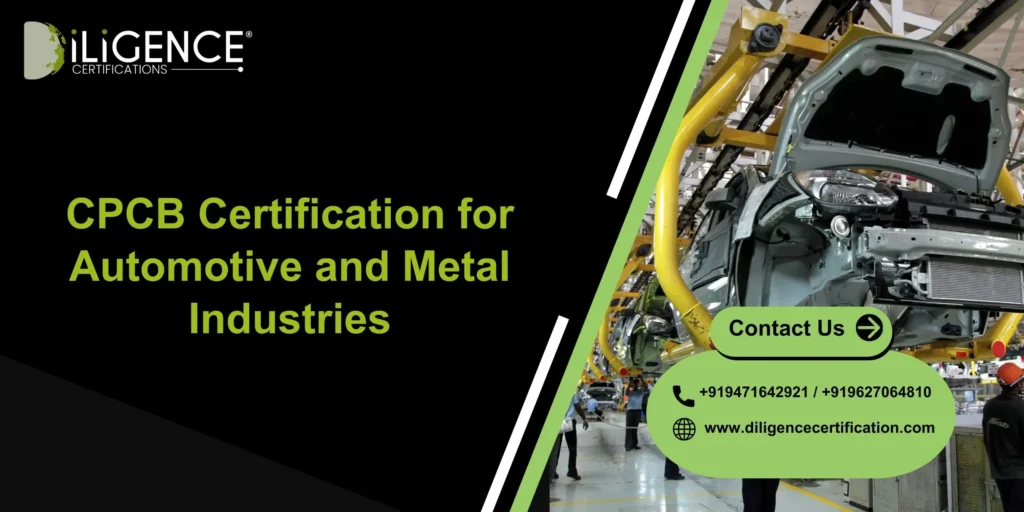
- CPCB certification for Automotive is a requirement for the manufacturers to comply with the environmental regulations.
- It guarantees the efficient and proper handling of emissions, effluents, and hazardous automotive waste.
- It is needed for legally done manufacturing, assembling, and operational activities.
- It will be a good way to prevent penalties, legal action, and operational shutdowns.
- It improves the reputation of the brand and encourages green automotive production.

Introduction
The CPCB Certification for Automotive and metal industries are the backbone of the economy and infrastructure, as well as the mainstay of industrial expansion. However, the same industries can also be a source of emissions, hazardous waste, effluents, and solid waste if not controlled appropriately they might harm the environment. Central Pollution Control Board
CPCB Certification for Automotive and Metal Industries is a guarantee for the manufacturing units’ adoption of pollution control technologies, waste disposal practices, and compliance with environmental standards. Certification enables the industries to allow for eco-friendly operations even at the most environmentally demanding conditions while keeping the same productivity and sustainability.
What is CPCB Certification for Automotive and Metal Industries?
CPCB Certification for Automotive and Metal Industries covers the approvals, registrations, and authorizations that the Central Pollution Control Board and corresponding State Pollution Control Boards (SPCBs) issue. It guarantees that industries conform to the environmental laws as per the Environment Protection Act, Air Act, and Water Act.
CPCB Certification includes:
Air emission standards – Reducing the amount of harmful substances released into the air
Water and effluent management – Treating and releasing wastewater in an acceptable manner
Hazardous waste management – Managing wastes in a lawful, and safe manner
EPR authorization – Covering batteries, waste oil, metal scrap, and automotive waste
Environmental monitoring – Regular monitoring to ensure compliance with the prescribed limits
The implementation of CPCB guidelines in the automotive and metal sectors not only assures safety for the long term but also guarantees environmental protection.
CPCB Authorization for Automotive and Metal Industries
The automotive and metal industries have to get the CPCB Certification for Automotive before starting their operation in India. The certification assures:
- The emission and pollution level is controlled
- The industry is complying with national environmental regulations
- Waste is managed responsibly
- The industry has improved sustainability and is operating eco-friendlier
- Legal approval to produce, process, and market products
Only after getting valid CPCB approvals from the concerned authorities, the industries are authorized to operate.
Why is CPCB Certification Mandatory for Automotive and Metal Industries?
Non-compliance with CPCB norms may lead to environmental and operational risks that are extremely severe, for instance:
- Pollution of air and water in large quantities
- Imposition of legal penalties, payment of fines, and closure of factories
- Destruction of the environment and worry over public health
- Negative impact on the business’s reputation and loss of market access
- Higher costs of operation and cleanup
CPCB Certification for Automotive and Metal Industries ensures:
- Environment laws are complied with
- Industrial pollution is managed
- Sustainability and efficiency in operations for the long term
- Customers, regulators, and stakeholders have more confidence in you
Importance and Benefits of CPCB Certification
| Importance | Benefits |
| Environmental compliance | Guarantees compliance with CPCB pollution control standards |
| Pollution control | Minimizes air, water, and soil pollution |
| Sustainable operations | Encourages green manufacturing practices |
| Legal approval | Avoids fines and regulatory actions |
| Brand credibility | Increases trust with customers and partners |
Step-by-Step CPCB Certification Process
Step 1: Documentation
Compile the details of your company incorporation, information on your manufacturing process, pollution control measures, and plans for environmental management.
Step 2: Application Submission
Online application submission through the CPCB/SPCB portal is required, while providing compliance details and necessary documents at the same time.
Step 3: Technical Scrutiny
The examining authorities investigate emission data, waste management plans, and pollution control systems.
Step 4: Inspection & Verification
Pollution control equipment, waste disposal systems, and environmental safeguards might be verified through a site inspection as part of the process conducted.
Step 5: Grant of CPCB Certification
The issuance of either CPCB or SPCB certification/authorization, which permits the legal operation of the industry, is conditional upon successful verification.
Documents Required for CPCB Certification
- Company registration and incorporation certificates
- Manufacturing process flow chart
- Details of pollution control equipment
- Environmental management plan
- Waste generation and disposal details
- Consent to Establish (CTE) / Consent to Operate (CTO)
- EPR authorization documents (if applicable)
Timeline, Validity & Renewal
Certification Timeline: 30–45 working days
Validity: 1–5 years (depending on the type of approval)
Renewal: Continuous renewal needed before expiration along with updated compliance reports
Conclusion
CPCB Certification for Automotive and Metal Industries is not just a legal requirement—it is a commitment to environmental protection, sustainable manufacturing, and compliance with regulations. The certified industries reap a lot of benefits such as the control of pollution levels, the mitigation of environmental risks, and the market credibility enhancement.
For the automotive and metal industry, the CPCB Certification for Automotive guarantees the smooth operation of business, the sustainability for the long run, and the trust of both the customers and the government. Following the CPCB Certification for Automotive standards is a wise investment that not only protects the environment but also promotes the growth and good reputation of the industry.
Frequenlty Asked for Questions
What does a CPCB Certification mean regarding the Automotive and Metal Industries?
It is a green signal for the environment through which the industries get certified that they are operating according to pollution control laws in India.
CPCB certification is a must for the automotive sector?
Definitely, it is a rule that allows only certified companies to produce and run automotive plants.
Who grants the CPCB certification?
The Central Pollution Control Board along with the concerned State Pollution Control Boards.
Which procedures get CPCB approval?
Production, waste management, discharge of pollutants, and emissions.
CPCB certification applicable to metal industries as well?
Yes, the CPCB regulations have to be observed by the metal processing and manufacturing companies.
What regulations work with the CPCB certification?
Environment Protection Act, Air Act, and Water Act.
What is the duration of CPCB certification?
Usually, it is for a period of 1 to 5 years depending on the type of approval.
What will happen if the CPCB standards are not maintained?
Industries will have to pay fines, face lawsuits, or get their operations stopped.
Is EPR authorization included in the CPCB certification?
Yes, it is applicable to batteries, waste oil, metal scrap, and automotive waste.
What are the reasons for making CPCB certification a necessity for manufacturers?
Legal compliance, environmental safety, and long-term sustainability are some benefits that come with such certifications.